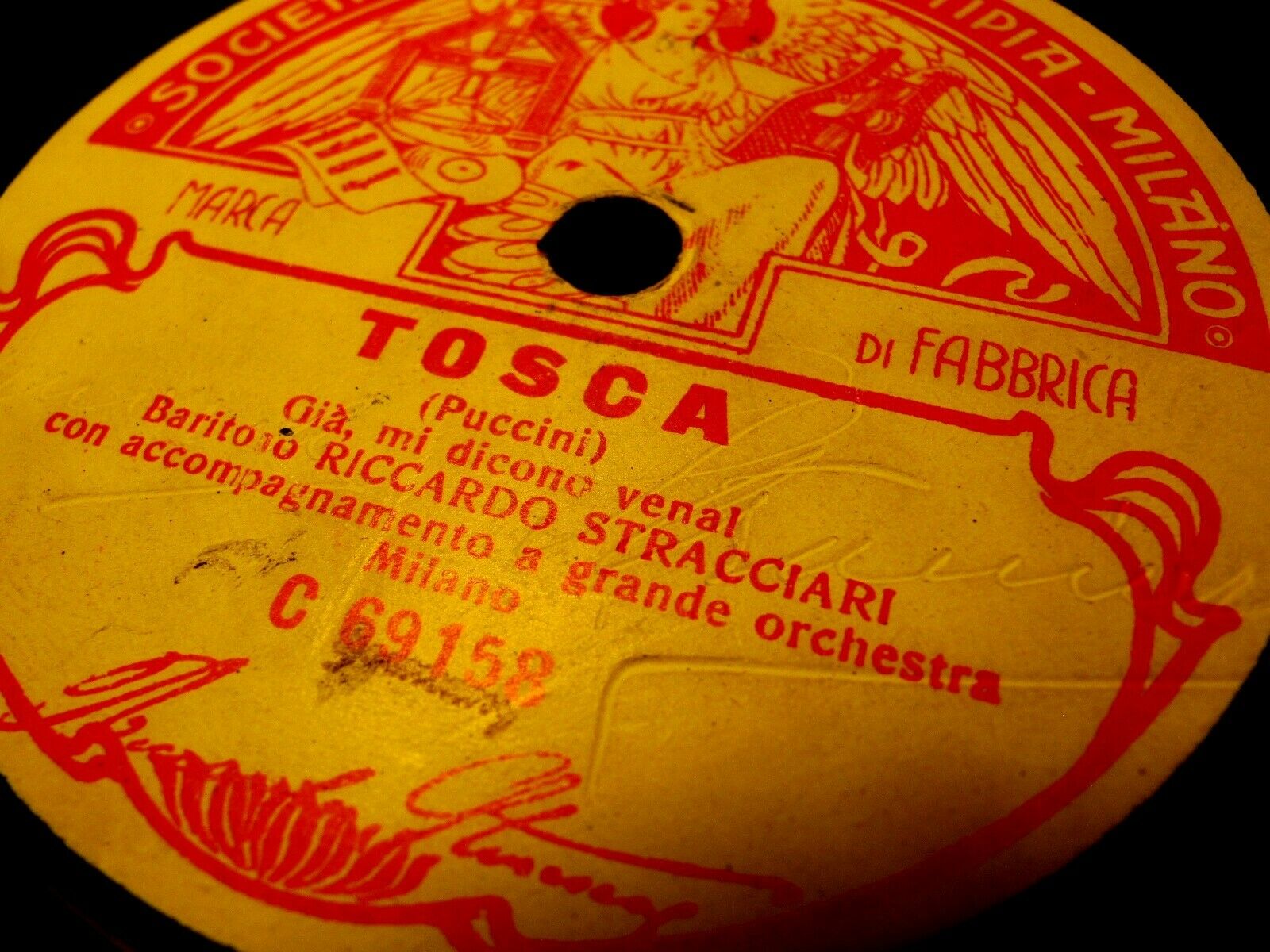
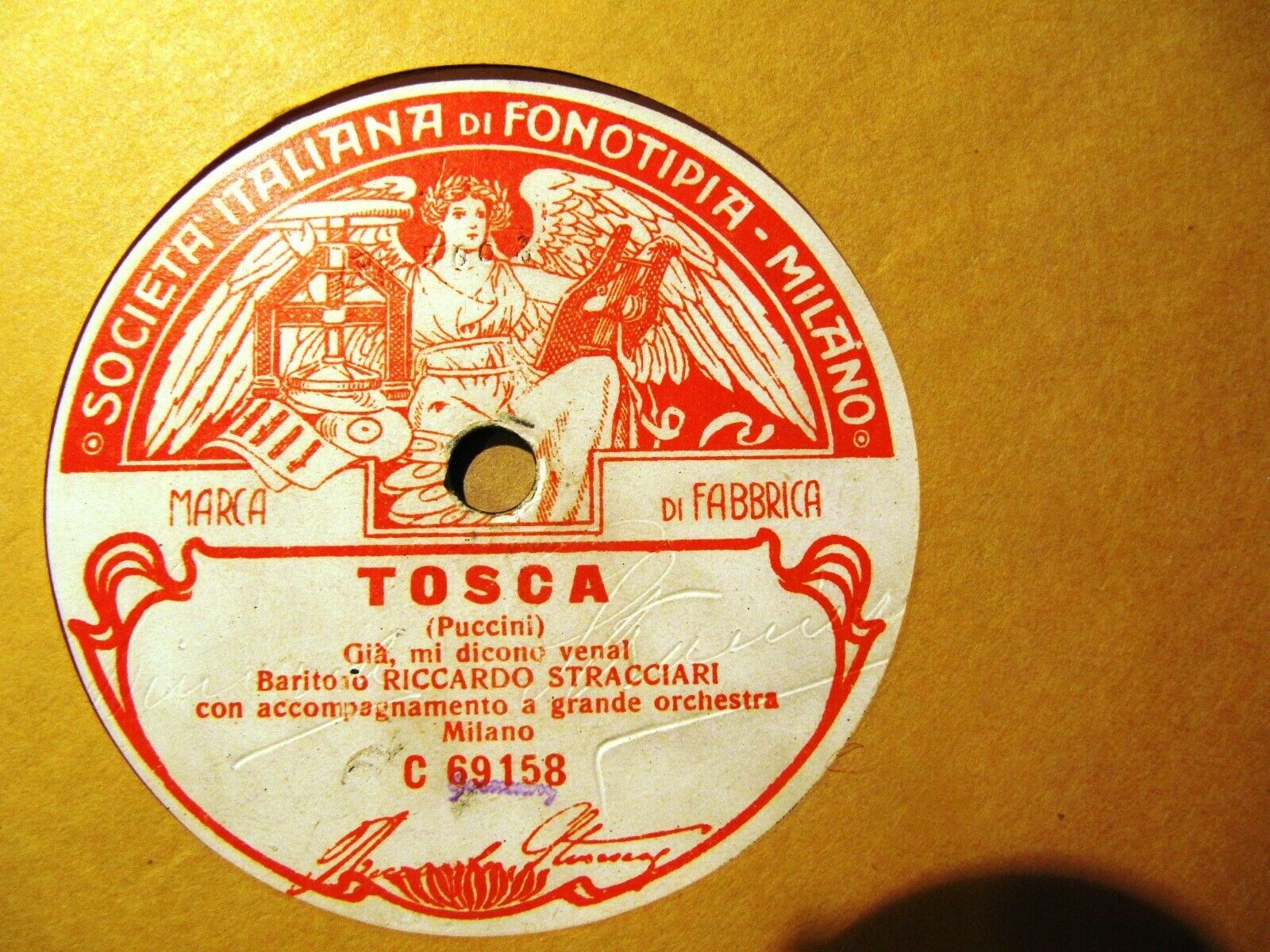
1914 Signed Riccardo STRACCIARI FONOTIPIA C 69158 TOSCA Cantabile di SCARPIA
$
45



Favourite Auctions
To save auctions to your favourites, please login
If you don't have an account, please register
Description
I am currently selling a series of great Richard Wagner and classic European 78 rpm orchestral recordings on all the great European labels:
Riccardo Stracciari, the favorite partner of Rosa Ponselle, is simply one of the greatest Baritones on records (he, and Titta Ruffo): His warmth of voice, effortless technique, and intelligence of expression make every recording of his a masterwork,
Here in his amazing early recordings with FONOTIPIA in MILAN
SIGNED ON BOTH SIDES under the label
master xPh 4997 D27 AN
ITA: Milano
1914.03.04 Wed
TOSCA (Giacomo Puccini / Giuseppe Giacosa, Luigi Illica)
II/1: Tarda è la notte — Monologo
Tarda è la notte…
Riccardo Stracciari (baritone).
…?… (MD). — (orchestra).
Fonotipia X 69157
master xPh 5003 D27 AN
ITA: Milano
1914.03.05 Thu
(Carl Max Goldstein ?)
TOSCA (Giacomo Puccini / Giuseppe Giacosa, Luigi Illica)
II/3: Già. Mi dicon venal — Cantabile
Già. Mi dicon venal
Riccardo Stracciari (baritone).
…?… (MD). — (orchestra).
Fonotipia X 69158
10 3/8" Orig Issue Italian FONOTIPIA 78 rpm
Condition: EXCELLENT MINUS, only hints of greying, scuffs, plays E very quiet faint hiss
A GREAT COPY
From a review in THE GRAMOPHONE 1923
Biographical notes:
He was born near Bologna where his father was a well-known stone carver and sculptor. He only attended the Bologna Conservatory after receiving his diploma in engineering. He occasionally participated in diverse theatre and opera productions as a chorister. In 1899 he stepped in for Giuseppe Kaschmann at the last minute in a performance of PerosiÆs oratorio The Ressurection of Christ. After this he decided to take up a career in singing. He made his operatic dTbut as Marcello in PucciniÆs La BohFme. For the next few years, this role was his entire opera repertoire! Finally, he enlarged the list of his roles and gradually became a sought-after promising Italian baritone. He sang with increasing success outside of Italy (South America, Spain, Egypt). He was also a member of the opera houses at Lisbon and Genova. He sang for the first time at La Scala (Aida and La Wally) in 1905. In 1906 he appeared at the Met (Traviata with Sembrich and Caruso). He had also great success at Covent Garden where he was especially popular as Rigoletto, Amonasro, Lord Ashton, Rodrigo and Conte di Luna. He sang for six seasons in Russia and for nine seasons in South America. His dTbut at the Chicago Opera house took place in 1917. Here he earned gratest success with his fiery characterization of RossiniÆs Figaro. He sang this role about 1000 times! He retired officially from the stage in 1936. However, he continued to appear in public (in full possession of his vocal faculties) until 1944. In his last years, he was active as a voice teacher. Boris Christoff is one of his best-known students.
Comment:
He is a beautiful baritone voice, full of warmth and richness. The purity of his legato singing is a model, the fioriture are graceful and he has a velvety mezza voce. He sings in true ôBelcanto style.ö
In my opinion, he is unsurpassed as Figaro in Il Barbiere di Siviglia and as Rigoletto. He had a superb technique and was able to sing until 1936. There is great singing in Nabucco, I Vespri Siciliani and I due Foscari. I love the Neapolitan songs!
price rating