1927 KARL MUCK Live BAYREUTH Parsifal Excerpts Transformation, FLOWER MAIDEN 78
$
34


Favourite Auctions
To save auctions to your favourites, please login
If you don't have an account, please register
Description
WEEK 1 of two weeks of great auctions ending May 11.
IF you are a non-US buyer or if buy multiple records, pls do not use EBAY check out.
Send me an invoice request (click on MORE ACTIONS to the right of the item), I can probably get you better shipping rate.
I am happy to hold your records and combine you winnings in one economic parcel after May 11.
Due to the volume of sales, invoicing and shipping may take up to 48 hours.
****
A series of great early Opera performances: From 1902 G&Ts to 40s wartime German records: I am currently selling a series of great Richard Wagener and classic European 78 rpm orchestral recordings on all the great European labels:
The famous 1927 Columbia Recordings of Wagner Operas recorded at the 1927 Wagner Festival in the Bayreuth Wagner Theater. This was the first time that an ACTUAL BAYREUTH festival production had been recorded ON LOCATION in the FAMED WAGNER THEATRE.
These are incredible recordings, and the first time that Wagner had been recorded electrically in Bayreuth. Of course the performers are stellar, Karl Muck, Siegfried Wagner conducting his father's works, Alexander Kipnis as Gurnermantz.
Also, hear the original Wagner Chimes in Parsifal, the only recording, as they were removed shortly thereafter.
Columbia was very proud of these recordings, since they capture the spirit and atmosphere of the Festival. Even after 75 years, these recordings sound incredible.
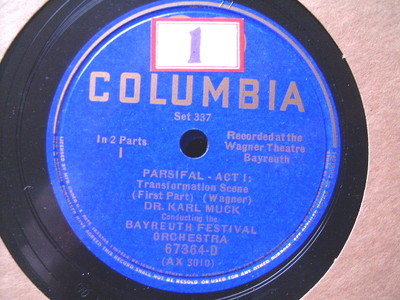
Transformation scene (2 sides) and Grail Scene (6 sides) Act I
The act II Flower maiden scene (2 Sides)- considered to be one of the most erotic musical pieces ever composed (next to Tristan and Brahms Liebesliederwalzer) the Flower Maiden are trying to seduce the pure fool parsifal.
Prelude Act 3 (2 sides)
Good Friday Spell (3 sides) Act III
(Franz v Hoesselin cond: ) Siegfried Act II Forest Murmurs
Karl MUCK conducting Excerpts from Parsifal
The act II Flower maiden scene - considered to be one of the most erotic musical pieces ever composed (next to Tristan and Brahms Liebesliederwalzer) the Flower Maiden are trying to seduce the pure fool parsifal.
Bayreuth Festival Orch, Chorus and Flower Maidens
.7x12" DIRECT PRESSING PRE WAR GOLD LABEL Columbia 78 rpm records w orig album M337
Condition: EXCELLENT quiet, dusty probably basically unplayed, most sides have a crayon mark from a radio station does not sound, and comes off easily. Album great, corners a little rough
For truly great performances of Parsifal on record (and there are very few) you have to look back in time, and invariably to the Bayreuth Festival. Hans Knappertsbusch conducted many performances at Bayreuth after the war and of these his1962 recording is the best, a visionary and cultured reading. Even greater, however, are these recordings on Naxos of Karl Muck conducting Parsifal, excerpts from Acts I and II, with Act III almost complete. Recorded in the studio, with Bayreuth forces, in 1927 and 1928, they are unmatched, particularly the final act which receives the greatest performance yet to appear on disc. No where else is the symphony of this act so compellingly realised.
Karl Muck is the nearest we have to a direct Wagner link, mainly through his relationship with Wagner's widow, Cosima. Born in 1859, he conducted Parsifal regularly at Bayreuth after 1901 and became something of a Wagner specialist. Comparable to Toscanini, Strauss and Weingartner in his advocacy of objective music making, his Wagner is noted for a disciplined clarity, with textures opening up to reveal the pulse of the music. These fine recordings, the outcome of sessions he did with Columbia, are representative of this.
Parsifal opens with a long prelude that sets the tension for the whole opera, a tension that is never released until the heavenly choral conclusion of Parsifal conducting communion with the Knights of the Holy Grail. The music at points reaches stasis, and in no other opera does Wagner rely on pure silence to achieve the effect of etherealism. Muck's conducting of the prelude is very slow (in my experience only Toscanini has been slower on a 1930s BBC recording, although that performance lacks mystery). The breadth of the tempo, from the opening in A flat major, makes the most of blending the themes played out on violins and cellos and combined clarinets and bassoons. The wind chorale that symbolises the guilt of Amfortas is played with pungency and the hushed, tremolando strings are precisely that. Few preludes on record are as clearly shaped and defined as this with the vast diatonic spaces of the music given a supreme nobility.
Similar depth of sound and tension are evident in the playing of the "Transformation Music" to Act I. This extraordinary, angst-ridden music is one of Wagner's great creations, music of extreme dissonance and languorous lamentation. Trombones bray above a great swathe of lush string melody as the music seems to both collapse and rise under the weight of the march that precedes the tolling of the bells. These bells, an ostinato theme in C, G, A and E appear firstly alone, but later play in unison with the bass instruments. Originally, Wagner had suggested that Chinese tamtams might offer the sound he needed, but in the end he had specially constructed metal canisters made to achieve the appropriate pitch. These became known as the Bells of Monslavet, and are heard on this recording (the only recording to exist with the original bell sounds. The bells were melted down by the German's during World War II.). The effect is very different from most performances of this scene you will hear - where the sound is invariably much brighter. Here there is a real hollowness and terror to the sound.
As I have suggested, Act III is the most symphonic of the opera. Here Muck includes all the major orchestral interludes - the prelude, the Act III Transformation Music and the Good Friday Music. The Act III Prelude probably includes the most desolate music Wagner ever wrote and although thematically the music is similar to the Act I Prelude its despondency is less clearly navigated by many conductors. The second act ends in the black key of B minor, and right from the outset of the prelude Muck makes the tension between B major and B flat minor the key to his interpretation. This music is all about anguish, despondency and distress. It fails to elude to the fact that it is now springtime, the music sinking under the weight of its own interminableness. By contrast, his reading of the Good Friday Music is light and lyrical, with an almost vocal strength deriving from his balancing of the textures. In few Wagner records is the tension between gravity and nature as well manipulated as here. Where needed, Muck can compel his musicians to make the right sound: an astringent oboe here, a cavernous brass sound there, strings ladened with depth. The superb playing makes understanding this opera slightly easier: polyphony and dissonance are materially integrated, layers of chords and voices are skillfully overlapped.
And the singers? Alexander Kipnis, in a separate reading of the Good Friday Spell under the baton of the composer's son, Siegfried, is superbly dark and broad-toned.
The transfers of these legendary recordings are quite astonishing, and certainly the best to have yet appeared. The recording, although dating from just two years after microphone recording became possible, offer clear acoustics and real bloom. There is a very natural surrounding spaciousness, the strings remastered with their depth intact, the Monslavet Bells clearly unique, and the brass and woodwind capable of the most focused forte. The importance of the recording itself underlines why the 1913 recordings under Alfred Hertz are only of slight interest. Although one of the most ambitious recording projects of the acoustic era it is evident how crowded the sound is, with balances often very wayward indeed. The brass is often very clearly evident, whilst the strings barely register.
* * *
Quick NOTE ON GRADING AND SHIPPING:
As you can see from my feedback, I try hard to earn your POSITIVE FEEDBACK and FIVE STAR RATINGS.
If for any reason your transaction was NOT SATISFACTORY, pls contact me and I will work something out with you. YOU WILL NEVER HAVE A REASON TO GIVE ME A NEGATIVE RATING or a LOW STAR RATING.
Quick note on grading:
The Grade (Excellent to Fair, I don't give Mint) refers to the WEAR of the record. Any other defects, like cracks, chips and scratches, are stated separately
When I listen to a record, I may also make a SUBJECTIVE judgment of the pressing quality for hiss and surface noise.
"SUPERQUIET" is basically noiseless, like a vinyl pressing.
"VERY QUIET" is an exceptionally quiet record for a given pressing.
"Quiet" is a record that is a great example without undue noise for a given pressing.
These judgments are SUBJECTIVE and will depend one the styli, phonograph etc. you use on your own equipment.
Pls check my other auctions for more great records and phonograph items:
http://stores.ebay.com/carstensf
http://stores.ebay.com/carstensf
====
I am happy to hold your items and bill you at the end of the auction cycle. Pls send me a note if you would like me to hold records
Multiple item shipping: I am happy to combine items for shipment in one parcel.
If you win multiple items, pls send me an INVOICE REQUEST to calculate the correct postage. Ebay check out will not give you the multiple item discount!
Records will be packed safely between corrugated cardboard in a sturdy box with plenty of padding for safe shipment.
Shipment is usually Media Mail, unless another service is requested. Shipping is at your risk.
If you are in the San Francisco area, I encourage pick-up in person.
US Domestic Shipping:
Here is a guideline for US Media Mail Shipping:
Prices below are for regular 78 rpm records. Up to about 5 records, I will ship Edison Discs for the same rates. Albums from Album Sets count as 1 record. Above that and for international shipments, it will be actual weight plus a small packing charge (1-3$ depending on size of shipment)
1 record: 4.50$
2 records: 5.50$
5 records: 7.50$
10 records: 9.50$
MANY MORE RECORDS: Don't worry. I safely ship 40 - 50 pounds of records double boxed in moving boxes, and even then Media Mail will probably not exceed 30$.
Please send me a message if you would like to lower your shipping rates!
International Buyers:
All'attenzione degli acquirenti italiani:
ATTENTION TO ITALIAN BUYERS:
Due to rare problems with delivery in ITALY, I will NOT GUARANTEE delivery of parcels sent by US Postal Service First Class and Priority Mail. If you prefer secure delivery, I will be happy to quote you either Registered Mail or shipment by FEDEX
I am very happy to ship records worldwide.
The US POSTAL SERVICE has increased international shipping rates in 2013.
A single record ships for around 25$ worldwide, depending on the weight.
There are some great options available for shipping multiple records at excellent rates.
Pls contact me if you plan to buy multiple records, and I will be happy to give you an estimate for best rates on USPS or Fedex. Pls let me know your country, home town and postal code for an estimate
=====
As always, I would appreciate any suggestions and corrections from you, pls contact me with any question.
Thank you very much, and good luck bidding !!!
price rating