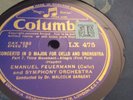
1935 Emanuel FEUERMANN Haydn CELLO CONCERTO D Major Malcolm Sargent Set 262
$
31


Favourite Auctions
To save auctions to your favourites, please login
If you don't have an account, please register
Description
Welcome to my new auctions of 2020. This is the FIRST WEEK of 2 Weeks of great auctions,
running until February 9th.
I would be happy to hold your won items until Feb 9th to combine them in one economical package.
Please wait for me to send you an invoice. DO NOT USE EBAY CHECKOUT if you want the lowest possible postage.
Pls shoot me a short email to request an invoice with the correct shipping charge
I am currently selling a series of great Richard Wagener and classic European 78 rpm orchestral recordings on all the great European labels:
Gerald Moore, noted of Feuermann: "He had perfect intonation, utmost clarity of articulation, beauty of tone quality and mastery of rhythm. All these attributes were the back-bone of his art. From these foundations his imagination ranged freely. His playing - like the man himself - was in perfect taste , though possessed of a fiery temperament, it was held in control and he gave the impression of a most relaxed individual. As a man Feuermann was very well balanced, a delightful companion with thought and kindness for others."
Emanuel Feuermann Cello
Haydn Cello Concerto in D Major (cellist: Emanuel Feuermann)
Op. 101
Emanuel Feuermann with orchestra conducted by Dr. Malcolm Sargent
Recorded November 25, 1935
Complete on 4x 12" 78 rpm pre war gold label Columbia records w orig album and booklet
Condition: EXCELLENT minus, scuffs needs cleaning, side 1 is very rubbed = VG++, has hiss first 7mm, side 3 has a few spots of wear at the end, the other sides play E very quiet. Pencil writing on booklet, album close to new
Emanuel Feuermann (1902-1942) was almost universally recognized during his brief lifetime as an unrivaled master of the cello. Artur Rubinstein said "Feuermann became for me the greatest cellist of all time". Jascha Heifetz accepted him as the first cellist worthy of serious collaboration, and would not play with another for nine years after his death. He was the cellist of choice for Toscanini, who described him as "the greatest" and said that "there is no one after him".
No cellist, not Casals, not Rostropovich, conveys for me the fire, the passion, the lyricism and the virtuosity of Feuermann. To me, his ur-recording is the great Brahms Double Concerto with Heifetz and Ormandy (1939) which has been my favorite for half a century. He died from easily preventable complications of a very minor surgery at age 39. His recordings are not many.
What is the nature of his greatness? It is not unlike that of Heifetz or Toscanini. Impeccable command and virtuosity go without saying. It is the underlying intensity--whether forte or piano or lyrical or martial, there is always the intensity of a musical life and sensibility that is always probing. There is no routine; every phrase, every note is informed with a vital spirit. Every note is pregnant with the next. Nothing is routine; nothing is repeated the same way. And there is the plangent tone--a bit thin and nervous compared to Rostropovich or Casals--that can either caress or whiplash, depending on the musical requirement. And how does one hear soft playing with such expression and underlying tension?
Suffice it to say that Feuermann knows how to be playful and dance as he does in the Schubert "Arpeggione" sonata. He opens the sonata with a light, somewhat sec tone, which announces that this is an early, light romantic work and not the C Major Quintet. He does not make heavy weather of the development, but keeps its dancing. Moore, perhaps the greatest accompanist who ever lived, is one with him. Feuermann's tone is a bit richer in the the lovely second movement, but he does not lean on the themes to exaggerate their importance. In the third movement, we are back to loose-limbed, insouciant joy.
I am currently selling a series of great Richard Wagener and classic European 78 rpm orchestral recordings on all the great European labels:
Gerald Moore, noted of Feuermann: "He had perfect intonation, utmost clarity of articulation, beauty of tone quality and mastery of rhythm. All these attributes were the back-bone of his art. From these foundations his imagination ranged freely. His playing - like the man himself - was in perfect taste , though possessed of a fiery temperament, it was held in control and he gave the impression of a most relaxed individual. As a man Feuermann was very well balanced, a delightful companion with thought and kindness for others."
Emanuel Feuermann Cello
Gerald Moore Piano.
in Schubert's sublime SONATA IN A MINOR (Arpeggione)
Complete on 3x 12" 78 rpm pre war gold label Columbia records no Album
Condition: EXCELLENT close to PRISTINE small rubs don't sound
Plays EXCEPTIONALLY quiet
A SUPERB COPY
A review of THIS RECORDING
Although Schubert wrote this sonata for Arpeggione and Piano, it is more usually played by cello and piano, and indeed on the discs from which this recording stems it is referred to as a Sonata for Cello and Piano. The Arpeggione was a curious instrument which didn't catch on. Developed in 1823 by the Viennese guitar luthier Johann Georg Staufer as a kind of upright bowed guitar, it had six strings, tuned as a guitar is, and was a fretted instrument.
Despite Schubert's use of it the following year, 1824, in this composition, written for an enthusiastic arpeggione player, Vincenz Schuster (who also wrote the only method book for the instrument in 1825), the use of the instrument never caught on and after about 10 years it had been largely abandoned.
Thus in the hands of Feuermann, with his subtle use of glissandi, the sonata is very much a piece for cello rather than a fretted arpeggione. His accompanist in this recording, Gerald Moore, noted of Feuermann: "He had perfect intonation, utmost clarity of articulation, beauty of tone quality and mastery of rhythm. All these attributes were the back-bone of his art. From these foundations his imagination ranged freely. His playing - like the man himself - was in perfect taste , though possessed of a fiery temperament, it was held in control and he gave the impression of a most relaxed individual. As a man Feuermann was very well balanced, a delightful companion with thought and kindness for others."
When listening to the marvellous third movement in our sample here and you can't help but delight in the playing of Feuermann, and agree with Moore's comments. This is a truly wonderful recording!
REVIEW OF: Schubert "Arpeggione" Sonata (Moore, 1937)
Emanuel Feuermann (1902-1942) was almost universally recognized during his brief lifetime as an unrivaled master of the cello. Artur Rubinstein said "Feuermann became for me the greatest cellist of all time". Jascha Heifetz accepted him as the first cellist worthy of serious collaboration, and would not play with another for nine years after his death. He was the cellist of choice for Toscanini, who described him as "the greatest" and said that "there is no one after him".
No cellist, not Casals, not Rostropovich, conveys for me the fire, the passion, the lyricism and the virtuosity of Feuermann. To me, his ur-recording is the great Brahms Double Concerto with Heifetz and Ormandy (1939) which has been my favorite for half a century. He died from easily preventable complications of a very minor surgery at age 39. His recordings are not many.
What is the nature of his greatness? It is not unlike that of Heifetz or Toscanini. Impeccable command and virtuosity go without saying. It is the underlying intensity--whether forte or piano or lyrical or martial, there is always the intensity of a musical life and sensibility that is always probing. There is no routine; every phrase, every note is informed with a vital spirit. Every note is pregnant with the next. Nothing is routine; nothing is repeated the same way. And there is the plangent tone--a bit thin and nervous compared to Rostropovich or Casals--that can either caress or whiplash, depending on the musical requirement. And how does one hear soft playing with such expression and underlying tension?
Suffice it to say that Feuermann knows how to be playful and dance as he does in the Schubert "Arpeggione" sonata. He opens the sonata with a light, somewhat sec tone, which announces that this is an early, light romantic work and not the C Major Quintet. He does not make heavy weather of the development, but keeps its dancing. Moore, perhaps the greatest accompanist who ever lived, is one with him. Feuermann's tone is a bit richer in the the lovely second movement, but he does not lean on the themes to exaggerate their importance. In the third movement, we are back to loose-limbed, insouciant joy.
More Great Records on sale right now:
https://www.ebay.com/sch/m.html?_ssn=carsten_sf&_from=R40&_nkw=&_sacat=0&_sop=1
http://shop.ebay.com/carsten_sf/m.html
====
A Quick NOTE ON GRADING AND SHIPPING:
As you can see from my feedback, I try hard to earn your POSITIVE FEEDBACK and FIVE STAR RATINGS.
If for any reason your transaction was NOT SATISFACTORY, pls contact me and I will work something out with you. YOU WILL NEVER HAVE A REASON TO GIVE ME A NEGATIVE RATING or a LOW STAR RATING.
Quick note on grading:
The Grade (Excellent to Poor, I don't give Mint) refers to the WEAR of the record. Any other defects are stated separately
When I listen to a record, I may also give it an aural grade (again E to P), and make a SUBJECTIVE judgment of the pressing quality for hiss and surface noise.
"SUPERQUIET" is basically noiseless, like a vinyl pressing.
"VERY QUIET" is an exceptionally quiet record for a given pressing.
"Quiet" is a record that is a great example without undue noise for a give pressing.
These judgments are SUBJECTIVE and will depend one the styli, phonograph etc. you use on your own equipment.
Multiple item shipping: I am happy to combine items for shipment in one parcel.
If you win multiple items, pls send me an INVOICE REQUEST to calculate the correct postage. Ebay check out will not give you the correct multiple item discount!
Records will be packed safely between corrugated cardboard in a sturdy box with plenty of padding for safe shipment.
Shipment is usually Media Mail, unless you request another service. Shipping is at your risk, I will be happy to insure items at your cost.
I charge actual postage plus a small fee for packing materials
As always, I guarantee your satisfaction. If you don't like the item, just return it, and I will refund the full purchase price.
If you are in the San Francisco area, I encourage pick-up in person.
US Domestic Shipping:
Here is a guideline for US Media Mail Shipping:
Prices below are for regular 78 rpm records. Up to about 5 records, I will ship Edison Discs for the same rates. Albums from Album Sets count as 1 record. Above that and for international shipments, it will be actual weight plus a small packing charge (1-3$ depending on size of shipment)
1 record: 4.85 – 5.75$
2 records: 6.75$
5 records: 9.00$
10 records: 12.00$
MANY MORE RECORDS: Don't worry. I safely ship 40 - 50 pounds of records double boxed in moving boxes, and even then Media Mail will probably not exceed 35$.
Please send me a message if you would like to get an estimate for you shipping rates!
I am very happy to ship records worldwide.
Please use the EBAY shipping cost only as a guideline. My actual charges are usually lower
One record usually ships for 25$ for 10" 25-35$ for most 12" records (Less for Canada).
As always, I would appreciate any suggestions and corrections from you, pls contact me with any question.
Thank you very much, and good luck bidding !!!
price rating