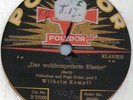
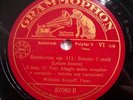
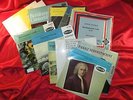
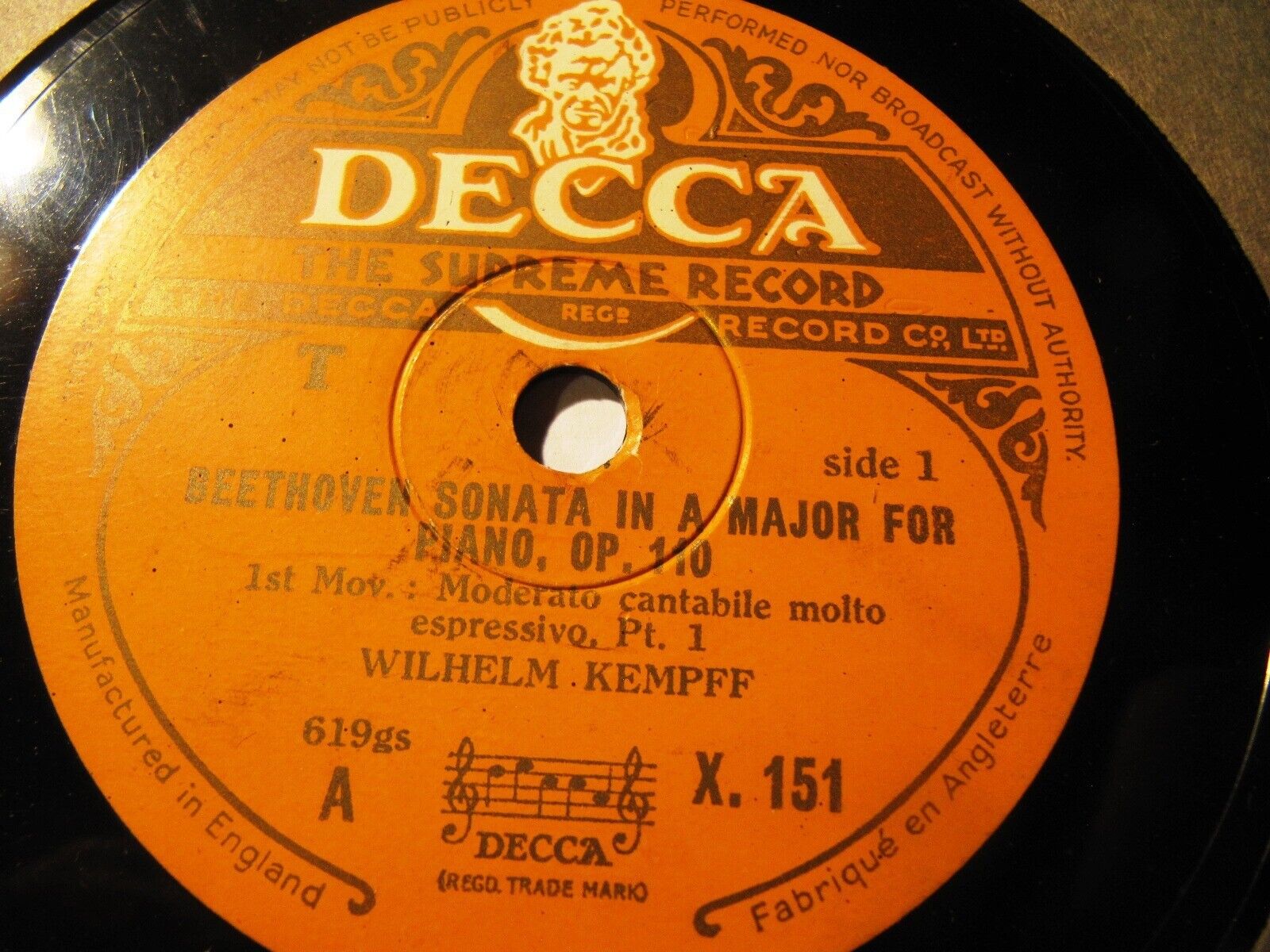
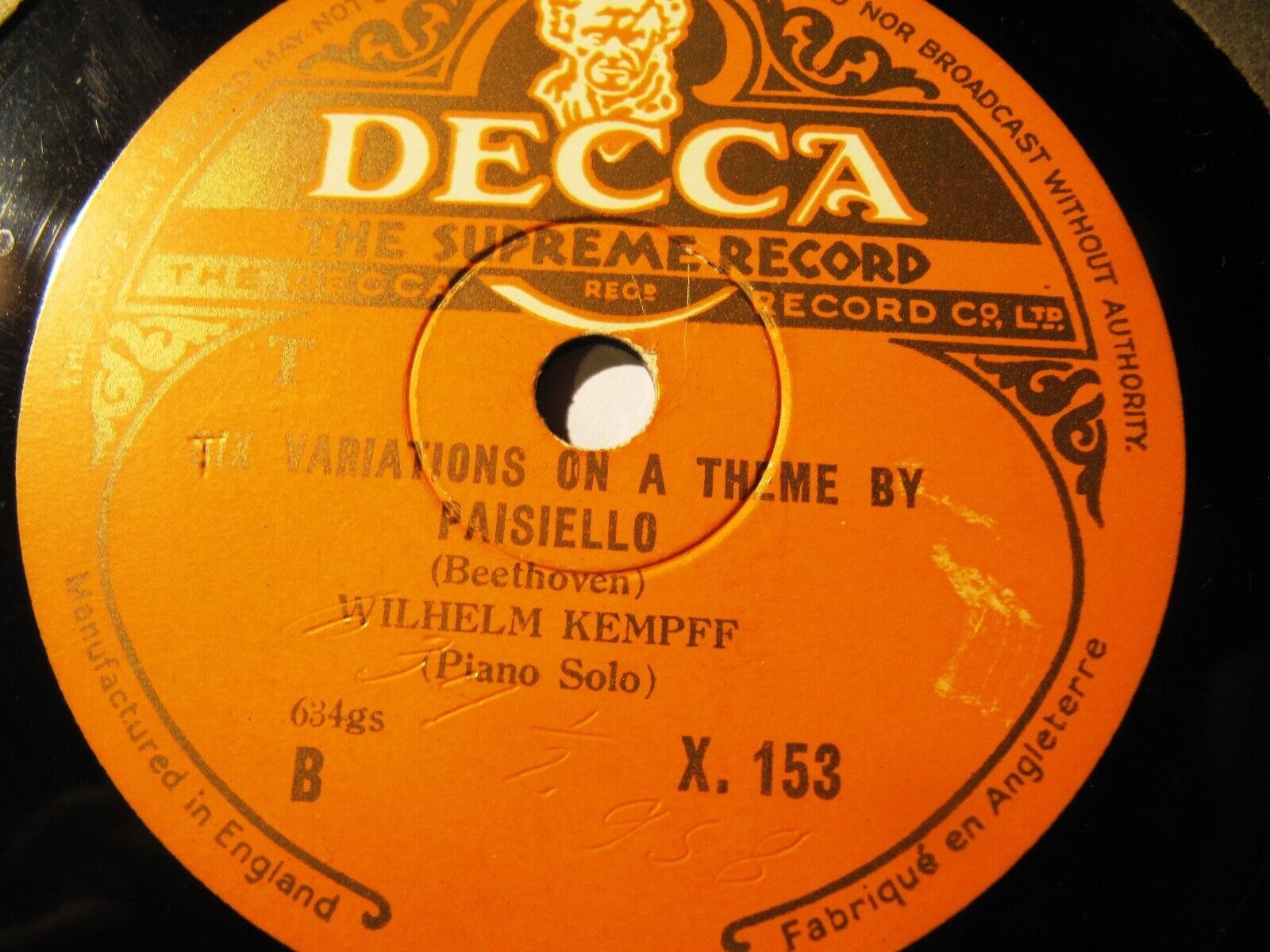
1936 WILHELM KEMPFF PIANO Beethoven Sonata in A Op 110 PAISIELLO Variations
$
60


$ 60
Sold For
Jan 13, 2023
Sold Date
1
Number Of Bids
USA
Country Of Seller
eBay
Sold at
Favourite Auctions
To save auctions to your favourites, please login
If you don't have an account, please register
Description
A series of great Solo instrumentals - Piano Violin Cello Harp, Winds and Brass on 78 rpm records
Click on this link to see more Solo Instrumental Records!
Legendary Pianist Wilhelm Kempff was one the greatest exponents of the German school of piano playing. His fruitful collaboration enabled him to already record an extensive Beethoven cycle in the acoustic era, a almost complete electric, and finally in the LP era, he recorded a complete cycle
Wilhelm Kempff - Beethoven :
Ludwig van Beethoven
Piano Sonata #31 in A flat major, Op. 110, Recorded 29 July, 1936
6 Variations for Piano in G major on the Duet "Nel cor più non mi sento" from Giovanni Paisiello's opera "La molinara", WoO 70
Please see top of the page for condition
Beethoven allegedly told his publisher Artaria, in connection with this Sonata, that “Here you have a sonata that will be a hard nut to crack”. Indeed, the enormous dimensions of the work, which was sketched in 1817 and completed in late 1818 or early 1819 and has nearly 1,200 measures, together with its numerous musical and technical challenges, long made it seem unplayable, and even today it is still considered a major challenge for concert pianists. The piece owes its nickname to the title of the original German edition, “Grosse Sonate für das Hammer-Klavier”, since Beethoven had been wanting since 1817 to Germanize the term “pianoforte” for the printing of his piano sonatas.
Wilhelm Walter Friedrich Kempff (25 November 1895 – 23 May 1991) was a German pianist and composer. Although his repertory included Bach, Liszt, Chopin, Schumann, and Brahms, Kempff was particularly well-known for his interpretations of the music of Ludwig van Beethoven and Franz Schubert, both of whose complete sonatas he also recorded.[1] He is considered to have been one of the great pianists of the 20th century.[2] Early lifeKempff was born in Jüterbog, Brandenburg, in 1895.[1] He grew up in nearby Potsdam where his father was a royal music director and organist at St. Nicolai Church. His grandfather was also an organist and his brother Georg became director of church music at the University of Erlangen. Kempff studied music at first at the Berlin Hochschule für Musik at the age of nine after receiving lessons from his father at a younger age. Whilst there he studied composition with Robert Kahn and piano with Karl Heinrich Barth[1] (with whom Arthur Rubinstein also studied). In 1914 Kempff moved on to study at the Viktoria gymnasium in Potsdam before returning to Berlin to finish his training.[1] [edit] As a pianistIn 1917, Kempff made his first major recital, consisting of predominantly major works, including Beethoven's Hammerklavier Sonata and Brahms Variations on a theme of Paganini.[1] Kempff toured very widely in Europe and much of the rest of the world. Between 1936 and 1979 he performed ten times in Japan (a small Japanese island was named Kenpu-san in his honor)[citation needed]. Kempff made his first London appearance in 1951 and in New York in 1964. He gave his last public performance in Paris in 1981, and then retired for health reasons (Parkinson's Disease). He died in Positano, Italy at the age of 95, five years after his wife, whom he had married in 1926. They are survived by seven children.[1] Wilhelm Kempff recorded over a period of some sixty years. His recorded legacy includes works of Schumann, Brahms, Schubert, Mozart, Bach, Liszt, Chopin and particularly, of Beethoven.[1] He was among the first to record the complete sonatas of Franz Schubert, long before these works became popular. He also recorded two sets of the complete Beethoven sonatas (and one early, almost complete set on shellac 1926-1945), one in mono (1951–1956) and the other in stereo (1964–1965). He recorded the complete Beethoven piano concertos twice as well, both with the Berlin Philharmonic; the first from the early 1950s in mono with Paul van Kempen, and the later in stereo from the early 1960s with Ferdinand Leitner. Kempff also recorded chamber music with Yehudi Menuhin, Pierre Fournier, Wolfgang Schneiderhan, Paul Grummer, and Henryk Szeryng, among others. The pianist Alfred Brendel has written that Kempff "played on impulse... it depended on whether the right breeze, as with an aeolian harp, was blowing. You then would take something home that you never heard elsewhere." (in Brendel's book, The Veil of Order). He regards Kempff as the "most rhythmical" of his colleagues. Brendel helped choose the selections for Phillip's "Great Pianists of the 20th Century" issue of Kempff recordings, and wrote in the notes that he regarded Kempff "achieves things that are beyond him" in his "unsurpassable" recording of Liszt's first Legende, "St. Francis Preaching to the Birds."
Kempff (right) with Ernest Ansermet (left) in 1965When pianist Artur Schnabel undertook his pioneering complete recording of the Beethoven sonatas in the 1930s, he told EMI that if he didn't complete the cycle, they should have Kempff complete the remainder - even though the two pianists took noticeably different approaches to the composer (for example, Schnabel preferred extremely fast or slow tempos, while Kempff preferred moderate ones). Later, when Kempff was in Finland, the composer Jean Sibelius asked him to play the slow movement of Beethoven's 29th Sonata, the Hammerklavier; after Kempff finished, Sibelius told him, "You did not play that as a pianist but rather as a human being."[3] [edit] TechniqueAs a performer he stressed lyricism, charm, and spontaneity in music, particularly effective in intimate pieces or passages. He always strove for a singing, lyrical quality. He avoided extreme tempos and display for its own sake. He left recordings of most of his repertory, including the complete sonatas of Beethoven and Schubert. He performed to an advanced age, often concertizing past his eightieth birthday. He appeared in 1979 with the Berlin Philharmonic, marking an association with them that spanned over sixty years. [edit] As a teacherIn 1924–1929 Wilhelm Kempff took over the direction of the Stuttgart College of Music as a successor of Max Pauer. In 1931 he was co-founder of the Summer courses at Marmorpalais Potsdam. In 1957 Wilhelm Kempff founded “Fondazione Orfeo” (today: Kempff Kulturstiftung) in the south-Italian city Positano and held his first Beethoven interpretation masterclass at Casa Orfeo, which Kempff had built especially for this reason. Until 1982 he continued teaching there once a year. After his death in 1991, Gerhard Oppitz taught the courses from 1992-1994 until John O'Conor continued till today. Oppitz and O’Conor had both been outstanding participants of Kempff's masterclasses and were personally closely connected with Wilhelm Kempff. Other noted pianists to have studied with Kempff include Jörg Demus, Norman Shetler, Mitsuko Uchida, Peter Schmalfuss, Idil Biret and Carmen Piazzini. [edit] CompositionA lesser-known activity of Kempff was composing. He composed for almost every genre and used his own cadenzas for Beethoven's Piano Concertos 1-4. His student Idil Biret has recorded a CD of his piano works. His second symphony premiered in 1929 at the Leipzig Gewandhaus by Wilhelm Furtwängler. He also prepared a number of Bach transcriptions, including the Siciliano from the Flute Sonata in E major, that have been recorded by Kempff and others.
price rating