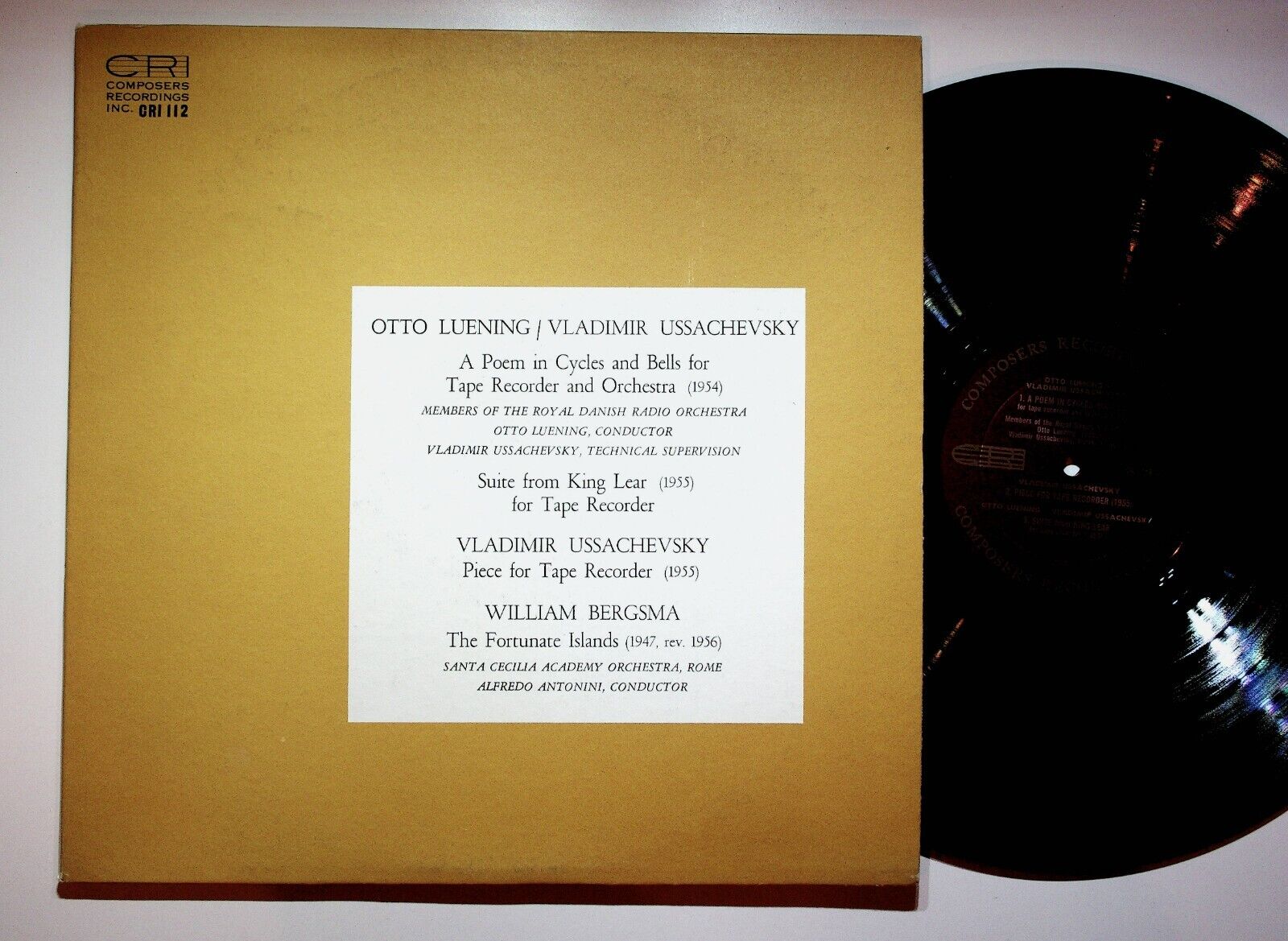
1957 Luening Ussachevsky Poem Cycles & Bells Tape Recorder Vinyl LP Record VG+
$
26


Favourite Auctions
To save auctions to your favourites, please login
If you don't have an account, please register
Description
Yes we combine shipping for multiple purchases. Add multiple items to your cart and the combined shipping total will automatically be calculated.
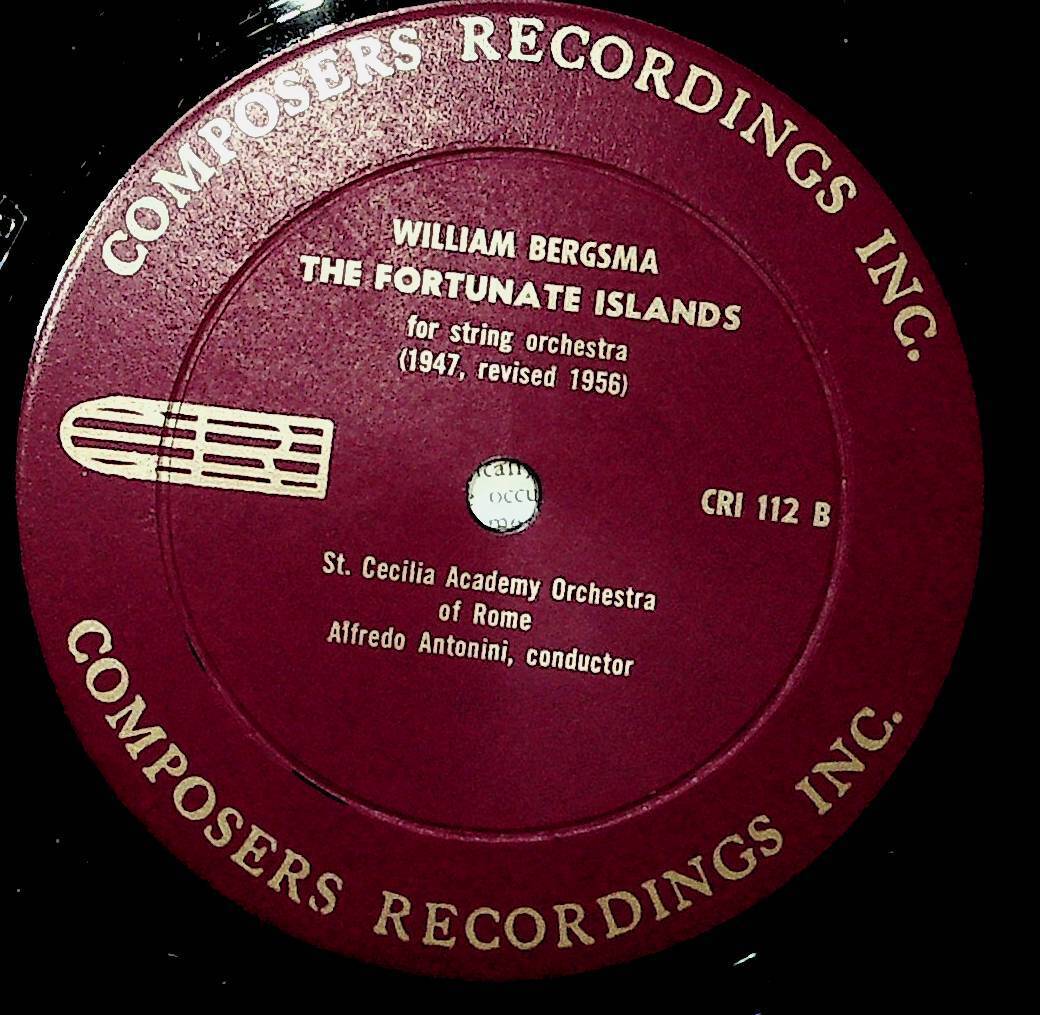
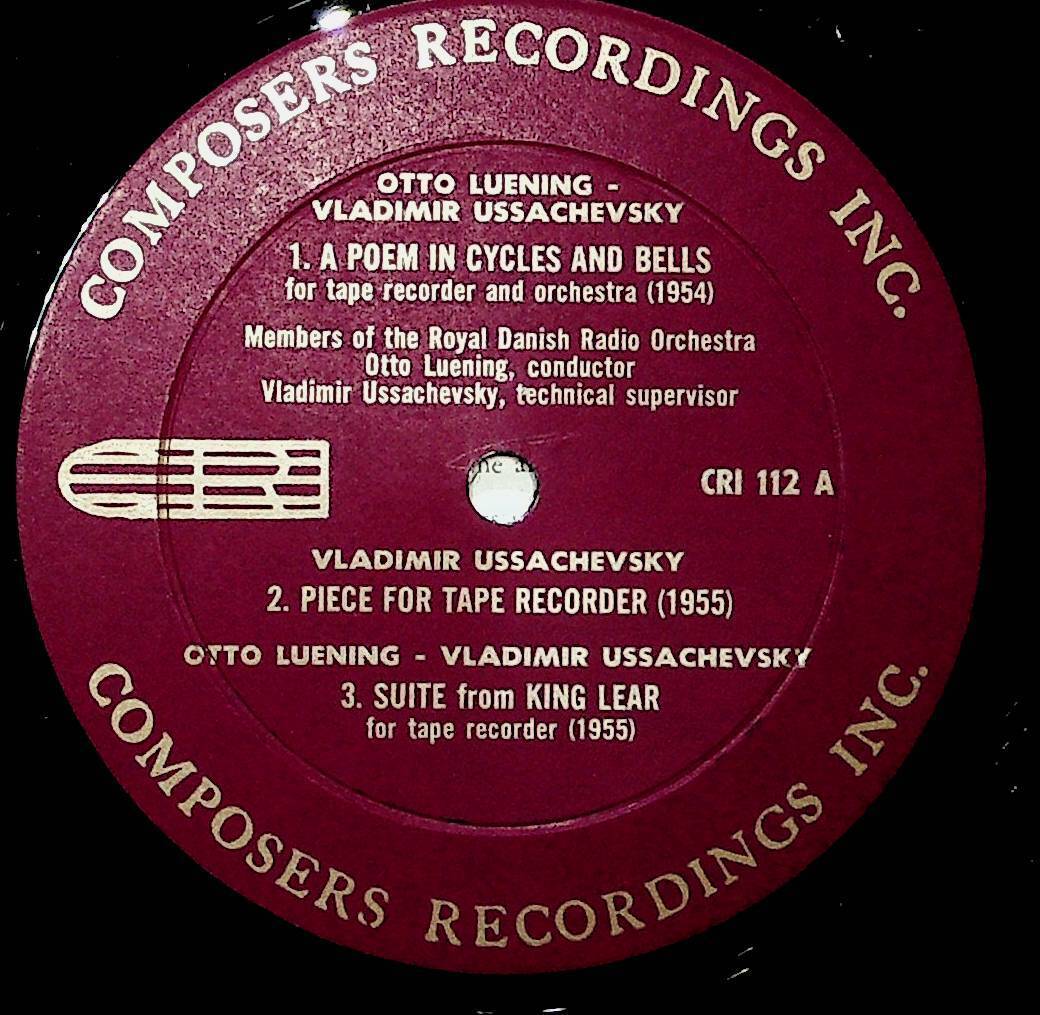
1957 Otto Luening / Vladimir Ussachevsky – A Poem In Cycles And Bells & Other Music For Tape Recorder
Record Grade per Goldmine Standard: VG+
A POEM IN CYCLES AND BELLS FOR TAPE RECORDER AND ORCHESTRA by OTTO LUENING and VLADIMIR USSACHEVSKY Members of the Royal Danish Radio Orchestra Conducted by OTTO LUENING Technical supervision by V. USSACHEVSKY SUITE FROM KING LEAR by OTTO LUENING and VLADIMIR USSACHEVSKY CRI-112 THE FORTUNATE ISLANDS for String Orchestra by WILLIAM BERGSMA Orchestra of the "Accademia Nazionale di Santa Cecilia-Roma" conducted by ALFREDO ANTONINI A PIECE FOR TAPE RECORDER by VLADIMIR USSACHEVSKY AMONG all the musical innovations that have taken place in the twentieth century, none has been more dramatic in its reassortment of traditional values than the composition of music for tape recorder, with the recorder acting both as a cre- ative medium and as a performer. This development has, in one action, exploded the element of sound much as the cyclotron has shattered the atom, reducing the component parts to a state of such non-connotative simplicity that they can be reassembled, combined, and spun out in time as an utterly new kind of music. Electronic developments have made it possible to separate fun- damentals from their overtones; to pick and choose among these overtones the ones that satisfy the needs of the tape-composer at a given moment; to superimpose abstracted sounds one upon another. A single timpani stroke can be manipulated by electronic instruments and by the tape recorder until it has produced a whole bevy of non-associative sounds ranging from almost in- audible depth to inaudible height. The intonation of a human voice, a drip of water, an auto horn, or a pure, electronically pro- duced tone — all or any can be used. Rather than an impoverish- ment of materials, the composer is presented with a universe of aural substance so vast that severe disciplines must be self-imposed in its examination. Otto Luening and Vladimir Ussachevsky, composers of the three tape recorder works presented on this disc, arrived at their new locations by different routes. Luening. who was born in Milwaukee, Wisconsin in 1900, first heard of the possibilities of electronic music during his studies with Busoni in Zurich, Switzerland. He subsequently enjoyed an extensive career as conductor and in- strumentalist, directing, during the course of it, the world premieres of Menotti’s opera, "The Medium," Virgil Thomson’s "The Mother of Us All," and his own ’ Evangeline." His catalogue of com- positions for traditional instruments runs to several pages of small type. Vladimir Ussachevsky, who, like Mr. Luening is a member of the music faculty at Columbia University, began his experiments with tape recorder in the winter of 1951 and presented a public demonstration of these experiments on the Composers Forum series in the Spring of 1952. Born in Hailar, Manchuria, of Russian parents, he arrived in this country in 1930, completing his education at Pomona College and, with Howard Hanson, at the Eastman School of Music. In the fall of 1953 he collaborated with Mr. Luening in the creation of . the first major work for tape recordei and orchestra in which a tape recorder was used as a solo instrument. This work, commissioned jointly from the two composers by the Louisville Orchestra, was entitled "Rhapsodic Variations for Tape Recorder and Orchestra" and received its premiere on March 20, 1954. POEM IN CYCLES AND BELLS by Otto Luening and Vladimir Ussachevsky (BAND I) was commissioned by conductor Alfred Wallenstein who, in 1954, requested a private hearing of the entire repertoire of tape music composed both jointly and separate- ly by Messrs. Luening and Ussachevsky. He then suggested that two solo tape compositions "Fantasy in Space" (Luening) and "Sonic Contours" (Ussachevsky) could be changed and expanded into a single composition for tape recorder and symphony orchestra. The composers were immediately interested in the project and worked on it through the summer of 1954. The first step was to transcribe the solo part, which was taken by ear from the tape recorder and notated on the conductor s score as accurately as possible. The total structure of the work, which was planned by the composers in conference, is as .follows: The materials of the first section are presented by the orchestra alone. After an introduction by woodwinds, strings, and horns, the harp, glockenspiel, and clarinet are blended and introduce a short passage based on a combination of C sharp minor, E minor, and A minor chords. A bridge leads to trill passages in the wood- winds. Then a solo for horn and chimes introduces a ballad-like theme, which is played by the violins. Joining them alternately are woodwinds, trombones, trumpets, and glockenspiel. The preceding material is now played by the tape recorder. With the flute as a sound-source, numerous complex variations and transformations are pres. nted. There is a delicate orchestral background of muted strings and occasional solo winds with triangle. The tape recorder plays the ballad-like theme alone, elaborately varied and developed in the background. Celeste, harp. English horn, glockenspiel, and cello enter pianissimo, re-stating the theme, while the tape recorder brings its variations to a high point and then tapers away. There is a brief transition into the work's second section. An orchestral transition follows with a terse, forte announce- ment of a harmonic progression from which much of the material in the following section is derived. The interval of a minor second figures predominantly as a dissonant factor, melodically and harmonically. The tape recorder enters, serving as a low. bass pedal to an expanded re-statement of the previously heard chords. Now come a series of low, bell-like notes, and new thematic material is introduced rhetorically by the tape recorder. A long, slightly metallic melodic line occurs against a background of low chords, which increase in volume and frequency to burst in organ- like harmonic clusters. As the melodic line disappears in a final low, metallic crescendo, new material enters. A modal theme is presented in canonic im- itation by sounds resembling a Balinese gamelan orchestra. As this section nears completion, other faint, tinkling bells are heard, followed by strangely distorted voices. The orchestra begins to enter very quietly and the tape recorder introduces an insistent rhythm which continues to the end of the piece, having the effect of a maze of echoes, always receding into the distance and intertwining with a dance-like tune. The orchestra is restrained until the finale, when it emerges over the pulsating mass of sound and marches on to a forceful, polytonal ending. A PIECE FOR TAPE RECORDER by Vladimir Ussachevsky ( BAND II) fully exploits the instrument as a creative medium. Extensive blending of timbres, transposition of pitches, and a careful control of dynamic properties has resulted in a composition wherein little is recognizable as to the origin of the sounds. The materials have been economically used and carefully developed by means of electronic manipulation as well as by traditional, instrumental techniques of thematic development. The composer feels that the work requires no elaborate explanation in order to be ap- preciated, although, he says, "a variety of subjective interpreta- tions is indeed welcomed from each listener according to his own taste and imagination". SUITE FROM "KING LEAR" by Otto Luening and Vladimir Ussachevsky (BAND III) — When called upon by Orson Welles to provide an abstract background score for his New York City Center production of Shakespeare's "King Lear," the composers found it necessary to develop a good deal of new material, tailoring it to the director’s conception. From a total of between forty and fifty cues used in the play, this recorded excerpt has been drawn. The brief sequence highlights two major episodes in the tragedy, rhe Storm Scene and Lear's madness. The impact of the brutal storm is portrayed by a howling ascent of grotesque and noise-infused chords. Splashes of impressionistic color break through like calls from another world. The storm dissolves into a quieter, mysterious movement which is used throughout the play to underline a mood of ever-deepening tragedy. Next come the cold and lonely sounds suggesting Lear's madness, as he wanders in his fantastic dress of Howers and jingles. A more complex version of the mysterious sonorities, with occasional echoes of the storm, doses the brief excerpt. WILLIAM BERGSMA is one of the United States’ most securely established and widely admired young composers; living proof of the opportunities for musical development which exist between American borders. Born in Oakland, California in 1921, he was playing violin at the age of six and composing orchestral music by the time he reached high school. Of his experiences at Bur- lingame high school, he writes: "If 1 wanted to write a piece and copy the parts, the orchestra would play it, and did; my first complete composition was for orchestra and was played at one of its concerts, as were two or three later ones." In the summer of 1937, he reports, "I hid the lack of a high school diploma and enrolled in my first formal composition course in the University' of Southern California, taught by the visiting Howard Hanson." The session lasted six weeks. At its termination, Bergsma was invited to send the score of his ballet, Paul Bunyan" (for puppets and solo dancers), to Dr. Hanson at the Eastman School of Music. He did so, and as a result, a Suite drawn from the score was broadcast by the Eastman-Roches- ter Orchestra. Hanson subsequently staged the ballet, with some- what altered scenario. Pierre Monteux broadcast still another Suite drawn from the original score, and a chain of about twenty- five performances and broadcasts was set off. Bergsma began his studies at Stanford University' in 1938, and two years later entered the Eastman School of Music. There he remained until 1944. first as a student, and then as a Teaching Fellow, studying composition with Dr. Hanson and orchestration with Bernard Rogers. Prizes, grants, and performances began to follow on each other's heels. In 1942, while he was still a student at Eastman, Bergsma’s First String Quartet was given its premiere by the Gordon String Quartet. In 1943, the work was awarded the Beams Prize; in 1945 it won an award from the Society for Publication of Amer- ican Music. In 1942, a ballet entitled "Gold and the Senor Com- mandante" was staged, and excerpts from the score were recorded for Victor by Howard Hanson and the Eastman-Rochester Or- chestra. A "Symphony for Chamber Orchestra" was commissioned by Town Hall, New York, in 1943. and in the same year, Bergsma’s "Music On a Quiet Theme" was given a special pub- lication award in the Independent Music*Publishers’ Contest. The year 1944 brought forth a Second String Quartet, commissioned by the Koussevitsky Foundation. This work, like the Quartet com- pleted in 1942, was given its first performance by the Gordon String Quartet. The following year, the composer took up residence in New York City. He arrived early in 1945 and by May of that year was the recipient of the National Institute of Arts and Letters’ award for $1,000. His appointment to the faculty of the Juilliard School of Music came a few months later, closely followed by the award of a Guggenheim Fellowship. In 1947, Carl Fischer, Inc. commissioned the composer to write "The Fortunate Islands" in honor of the twenty-fifth anniversary' of the League of Com- posers. The work was composed during the period of Bergsma’s Guggenheim Fellowship, which he spent, appropriately to his project, on the Caribbean island of Jamaica. The score, as here recorded, represents a later, revised version dating from 1956. One is not surprised to hear the composer state with regard to Jamaica: "My imaginings took a certain color from the dis- turbing beauty of that island," for passages of portentous loveliness present themselves at every turning in the score of "The Fortunate' Islands." The title, says Bergsma, was taken from "a rather slight- ing paragraph by Sir Walter Raleigh": "He (the artist) stands on the promontory and watches the shore beneath. He sees the sailors struggling in the surf and pities them; but he cannot aid them or even suffer with them. He does not guide the ship . . . nor discover the Fortunate Islands. "This perfectly accurate statement annoyed me. Discovery’, in his own field, is precisely the purpose of a working composer. While I had never located a new island, 1 could imagine one. I could bring back a sound in celebration of discovery. "If 1 were to discover the Fortunate Islands, this piece is what they would sound like. They would have beauty (the slow in- troduction); energy’ (the Allegro); they might have elements of ritual oi terror beyond my comprehension (a slashing passacaglia with one recurrent quarter-tone, deliberately out of tune); of changing dance; and, finally, despite great variety, my Islands would have one spirit: an overall serenity." The Fortunate Islands is published by Carl Fischer Inc. Notes by LESTER TRIMBLE COMPOSERS RECORDINGS, INC. 170 West 74th Street, New York 23, N. Y.
LP723
price rating