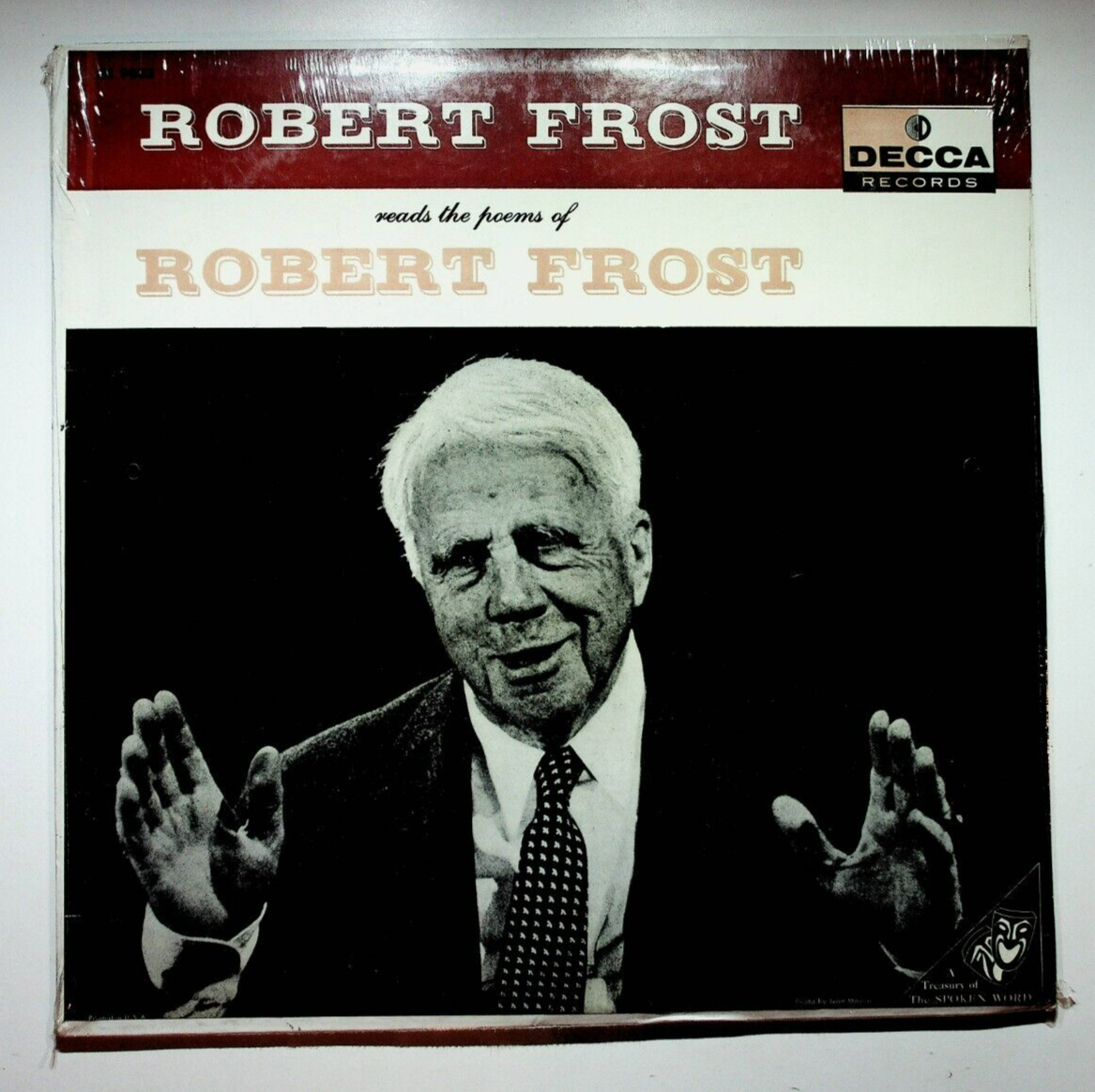
1957 Robert Frost Reads The Poems Of Robert Frost Vinyl LP Record SEALED
$
29


Favourite Auctions
To save auctions to your favourites, please login
If you don't have an account, please register
Description
1957 Robert Frost Reads The Poems Of Robert Frost Vinyl LP Record SEALED
Vinyl / Jacket Grade per Goldmine Standard: NM / NM; Sealed
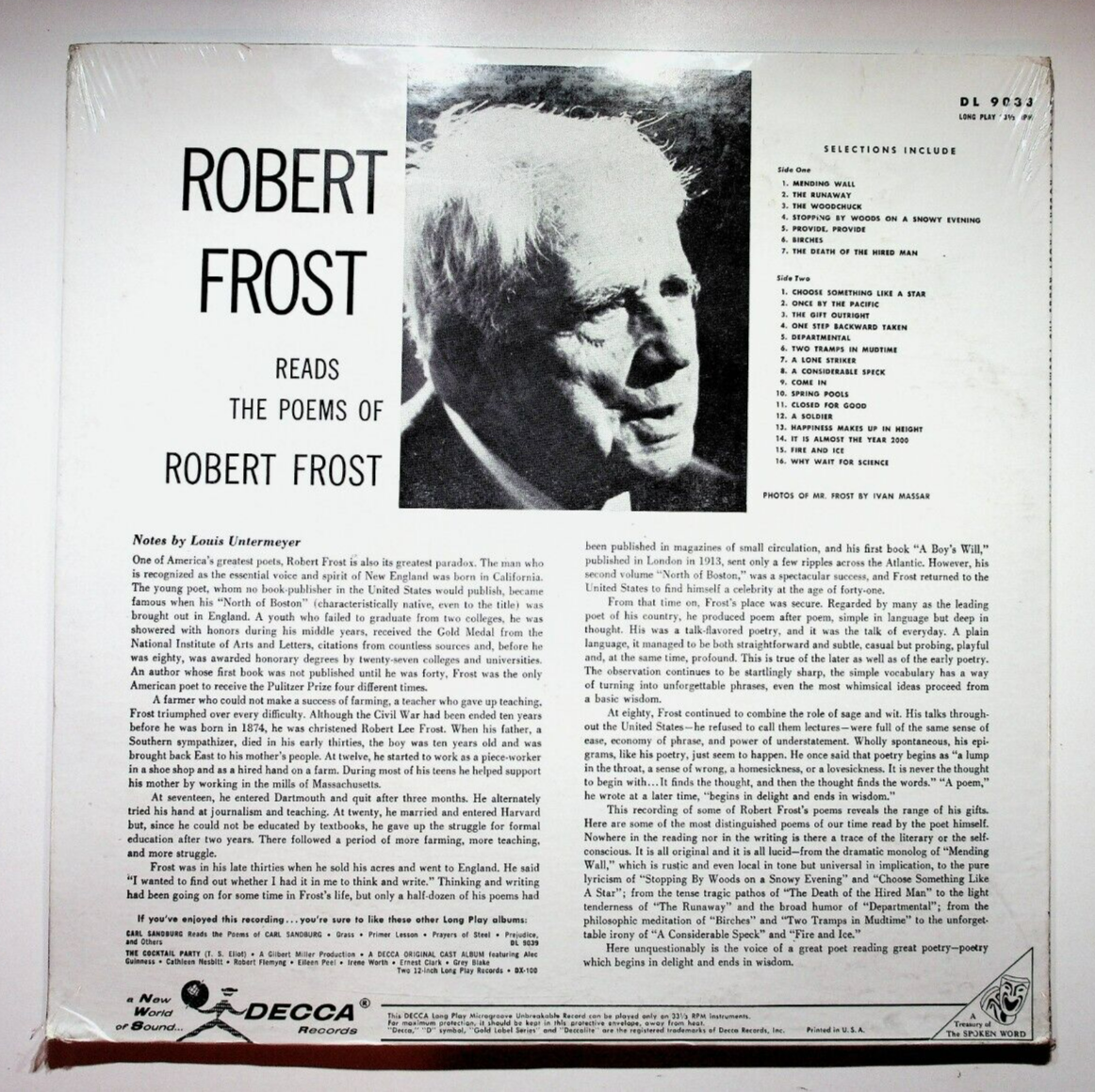
SELECTIONS INCLUDE Side One 1. MENDING WALL 2. THE RUNAWAY 3. THE WOODCHUCK 4. STOPPING BY WOODS ON A SNOWY EVENING 5. PROVIDE, PROVIDE 6. BIRCHES 7. THE DEATH OF THE HIRED MAN Side Two 1. CHOOSE SOMETHING LIKE A STAR 2. ONCE BY THE PACIFIC 3. THE GIFT OUTRIGHT 4. ONE STEP BACKWARD TAKEN 5. DEPARTMENTAL 6. TWO TRAMPS IN MUDTIME 7. A LONE STRIKER 8. A CONSIDERABLE SPECK 9. COME IN 10. SPRING POOLS 11. CLOSED FOR GOOD 12. A SOLDIER 13. HAPPINESS MAKES UP IN HEIGHT 14. IT IS ALMOST THE YEAR 2000 15. FIRE AND ICE 16. WHY WAIT FOR SCIENCE Notes by Louis Untermeyer One of America’s greatest poets, Robert Frost is also its greatest paradox. The man who is recognized as the essential voice and spirit of New England was born in California. The young poet, whom no book-publisher in the United Stales would publish, became famous when his “North of Boston” (characteristically native, even to the title) was brought out in England. A youth who failed to graduate from two colleges, he was showered with honors during his middle years, received the Gold Medal from the National Institute of Arts and Letters, citations from countless sources and, before he was eighty, was awarded honorary degrees by twenty-seven colleges and universities. An author whose first book was not published until he was forty, Frost was the only American poet to receive the Pulitzer Prize four different times. A farmer who could not make a success of farming, a teacher who gave up teaching, Frost triumphed over every difficulty. Although the Civil War had been ended ten years before he was born in 1874, he was christened Robert Lee Frost. When his father, a Southern sympathizer, died in his early thirties, the boy was ten years old and was brought back East to his mother’s people. At twelve, he started to work as a piece-worker in a shoe shop and as a hired hand on a farm. During most of his teens he helped support his mother by working in the mills of Massachusetts. At seventeen, he entered Dartmouth and quit after three months. He alternately tried his hand at journalism and teaching. At twenty, he married and entered Harvard but, since he could not be educated by textbooks, he gave up the struggle for formal education after two years. There followed a period of more farming, more teaching, and more struggle. Frost was in his late thirties when he sold his acres and went to England. He said “I wanted to find out whether I had it in me to think and write.” Thinking and writing had been going on for some time in Frost’s life, but only a half-dozen of his poems had If you've enjoyed this recording... you're sure to like these other Long Play albums: CARL SANDBURG Reads the Poems of CARL SANDBURG • Grass • Primer Lesson • Prayers of Steel • Prejudice, and Others DL 9039 THE COCKTAIL PARTY (T. S. Eliot) • A Gilbert Miller Production • A DECCA ORIGINAL CAST ALBUM featuring Alec Guinness • Cathleen Nesbitt • Robert Flemyng • Eileen Peel • Irene Worth • Ernest Clark • Grey Blake Two 12-inch Long Play Records • DX-100 been published in magazines of small circulation, and his first book “A Boy’s Will,” published in London in 1913, sent only a few ripples across the Atlantic. However, his second volume “North of Boston,” was a spectacular success, and Frost returned to the United States to find himself a celebrity at the age of forty-one. From that time on, Frost’s place was secure. Regarded by many as the leading poet of his country, he produced poem after poem, simple in language but deep in thought. His was a talk-flavored poetry, and it was the talk of everyday. A plain language, it managed to be both straightforward and subtle, casual but probing, playful and, at the same lime, profound. This is true of the later as well as of the early poetry. The observation continues to be startlingly sharp, the simple vocabulary has a way of turning into unforgettable phrases, even the most whimsical ideas proceed from a basic wisdom. At eighty, Frost continued to combine the role of sage and wit. His talks through- out the United States —he refused to call them lectures—were full of the same sense of ease, economy of phrase, and power of understatement. Wholly spontaneous, his epi- grams, like his poetry, just seem to happen. He once said that poetry begins as “a lump in the throat, a sense of wrong, a homesickness, or a lovesickness. It is never the thought to begin with...It finds the thought, and then the thought finds the words.” “A poem,” he wrote at a later time, “begins in delight and ends in wisdom.” This recording of some of Robert Frost’s poems reveals the range of his gifts. Here are some of the most distinguished poems of our time read by the poet himself. Nowhere in the reading nor in the writing is there a trace of the literary or the self- conscious. It is all original and it is all lucid—from the dramatic monolog of “Mending Wall,” which is rustic and even local in tone but universal in implication, to the pure lyricism of “Stopping By Woods on a Snowy Evening” and “Choose Something Like A Star”; from the tense tragic pathos of “The Death of the Hired Man” to the light tenderness of “The Runaway” and the broad humor of “Departmental ’; from the philosophic meditation of “Birches” and “Two Tramps in Mudtime” to the unforget- table irony of “A Considerable Speck” and “Fire and Ice.” Here unquestionably is the voice of a great poet reading great poetry—poetry which begins in delight and ends in wisdom.
lp4358-AV
price rating