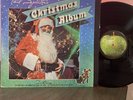
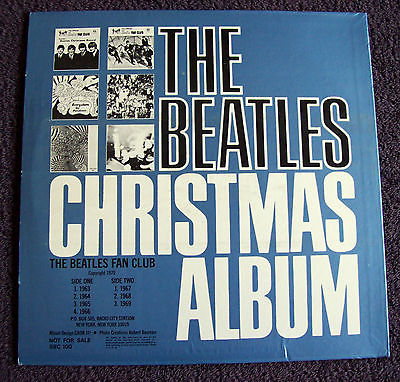
1970 THE BEATLES CHRISTMAS ALBUM AUTHENTIC ORIGINAL FANCLUB ONLY VG++/VG++ CLEAN
$
400


Favourite Auctions
To save auctions to your favourites, please login
If you don't have an account, please register
Description
1970 THE BEATLES CHRISTMAS ALBUM MONO SBC100. VG++ / VG++. ASIDE FROM LIGHT MARKINGS ON THE WHITE LETTERS OF THE COVER, THIS IS A NEAR MINT COVER. NO SEAMS SPLITS OR CORNER BLUNTS. THE RECORD IS ALSO CLOSE TO NEAR MINT WITH SOME LIGHT MARKS. THE RECORD, COVER, AND INNER SLEEVE HAVE BEEN CLEANED AND COME IN A RESEALABLE PROTECTIVE COVER. FREE SHIP IN USA. THANKS.
Spotting the fakes
The Beatles Christmas Album has been frequently counterfeited. Here are some authenticity tests to determine if your copy is real. If any one of these tests fail, you have an illegitimate version of the record.
- The earliest fakes have blurry cover photos on the front side. One authenticity test is to look at the photo of the four Beatles in the lower left corner. The photo should be sharp enough to see both of Ringo’s eyeballs. If the right eye is covered by a dark shadow, it is a counterfeit. Click photo at right to enlarge.
- Similar to the first test, if you look directly over John’s head in the photo immediately to the right of the lower left corner photo, you will plainly see the words “Theatre Royal”. If this does not show up distinctly, it is a counterfeit. Click photo at right to enlarge. Note: The album pictured in the photo is authentic, but the “Theatre Royal” is not not large enough to be seen in this picture.
- All legitimate copies of this record were manufactured at Capitol’s Winchester, Virginia factory. The pressing machines there made a 1 ½” diameter indentation ring which is 5/8? out from the center hole. If the LP has a different sized indentation, or if there is no indentation there at all, then it is a fake. Most fakes have a significantly larger indentation ring. I see them on sale for $400 on Ebay all the time, and they aren’t worth $10. The correct appearance of this ring is seen in the photos below, and it shows up clearest on the sliced Apple side (i.e. side 2) (click to enlarge).
The Beatles Christmas Album Side 1 Label
The Beatles Christmas Album Side 2 Label
- On legitimate copies, four markings are etched into the trail-off area of the vinyl (all should be apparent):
- the catalog number “SBC-1-100-A” on side 1 and “SBC-2-100-B” on side 2
- a crudely drawn rifle (symbol of Winchester, VA, factory where all legitimate copies were pressed).
- a hand etched “sf”
- a scripted typset that reads “Bell Sound”
- Any colored vinyl pressings are fakes.
G
Description of each message 1963-1969
Each of the seven messages are described briefly below:
- The Beatles Christmas Record (1963): John Lennon & Ringo Starr both sing a few rounds of “Good King Wenceslaus,” and The Beatles all sing “Rudolph The Red Nosed Reindeer.” There is also a Christmas greeting script that was written by Tony Barrow that each Beatle cheerfully delivers. Also released on soundcard in U.S. in Dec. 1964. Time: 5:00
- Another Beatles Christmas Record (1964): The Beatles run through another script prepared by Tony Barrow and conclude by singing “Oh, Can You Wash Your Father’s Hair” to a piano accompaniment followed by the sound of running feet as the sound on the disc fades away. Unlike other flexis, this one plays at 45rpm instead of 33 1/3 rpm. Not issued in U.S. (where the 1963 message was distributed in 1964 instead). Time: 4:05
- The Beatles Third Christmas Record (1965): The group sings an off-key account of “Yesterday.” The Beatles follow another of Tony Barrow’s scripts, though it is obvious John is doing so reluctantly, judging by his mumbling and not making much sense. They sing a short line of “It’s The Same Old Song” (a Four Tops hit) and a cadence-driven version of “Auld Lang Syne” that somehow references the gore in Vietnam. After a few more words they sing “Christmas Comes But Once A Year,” which segues back into another off-key rendition of “Yesterday.” Not issued in U.S. (because it was not received by the U.S. fan club in time to be distributed for the holiday season). Time: 6:26
- Pantomime: Everywhere It’s Christmas (1966): Unlike previous years, there is no Tony Barrow script to follow. The Beatles came up with a pantomime idea and open with a short piano tune called “Everywhere It’s Christmas,” followed by some group harmonies where they sing something called “Orowaynya.” After that, there is a series of humorous skits, sound effects and even yodeling. Then there is another piano tune called “Please Don’t Bring Your Banjo Back” followed by a reprise of “Everywhere It’s Christmas.” The British sleeve has colorful artwork designed by Paul McCartney. It was issued in America on a one sided thin vinyl record similar to a flexi-disc and a postcard without the artwork. Time: 6:40
- Christmas Time (Is Here Again) (1967): Another series of skits interlaced with bits and pieces of a theme song, “Christmas Time (Is Here Again),” with Paul on piano and George on acoustic guitar, John on timpani, and Ringo on drums. All four cheerfully chant the title. There are also parody commercials and a segment where The Beatles portray a band called “The Ravellers” to sing a song called “Plenty Of Jam Jars.” It was issued in America on a one sided thin vinyl record similar to a flexi (called a soundsheet) and a postcard without the artwork. Time: 6:10
- The Beatles Sixth Christmas Record (1968): Each Beatle recorded his part separately, and it was later edited together. Paul plays an acoustic Christmas song which starts off with him singing “Happy New Year, Happy Christmas, Happy Easter, Happy Autumn, Happy Michaelmas, Happy Christmas, everybody to you.” John reads some of his crazy writings similar to what he did in his In His Own Write book, with various echo effects on his voice. George speaks with Tiny Tim who sings “Nowhere Man” in a falsetto voice, and Ringo talks nonsense. For the first time the disc plays on two sides instead of one due to it’s longer duration. Issued in U.S. on flexi-disc just like the U.K., however the year-old 1967 U.K. cover is used on the 1968 U.S. version and the title is listed as “The Beatles 1968 Christmas Record.” Time: 7:55
- The Beatles Seventh Christmas Record (1969): Each Beatle recorded his part separately, and it was later edited together. On this message we hear John and Yoko walking around outside and talking outside their new Ascot home. John also interviews Yoko about “freedom of mind and everything.” Paul plays another acoustic Christmas improvisation where he sings “This Is To Wish You A Very Merry Christmas, This Is To Wish You A Happy New Year.” Ringo sings something that seems to be called “Good Evening To You Gentlemen,” which continues into part of “The End” from the Abbey Road album. George gives a quick holiday greeting. Once again, due to its longer duration, the disc plays on two sides instead of one. Also issued with same cover art on flexi-disc in the U.S. Time: 7:42
Even though only five of the seven messages were received by U.S. fan club members, all seven messages appeared on both the U.S. and U.K. fan club albums. Both contained the 1963-1966 messages on side 1 and the 1967-1969 messages on side 2.
Goldmine's Record Album Grading System
How to Grade: Look at everything about a record -- Its playing surface, its label, its edges -- under a strong light. Then, based on your overall impression, give it a grade based on the following criteria:
Mint (M): Absolutely perfect in every way -- certainly never played, possibly even still sealed (More on still sealed under "Other considerations"). Should be used sparingly as a grade, if at all.
Near Mint (NM or M-): A nearly perfect record. Many dealers won't give a grade higher than this, implying (perhaps correctly) that no record is ever truly perfect.
The record should show no obvious signs of wear. A 45 RPM or EP sleeve should have no more than the most minor defects, such as almost invisible ring wear or other signs of slight handling.
An LP jacket should have no creases, folds, seam splits or any other noticeable similar defect. No cut-out holes, either. And of course, the same should be true of any other inserts, such as posters, lyric sleeves and the like.
Basically, an LP in Near Mint condition looks as if you just got it home from a new record store and removed the shrink wrap.
Very Good Plus (VG+): A Very Good Plus record will show some signs that it was played and otherwise handled by a previous owner who took good care of it.
Record surfaces may show some slight signs of wear and may have slight scuffs or very light scratches that don't affect one's listening experience. Slight warps that do not affect the sound are OK.
The label may have some ring wear or discoloration, but it should be barely noticeable. The center hole will not have been misshapen by repeated play.
Picture sleeves and LP inner sleeves will have some slight ring wear, lightly turned-up corners, or a slight seam split. An LP jacket may have slight signs of wear also and may be marred by a cut-out hole, indentation or corner indicating it was taken out of print and sold at a discount.
In general, if not for a couple minor things wrong with it, this would be Near Mint. All but the most mint-crazy collectors will find a Very Good Plus record highly acceptable.
A synonym used by some collectors and dealers for "Very Good Plus" is "Excellent."
Very Good (VG): Many of the defects found in a VG+ record will be more pronounced in a VG disc. Surface noise will be evident upon playing, especially in soft passages and during a song's intro and fade, but will not overpower the music otherwise. Groove wear will start to be noticeable, as will light scratches (deep enough to feel with a fingernail) that will affect the sound.
Labels may be marred by writing, or have tape or stickers (or their residue) attached. The same will be true of picture sleeves or LP covers. However, it will not have all these problems at the same time, only two or three of them.
Good (G), Good Plus (G+): Good does not mean Bad! A record in Good or Good Plus condition can be put onto a turntable and will play through without skipping. But it will have significant surface noise and scratches and visible groove wear (on a styrene record, the groove will be starting to turn white).
A jacket or sleeve will have seam splits, especially at the bottom or on the spine. Tape, writing, ring wear or other defects will start to overwhelm the object.
If it's a common item, you'll probably find another copy in better shape eventually. Pass it up. but if it's something you have been seeking for years, and the price is right, get it... but keep looking to upgrade.
Poor (P), Fair (F): The record is cracked, badly warped, and won't play through without skipping or repeating. The picture sleeve is water damaged, split on all three seams and heavily marred by wear and writing. The LP jacket barely keeps the LP inside it. Inner sleeves are fully seam split, crinkled, and written upon.
Except for impossibly rare records otherwise unattainable, records in this condition should be bought or sold for no more than a few cents each.
Other grading considerations. Most dealers give a separate grade to the record and its sleeve or cover. In an ad, a record's grade is listed first, followed by that of the sleeve or jacket.
With Still Sealed (SS) records, it's safe to assume that they are in Very Good Plus to Near Mint
condition (unless there is notable damage). There are many original factory sealed records still out there (warehouses full)--just be carefull: it's easy to re-seal one. Let the buyer beware!