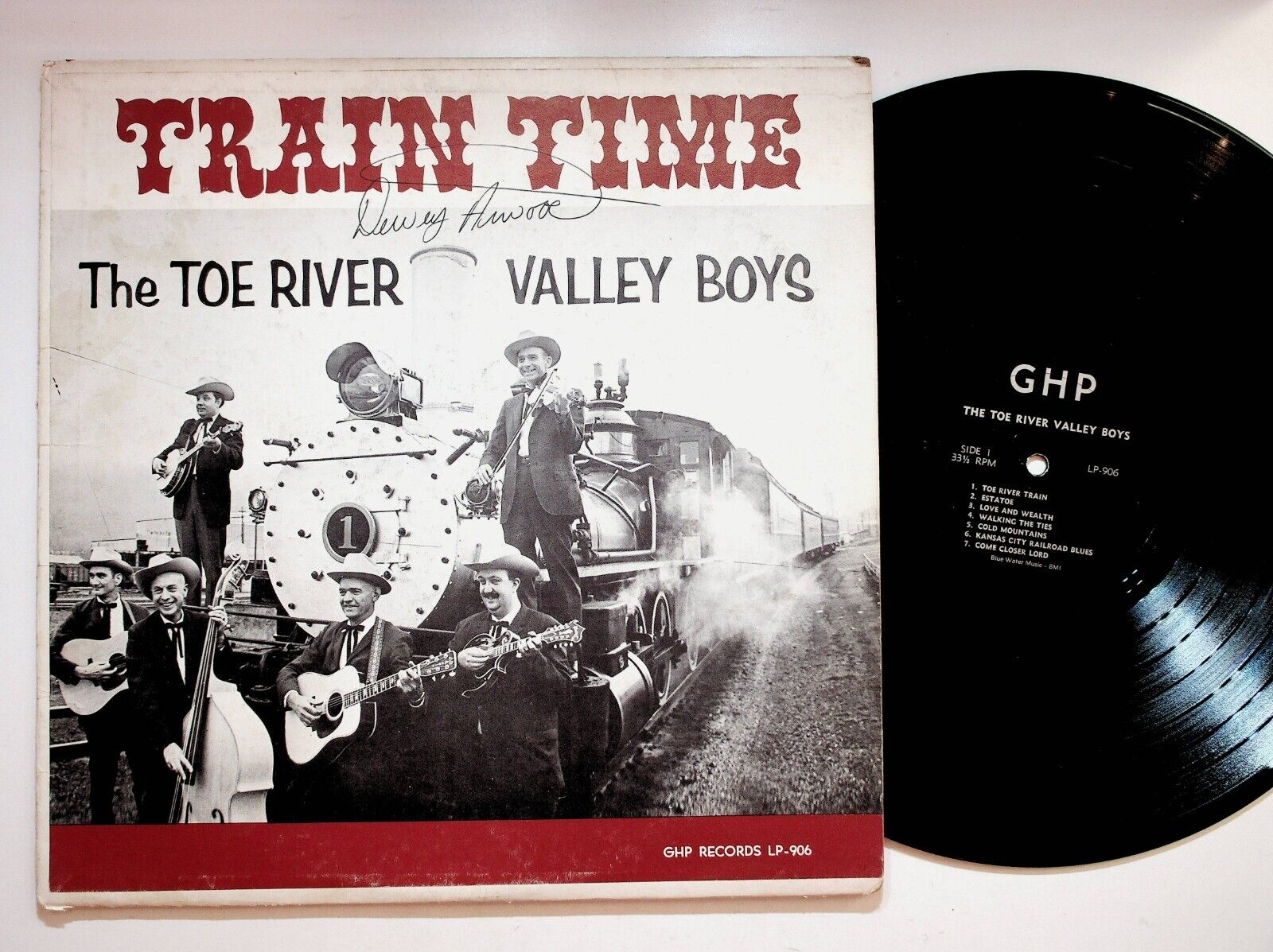
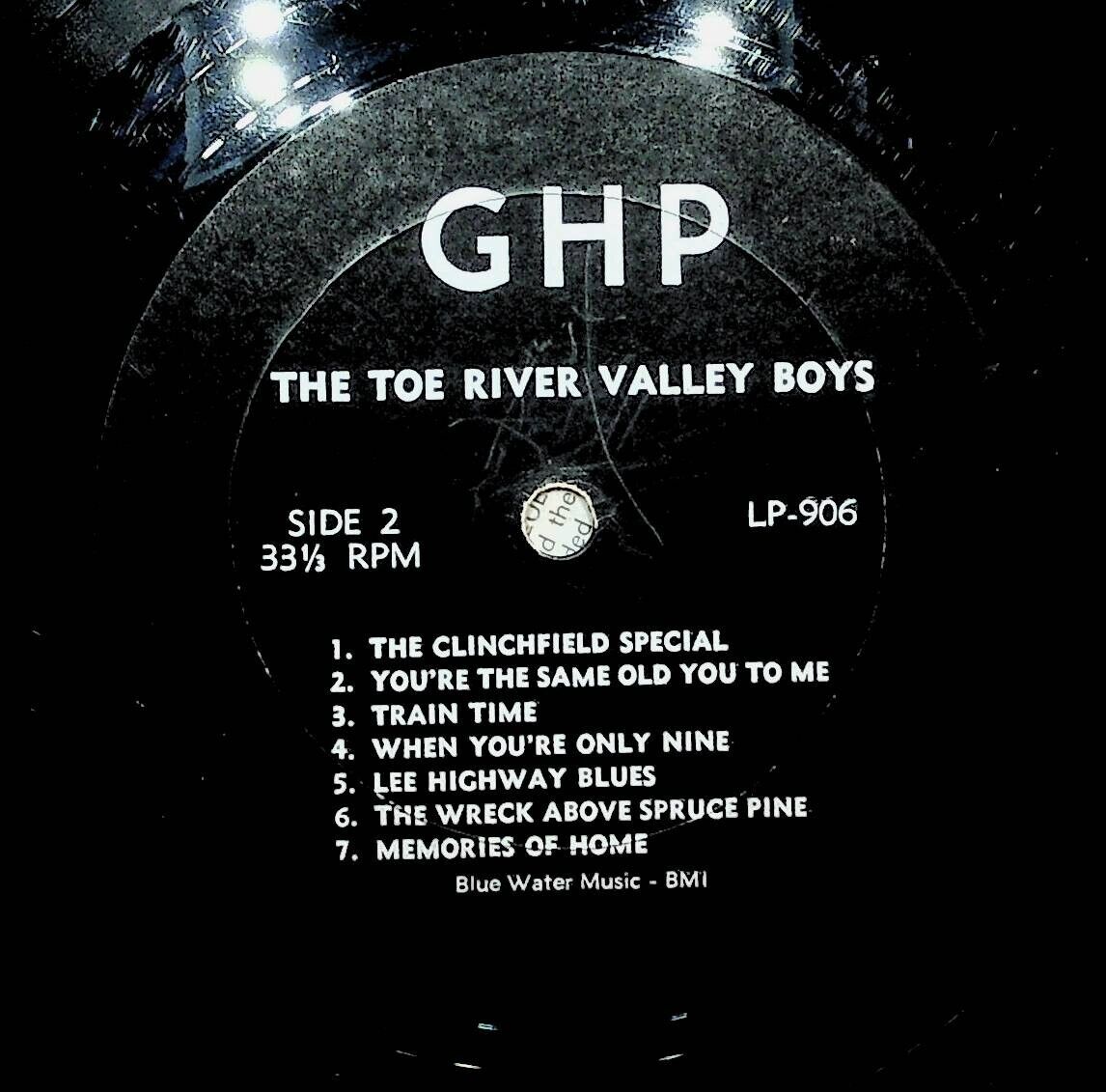
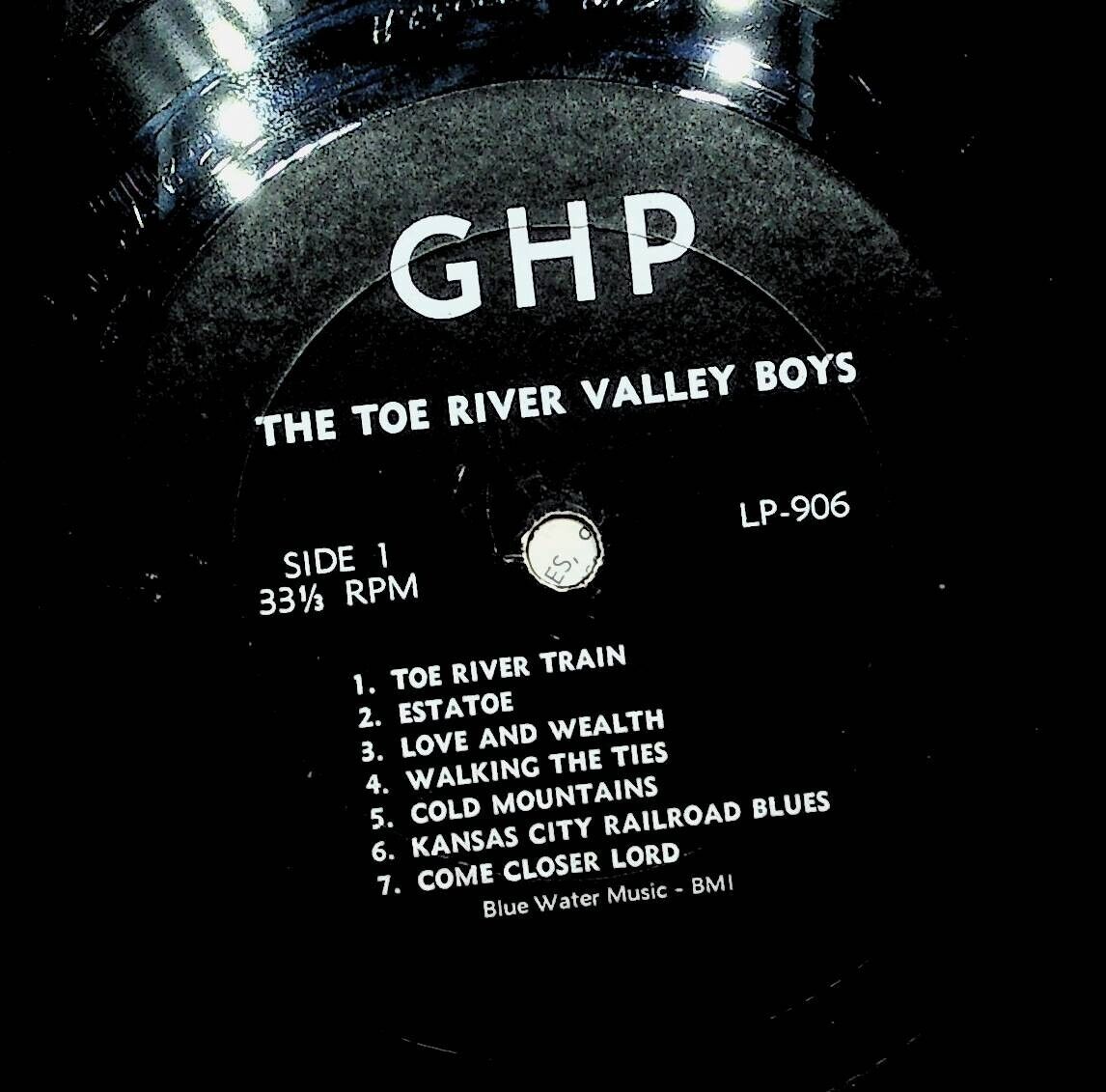
1970 The Toe River Valley Boys Train Time Bluegrass Vinyl LP Record
$
32


Favourite Auctions
To save auctions to your favourites, please login
If you don't have an account, please register
Description
Yes we combine shipping for multiple purchases. Add multiple items to your cart and the combined shipping total will automatically be calculated.
1970 The Toe River Valley Boys Train Time Bluegrass Vinyl LP Record
SIDE ONE TOE RIVER TRAIN ESTATOE LOVE AND WEALTH WALKING THE TIES COLD MOUNTAINS KANSAS CITY RAILROAD BLUES COME CLOSER, LORD SIDE TWO THE CLINCHFIELD SPECIAL YOU'RE THE SAME OLD YOU TO ME TRAIN TIME WHEN YOU'RE ONLY NINE LEE HIGHWAY BLUES THE WRECK ABOVE SPRUCE PINE MEMORIES OF HOME Oscar O. "Fiddlin' Red" Wilson — fiddle E. C. Miller — banjo Clarence H. Greene — mandolin, lead guitar Charles Renfro, Jr. — guitar C. A. "Gus" Washburn — guitar, harmonica Cecil "Curly" Burleson — bass TRAIN TIME! with The Toe River Valley Boys, the second long-ploying album on GHP Records by this western North Carolina group, is a collection of fourteen carefully selected mountain Blue- grass and old-timey ballads, songs and instrumentals, nine of which have never before been heard on commercial recordings. Included in the assortment are a number of new compositions by Moe Riddle Greene, among which are two original Bluegrass hymns; two new fast-moving instrumentals by Clarence Greene and E. C. Miller; a couple of standard fiddle hoedowns showcasing the talents of Red Wilson; some new arrangements of older material; and one fairly recent "heart" song. All tracks feature of course, the tra- ditional string band flavor utilizing fiddle, five string banjo, mandolin, guitar and harmonica — all supported by the rock-solid string bass of Cecil Burleson. Our decision to use a "train" theme as the underlying idea for this LP came about chiefly because exactly half of the songs chosen for it were related, directly or indirectly, to railroads, their functions and romance. The idea particularly appealed to me because of my lifelong interest in railroading, and Gerd Hadeler of GHP Records gave his wholehearted approval to the project. We hope you'll enjoy the result of our efforts as much as we enjoyed preparation and production of this album. We would like to extend sincere appreciation to Thomas D. Moore, Jr., P. O. Likens and J. L. Lonon, General Manager, Chief Mechanical Officer and Super- intendent, respectively, of the Clinchfield Railroad Company for their fine cooperation in making "THE CLINCHFIELD SPECIAL" available for photographs with the band, one of which serves as the album's cover picture. Special thanks also go to our excellent photographer, C. E. Westveer of Little Switzerland, N. C The excellent five string banjo picking heard on this LP is by E. C. Miller, newest member of the TRVB, who joined the group in December 1969. A dedicated Bluegrass exponent, Miller is a close friend of pioneering three finger banjoist Earl Scruggs and incorpo- rates many -of the latter's better arpeggio arrangements in his own playing while maintaining his own imaginative, tasteful style. Five string improvisation is one of E. C.'s hallmarks, and he is consist- ently an accurate, inventive and sensitive musician. He is also quite capable of inducing some pretty fancy pyrotechnics from his pre-war Mastertone, as can be heard to good advantage on his solo here, TRAIN TIME. Elbert Columbus Miller was born in 1934 in Butler, Tennes- see, a small community in Carter County near the Tenn.-N.C. state line. He taught himself to play the guitar as a child and later learned the banjo at the age of 17. Featured at various times on WJHL-TV, Johnson City, Tenn., WCYB Radio (Farm and Fun Time), in Bristol, Tenn.-Va., WNOX Radio, Knoxville, Tenn,, and WBEJ Radio, Elizabethton, Tenn., among others, he has worked profession- ally on cross-country tours to the Western U.S. with his own band. Between times he has kept busy performing at universities and colleges, high schools, state fairs, resorts, private clubs and the like. Although this session marks E.C.'s initial album recording, he assisted in the production of a number of single records for Birch Recording Company in Morristown, Tenn., a few years ago. He confines him- self almost exclusively to the banjo, but is also competent on the guitar and mandolin. Miller resides in Elizabethton, Tenn. We substituted the word "Toe" for "New" and added a little speed to the old favorite, NEW RIVER TRAIN, retitling it TOE RIvER TRAIN to fit in with the theme of the album. This song .seems to have been neglected by Bluegrass artists in recent years, although the original recording by the Monroe Brothers at their first Bluebird session on February 17, 1936, is well known. Red sings lead on TOE RIVER TRAIN and Charles adds the tenor on the chorus. ESTATOE is a new song by Mae Greene describing the legend- ary double suicide of the beautiful Cherokee Indian maiden of the same name and her lover, Red Fox, who was Chief of one of the Unaka tribes located near the present town of Erwin, Tenn., centu- ries ago. Estatoe and Red Fox were forbidden to marry by her father, Cherokee, Chief Rising Sun. In desperation, the two eloped one moonlit night and were on their way to Red Fox's village to be wed when they were overtaken by Chief Rising Sun and a party of 12 braves, all intent on bringing back the beautiful maiden. Rather than be parted against their will, the legend says, Estatoe and her lover leaped to their deaths from a high, rocky cliff into what is today the Nolichucky River (near the Tenn.-N.C. state line). After retrieving the body of Estatoe from the turbulent waters, a sorrowful Chief Rising Sun proclaimed that thereafter the river should be called Estatoe. The name survives today, in the shortened form ("Toe"), and is also preserved in a small community named Estatoe located near Spruce Pine. Estatoe means "beautiful river" in the Cherokee tongue Charles Renfro, who sings this number as a solo, assisted me in writing the somewhat unusual tune, which seems to fit the lyrics. We've been including LOVE AND WEALTH, a song written by the late Ira Louvin and his brother, Charlie, and subsequently re- corded by Carl Story and The Rambling Mountaineers, on TRVB shows for about three years. The boys like to sing it, so we decided to include it here as a trio with Red, Charles and Louise Renfro, Charles' wife, singing lead, tenor and alto, respectively. I, learned WALKING THE TIES from my dad, who played it as a fiddle solo. I'm not sure of its derivation — he called it the "Wizard Oil Company " tune. I wonted to make a fast Bluegrass instrumental out of it, so we worked out parts for mandolin, fiddle, banjo and harmonica and renamed the tune for this album. COLD MOUNTAINS is probably the oldest song in this col- lection. A mournful dirge of loneliness and death, my father learned it about 20 years ago from an old hill woman who was eightyish at that time. I had retained a copy of the lyrics and Gus Washburn remembered the tune and he sings it here in the key of A Minor. The number appears to be structurally related to "Wayfaring Stranger" and "Claude Allen", although there are no previous commercial recordings that I have been able to unearth. Field recordings were obtained from two separate sources in western North Carolina in 1922 on expeditions conducted by Frank C. Brown, a folklorist and collector who organized the N.C. Folklore Society. KANSAS CITY RAILROAD BLUES, a fiddle tune recorded by Buck Ryan, seems to be rarely heard these days — hence its inclusion in this album. Don Reno also recorded a banjo version of the number for King, and the author is listed on that disc as W. Traugott. Red Wilson has been playing it for years. Mae Greene's COME CLOSER, LORD dates from 1958. Charles and I worked out the arrangement for this hymn. He, Red, Gus and Louise comprise a quartet here, with mandolin and harmonica "taking leads". I wanted to have a sort of a "commemorative" song in honor of the Clinchfield's steam excursion passenger train, especially since the company was cooperating in providing a cover for this LP; when the winning entry in a "name the train" contest sponsored by the railroad proved to be THE CLINCHFIELD SPECIAL, I had my title. As will be evident to the listener I wrote the song off the old Jim and Jesse Capitol classic, "Airmail Special", with an added chorus. Although no scheduled passenger runs had been made on the Clinch- field since 1955, in the fall of 1968 the company restored its ancient steam locomotive, "No.l", and began operating scenic excursion trains on a regular basis. Response has been overwhelming, and 1970 looks bigger than ever for the venture. YOU'RE THE SAME OLD YOU TO ME was written over 35 years ago by Hanford Wilson, a prolific if unsung composer of the Little Rock Creek section (Rt. 1, Bakersville, N. C.), who copyrighted it in 1933. The only previous recording is a Bluebird disc by "Fiddlin' Steve" Ledford, Clyde Moody and Jay Hugh Hall. Steve who lives near Hanford Wilson, recalls that the session was held in Rock Hill, S. C. The Toe River Valley Boys (Red, lead, Charles, tenor, and Louise, alto), form a trio on this number in the key of A. E. C. Miller's contribution to this collection is TRAIN TIME, a hard-driving banjo instrumental which serves as the album's title song. Fiddle and guitar breaks supplement E.C.'s creativity and the tune is climaxed by an unusual banjo-guitar-banjo finale. WHEN YOU'RE ONLY NINE, another of Mae's new songs which she turned out with help from Charles Renfro and me, tells the age- old story of the railroads role in returning war dead to their bereaved families who are waiting "back home". In this case the war is the current Vietnam conflict. The song depicts with a quiet eloquence the sorrow felt by a child upon the loss of this heroic father on the battlefield.. The tune is slightly reminiscent of "The Lightning Express". Red Wilson again displays his bowing dexterity on LEE HIGH- WAY BLUES, a standard breakdown which has been a Bluegrass favorite for many years. It is generally considered to be the work of George B. Grayson, the ableptical pioneer fiddler-singer from Laurel Bloomery, Tenn., whose Bluebird recording with guitarist Henry Whitter was called "Going Down Lee Highway". E. C. Miller and I get in on this one, too. THE WRECK ABOVE SPRUCE PINE tells the tragic story of a head-on collision between a passenger train and a pusher engine on the Clinchfield Railroad in 1932. Two crewmen were killed in the crash, which occurred near Spruce Pine, N.C. My dad composed this ballad shortly after the tragedy happened, but in later years he had forgotten it and I never actually heard it until Gus "pulled it out of the bag" three or four years ago. The Toe River Valley Boys conclude this album with another new Bluegrass hymn from the pen of Mae Riddle Greene, MEMORIES OF HOME. Red and Charles form their usual close-knit duet. The subject matter is one of the all-time favorite topics of Bluegress writers, and is timeless. — CLARENCE H. GREENE March 20. 1970 AUDIO NOTES: This album was recorded in Ledger, N. C., April 3-4, 1970 Producer: Gerd F. Hadeler Engineer: Charles Faurot / County Records Cover/Credit: C. E. Westveer, Little Switzerland, N. C.
Thank you for your business.
Gallimoresgoods
price rating