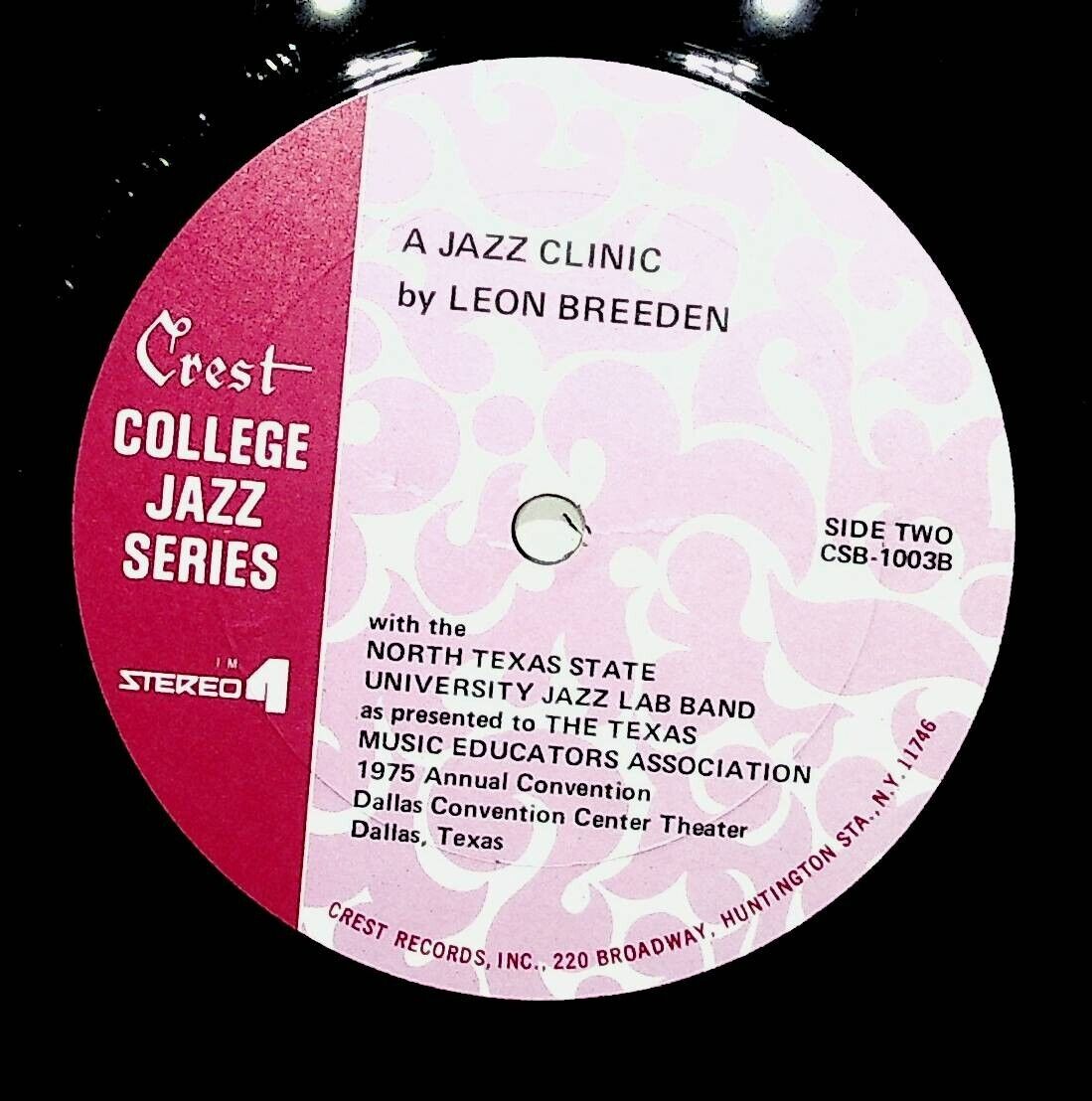
1975 North Texas State University Leon Breeden Jazz Lab Band Vinyl LP Record VG+
$
42




Favourite Auctions
To save auctions to your favourites, please login
If you don't have an account, please register
Description
1975 North Texas State University Leon Breeden Jazz Lab Band Vinyl LP Record VG+
Vinyl / Jacket Grade per Goldmine Standard: VG+ / VG+
FEBRUARY 13,1975 DALLAS CONVENTION CENTER THEATER DALLAS, TEXAS ANNUAL CONVENTION: TEXAS MUSIC EDUCATORS ASSOCIATION 1. The soloist is trying to play every “hot lick” he knows on the solo! 2. Performers are closing the throat and playing with small, timid, sounds which lack vibrancy and warmth. 3. On releases the air is not stopped cleanly — it is forced rapidly through the instrument on the release with the result of a quick crescendo. 4. The band’s dynamics are not natural and musical . . . the effect is either soft or loud, with no natural builds and/or decres- cendos. 5. The ends of phrases are being rushed! Play in time RIGHT TO THE ENDS OF PHRASES! 6. Accents are not clean because of throat attacks (“Whoo”) instead of tongue attacks (tip of tongue i.e.). 7. On loud passages the band does not control the sound; the effect is too blasting & is not musical. 8. The rhythm section is much too “busy” and is competing with the band instead of complimenting the band’s performance. 9. The BALANCE in the sections suffers because the performers are not listening to each other to be sure that they are not playing too loud or too soft for the general level of the section and/or band. 10. Since the time is erratic with some rushing and some dragging at times, it will be well for you to rehearse the wind instruments without the rhythm section to make EACH PERFORMER more aware of the importance of his TIME! 11. Releases are NOT together! Mark the parts so that all will know when to release the notes and will do so consistently with each performance. 12. The soloist is obviously reading every note of the solo! The best effect is to avoid this as much as possible, even to the point (if the soloist has trouble improvising) of memorizing the solo. The best thing, of course, is to improvise, even if the solo is not monumental in scope! This will come with experience of trying at least, never if one reads repeatedly every solo! 13. Performers are pinching the mouthpieces, thus playing quite sharp, especially in the upper register! 14. The bass amplifier is set much too low and is much too loud! 15. Performers are not breathing together, making gasping, frag- mented phrases. Connected, smoother phrasing will be much better! 16. It is best to honor the general style of the band for which the chart was written. Vibrato is something which should be con- sidered if you are to do this. Often, like in a Kenton chart, NO vibrato in the saxes is a must! CLINIC MUSIC (EXCERPTS) Gist & Rich It Thad Jones So in Love Arr. Lennie Niehaus (Stan Kenton Orchestra Library) Polkadots & Moonbeams The Spirit is Willing Don’t Get Sassy Bundle o’ Funk Doin' Basie's Thing All My Life Ringin’ 'N Swingin’ This Way Switch in Time That Warm Feeling Scott’s Place Arr. Tom Wirtel (NTSU Lab Band Library) Sammy Nestico (Kendor Music) Thad Jones (Kendor Music) Sammy Nestico (Kendor Music) Sammy Nestico (Kendor Music) Sammy Nestico (Kendor Music) Sammy Nestico (Kendor Music) Sammy Nestico (Kendor Music) Sammy Nestico (Kendor Music) Sammy Nestico (Kendor Music) Sammy Nestico (Kendor Music) W. A. Mozart, Concerto for Clarinet Couperin, Concert A Deux Violoncelles G. F. Handel, Aria con Variazioni Three-Cornered Cat Background arrangement by Rule Beasley Johnny Richards
lp3956-ag
price rating






![John Mayer Heavier Things [New Vinyl LP] Daughters - Columbia Records New](https://www.popsike.org/php/thumbnail.php?url=https://www.popsike.pics/pix/20260503/389886541398.jpg)


