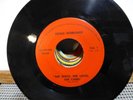
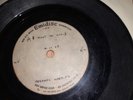
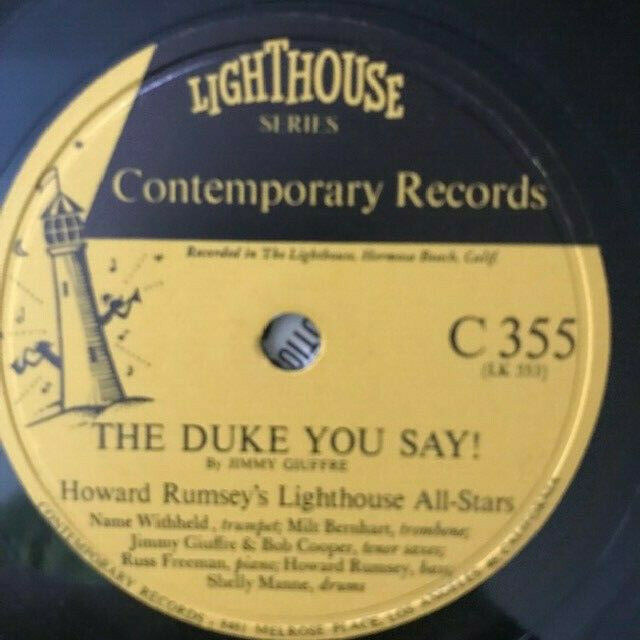
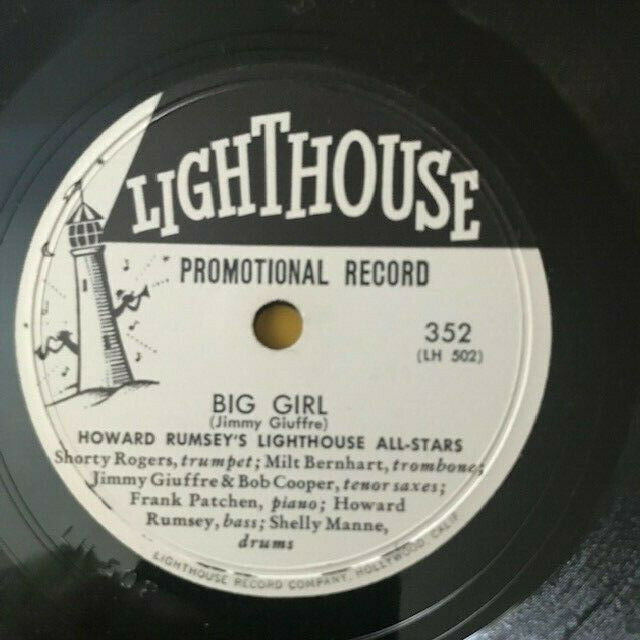
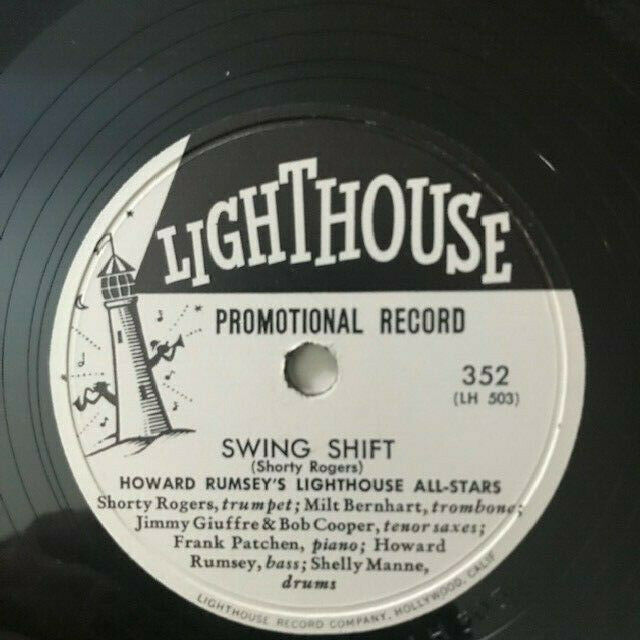
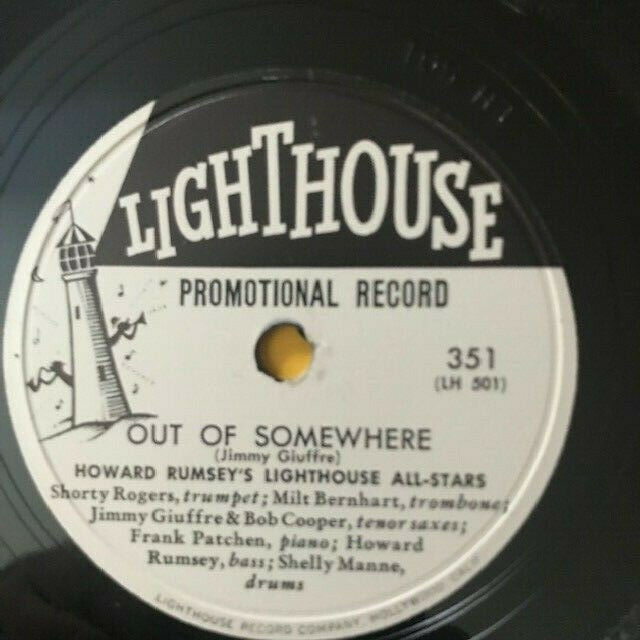
5 discs RARE JAZZ Shelly MAnne Contemporary Lighthouse 78 rpm
$
20
Favourite Auctions
To save auctions to your favourites, please login
If you don't have an account, please register
Description
Here's the list. These are all E_ or better--amazing sides. I do know how to properly ship 78s--check my feedback.
1. CONTEMPORARY RECORDS 354 Shelly Manne Mallets / La Mecura
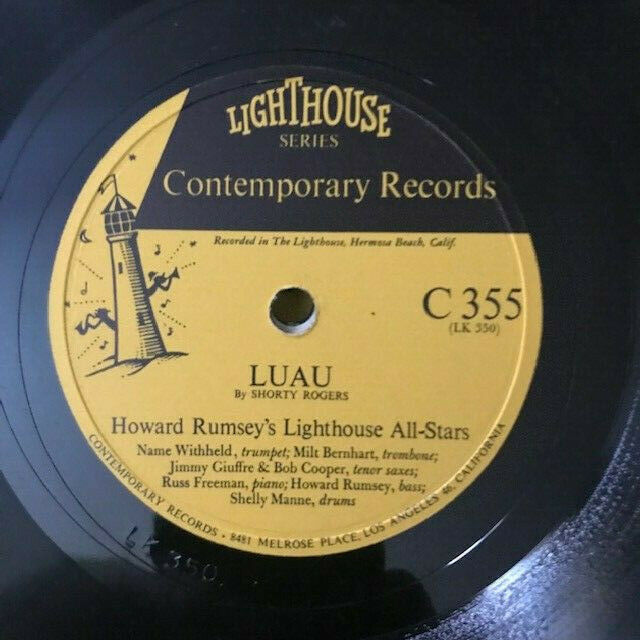
2. CONTEMPORARY RECORDS 357 Shelly Manne Fugue / Sweets 3. LIGHTHOUSE promo 351 Howard Rumsey's all stars Viva Zapata / Out of Somewhere 4. LIGHTHOUSE promo 352 Howard Rumsey's all stars Swing Shift / Big Girl 5. LIGHTHOUSE CONTEMPORARY 355 Howard Rumsey The duke you say / Luau
Shipping: $9
WIKIPEDIA:
The phonautograph, patented by Léon Scott in 1857, used a vibrating diaphragm and stylus to graphically record sound waves as tracings on sheets of paper, purely for visual analysis and without any intent of playing them back. In the 2000s, these tracings were first scanned by audio engineers and digitally converted into audible sound. Phonautograms of singing and speech made by Scott in 1860 were played back as sound for the first time in 2008. Along with a tuning fork tone and unintelligible snippets recorded as early as 1857, these are the earliest known recordings of sound.
In 1877, Thomas Edison invented the phonograph. Unlike the phonautograph, it could both record and reproduce sound. Despite the similarity of name, there is no documentary evidence that Edison's phonograph was based on Scott's phonautograph. Edison first tried recording sound on a wax-impregnated paper tape, with the idea of creating a "telephone repeater" analogous to the telegraph repeater he had been working on. Although the visible results made him confident that sound could be physically recorded and reproduced, his notes do not indicate that he actually reproduced sound before his first experiment in which he used tinfoil as a recording medium several months later. The tinfoil was wrapped around a grooved metal cylinder and a sound-vibrated stylus indented the tinfoil while the cylinder was rotated. The recording could be played back immediately. The Scientific American article that introduced the tinfoil phonograph to the public mentioned Marey, Rosapelly and Barlow as well as Scott as creators of devices for recording but, importantly, not reproducing sound.[13] Edison also invented variations of the phonograph that used tape and disc formats.[14][failed verification] Numerous applications for the phonograph were envisioned, but although it enjoyed a brief vogue as a startling novelty at public demonstrations, the tinfoil phonograph proved too crude to be put to any practical use. A decade later, Edison developed a greatly improved phonograph that used a hollow wax cylinder instead of a foil sheet. This proved to be both a better-sounding and far more useful and durable device. The wax phonograph cylinder created the recorded sound market at the end of the 1880s and dominated it through the early years of the 20th century.
Emile Berliner with disc record gramophoneLateral-cut disc records were developed in the United States by Emile Berliner (although Thomas Edison's original patent included flat disks), who named his system the "gramophone", distinguishing it from Edison's wax cylinder "phonograph" and American Graphophone's wax cylinder "graphophone". Berliner's earliest discs, first marketed in 1889, only in Europe, were 12.5 cm (approx 5 inches) in diameter, and were played with a small hand-propelled machine. Both the records and the machine were adequate only for use as a toy or curiosity, due to the limited sound quality. In the United States in 1894, under the Berliner Gramophone trademark, Berliner started marketing records of 7 inches diameter with somewhat more substantial entertainment value, along with somewhat more substantial gramophones to play them. Berliner's records had poor sound quality compared to wax cylinders, but his manufacturing associate Eldridge R. Johnson eventually improved it. Abandoning Berliner's "Gramophone" trademark for legal reasons, in 1901 Johnson's and Berliner's separate companies reorganized to form the Victor Talking Machine Company in Camden, New Jersey, whose products would come to dominate the market for many years.[15] Emile Berliner moved his company to Montreal in 1900. The factory, which became the Canadian branch of RCA Victor, still exists. There is a dedicated museum in Montreal for Berliner (Musée des ondes Emile Berliner).
In 1901, 10-inch disc records were introduced, followed in 1903 by 12-inch records. These could play for more than three and four minutes, respectively, whereas contemporary cylinders could only play for about two minutes. In an attempt to head off the disc advantage, Edison introduced the Amberol cylinder in 1909, with a maximum playing time of 4 1⁄2 minutes (at 160 rpm), which in turn were superseded by Blue Amberol Records, which had a playing surface made of celluloid, a plastic, which was far less fragile. Despite these improvements, during the 1910s discs decisively won this early format war, although Edison continued to produce new Blue Amberol cylinders for an ever-dwindling customer base until late in 1929. By 1919, the basic patents for the manufacture of lateral-cut disc records had expired, opening the field for countless companies to produce them. Analog disc records dominated the home entertainment market until they were outsold by digital compact discs in the 1980s, which were in turn supplanted by digital audio recordings distributed via online music stores and Internet file sharing.
78 rpm disc developments
Hungarian Pathé record, 90 to 100 rpmEarly speeds
Early disc recordings were produced in a variety of speeds ranging from 60 to 130 rpm, and a variety of sizes. As early as 1894, Emile Berliner's United States Gramophone Company was selling single-sided 7-inch discs with an advertised standard speed of "about 70 rpm".[16]
One standard audio recording handbook describes speed regulators, or governors, as being part of a wave of improvement introduced rapidly after 1897. A picture of a hand-cranked 1898 Berliner Gramophone shows a governor. It says that spring drives replaced hand drives. It notes that:
The speed regulator was furnished with an indicator that showed the speed when the machine was running so that the records, on reproduction, could be revolved at exactly the same speed...The literature does not disclose why 78 rpm was chosen for the phonograph industry, apparently this just happened to be the speed created by one of the early machines and, for no other reason continued to be used.[17]
A multinational product: an operatic duet sung by Enrico Caruso and Antonio Scotti, recorded in the US in 1906 by the Victor Talking Machine Company, manufactured c. 1908 in Hanover, Germany, for the Gramophone Company, Victor's affiliate in EnglandBy 1925, the speed of the record was becoming standardized at a nominal value of 78 rpm. However, the standard differed between places with alternating current electricity supply at 60 hertz (cycles per second, Hz) and those at 50 Hz. Where the mains supply was 60 Hz, the actual speed was 78.26 rpm: that of a 60 Hz stroboscope illuminating 92-bar calibration markings. Where it was 50 Hz, it was 77.92 rpm: that of a 50 Hz stroboscope illuminating 77-bar calibration markings.[18]
Acoustic recording
Early recordings were made entirely acoustically, the sound being collected by a horn and piped to a diaphragm, which vibrated the cutting stylus. Sensitivity and frequency range were poor, and frequency response was very irregular, giving acoustic recordings an instantly recognizable tonal quality. A singer almost had to put his or her face in the recording horn. A way of reducing resonance was to wrap the recording horn with tape.[19]
Lower-pitched orchestral instruments such as cellos and double basses were often doubled (or replaced) by louder instruments, such as tubas. Standard violins in orchestral ensembles were commonly replaced by Stroh violins, which became popular with recording studios.
Even drums, if planned and placed properly, could be effectively recorded and heard on even the earliest jazz and military band recordings. The loudest instruments such as the drums and trumpets were positioned the farthest away from the collecting horn. Lillian Hardin Armstrong, a member of King Oliver's Creole Jazz Band, which recorded at Gennett Records in 1923, remembered that at first Oliver and his young second trumpet, Louis Armstrong, stood next to each other and Oliver's horn could not be heard. "They put Louis about fifteen feet over in the corner, looking all sad."[20][21]
Electrical recording
An electronically recorded disc from Carl Lindström AG, Germany, c. 1930During the first half of the 1920s, engineers at Western Electric, as well as independent inventors such as Orlando Marsh, developed technology for capturing sound with a microphone, amplifying it with vacuum tubes, then using the amplified signal to drive an electromechanical recording head. Western Electric's innovations resulted in a broader and smoother frequency response, which produced a dramatically fuller, clearer and more natural-sounding recording. Soft or distant sounds that were previously impossible to record could now be captured. Volume was now limited only by the groove spacing on the record and the amplification of the playback device. Victor and Columbia licensed the new electrical system from Western Electric and began recording discs during the Spring of 1925. The first electrically recorded Red Seal record was Chopin's "Impromptus" and Schubert's "Litanei" performed by Alfred Cortot for Victor in Camden, New Jersey.[22]
A 1926 Wanamaker's ad in The New York Times offers records "by the latest Victor process of electrical recording".[23] It was recognized as a breakthrough; in 1930, a Times music critic stated:
... the time has come for serious musical criticism to take account of performances of great music reproduced by means of the records. To claim that the records have succeeded in exact and complete reproduction of all details of symphonic or operatic performances ... would be extravagant ... [but] the article of today is so far in advance of the old machines as hardly to admit classification under the same name. Electrical recording and reproduction have combined to retain vitality and color in recitals by proxy.[24]
Examples of Congolese 78 rpm records A 10-inch Decelith blank for making an individually cut one-off recording. A German product introduced in 1937, these flexible all-plastic discs were a European alternative to rigid-based lacquer (acetate) discs.Electrically amplified record players were initially expensive and slow to be adopted. In 1925, the Victor company introduced both the Orthophonic Victrola, an acoustical record player that was designed to play electrically recorded discs, and the electrically amplified Electrola. The acoustical Orthophonics were priced from US$95 to $300, depending on cabinetry. However the cheapest Electrola cost $650, in an era when the price of a new Ford Model T was less than $300 and clerical jobs paid around $20 a week.
The Orthophonic had an interior folded exponential horn, a sophisticated design informed by impedance-matching and transmission-line theory, and designed to provide a relatively flat frequency response. Its first public demonstration was front-page news in The New York Times, which reported:
The audience broke into applause ... John Philip Sousa [said]: '[Gentlemen], that is a band. This is the first time I have ever heard music with any soul to it produced by a mechanical talking machine' ... The new instrument is a feat of mathematics and physics. It is not the result of innumerable experiments, but was worked out on paper in advance of being built in the laboratory ... The new machine has a range of from 100 to 5,000 [cycles], or five and a half octaves ... The 'phonograph tone' is eliminated by the new recording and reproducing process.[25]
Gradually, electrical reproduction entered the home. The spring motor was replaced by an electric motor. The old sound box with its needle-linked diaphragm was replaced by an electromagnetic pickup that converted the needle vibrations into an electrical signal. The tone arm now served to conduct a pair of wires, not sound waves, into the cabinet. The exponential horn was replaced by an amplifier and a loudspeaker.
Sales of records declined precipitously during the Great Depression of the 1930s. RCA, which purchased the Victor Talking Machine Company in 1929, introduced an inexpensive turntable called the Duo Jr., which was designed to be connected to their radio sets. According to Edward Wallerstein (the general manager of RCA's Victor division), this device was "instrumental in revitalizing the industry".[26]
78 rpm materials
The earliest disc records (1889–1894) were made of variety of materials including hard rubber. Around 1895, a shellac-based material was introduced and became standard. Formulas for the mixture varied by manufacturer over time, but it was typically about one-third shellac and two-thirds mineral filler (finely pulverized slate or limestone), with cotton fibers to add tensile strength, carbon black for color (without which it tended to be an unattractive "dirty" gray or brown color), and a very small amount of a lubricant to facilitate release from the manufacturing press. Columbia Records used a laminated disc with a core of coarser material or fiber.
The production of shellac records continued throughout the 78 rpm era which lasted until the 1950s in industrialized nations, but well into the 1960s in others. Less abrasive formulations were developed during its waning years and very late examples in like-new condition can have noise levels as low as vinyl.[citation needed]
Flexible, "unbreakable" alternatives to shellac were introduced by several manufacturers during the 78 rpm era. Beginning in 1904, Nicole Records of the UK coated celluloid or a similar substance onto a cardboard core disc for a few years, but they were noisy. In the United States, Columbia Records introduced flexible, fiber-cored "Marconi Velvet Tone Record" pressings in 1907, but their longevity and relatively quiet surfaces depended on the use of special gold-plated Marconi Needles and the product was not successful. Thin, flexible plastic records such as the German Phonycord and the British Filmophone and Goodson records appeared around 1930 but not for long. The contemporary French Pathé Cellodiscs, made of a very thin black plastic resembling the vinyl "sound sheet" magazine inserts of the 1965–1985 era, were similarly short-lived. In the US, Hit of the Week records were introduced in early 1930. They were made of a patented translucent plastic called Durium coated on a heavy brown paper base. A new issue debuted weekly, sold at newsstands like a magazine. Although inexpensive and commercially successful at first, they fell victim to the Great Depression and US production ended in 1932. Durium records continued to be made in the UK and as late as 1950 in Italy, where the name "Durium" survived into the LP era as a brand of vinyl records. Despite these innovations, shellac continued to be used for the overwhelming majority of commercial 78 rpm records throughout the format's lifetime.
In 1931, RCA Victor introduced vinyl plastic-based Victrolac as a material for unusual-format and special-purpose records. One was a 16-inch, 33 1⁄3 rpm record used by the Vitaphone sound-on-disc movie system. In 1932, RCA began using Victrolac in a home recording system. By the end of the 1930s vinyl's light weight, strength, and low surface noise had made it the preferred material for prerecorded radio programming and other critical applications. For ordinary 78 rpm records, however, the much higher cost of the synthetic plastic, as well as its vulnerability to the heavy pickups and mass-produced steel needles used in home record players, made its general substitution for shellac impractical at that time.
During the Second World War, the United States Armed Forces produced thousands of 12-inch vinyl 78 rpm V-Discs for use by the troops overseas.[27] After the war, the use of vinyl became more practical as new record players with lightweight crystal pickups and precision-ground styli made of sapphire or an exotic osmium alloy proliferated. In late 1945, RCA Victor began offering "De Luxe" transparent red vinyl pressings of some Red Seal classical 78s, at a de luxe price. Later, Decca Records introduced vinyl Deccalite 78s, while other record companies used vinyl formulations trademarked as Metrolite, Merco Plastic, and Sav-o-flex, but these were mainly used to produce "unbreakable" children's records and special thin vinyl DJ pressings for shipment to radio stations.[28]
78 rpm disc sizes
In the 1890s, the diameter of the earliest (toy) discs was generally 12.5 cm (nominally 5 inches). By the mid-1890s, discs were usually 7 inches (nominally 17.5 cm) in diameter.
By 1910, the 10-inch (25 cm) record was by far the most popular standard, containing about three minutes of music or other entertainment on one side.
From 1903 onwards, 12-inch (30 cm) records were produced, mostly featuring classical music or operatic selections, with four to five minutes of music per side. Victor, Brunswick and Columbia also issued 12-inch popular medleys, usually spotlighting a Broadway show score.
An 8-inch (20 cm) disc with a 2-inch (50 mm)-diameter label became popular for about a decade[when?] in Britain, but those records cannot be played in full on most modern record players, because tonearms cannot track far enough toward the center of the record without modifying the equipment. In 1903, Victor offered a series of 14-inch (36 cm) "Deluxe Special" records, which played at 60 rpm and sold for two dollars. Fewer than fifty titles were issued, and the series was dropped in 1906, due to poor sales. Also in 1906, a short-lived British firm called Neophone marketed a series of single-sided 20-inch (50 cm) records, offering complete performances of some operatic overtures and shorter pieces. Pathé also issued 14-inch and 20-inch records around the same time.
78 rpm recording time
The playing time of a phonograph record depends on the available groove length divided by the turntable speed. Total groove length in turn depends on how closely the grooves are spaced, in addition to the record diameter. At the beginning of the 20th century, the early discs played for two minutes, the same as cylinder records.[29] The 12-inch disc, introduced by Victor in 1903, increased the playing time to three and a half minutes.[30] Because the standard 10-inch 78 rpm record could hold about three minutes of sound per side, most popular recordings were limited to that duration.[31] For example, when King Oliver's Creole Jazz Band, including Louis Armstrong on his first recordings, recorded 13 sides at Gennett Records in Richmond, Indiana, in 1923, one side was 2:09 and four sides were 2:52–2:59.[32]
In January 1938, Milt Gabler started recording for Commodore Records, and to allow for longer continuous performances, he recorded some 12-inch discs. Eddie Condon explained: "Gabler realized that a jam session needs room for development." The first two 12-inch recordings did not take advantage of their capability: "Carnegie Drag" was 3m 15s; "Carnegie Jump", 2m 41s. But at the second session, on April 30, the two 12-inch recordings were longer: "Embraceable You" was 4m 05s; "Serenade to a Shylock", 4m 32s.[33][34] Another way to overcome the time limitation was to issue a selection extending to both sides of a single record. Vaudeville stars Gallagher and Shean recorded "Mr. Gallagher and Mr. Shean", written by themselves or, allegedly, by Bryan Foy, as two sides of a 10-inch 78 in 1922 for Victor.[35] Longer musical pieces were released as a set of records. In 1903 HMV in England made the first complete recording of an opera, Verdi's Ernani, on 40 single-sided discs.[36] In 1940, Commodore released Eddie Condon and his Band's recording of "A Good Man Is Hard to Find" in four parts, issued on both sides of two 12-inch 78s. The limited duration of recordings persisted from their advent until the introduction of the LP record in 1948. In popular music, the time limit of 3 1⁄2 minutes on a 10-inch 78 rpm record meant that singers seldom recorded long pieces. One exception is Frank Sinatra's recording of Rodgers and Hammerstein's "Soliloquy", from Carousel, made on May 28, 1946. Because it ran 7m 57s, longer than both sides of a standard 78 rpm 10-inch record, it was released on Columbia's Masterwork label (the classical division) as two sides of a 12-inch record.[37] The same was true of John Raitt's performance of the song on the original cast album of Carousel, which had been issued on a 78-rpm album set by American Decca in 1945.
In the 78 era, classical-music and spoken-word items generally were released on the longer 12-inch 78s, about 4–5 minutes per side. For example, on June 10, 1924, four months after the February 12 premier of Rhapsody in Blue, George Gershwin recorded an abridged version of the seventeen-minute work with Paul Whiteman and His Orchestra. It was released on two sides of Victor 55225 and ran for 8m 59s.[38]
Record albums
78 rpm records were normally sold individually in brown paper or cardboard sleeves that were plain, or sometimes printed to show the producer or the retailer's name. Generally the sleeves had a circular cut-out exposing the record label to view. Records could be laid on a shelf horizontally or stood on an edge, but because of their fragility, breakage was common.
German record company Odeon pioneered the album in 1909 when it released the Nutcracker Suite by Tchaikovsky on 4 double-sided discs in a specially designed package.[36] However, the previous year Deutsche Grammophon had produced an album for its complete recording of the opera Carmen. The practice of issuing albums was not adopted by other record companies for many years. One exception, HMV, produced an album with a pictorial cover for its 1917 recording of The Mikado (Gilbert & Sullivan).
By about 1910,[note 1] bound collections of empty sleeves with a paperboard or leather cover, similar to a photograph album, were sold as record albums that customers could use to store their records (the term "record album" was printed on some covers). These albums came in both 10-inch and 12-inch sizes. The covers of these bound books were wider and taller than the records inside, allowing the record album to be placed on a shelf upright, like a book, suspending the fragile records above the shelf and protecting them.
In the 1930s, record companies began issuing collections of 78 rpm records by one performer or of one type of music in specially assembled albums, typically with artwork on the front cover and liner notes on the back or inside cover. Most albums included three or four records, with two sides each, making six or eight tunes per album. When the 12-inch vinyl LP era began in 1948, each disc could hold a similar number of tunes as a typical album of 78s, so they were still referred to as an "album", as they are today.
78 rpm releases in the microgroove era
For collectible or nostalgia purposes, or for the benefit of higher-quality audio playback provided by the 78 rpm speed with newer vinyl records and their lightweight stylus pickups, a small number of 78 rpm records have been released since the major labels ceased production. One attempt at this was in 1951, when inventor Ewing Dunbar Nunn founded the label Audiophile Records, which released a series of 78 rpm-mastered albums that were microgroove and pressed on vinyl (as opposed to traditional 78s, with their shellac composition and wider 3-mil sized grooves). This series came in heavy manilla envelopes and began with a jazz album AP-1 and was soon followed by other AP numbers up through about AP-19. Around 1953 the standard LP had proven itself to Nunn and he switched to 33 1⁄3 rpm and began using art slicks on a more standard cardboard sleeve. The Audiophile numbers can be found into the hundreds today but the most collectable ones are the early 78 rpm releases, especially the first, AP-1. The 78 rpm speed was mainly to take advantage of the wider audio frequency response that faster speeds like 78 rpm can provide for vinyl microgroove records, hence the label's name (obviously catering to the audiophiles of the 1950s "hi-fi" era, when stereo gear could provide a much wider range of audio than before). Also around 1953, Bell Records released a series of budget-priced plastic 7-inch 78 rpm pop music singles.[citation needed]
In 1968, Reprise planned to release a series of 78 rpm singles from their artists on their label at the time, called the Reprise Speed Series. Only one disc actually saw release, Randy Newman's "I Think It's Going to Rain Today", a track from his self-titled debut album (with "The Beehive State" on the flipside).[39] Reprise did not proceed further with the series due to a lack of sales for the single, and a lack of general interest in the concept.[40]
In 1978, guitarist and vocalist Leon Redbone released a promotional 78 rpm record featuring two songs ("Alabama Jubilee" and "Please Don't Talk About Me When I'm Gone") from his Champagne Charlie album.[41]
In 1980, Stiff Records in the United Kingdom issued a 78 by Joe "King" Carrasco containing the songs "Buena" (Spanish for "goo
of Fame.[citation needed]Manne's father and uncles were drummers. In his youth he admired many of the leading swing drummers of the day, especially Jo Jones and Dave Tough.[1] Billy Gladstone, a colleague of Manne's father and the most admired percussionist on the New York theatrical scene, offered the teenage Shelly tips and encouragement.[2] From that time, Manne rapidly developed his style in the clubs of 52nd Street in New York in the late 1930s and 1940s.[3] His first professional job with a known big band was with the Bobby Byrne Orchestra in 1940.[4] In those years, as he became known, he recorded with jazz stars like Coleman Hawkins, Charlie Shavers, and Don Byas. He also worked with a number of musicians mainly associated with Duke Ellington, like Johnny Hodges, Harry Carney, Lawrence Brown, and Rex Stewart.[5]
In 1942, during World War II, Manne joined the Coast Guard and served until 1945.[6]
In 1943, Manne married a Rockette named Florence Butterfield (known affectionately to family and friends as "Flip").[7] The marriage would last 41 years, until the end of Manne's life.
When the bebop movement began to change jazz in the 1940s, Manne loved it and adapted to the style rapidly, performing with Dizzy Gillespie and Charlie Parker.[8] Around this time he also worked with rising stars like Flip Phillips, Charlie Ventura, Lennie Tristano, and Lee Konitz.
Manne rose to stardom when he became part of the working bands of Woody Herman and, especially, Stan Kenton in the late 1940s and early 1950s, winning awards and developing a following at a time when jazz was the most popular music in the United States.[9] Joining the hard-swinging Herman outfit allowed Manne to play the bebop he loved. The controversial Kenton band, on the other hand, with its "progressive jazz", presented obstacles, and many of the complex, overwrought arrangements made it harder to swing.[10] But Manne appreciated the musical freedom that Kenton gave him and saw it as an opportunity to experiment along with what was still a highly innovative band.[11] He rose to the challenge, finding new colors and rhythms, and developing his ability to provide support in a variety of musical situations.[12]
In California
In the early 1950s, Manne left New York and settled permanently on a ranch in an outlying part of Los Angeles, where he and his wife raised horses. From this point on, he played an important role in the West Coast school of jazz, performing on the Los Angeles jazz scene with Shorty Rogers, Hampton Hawes, Red Mitchell, Art Pepper, Russ Freeman, Frank Rosolino, Chet Baker, Leroy Vinnegar, Pete Jolly, Howard McGhee, Bob Gordon, Conte Candoli, Sonny Criss, and numerous others.[13] Many of his recordings around this time were for Lester Koenig's Contemporary Records, where for a period Manne had a contract as an "exclusive" artist (that is, he needed permission to record for other labels).
Manne led a number of small groups that recorded under his name and leadership. One consisting of Manne on drums, trumpeter Joe Gordon, saxophonist Richie Kamuca, bassist Monty Budwig, and pianist Victor Feldman performed for three days in 1959 at the Black Hawk club in San Francisco. Their music was recorded on the spot, and four LPs were issued. Highly regarded as an innovative example of a "live" jazz recording,[14] the Black Hawk sessions were reissued on CD in augmented form years later.
West Coast jazz
Main article: West Coast jazzManne is often associated with the once frequently criticized West Coast school of jazz.[15] He has been considered "the quintessential" drummer in what was seen as a West Coast movement, though Manne himself did not care to be so pigeonholed.[16] In the 1950s, much of what he did could be seen as in the West Coast style: performing in tightly arranged compositions in what was a cool style, as in his 1953 album named The West Coast Sound, for which he commissioned several original compositions. Some of West Coast jazz was experimental, avant-garde music several years before the more mainstream avant-garde playing of Cecil Taylor and Ornette Coleman (Manne also recorded with Coleman in 1959); a good deal of Manne's work with Jimmy Giuffre was of this kind. Critics would condemn much of this music as overly cerebral.[17]
Another side of West Coast jazz that also came under critical fire was music in a lighter style, intended for popular consumption.[18] Manne made contributions here too. Best known is the series of albums he recorded with pianist André Previn and with members of his groups, based on music from popular Broadway shows, movies, and television programs. (The first and most successful of these was the My Fair Lady album based on songs from the musical, recorded by Previn, Manne, and bassist Leroy Vinnegar in 1956.) The recordings for the Contemporary label, with each album devoted to a single musical, are in a light, immediately appealing style aimed at popular taste. This did not always go over well with aficionados of "serious" jazz, which may be one reason why Manne has been frequently overlooked in accounts of major jazz drummers of the 20th century.[19] Much of the music produced on the West Coast in those years, as Robert Gordon concedes, was in fact imitative and "lacked the fire and intensity associated with the best jazz performances".[20] But Gordon also points out that there is a level of musical sophistication, as well as an intensity and "swing", in the music recorded by Manne with Previn and Vinnegar (and later Red Mitchell) that is missing in the many lackluster albums of this type produced by others in that period.[21]
West Coast jazz, however, represented only a small part of Manne's playing. In Los Angeles, and occasionally returning to New York and elsewhere, Manne recorded with musicians of all schools and styles, ranging from those of the swing era through bebop to later developments in modern jazz, including hard bop, usually seen as the antithesis to the cool jazz frequently associated with West Coast playing.[22]
Collaborations
Stan Kenton, Eddie Safranski, Shelly Manne, Chico Alvarez, Ray Wetzel, Harry Betts, Bob Cooper, and Art Pepper, 1947 or 1948From the 78-rpm recordings of the 1940s to the LPs of the 1950s and later, to the hundreds of film soundtracks he appeared on, Manne's recorded output was enormous and often hard to pin down.[23] According to the jazz writer Leonard Feather, Manne's drumming had been heard on well "over a thousand LPs"—a statement that Feather made in 1960, when Manne had not reached even the midpoint of his 45-year-long career.[24]
An extremely selective list of those with whom Manne performed includes Benny Carter, Earl Hines, Clifford Brown, Zoot Sims, Ben Webster, Maynard Ferguson, Wardell Gray, Lionel Hampton, Junior Mance, Jimmy Giuffre, and Stan Getz. In the 1950s, he recorded two solid albums with Sonny Rollins—Way Out West (Contemporary, 1957) received particular acclaim and helped dispel the notion that West Coast jazz was always different from jazz made on the East Coast[25]—and, in the 1960s, two with Bill Evans. Around the same time in 1959, Manne recorded with the traditional Benny Goodman and the iconoclastic Ornette Coleman, a striking example of his versatility.
One of Manne's most adventurous 1960s collaborations was with Jack Marshall, the guitarist and arranger celebrated for composing the theme and incidental music for The Munsters TV show in that period. Two duet albums (Sounds Unheard Of!, 1962, and Sounds!, 1966) feature Marshall on guitar, accompanied by Manne playing drums and a wide variety of percussion instruments unusual in jazz, from "Hawaiian slit bamboo sticks", to a Chinese gong, to castanets, to piccolo Boo-Bam.
Another example of Manne's ability to transcend the narrow borders of any particular school is the series of trio albums he recorded with guitarist Barney Kessel and bassist Ray Brown as "The Poll Winners". (They had all won numerous polls conducted by the popular publications of the day; the polls are now forgotten,[26] but the albums endure, now reissued on CD.) Manne even dabbled in Dixieland and fusion, as well as "Third Stream" music. He participated in the revival of that jazz precursor ragtime (he appears on several albums devoted to the music of Scott Joplin), and sometimes recorded with musicians best associated with European classical music. He always, however, returned to the straight-ahead jazz he loved best.
Style and influences
In addition to Dave Tough and Jo Jones, Manne admired and learned from contemporaries like Max Roach and Kenny Clarke, and later from younger drummers like Elvin Jones and Tony Williams. Consciously or unconsciously, he borrowed a little from all of them, always searching to extend his playing into new territory.[27]
Despite these and numerous other influences, however, Shelly Manne's style of drumming was always his own—personal, precise, clear, and at the same time multilayered,[28] using a very broad range of colors.[29] Manne was often experimental, and had participated in such musically exploratory groups of the early 1950s as those of Jimmy Giuffre and Teddy Charles.[30] Yet his playing never became overly cerebral, and he never neglected that element usually considered fundamental to all jazz: time.[31]
Whether playing Dixieland, bebop, or avant-garde jazz, in big bands or in small groups, Manne's self-professed goal was to make the music swing.[32] His fellow musicians attested to his listening appreciatively to those around him and being ultra-sensitive to the needs and the nuances of the music played by the others in the band,[33] his goal being to make them—and the music as a whole—sound better, rather than calling attention to himself with overbearing solos.[34]
Manne refused to play in a powerhouse style, but his understated drumming was appreciated for its own strengths. In 1957, critic Nat Hentoff called Manne one of the most "musical" and "illuminatively imaginative" drummers.[35] Composer and multi-instrumentalist Bob Cooper called him "the most imaginative drummer I've worked with".[36] In later years this kind of appreciation for what Manne could do was echoed by jazz notables like Louie Bellson, John Lewis, Ray Brown, Harry "Sweets" Edison, and numerous others who had worked with him at various times. Composer, arranger, bandleader, and multi-instrumentalist Benny Carter was "a great admirer of his work". "He could read anything, get any sort of effect", said Carter, who worked closely with Manne over many decades.[37]
Though he always insisted on the importance of time and "swing", Manne's concept of his own drumming style typically pointed to his melody-based approach.[38] He contrasted his style with that of Max Roach: "Max plays melodically from the rhythms he plays. I play rhythms from thinking melodically".[39]
Manne had strong preferences in his choice of drum set. Those preferences, however, changed several times over his career. He began with Gretsch drums. In 1957, intrigued by the sound of a kind of drum made by Leedy (then owned by Slingerland), he had a line made for him that also became popular with other drummers. In the 1970s, after trying and abandoning many others for reasons of sound or maintainability, he settled on the Japanese-made Pearl Drums.[40]
Singers
Manne was also acclaimed by singers. Jackie Cain, of the vocal team of Jackie and Roy ("Roy" being Roy Kral), claimed that she had "never heard a drummer play so beautifully behind a singer".[41] Jackie and Roy were only two of the many singers he played behind, recording several albums with that husband-and-wife team, with their contemporary June Christy,[42] and with Helen Humes, originally made famous by her singing with the Count Basie orchestra.
Over decades, Manne recorded additional albums, or sometimes just sat in on drums here and there, with renowned vocalists like Ella Fitzgerald,[43] Mel Tormé,[44] Peggy Lee, Frank Sinatra, Ernestine Anderson,[45] Sarah Vaughan,[46] Lena Horne,[47] Blossom Dearie,[48] and Nancy Wilson.[49] Not all the singers Manne accompanied were even primarily jazz artists. Performers as diverse as Teresa Brewer,[50] Leontyne Price,[51] Tom Waits,[52] and Barry Manilow[53] included Manne in their recording sessions.
Film and television
At first, jazz was heard in film soundtracks only when a jazz-band performance was an element of the story. Early in his career, Manne was occasionally seen and heard in the movies, for example in the 1942 film Seven Days Leave, as the drummer in the highly popular Les Brown orchestra (soon to be known as "Les Brown and His Band of Renown").
In the 1950s, however, jazz began to be used for all or parts of film soundtracks, and Manne pioneered in these efforts, beginning with The Wild One (1953). As jazz quickly assumed a major role in the musical background of films, so did Manne assume a major role as a drummer and percussionist on those soundtracks. A notable early example was 1955's The Man with the Golden Arm; Manne not only played drums throughout but functioned as a personal assistant to director Otto Preminger and tutored star Frank Sinatra.[54] The Decca soundtrack LP credits him prominently for the "Drumming Sequences".
From then on, as jazz became more prominent in the movies, Manne became the go-to percussion man in the film industry;[55] he even appeared on screen in some minor roles. A major example is Johnny Mandel's jazz score for I Want to Live! in 1958.[56]
Soon, Manne began to contribute to film music in a broader way, often combining jazz, pop, and classical music. Henry Mancini in particular found plenty of work for him; the two shared an interest in experimenting with tone colors, and Mancini came to rely on Manne to shape the percussive effects in his music. Breakfast at Tiffany's (1961), Hatari! (1962) and The Pink Panther (1963) are only a few of Mancini's films where Manne's drums and special percussive effects could be heard.
Manne frequently collaborated with Mancini in television as well, such as in the series Peter Gunn (1958–1961) and Mr. Lucky (1959–1960). Although Mancini developed such a close partnership with Manne that he was using him for practically all his scores and other music at this time,[57] the drummer still found time to perform on movie soundtracks and in TV shows with music by others, including the series Richard Diamond (music by Pete Rugolo, 1959–1960), and Checkmate (music by John Williams, 1959–1962), and the film version of Leonard Bernstein's West Side Story (1961).
In the late 1950s, Manne began to compose his own film scores, such as that for The Proper Time (1959), with the music also played by his own group, Shelly Manne and His Men, and issued on a Contemporary LP. In later years, Manne divided his time playing the drums on, adding special percussive effects to, and sometimes writing complete scores for both film and television. He even provided a musical setting for a recording of the Dr. Seuss children's classic Green Eggs and Ham (1960) and later performed in and sometimes wrote music for the backgrounds of numerous animated cartoons. For example, he joined other notable jazz musicians (including Ray Brown and Jimmy Rowles) in playing Doug Goodwin's music for the cartoon series The Ant and the Aardvark (1969–1971).[58] Notable examples of later scores that Manne wrote himself and also performed in are, for the movies, Young Billy Young (1969) and Trader Horn (1973), and, for television, Daktari, 1966–1969. With these and other contributions to cartoons, children's stories, movies, television programs (and even commercials), Manne's drumming became woven into the popular culture of several decades.[59]
Later career
A star in Stan Kenton's famous orchestra in the 1940s and 1950s, as well as that of Woody Herman, also in the 1940s, and winner of numerous awards, Manne slipped from public view as jazz became less central in popular music.[60] In the 1960s and early 1970s, however, he helped keep jazz alive on the Los Angeles scene as part owner of the nightclub Shelly's Manne-Hole on North Cahuenga Boulevard.[61] There, the house band was Shelly Manne and His Men, which featured some of his favorite sidemen, such as Russ Freeman, Monty Budwig, Richie Kamuca, Conte Candoli, and later Frank Strozier, John Morell, and Mike Wofford, among many other notable West Coast jazz musicians. Also appearing at the club was a roster of jazz stars from different eras and all regions, including Ben Webster, Rahsaan Roland Kirk, Les McCann, Bill Evans, John Coltrane, Sonny Stitt, Thelonious Monk, Michel Legrand, Carmen McRae, Milt Jackson, Teddy Edwards, Monty Alexander, Lenny Breau, Miles Davis, and many, many others. Stan Getz was the last to be featured (at a briefly occupied second location at Tetou's restaurant on Wilshire Boulevard), when, late in 1973, Manne was forced to close the club for financial reasons.[62]
From that point, Manne refocused his attention on his own drumming. It might be argued that he never played with more taste, refinement, and soulful swing than in the 1970s,[63] when he recorded numerous albums with musicians like trumpeter Red Rodney, pianist Hank Jones, saxophonists Art Pepper and Lew Tabackin, and composer-arranger-saxophonist Oliver Nelson.[64]
From 1974 to 1977 he joined guitarist Laurindo Almeida, saxophonist and flutist Bud Shank, and bassist Ray Brown to perform as the group The L.A. Four, which recorded four albums before Manne left the ensemble.
In the 1980s, Manne recorded with such stars as trumpeter Harry "Sweets" Edison, saxophonist Zoot Sims, guitarists Joe Pass and Herb Ellis, and pianist John Lewis (famous as the musical director of the Modern Jazz Quartet).
Meanwhile, he continued to record with various small groups of his own. Just one representative example of his work in this period is a live concert recorded at the Los Angeles club "Carmelo's" in 1980 with pianists Bill Mays and Alan Broadbent and bassist Chuck Domanico. With their enthusiasm and spontaneity, and the sense that the audience in the intimate ambience of the club is participating in the music, these performances share the characteristics that had been celebrated more than two decades before in the better-known Black Hawk performances.[65] Although this phase of his career has frequently been overlooked, Manne, by this time, had greatly refined his ability to back other musicians sympathetically, yet make his own musical thoughts clearly heard.[66]
Manne's heavy load of Hollywood studio work sometimes shifted his attention from his mainstream jazz playing. Even in lackluster films, however, he nevertheless often succeeded in making art of what might be called hackwork.[67] Still, for all his tireless work in the studios, Manne's labor of love was his contribution to jazz as an American art form, to which he had dedicated himself since his youth and continued to work at almost to the last day of his life.[68]
Manne died somewhat before the popular revival of interest in jazz had gained momentum. But in his last few years, his immense contribution to the music regained at least some local recognition, and the role Manne had played in the culture of his adopted city began to draw public appreciation.[69] Two weeks before his sudden death of a heart attack, he was honored by the City of Los Angeles in conjunction with the Hollywood Arts Council when September 9, 1984 was declared "Shelly Manne Day".[70]
Discography
Main article: Shelly Manne discographyprice rating
![Bright Wynter - Words Of Fire [Fullfilment Of Prophecy] ? VG-](https://www.popsike.org/php/thumbnail.php?url=https://www.popsike.pics/pix/20160605/282058636453.jpg)