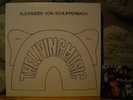
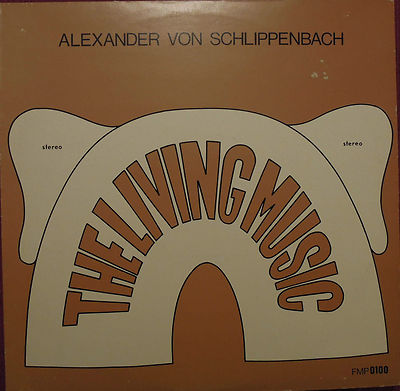
ALEXANDER VON SCHLIPPENBACH "The Living Music" FMP 0100
C$
52
$
37


Favourite Auctions
To save auctions to your favourites, please login
If you don't have an account, please register
Description
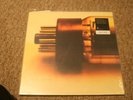
Minor cover damage where price sticker removed the cover's finish... vinyl is in mint condition.
Track Listing: The Living Music; Into The Staggerin; Wave; Tower; Lollopalooza; Past Time.
Personnel: Peter Brotzmann: tenor and baritone saxophone; Michel Pilz: bass clarinet, baritone saxophone; Manfred Schoof: cornet, flugelhorn; Paul Rutherford: trombone; Alexander von Schlippenbach: piano, percussion; J. B. Niebergall: bass, bass trombone; Han Bennink: drums, percussion.
“When this session was done, everyone needed a shower. There's no doubt about that. The Living Music lives and breathes at such a high level of intensity (and coherence) that it must have brought these seven European free improvisers to sheer exhaustion that long, productive afternoon almost exactly 24 years ago in Köln (1972)….
Belonging is a relative concept, of course, and when free spirits fly together, they nudge and jostle enough to make order an impossibility. A few hints appear here and there, compositional aspects of these pieces that allude to formal structure. Manfred Schoof's pieces "Wave" and "Past Time" are remarkable in this regard. The leader's "Into the Staggerin" dwells briefly on a warm, full- bodied group theme before it swings off into the abyss. Drummer Han Bennink, omnipresent on the record, gets a rare opportunity to ride the beat, implying broken triplets on the cymbals while he engages in a little Max Roach action on the snare.
But not for long, because Peter Brötzmann gets his noodle in the horn and starts blowing so hard you think his brain is going to explode. (Yes, typical behavior at the time. Apparently his skull was very thick.) Little punchy rifflets, overblown and sharp, along with some unknown human voice howling strangely in the background. After two and a half minutes, the band stops playing completely while Brotzmann plateaus. Not content with one simple orgasm, he pauses only a moment before shooting off again. Riffing in pulse-like fashion, he hits the sky and falls back to earth. Seconds after the piece is over, we're all back on the horse again and the full unit comes back into play.
Schlippenbach seems content to play more of a catalytic, egalitarian role in the group, rather than riding out front on his instrument, though he's definitely not shy. He gets credit for half of these compositions, two of which (the title track and "Tower") are gargantuan in scale. While formal organization helps ground the group now and then, these players clearly feel most comfortable in the range where rules rarely apply, where the little children can come out and play. That means the longer pieces tend to work the best. "Tower" in particular has a sprawling sense of scale.
There's a strong vibe here of the European free big band tradition. Seven players, when they're as forward as this group, pretty much comprise a big band anyway. It makes little sense to single out individuals, except of course for Bennink (whose constant energy pulls everyone forward) and Brötzmann (whose voice is so singularly emphatic that it's impossible to ignore). The rest form a group, a like-minded collective that agrees to disagree.”
– By NILS JACOBSON, Published: May 1, 2003 AllAboutJazz
price rating