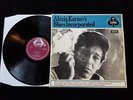
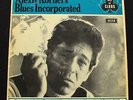
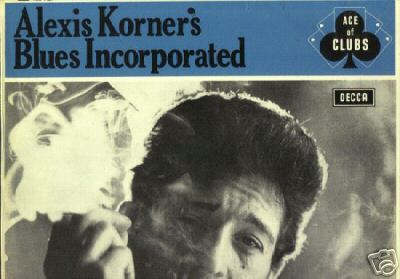
ALEXIS KORNER'S BLUES INCORPORATED LP ACE OF CLUBS 1965
£
105
$
139


Favourite Auctions
To save auctions to your favourites, please login
If you don't have an account, please register
Description
ALEXIS KORNER'S BLUES INCORPORATED
Ace Of Clubs Mono ACL 1187 (1965)
Original sleeve note from Alexis Korner Blues Incorporated L.P.
People have a habit of getting set in their ideas. Once it was de rigeur to imagine that the only worthwhile jazz was blown – and in odd moments, too – by manual labourers in Louisiana. An equally romantic legend nowadays bids us think of blues as indissolubly wedded to guitars and harmonicas and the grittier species of singer. All the more reason, therefore, to welcome the defiantly individual rejoinder provided by the music of Alexis Korner's Blues Incorporated. The original Blues Incorporated – which virtually began British rhythm-and-blues when it opened the Ealing Club on St. Patrick's Day, 1962 – included a harmonica player, and a very fine one too, in the person of Cyril Davies. Yet even at the start Alexis Korner was determined to use jazz players, especially very modern jazz musicians. "They're the ones who get that shout inside their music," he says, "And after all it's not the instrument that matters, it's the player." Ever since Cyril Davies left the group in the autumn of 1962, Alexis has been the only member who came out of country blues rather than jazz. Yet the sound, the tilt of country blues still runs through all his music. Indeed, one of the aims of this particular LP was to deploy avant-grade jazz against that grass-roots sound. The music was recorded at three sessions during the summer of 1963. On saxophones were Dick Heckstall-Smith and Art Themen, both, at different times, members of prize-winning Cambridge University Jazz Bands. (Even more importantly, they happen to be two of the finest and most trenchant saxophonists that Britain has produced.) Johnny Parker is best known for his long stint as pianist with Humphrey Lyttelton's band, although his work here may surprise aficionados who remember him only in that setting. Mike Scott, a Mancunian, played bass, while the drummer was Phil Seamen, without doubt one of the greatest jazz musicians to be found anywhere in Europe. Three days before the first session, Alexis Korner got out his guitar and sat down before a tape-recorder. Between midnight and dawn he worked out nine of the compositions heard on this LP. They are quite startlingly diverse. He describes Blue Mink as "really a country blues, but dedicated to Monk and Mingus", yet the piece builds up like a pyramid. There are five choruses in all, the first and last being ten bars long. The one right in the middle – Chorus No.3, in other words – lasts for twelve bars and has the two tenor saxists weaving round one another, using different root-lines. On either side – Choruses 2 and 4 – are eleven-bar sequences. The final seven bars of the former (yes, you really do need pencil and paper) are played by Dick Heckstall-Smith, while Art Themen pops up in the corresponding passage of the latter.
Yogi – named, of course, after the universal bear, - is every bit as unorthodox. The theme – 20 bars long, in 3/4 time – is a stretched-out blues sequence, with Themen playing the first tenor solo and Heckstall-Smith heard after the piano-and-guitar duet.
Rainy Tuesday (a sort of sequel to Stormy Monday) and Navy Blue are straightforward twelve-bar blues. The former has Art Themen playing a solo on his white plastic alto saxophone (it looks just the same as Ornette Coleman's) and also contains one of Alexis Korner's rare guitar solos. Another guitar solo – probably the finest Alexis has put on record – occurs in Sappho, a 32-bar tune named after the bandleader's daughter. As for Royal Dooji, a twelve-bar blues, this lopes along in 4/4 time but has Dick Heckstall-Smith moving on top in 3/4 and 6/8.
Preachin' The Blues, adapted from a 1936 recording by the obscure yet superb blues-singer Robert Johnson, is decidedly offbeat. "You might call it a Mississippi blues gone Greek", explains Korner, for on this track he plays bouzouki, a Middle Eastern instrument which looks, as he puts it, "rather like a pear cut in half". The unique reverberations are created by using the blues guitarist's "bottle-neck" technique, although the object which Alexis slides along the strings was actually a door-key picked up off the studio floor. The 22-bar theme is played in 8/8 time over Phil Seamen's 12/4 and 12/8 ("It's basically African drumming"), while the tenor saxophonists pitch a quarter-tone apart, aiming at a certain ambiguity. The Captain's Tiger enshrines an arcane piece of information, for this, it appears, was the name given aboard the old sailing ships to the special steward who waited on the captain, and who wore a yellow-and-black striped jumper or waistcoat. The composition itself, a twelve-bar blues, is basically in 3/4 time, but the theme and the soloist – in this case, Art Themen – coast along in 9/8.
A Little Bit Groovy and Chris Trundle's Habit were both written by Johnny Parker. The former (which has Alexis and the two reed players sitting out) is a twelve-bar blues, but Chris Trundle's Habit (the title was inspired by a fragment of graffiti discovered in the Thames Valley area) opens with a 16-bar section, followed by a middle-eight and a final eight, and includes a sequence of "fours" by Phil Seamen and both saxophonists. (The first man off the mark is Art Themen). Anything Fro Now, conceived and executed by Dick Heckstall-Smith, might be called an oblique genuflection towards Sindney Bechet, the saxophonist's first great hero. The LP ends with Trundin', best described as a blues pushed along four bars. (It begins with the subdominant and ends in the tonic.) Once again the tenor soloist is Dick Heckstall-Smith. Sleeve-notes that explain too much are likely to put the more timid customers off. Yet the performances on this record deserve some kind of analysis – and knowing how the pieces work ought to add to the enjoyment. Still, it should be emphasised over and over again that the music is essentially emotional, essentially passionate. Experiment, after all, need never rule out excitement. What Alexis Korner has done here is to reveal the blues in yet a few more of its many guises. And underneath everything is the rock-hard integrity of musicians who are involved in what they play. "A blues player," says Alexis, "has got a blues feeling whatever he does. That's what really counts."
1. Blue Mink (Korner) 3:26
2. Rainy Tuesday (Korner) 4:19
3. Yogi (Korner) 2:43
4. Sappho (Korner) 2:55
5. Navy Blue (Korner) 2:45
6. Royal Dooji (Korner) 3:09
7. Preachin' The Blues (Trad.Arr.Korner) 2:17
8. The Captain's Tiger (Korner) 2:15
9. A Little Bit Groovy (Parker) 2:46
10. Anything For Now (Heckstall-Smith) 2:42
11. Chris Trundle's Habit (Parker) 2:30
12. Trundlin' (Korner) 2:14
Alexis Korner: electric guitar (except for 7,9,11), bouzouki (7), vocal
Dick Heckstall-Smith: tenor saxophone (except for 9)
Art Themen: tenor saxophone (except for 2,9,10), alto saxophone (2)
Johnny Parker: piano (except for 7)
Mike Scott: string bass (except for 7)
Phil Seamen: drums
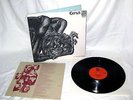
The vinyl is near mint. Not a mark on it.
The sleeve is also in superb condition, with just the slightest wear at the edges & corners (korners?), & the laminate is coming away from the card very slightly at the spine.
All in all & really lovely copy.