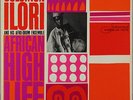
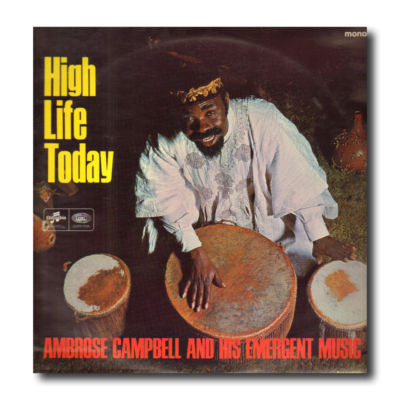
AMBROSE CAMPBELL HIGH LIFE TODAY V RARE 1966 AFRICAN MUSIC LP FELA KUTI NIGERIA
$
160


Favourite Auctions
To save auctions to your favourites, please login
If you don't have an account, please register
Description
AMBROSE CAMPBELL~HIGH LIFE TODAY~V RARE 1966 AFRICAN MUSIC LP~FELA KUTI~NIGERIA
Click to Enlarge Click to Enlarge Click to Enlarge Click to EnlargeDescription :
EXTREMELY RARE COLUMBIA NIGERIAN PRESSING FROM THE 1960s! TRADITIONAL LAMINATED COVER IS IN EXCELLENT CONDITION WITH LIGHT WEAR. VINYL IS IN VG++/EXCELLENT CONDITION WITH LIGHT SURFACE WEAR AND A FEW SPINDLE MARKS.
THIS IS THE ONLY COPY OF THE ALBUM THAT WE COULD FIND ON THE INTERNET! THIS MAY TRULY BE YOUR ONLY CHANCE TO ACQUIRE THIS LP! NOT AVAILABLE ON CD!
Nigerian musician whose career took in the postwar Soho of Colin MacInnes, Nashville - and Leon Russell
As a boy in Nigeria, Ambrose Campbell, sang in the church choir and grew up - the son of a minister - under a strict Victorian regime. But after dark he escaped, slipping out to the Lagos waterfront where seamen gathered from along the coast, sharing experiences, drinking palm wine. These travellers brought musical influences from across the world. They played guitars, mandolins and drums, and eventually the youngster joined them, beating rhythms on a tin can. He disguised his identity - he had been christened Oladipupo Adekoya Campbell - as Ambrose but failed to escape the wrath of his father for whom playing music made his son a beggar, worthy only of rejection.
In his teens he found refuge at the residence of Herbert Macaulay, the father of Nigerian nationalism. Playing tambourine with friends, he entertained drinkers, then, at 16, began work as a printer.
The sea promised better. He signed up with the Elder Dempster Line and sailed into the second world war. He saw a blacked-out Liverpool as bombs were falling and was nervous, but on a second voyage he jumped ship and moved to London. There would be another trip, to South America, but Campbell was slight of stature and unable to keep up with the demands of carrying coal to the stokers. Discharged, he was happy to settle ashore, whatever the problems.
While some Londoners welcomed the "dusky strangers" in their midst, others were abusive. But for every one who spurned the Africans, there were well-wishers and lovers who fed and embraced them. He formed a relationship with Ida Gould, a waitress from Plymouth, although whenever he joined other Nigerians to drink and play music, her friends mocked their "jungle rhythms". He assembled a band in response to these taunts, and on VE Day, this ad hoc mix of students and seamen joined the Piccadilly celebrations, making their mark as Londoners.
With guitarist Brewster Hughes, he formed a professional band to accompany Britain's first black ballet company, Les Ballets Nègres. They toured Britain in 1946 to great acclaim and were befriended by the likes of George Bernard Shaw and Aneurin Bevan. The Chelsea and Hampstead arts balls followed.
By the late 1940s they had appeared on television, but away from the spotlight, conditions were grim. With racism limiting accommodation, interracial relationships made finding rooms even harder. For a year Campbell lived in a condemned house with Ida, and bongoeist Ade Bashorun, sharing a basement still being used as a coal cellar.
Campbell, an occasional guitarist, improved when he took lessons from the Trinidadian Lauderic Caton. Hughes was the West African Rhythm Brothers' main soloist, an accomplished guitarist and the group's spokesman, but Campbell's mellow voice self-selected him for leadership. This was problematic. Yoruba society requires deference to elders and Hughes, the older man, had more years in Britain. The two men were rivals for female attention too, and as Campbell played more guitar, rifts developed.
By the 1950s the WARB were ubiquitous figures in jazz circles and Campbell a much-loved figure. Traditionalists delighted in their African authenticity while progressives, saxophonists Ronnie Scott and Kenny Graham among them, recognised their affinity with the race-conscious Afro-Cuban movement. Drummer Phil Seamen was one of the band's greatest fans. He studied their rhythms, later to pass on what he learnt to John Stevens, Ginger Baker and another percussion generation.
At the Abalabi, a Berwick Street cellar run by the Nigerian Ola Dosunmu and his English wife, record collectors rubbed shoulders with debutantes and diplomats, attracted to the rhythmic and cultural diversions. Campbell defied convention by using a piano and employing Caribbean hornmen, and entertained many of the louche Soho-ites associated with the Colony Room drinking club. Colin MacInnes, godfather to one of his sons, included Campbell in his 1957 novel, City of Spades, and Daniel Farson photographed Abalabi dancers.
While the band recorded prolifically, their incomes remained modest. As day-jobs sapped musicians' energy, the personnel fluctuated, but in 1957, Hughes and Campbell were reunited for a Nigerian visit. The occasion was home rule for the western region, a precursor to national independence, and should have been a triumph, but Campbell became ill. While Bashorun struggled to keep the musicians together, Hughes returned to England and formed a new band. Soon afterwards, the Dosunmus moved their operation to Wardour Street, opening the upmarket Club Afrique. Campbell remained their favourite resident attraction.
In the 1960s, Campbell, after taking a new band to Italy, formed a production company with the help of Lord Goodman. Then in 1972, he moved to the US. Record producer Denny Cordell, a longtime admirer, persuaded Campbell to join him in an enterprise with Leon Russell, the white Oklahoman soulman, and, while waiting for their studio to be completed, Russell took Campbell on the road, playing percussion. They toured Australia and the far east but, following an acrimonious parting between Cordell and Russell, Campbell followed the singer to Los Angeles.
In 1982 he moved to Nashville, still touring with Russell, who named the Nigerian his "spiritual adviser", while composing music which he recorded for his own pleasure. He married and started another family and in 2004, he returned to England and settled in Plymouth. There he displayed a gold disc for his part in the Willie Nelson/Leon Russell million-seller, One for the Road, and enchanted visitors with his eloquence and live-and-let-live philosophy.
Campbell was an interviewer's dream, patient, thoughtful, with a remarkable memory, and we spoke often by phone. Last year saw a CD compilation of his early recordings. He was elated by this renewal of interest and to know that his music had stood the test of time.
In his final illness, he was cared for by his eldest child, Dawn. She, another daughter and three sons survive him.
· Oladipupo Adekoya (Ambrose) Campbell, musician, born August 19 1919; died June 22 2006.
The image included with the auction is a scan of the actual item but, due to size limitations of the scanner, the edges of the item may have been cropped.
If you have questions, BEFORE you buy, email us.
In Your Ear has been selling music to the masses since 1982. We carry new and used LPs, CDs, DVDs, 45s, 12" singles, posters and who-knows-what-else! We have 2 physical locations in Massachusetts and 1 in Rhode Island:
957 Commonwealth Avenue, Boston, MA. 02215
72 Mt. Auburn Street, Cambridge, MA. 02138
462 Main Street, Warren, RI 02885
SHIPPING PRICES ARE AUTOMATICALLY CALCULATED BASED ON YOUR GEOGRAPHIC LOCATION. PLEASE NOTE: WE PACK OUR LPs WITH LOTS OF ADDED PADDING, USING OTHER EMPTY LPs SLEEVES TO REINFORCE THE MAILER AND PROTECT THE ITEM BEING SHIPPED. THIS ADDS CONSIDERABLY TO THE WEIGHT AND, THEREFORE, TO THE COST OF SHIPPING.
RECORD GRADING POLICY
MINT = like new or near new with only one or two small insignificant defects, a 9 or better on a 1-10 scale
EXCELLENT = Would be Near Mint, except for a couple of light hairlines or scuffs, which do not affect play
VG++ = still a very nice record with all or nearly all of its original gloss but may have a few more light, surface marks, hairlines, needle tracks or the like which should not materially affect play
VG+ = a nice, but used record that may have a series of light scuffs or scratches. It probably plays with a few pops, but has no serious problems.
VG = a well-used record that still should sound OK when played, but may have moderate surface noise, pops, etc.
VG- = a very well-worn record that plays through without skipping, but will do until a better copy comes along.
Good = not actually good at all but probably will play through but with much in the way of surface noise, pops, crackles, etc. Still, will have no cracks, chips or the like
Fair = you are getting this record just to own but not to play
Poor = the sky's the limit, generally I will discard a record this bad (and sell the cover, jacket or sleeve alone) unless the label holds some particular interest
For listings for our Boston/Cambridge stores, CLICK HERE.
For additional listings for our Rhode Island store, CLICK HERE.
Don't forget to visit our "About Me" page to find out lots more about our online and retail stores!
Bid with confidence at In Your Ear! Check out our customer feedback. CLICK HERE!
Shipping :
IN YOUR EAR SHIPS ITEMS 5 DAYS A WEEK. IN MOST CASES, WE SHIP ITEMS WITHIN 3 DAYS OF PAYMENT. YOUR ITEM'S ARRIVAL DATE WILL VARY DEPENDING UPON YOUR CHOSEN SHIPPING METHOD AND YOUR LOCATION.
DUE TO SLOW SHIPPING RATES OUTSIDE THE U.S., OVERSEAS CUSTOMERS MUST AGREE TO WAIT UP TO 60 DAYS BEFORE FILING A CLAIM.
ALL PACKAGES BEING SENT TO ITALY MUST BE SENT BY REGISTERED MAIL AT A COST OF $11.50.
BECAUSE OF INCREASED PROBLEMS WITH ITEMS NOT REACHING THEIR DESTINATION, WE WILL NOT SHIP TO ITALY.
DUE TO OVERSEAS POSTAGE SLOWDOWNS, ALL FOREIGN CUSTOMERS MUST AGREE TO WAIT 2 MONTHS BEFORE FILING A LOST PACKAGE CLAIM.
Shipping and handling fees are non-refundable.
PLEASE NOTE: We have set our shipping prices to cover costs on an average basis. You may be charged slightly more - or less - than the actual cost of postage; Priority postage varies according to destination, records and jackets vary in weight, all of which makes it impossible to set an exact "correct" price for all customers, especially internationally. We ship all LP's in new (unused) custom LP mailers. We pack records with filler pads, placing the disc in an inner sleeve outside the cover to prevent seam splitting in transit. Part of our postage fee covers the cost of the mailer and pads (which currently costs us up to a dollar per).
BY BIDDING ON AN ITEM, YOU ARE AGREEING TO IN YOUR EAR'S POLICIES.
YES, we ship to Japan!
Payment :
In Your Ear accepts Paypal as its payment option. We will only ship parcels to the buyer's registered PayPal address.
Winning bidders will be notified within 3 days of the end of the auction and are expected to remit payment within 7 days.
inkfrog terapeak
i000000
Analyzing "Smart Counters" only at inkFrog
price rating