ANDRZEJ PANUFNIK+STANISLAW KRUPOWICZ+RAFAL AUGUSTYN ELECTRONIC LP POLISH AVANT
$
35


Favourite Auctions
To save auctions to your favourites, please login
If you don't have an account, please register
Description
STANISLAW KRUPOWICZ / ANDRZEJ PANUFNIK / RAFAL AUGUSTYN
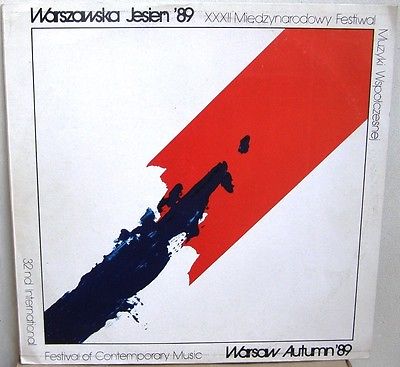
WARSAW AUTUMN 89 VOL.2 : ONLY BEATRICE / SINFONIA MISTICA / SUB LOVE LP
Polskie Nagrania Muza
Rare original issue from Poland with electronic & avant-garde pieces from three important polish composers, unavailable elsewhere.
Some info on the release: Rare original issue, released in Poland sometime in the 80's on the great Muza label (Wlodzimierz Kotonski, Zygmunt Krauze, etc.), as a documentation for the famous "Warsaw Autumn Festival". A great selection of electronic & avant-garde compositions from 3 polish composers with Krupowicz's "Only Beatrice for female reciting voice, amplified string quartet and tape", Rafal Augustyn's abstract "Sub Love for mixed choir" and the excellent "Sinfonia Mistica" by Andrzej Panufnik. Pieces unavailable elsewhere.
Andrzej Panufnik was living proof that genius is exportable. Without compromising his Polish roots, he became a British citizen, and eventually reached full stature as a composer in his adopted country, but it was not an easy transition. Son of a leading violinmaker, he studied with Sikorski at the Warsaw Conservatory and Weingartner in Vienna. After the german invasion of Poland, he kept the creative spark alive in the Polish underground, where he became a friend of Witold Lutoslawski and was conductor of the Krakow Philharmonic Orchestra from 1945 to 1946. His first serious work, the Tragic Overture, composed in 1944, was followed in 1949 by Homage to Chopin, for soprano and piano (or -- an early example of Panufnik's readiness to encourage freedom of musical expression -- for flute and strings). By 1954, Panufnik was Poland's leading composer, but Russian domination was making artistic freedom impossible; in 1956, while on a recording trip to Switzerland, he boarded a flight to London with no intention of returning to his native country. For some years, he was treated coldly by the British musical intelligentsia. His style was neither traditionally tonal nor fashionably serial; but it certainly sounded "un-British," and for nine years, none of his music was broadcast by the BBC. (American audiences were to prove more responsive). At his home in Twickenham near the River Thames, Panufnik continued to work on symphonies constructed from small cells of two or three notes arranged in geometric forms, somewhat akin to Webern. By the end of his life, Panufnik had written ten symphonies, including Sinfonia Elegiaca, premiered in Boston in 1957 by Stokowski. Much of his work reflects the sufferings of the war and its aftermath. It is easy to see why Panufnik would not have survived as an artist under a Stalinist dictatorship. The composer exacted his own bleak revenge: Katyn Epitaph (again premiered by Stokowski in 1968) exposed the massacre of 15,000 Polish officers executed on Stalin's orders. Sinfonia Votiva (premiered in Boston by Seiji Ozawa in 1982) celebrates the popular uprising against Communist rule in the form of a votive offering to the "black Madonna," a statue in Gdansk where the first blows for Polish freedom were struck. After the solo cadenza that opens the Violin Concerto written in 1972 for Yehudi Menuhin, the soloist is (unusually) allowed to decide both the tempo and overall interpretation of the whole work, perhaps yet another symbol of the freedom Panufnik had demonstrated by his own self-exile. After the collapse of Communism in Poland, Panufnik's reputation there was quickly re-established, and his music became part of the militant modernism for which the country was noted in the liberalization that followed. In Britain, where he conducted the City of Birmingham Symphony Orchestra from 1957 to 1959, his music was gradually becoming better-known, with performances in London of the Symphony of the Spheres (1976) and Ninth Symphony (1987). The Tenth Symphony was premiered in Chicago in 1990. When his last work, a cello concerto written for Rostropovich, was played in London in 1990, Panufnik had achieved full recognition in his adopted country. In 1987, he wrote a revealing biography called Composing Myself.
Panufnik's notes on "Sinfonia Mistica": The title Sinfonia Mistica reflects my deep fascination with the mystery and beauty of geometry; referring in this composition specifically to one figure which for me personally is a symbol of universal order and inner harmony. This figure illustrates the curious fact that it take SIX circles precisely equal in size to fully encircle a seventh circle of the same size: not five or seven but SIX. Perhaps this could be explained simply by mathematical formulae, but for me this geometric figure instils a sense of wonder and seems to have some mystical significance. Although the structure and musical material of this symphony are influenced by this geometric figure, my idea in composing this work was not limited to just a realisation of a purely technical concept. Rather I wanted to convey to listeners some spiritual content, some contemplative and hidden messages by means of a meticulously structured framework, through which also I was trying to transcend the existing methods of composition. (My personal approach to mysticism has no connection with the mysticism of any specific religion: neither with Western doctrines nor any religious philosophies of the Far East.) The SIX circles of this curious geometric figure imposed up me the number SIX. This number I regard as having a twofold significance, a hidden power as well as its unique arithmetic properties: 1+2+3= 6; 3x2=6 (2+2+2=6); 2x3=6 (3+3=6). One plus two plus three gave me the triads for my melodic and harmonic devices, while three twos and two threes gave me the meter for the whole composition. Thus every aspect of my Sinfonia Mistica is strictly relation to this number: the whole works consists of SIX substantial sections, based on SIX triads, SIX melodic patterns, SIX harmonic combinations, composed in the meter of SIX (and it happens to be my SIXth symphony). With these SIXes, I endeavoured to use the law of geometrical proportion to provide structural binding forces through the elements of ’geometric’ melody, ‘geometric’ harmony and ‘geometric’ rhythm and meter.
Stanis?aw Krupowicz, composer, born on 25th November 1952 in Grodno. In 1971-76, he studied at the Department of Mathematics and Mechanics of Warsaw University. In 1975-81 he studied composition with Tadeusz Baird and W?odzimierz Koto?ski at the State Higher School of Music. The character of Stanis?aw Krupowicz’s music has been determined to a large extent by his interest in mathematics and computers, which he earlier pursued at Warsaw University during his studies at the Department of Mathematics and Mechanics. After the completion of these studies in 1976, he studied composition at the State Higher School of Music with W?odzimierz Koto?ski, the master and pioneer of Polish electroacoustic composition. Krupowicz continued his work on computer music in the Center for Computer Resarch in Music and Acoustics at Stanford University, California, first as a postgraduate student with a Fulbright grant, later – as assistant researcher. In 1981 he set up an "Independent Studio of Electroacoustic Music" ( with Fluxus artist Andrzej Mitan and composers Andrzej Bie?an, Mieczys?aw Litwi?ski and ) In 1984, Krupowicz made his “Warsaw Autumn” debut Tadeusz Sudnik with a piece for tape bearing the English title Music for S, which was in fact a dedication to the underground “Solidarity” movement, abbreviated because of censorship. The music was prepared at Stanford University and used computer equipment. In the commentary published in the “Warsaw Autumn” programme book, the composer described this work as a result of “unremitting struggle with a soulless mechanism.” The result was greeted with applause, though the “Polskie Nagrania” label released a record with the Warsaw Autumn concert on which Music for S could be heard... backward!
Rafa? Augustyn is a composer of classical music, and a pianist, music critic, writer and scholar of Polish philology. As a composer he has written symphonies, chamber orchestra works, vocal and electronic music, as well as music for theatre. Since the mid 1990s, Augustyn has collaborated with visual artists, architects and photographers on numerous multimedia art works. Augustyn studied composition under Ryszard Bukowski at the State Higher School of Music in Wroc?aw between 1971–74, and between 1975-77 at the State Higher School of Music in Katowice, where he studied under Henryk Górecki. In 1979, Augustyn began to teach at the Institute of Polish Philology at Wroc?aw University and has remained there since. His works have had numerous performances at the Warsaw Autumn Festival, as well as at other Polish festivals, and across Europe, North America and the Far East. Along with Andrzej Krzanowski and Eugeniusz Knapik, Augustyn is sometimes included as a member of the so called "Silesian School"; that is, a group of composers who studied under Górecki in Katowice, Silesia, and are noted for their break with the current dominant postmodernist approach to classical music in Poland. One of his major pieces, his "Symphony of Hymns", took 20 years to complete, typically lasts for 100 minutes and requires an orchestra of over 170 players. It was described in 2004 by the music critic Tim Rutherford-Johnson as "a monster of a work....[but] has that broad sweeping feel of neo-Romanticism that one might expect from a contemporary Polish symphonist, although it features none of Górecki’s direct simplicity, or Penderecki’s gloomy ponderousness. It does however...continually blur the line between orchestration and form. Melody and harmony are present, but not discernible as such; more important is a lilting shifting of colours that tumbles the music forward."
Condition: Vinyl lies in mint condition, looks super clean and plays perfectly, while cover lies in excellent shape, with light age wear & minor corner creasings (see picture).
Tracklist
A Andrzej Panufnik – Sinfonia Mistica Conductor – Tadeusz Struga?aOrchestra – National Philharmonic Orchestra B1 Stanis?aw Krupowicz – Only Beatrice Cello – Piotr JanosikStrings – Silesian String Quartet, TheViola – ?ukasz SyrnickiViolin – Arkadiusz Kubica, Marek Mo? B2 Rafa? Augustyn – Sub Love Choir – RIAS-KammerchorConductor – Marous CreedSHIPPING & PAYMENT
Shipping: Shipping for this LP is 9$ airmail in Europe / 11$ for the rest of the world
Registered mail: +5$
Insurance: optional
Combined shipping: BIG discounts
Payment: Paypal
Packaging: I am a collector too and i know
price rating






![Return of Saturn [LP] by No Doubt (Vinyl, Apr-2000, Interscope Records USA)](https://www.popsike.org/php/thumbnail.php?url=https://www.popsike.pics/pix/20160407/272204192911.jpg)