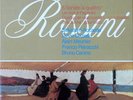
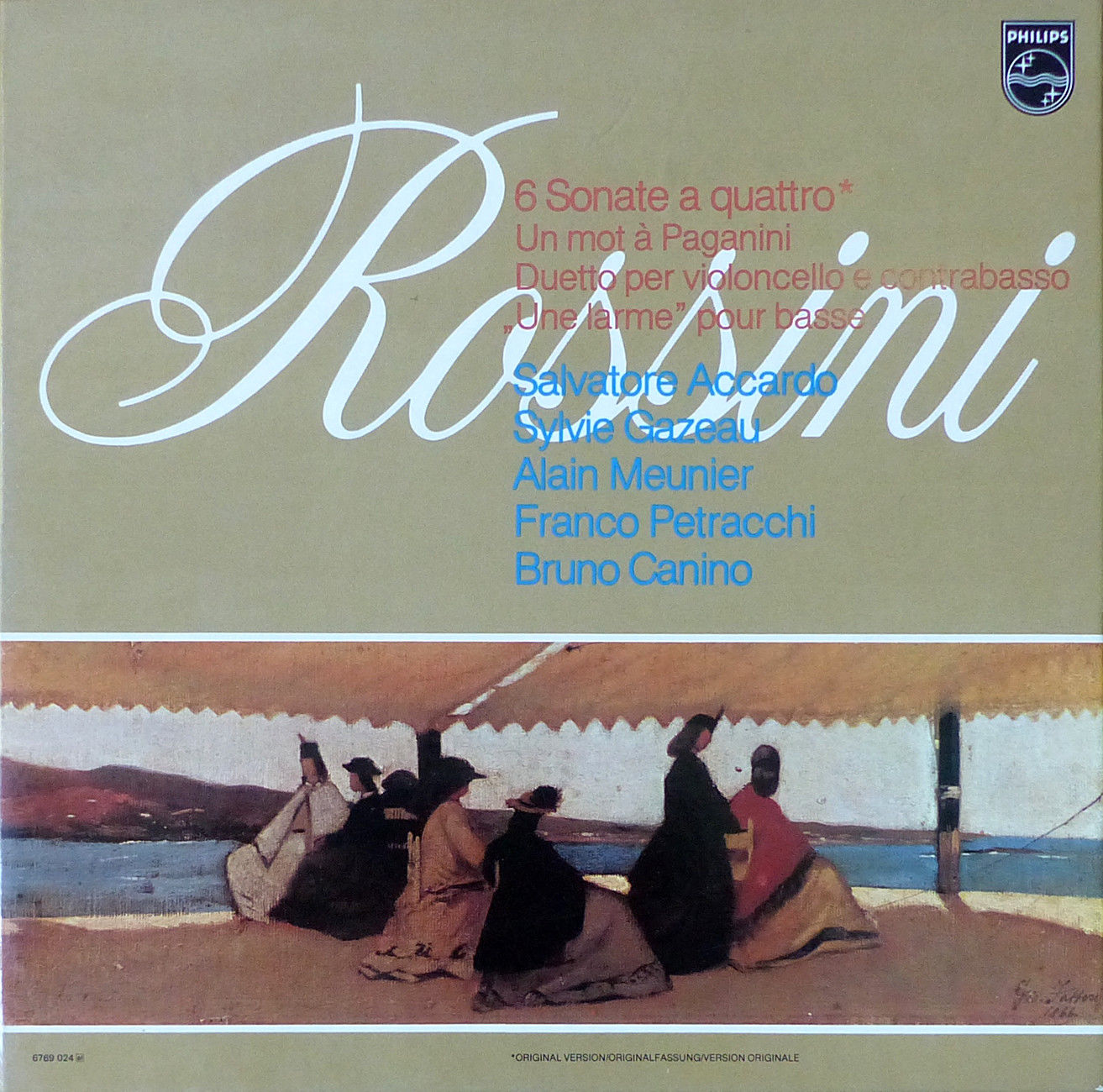
Accardo: Rossini 6 Sonate a Quattro - Philips 6769 024 (2 LP box set); ED1 TAS
$
950


Favourite Auctions
To save auctions to your favourites, please login
If you don't have an account, please register
Description
ITEM DESCRIPTION:
This beautiful and very rare 2LP box set – a superb collector’s copy – from Philips (6769 024, Dutch pressing, red/white labels, stereo, booklet included) preserves one of the greatest chamber music albums every made, that of violinist Salvatore Accardo and colleagues’ in stunning and sought-after account of Rossini’s “Sei Sonate a quattro” (6 String Sonatas), here performed in their original version for two violins, cello, and bass – truly magnificent.
PLEASE NOTE:
This is the original Philips release, and not the later Japanese Philips re-issue.
Accardo was joined for this memorable recording by violinist Sylvie Gazeau, cellist Alain Meunier, and double-bassist Franco Petracchi, in sessions held in October 1978.
Filling out the set are three Rossini rarities:
Duetto per violoncello e contrabasso
> with Alain Meunier, cello and Franco Petracchi, contrabasso
“Un Mot à Paganini”
> with Salvatore Accardo, violin and Bruno Canino, piano
“Une larme” pour basse
> with Franco Petracchi, contrabass and Bruno Canino, piano
------------------------------------------
Of the original Philips release, that on offer here, the eminent critic Lionel Salter wrote in his review for the April 1981 issue of The Gramophone:
“Every time the Rossini string Sonatas show up, reviewers are bowled over by their breezy high spirits, freshness of invention and humour; and I happily succumb once again, especially to this recording, which is a sheer delight. In reviewing the version by the Academy of St Martin-in-theFields (Argo ZK26-7, 12/77), TH very justly praised the whole-hearted brio and spectacular ensemble in whirling passage-work which Neville Marriner secured from his players; but when performed as a solo quartet of two violins, cello and bass, as here, the effect is inevitably still cleaner and crisper and the texture pellucid. This is how they were intended, for Rossini amusingly describes the "dreadful" first performance at the home of his patron Triossi (in Conventello, where he wrote his first orchestral overture), with himself "to tell the truth, the least appalling" playing second violin. It is hard to believe, but almost certainly true, that he was only 12 at the time— one forgets that he was to be already famous at 21: but his claim that all six sonatas were composed and copied in three days, and that he had not at that time had any lessons in accompagnamento (thorough-bass) strains credulity to the limit, for in harmony, Construction and, particularly, instrumentation they are completely assured.
“Each work is cast in three movements—the first in sonata form, the second a slow cantabile, and the finale usually a Rondo, though No. 6 ends with a raging Tempesta and No. 3 with a sparkling set of variations on a theme which, eight years later, he used again in La scala di seta. But it is the string writing that leaves one gaping at this adolescent's precocity. Where had he learned the kind of pyrotechnics he gave his violins (brilliant rapid passages, sometimes ascending to dizzy heights, as in No. 5, or rising scales in broken octaves in No. 4), or special effects such as the weird ponti'cello in the finale of No. 5, or the extraordinary enterprise demanded from his bass player? With string parts like these, it is hardly surprising if the original group of amateurs sounded dreadful.
“In the hands of the splendid team assembled here, however, the effect is enormously exhilarating. As well as virtuosity from all, there is an uncommon purity of intonation and the kind of rhythmic and tonal nuance that makes it clear that sensitivity, not exhibitionism, is the ruling factor, though the players respond with evident zest to Rossini's flights of ebullience. The internal balance too is judged to a nicety: when the first and second violins repeat each other's phrases they are differentiated only by their positioning and individual timbre. Very strongly recommended. If 1 allowed myselfjust one cavil it would be that Accardo snatches at the turns in the finale of No. 2.
“The last side is given over to some rarities. The Duetto for cello and bass (written for a talented English amateur and the great Dragonetti, but published for the first time only in 1969) is a three-movement work, ending in a cheerful polacca, that treats the instruments on absolutely equal terms, expecting the bass to rush about and to sing melodies as freely as its partner. It is superbly played here, with first-class unanimity and the utmost finesse. Rossini knew Paganini well, and the violin piece which bears his name is full of the elaborate technical demands—doublestops, rapid arco-pizzicato alterations, etc.— which might be expected in the circumstances. Over Une larme I am somewhat puzzled. It is a set of loose variations for cello, but what we have here is the theme alone, played on the bass— though with such beauty of tone and expressive quality as to be utterly disarming.”
------------------------------------------
And of the Ultra HD CD re-issue by First Impression Music (LIM UHD 049), the critic John J. Puccio wrote on his blog classicalcandor:
“Gioacchino Rossini (1792-1868) wrote his six Sonatas for two violins, cello and double-bass in 1804, and scholars only discovered them in the Library of Congress after World War II. Most often, we hear them in their transcriptions for small string orchestra, but it's especially nice to hear them as the original scores arrange them, for string quartet. Almost as remarkable as the young prodigy composing these works at so early an age is that after Rossini wrote thirty-eight operas by the age of thirty-eight, he pretty much retired, writing only a few occasional pieces of music during the next thirty-odd years. Apparently, he spent much of his time in retirement as a gourmet, portraits of his girth in later years attesting to the fact.
In any case, his youthful Sonatas all follow the same basic pattern: They start with relatively long opening Allegros, followed by brief central slow movements, and concluding with moderately quick-paced finales of modest duration. My favorite among them, for what it's worth, is No. 5 because it sums up everything good about the music; it's both delicately enchanting and playfully witty by turns.
The performances by Salvatore Accardo, first violin, Sylvie Gazeau, second violin, Alain Meunier, cello, and Franco Petracchi, double bass is as sweet, melodious, refined, exacting, and flexible as a listener will find anywhere. This is virtuosic playing that is completely at the service of the music: graceful, lilting, and lyrical, yet jaunty and lively when necessary. I have heard the Sonatas played by a number of different performers and groups over the years, but none surpass Accardo and his colleagues.”
------------------------------------------
Included is a full-size, 4-page booklet, on handsome glossy paper, with extensive notes by the preeminent Rossini scholar Philip Gossett of the University of Chicago. All texts are provided in English, German, and French.
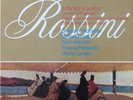
Incidentally, the cover art on the front of the box reproduces “La Rotonda di Palmieri” by Giovanni Fattori (1825-1908), held at the Galleria d’Arte Moderne, Firenze.
CONDITION – PLEASE READ CAREFULLY:
The gradations of condition I use are as follows: MINT, Near-Mint, Excellent, Very Good, Good, Fair, Poor.
The condition of the box is NM-. There is some slight scuffing at corners and mild shelfwear. However, there are no bends, corner breaks, seamsplits, owners’ markings, or other defects, and the box remains solid, bright, glossy, and highly attractive – overall, this rates as a fine collector's copy.
The condition of the full-size, 4-page booklet is NM. There are no flaws to speak of – overall, a very fine copy.
The condition of the 2 LPs is near-MINT. Both appear, and sound, unplayed. There are no spindle trails nor any scratches and both LPs retain a high gloss. All 4 sides have been very carefully play-graded – there are no tics, pops, or other defects – these absolutely rate as NM collector's copies.
PLEASE NOTE:
All LPs are provided with a new Nagaoka (or Nagaoka-style) inner sleeve. The images I've provided are of the actual item you are potentially bidding on - these are not stock images or images I've taken from other sites. Bid with confidence!
PAYMENT:
Payment by PayPal is greatly preferred. Payment should be made within 5 days.
SHIPPING:
Shipping is free to anywhere in the world; this is true regardless of the number of LPs you buy, be it 1 or a 100. This particular item will be sent via certified airmail (i.e., with a tracking number).
FEEDBACK:
I will promptly leave feedback for all buyers. Please do not leave negative, or even neutral, feedback without first giving me an opportunity to resolve any dissatisfaction you might have with an item or transaction. I do understand that, on occasion, a buyer might believe the item description to be inaccurate or that a buyer may be disappointed in some other way regarding the sale. I promise I will do my very best to resolve any unhappiness you've experienced in your buying experience with me to your complete satisfaction. Thank you.
REFUNDS:
Returns are honored, and any buyer you makes a return will be refunded in full. Please let me know before making a return.
Please see my other classical LP and CD auctions, and feel free to write with any questions, I'll be glad to help.
price rating