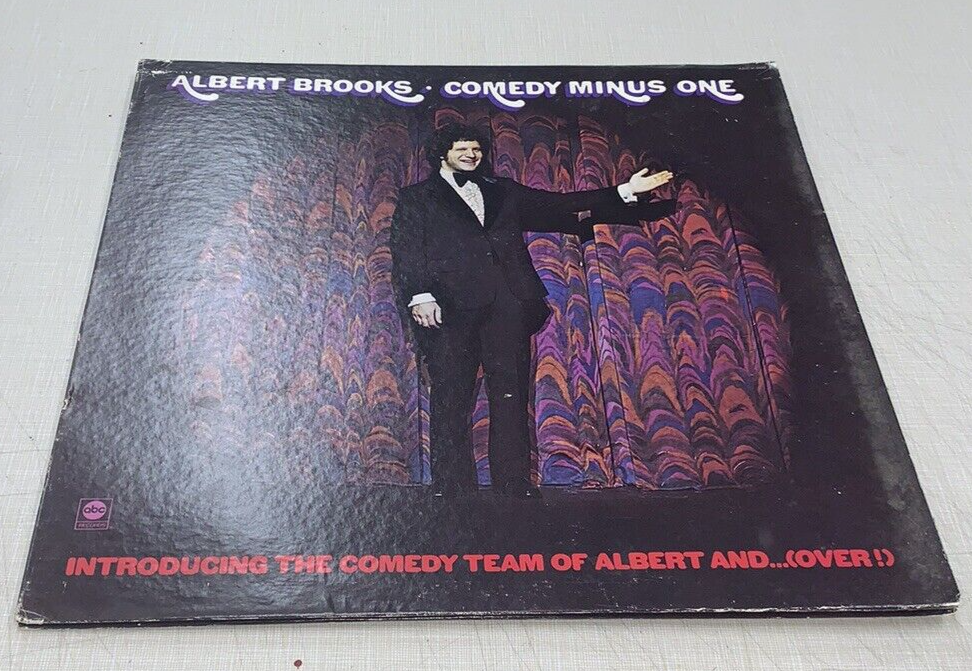
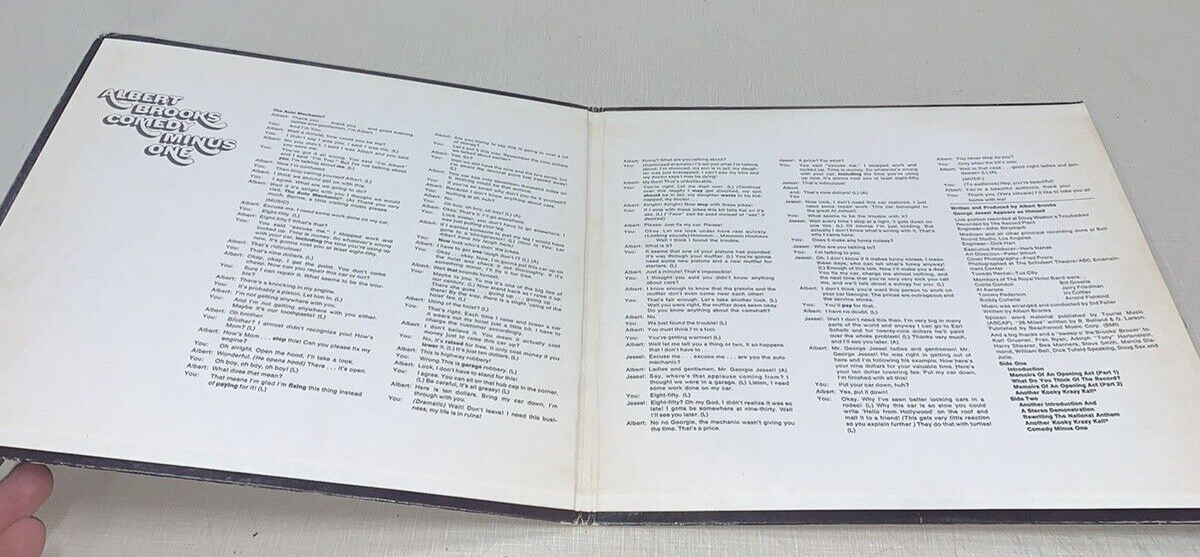
Albert Brooks Comedy Minus One ABCX-800 1973 Rare Comedy LP Gatefold HTF VG+/VG+
$
50

Favourite Auctions
To save auctions to your favourites, please login
If you don't have an account, please register
Description
Albert Brooks - Comedy Minus One
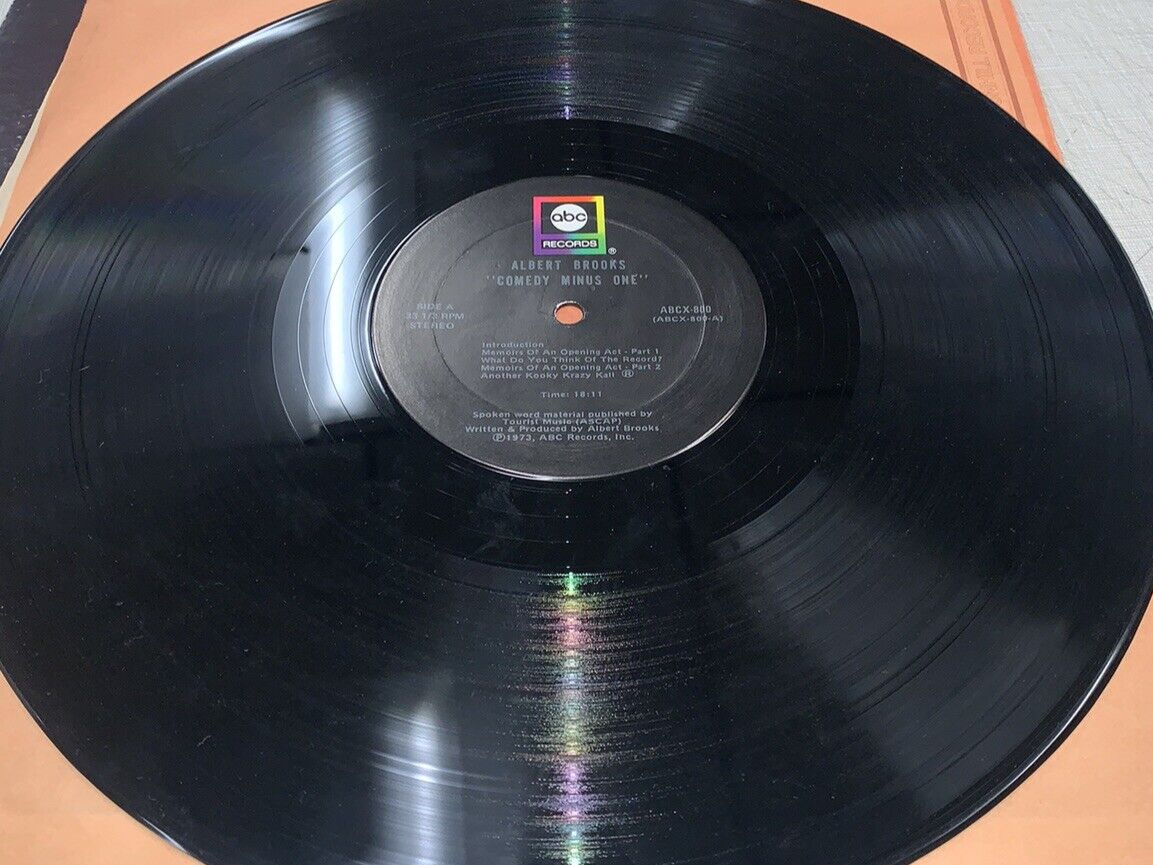
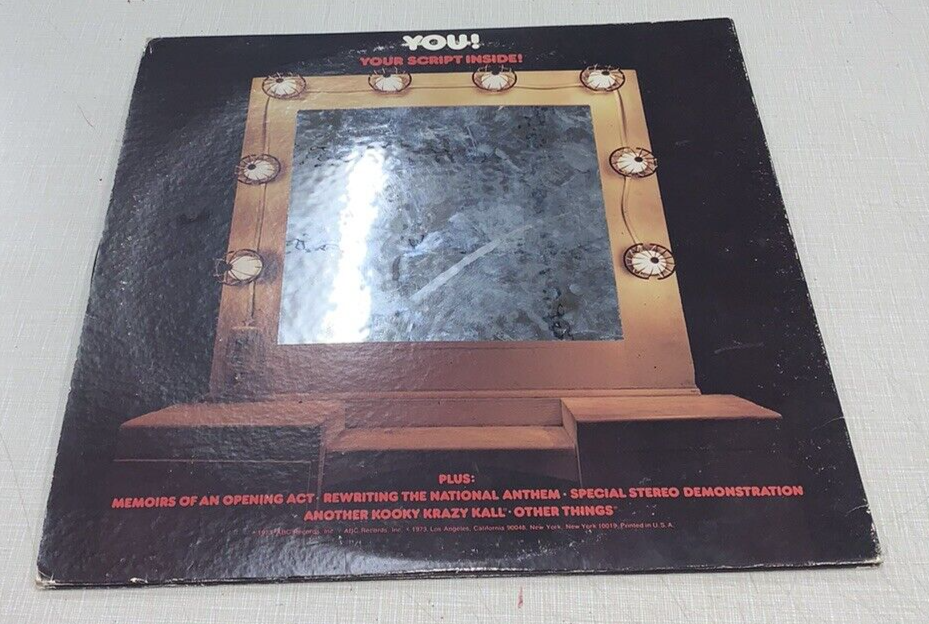
Label: ABC Records – ABCX-800 Format: Vinyl, LP, Album, Stereo, Terre Haute Pressing Country: US Released: 1973 Genre: Non-Music Style: Comedy, Spoken Word A1 Introduction A2 Memoirs Of An Opening Act - Part 1 A3 What Do You Think Of The Record? A4 Memoirs Of An Opening Act - Part 2 A5 Another Kooky Krazy Kall B1 Another Introduction And A Stereo Demonstration B2 Rewriting The National Anthem Songwriter – Bruce Belland, Glen Larson B3 Another Kooky Krazy Kall B4 Comedy Minus One Phonographic Copyright ℗ – ABC Records, Inc. Copyright © – ABC Records, Inc. Recorded At – The Troubadour Recorded At – Bell Sound Studios, Hollywood Recorded By – Record Plant, Los Angeles Mixed At – Bell Sound Studios, Hollywood Published By – Tourist Music Published By – Beechwood Music Corp. Lacquer Cut At – The Mastering Lab Pressed By – Columbia Records Pressing Plant, Terre Haute Arranged By [Music], Conductor [Music] – Sid Feller Art Direction – Peter Whorf Engineer – John Stromach* Engineer [Mixdown] – Dick Hart* Executive-Producer – Herb Nanas Performer [As Himself] – George Jessel Performer [The Royal Hotel Band] – Al Aarons, Arnold Fishkind*, Buddy Collette, Conte Condoli*, Irv Cottler, Jerry Friedman, Tommy Pederson, Bill Greene* Photography By [Cover] – Fred Poore Written-By, Producer – Albert Brooks Side A Time: 18:11 Side B Time: 21:24
Albert Brooks (born Albert Lawrence Einstein; July 22, 1947)[1] is an American actor, director, and screenwriter. He received an Academy Award nomination for Best Supporting Actor for his performance in the 1987 comedy-drama film Broadcast News and was widely praised for his performance in the 2011 action drama film Drive.[2] Brooks has also acted in films such as Taxi Driver (1976), Private Benjamin (1980), Unfaithfully Yours (1984), and My First Mister (2001). He has written, directed, and starred in several comedy films, such as Modern Romance (1981), Lost in America (1985), and Defending Your Life (1991). He is also the author of 2030: The Real Story of What Happens to America (2011).
Brooks has also voiced several characters in animated films and television shows. His voice acting roles include Marlin in Finding Nemo (2003) and its sequel Finding Dory (2016), Tiberius in The Secret Life of Pets (2016), and several one-time characters in The Simpsons, including Hank Scorpio in "You Only Move Twice" (1996) and Russ Cargill in The Simpsons Movie (2007).
Early life Brooks was born Albert Lawrence Einstein on July 22, 1947 into a Jewish show business family in Beverly Hills, California,[3][1] to Thelma Leeds (née Goodman), an actress, and Harry Einstein, a radio comedian who performed on Eddie Cantor's radio program and was known as "Parkyakarkus".[1] He is the youngest of three sons. His older brothers are the late comedic actor Bob Einstein (1942–2019), and Clifford Einstein (b. 1939), a partner and longtime chief creative officer at Los Angeles advertising agency Dailey & Associates. His older half-brother was Charles Einstein (1926–2007), a writer for such television programs as Playhouse 90 and Lou Grant. His grandparents emigrated from Austria and Russia. He grew up among show business families in Southern California, attending Beverly Hills High School with Richard Dreyfuss and Rob Reiner.[4]
Career Early career Brooks attended Carnegie Institute of Technology (now Carnegie Mellon University) in Pittsburgh (where his classmates included Michael McKean and David L. Lander), but dropped out after one year to focus on his comedy career.[5] By the age of 19, he had changed his professional name to Albert Brooks, joking that "the real Albert Einstein changed his name to sound more intelligent".[6] He quickly became a regular on variety and talk shows during the late 1960s and early 1970s, and was on the writing staff for the ill-fated ABC show Turn-On, which was cancelled after one episode.[7] In 1970-71, he also worked with college friends McKean and Lander (alongside Harry Shearer) as a writer/guest performer on some early material by radio and LP record comedy group The Credibility Gap. Brooks led a new generation of self-reflective baby-boomer comics appearing on NBC's The Tonight Show Starring Johnny Carson. His on-stage persona, that of an egotistical, narcissistic, nervous comic, an ironic showbiz insider who punctured himself before an audience by disassembling his mastery of comedic stagecraft, influenced other post-modern comedians of the 1970s, including Steve Martin, Martin Mull, and Andy Kaufman.
After two successful comedy albums, Comedy Minus One (1973) and the Grammy Award–nominated A Star Is Bought (1975), Brooks left the stand-up circuit to try his hand as a filmmaker. He had already made his first short film, The Famous Comedians School, a satiric short and an early example of the mockumentary subgenre that was aired in 1972 on the PBS show The Great American Dream Machine.[8]
In 1975, Brooks directed six short films for the first season of NBC's Saturday Night Live.[9] In 1976, he appeared in his first mainstream film role, in Martin Scorsese's landmark Taxi Driver; Scorsese allowed Brooks to improvise much of his dialogue.[10]
Brooks directed his first feature film, Real Life, in 1979, which he co-wrote with Harry Shearer. The film, in which Brooks (playing a version of himself) films a typical suburban family in an effort to win both an Oscar and a Nobel Prize, was a sendup of PBS's An American Family documentary. It has also been viewed as foretelling the emergence of reality television.[11] Brooks also appeared in the film Private Benjamin (1980), starring Goldie Hawn
price rating