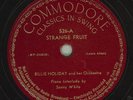
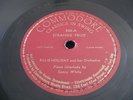
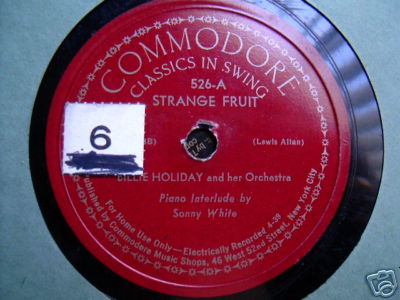
BILLIE HOLIDAY Strange Fruit COMMODORE 78 RPM Record
$
81


Favourite Auctions
To save auctions to your favourites, please login
If you don't have an account, please register
Description
Billie Holiday's most famous record:
- STRANGE FRUIT - Lewis Allen - COM 01.01 WP24403B
- FINE AND MELLOW - Billie Holiday - COM 01.05 WP24405A
The original 1939 recording on the original Commodore label .
Commodore 10" 78rpm record.
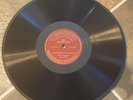
CONDITION: VERY GOOD PLUS, unworn, but scuffs and some sounding scratches
Billie Holiday (born Eleanora Fagan; April 7, 1915 – July 17, 1959) was an American jazz singer and songwriter.
Nicknamed Lady Day[1] by her sometime collaborator Lester Young, Holiday was a seminal influence on jazz, and pop singing. Her vocal style — strongly inspired by instrumentalists — pioneered a new way of manipulating wording and tempo, and also popularized a more personal and intimate approach to singing. Critic John Bush[2] wrote that she "changed the art of American pop vocals forever." She co-wrote only a few songs, but several of them have become jazz standards, notably "God Bless the Child," "Don't Explain," and "Lady Sings the Blues."
Biography
[edit] Early life
Photograph of a two-year-old HolidayBillie Holiday had a difficult childhood, which greatly affected her life and career. Much of her childhood is clouded by conjecture and legend, some of it propagated by her autobiography, Lady Sings the Blues, published in 1956. This account is known to contain many inaccuracies.[3]
Her professional pseudonym was taken from Billie Dove, an actress she admired, and Clarence Holiday, her probable father. At the outset of her career, she spelled her last name "Halliday," presumably to distance herself from her neglectful father, but eventually changed it back to "Holiday."
There is some controversy regarding Holiday's paternity, stemming from a copy of her birth certificate in the Baltimore archives that lists the father as a "Frank DeViese". Some historians consider this an anomaly, probably inserted by a hospital or government worker.[4]
Thrown out of her parents' home in Baltimore, Billie's mother, Sadie Fagan, moved to Philadelphia where Billie was born. Mother and child eventually settled in a poor section of Baltimore. Her parents married when she was three, but they soon divorced, leaving her to be raised largely by her mother and other relatives. At the age of 10, she reported that she had been raped.[5] That claim, combined with her frequent truancy, resulted in her being sent to The House of the Good Shepherd, a Catholic reform school, in 1925. It was only through the assistance of a family friend that she was released two years later.[6] Scared by these experiences, Holiday moved to New York City with her mother in 1928. In 1929 Holiday's mother discovered a neighbor, Wilbert Rich, in the act of raping her daughter; Rich was sentenced to three months in jail.
[edit] Early singing career
Photo by Ralph F. SeghersAccording to Billie Holiday's own account, she was recruited by a brothel, worked as a prostitute in 1930, and was eventually imprisoned for a short time for solicitation. It was in Harlem in the early 1930s that she started singing for tips in various night clubs. According to legend, penniless and facing eviction, she sang "Travelin All Alone" in a local club and reduced the audience to tears. She later worked at various clubs for tips, ultimately landing at Pod's and Jerry's, a well known Harlem jazz club. Her early work history is hard to verify, though accounts say she was working at a club named Monette's in 1933 when she was discovered by talent scout John Hammond.[7]
Hammond arranged for Holiday to make her recording debut on a 1933 Benny Goodman date, and Goodman was also on hand in 1935, when she continued her recording career with a group led by pianist Teddy Wilson. Their first collaboration included "What A Little Moonlight Can Do" and "Miss Brown To You", which helped to establish Billie Holiday as a major vocalist. She began recording under her own name a year later, producing a series of extraordinary performances with groups comprising the Swing Era's finest musicians.
Wilson was signed to Brunswick by John Hammond for the purpose of recording current pop tunes in the new Swing style for the growing jukebox trade. They were given free rein to improvise the material. Holiday's amazing method of improvising the melody line to fit the emotion was revolutionary (Wilson and Holiday took pedestrian pop tunes like "Twenty Four Hours A Day" or "Yankee Doodle Never Went To Town" and turned them into jazz classics with their arrangements). With few exceptions, the recordings she made with Wilson or under her own name during the 1930's and early 1940's are regarded as important parts of the jazz vocal library.
Among the musicians who accompanied her frequently was tenor saxophonist Lester Young, who had been a boarder at her mother's house in 1934 and with whom she had a special rapport. "Well, I think you can hear that on some of the old records, you know. Some time I'd sit down and listen to 'em myself, and it sound like two of the same voices, if you don't be careful, you know, or the same mind, or something like that."[8] Young nicknamed her "Lady Day" and she, in turn, dubbed him "Prez." She did a three-month residency at Clark Monroe's Uptown House in New York in 1937. In the late 1930s, she also had brief stints as a big band vocalist with Count Basie (1937) and Artie Shaw (1938). The latter association placed her among the first black women to work with a white orchestra, an arrangement that went against the temper of the times.
[edit] The Commodore Years and "Strange Fruit"
Holiday was recording for Columbia in the late 1930s when she was introduced to "Strange Fruit," a song based on a poem about lynching written by Abel Meeropol, a Jewish schoolteacher from the Bronx. Meeropol used the pseudonym "Lewis Allan" for the poem, which was set to music and performed at teachers' union meetings. It was eventually heard by Barney Josephson, proprietor of Café Society, an integrated nightclub in Greenwich Village, who introduced it to Holiday. She performed it at the club in 1939, with some trepidation, fearing possible retaliation. Holiday later said that the imagery in "Strange Fruit" reminded her of her father's death, and that this played a role in her persistence to perform it. In a 1958 interview, she also bemoaned the fact that many people did not grasp the song's message: "They'll ask me to 'sing that sexy song about the people swinging'," she said.[9]
When Holiday's producers at Columbia found the subject matter too sensitive, Milt Gabler agreed to record it for his Commodore Records. That was done in April, 1939 and "Strange Fruit" remained in her repertoire for twenty years. She later recorded it again for Verve. While the Commodore release did not get airplay, the controversial song sold well, though Gabler attributed that mostly to the record's other side, "Fine and Mellow," which was a jukebox hit.[10]
[edit] Decca Records and "Lover Man"
In addition to owning Commodore Records, Milt Gabler was an A&R man for Decca Records, and he signed Holiday to the label in 1944. Her first recording for Decca, "Lover Man," was a song written especially for her by Jimmy Davis, Roger "Ram" Ramirez, and Jimmy Sherman. Although its lyrics describe a woman who has never known love ("I long to try something I never had"), its theme—a woman longing for a missing lover—and its refrain, "Lover man, oh, where can you be?", struck a chord in wartime America and the record became one of her biggest hits.
Holiday continued to record for Decca until 1950, including sessions with the Duke Ellington and Count Basie orchestras, and two duets with Louis Armstrong. Holiday's Decca recordings featured big bands and, sometimes, strings, contrasting her intimate small group Columbia accompaniments. Some of the songs from her Decca repertoire became signatures, including "Don't Explain" and "Good Morning Heartache".
[edit] Film
Holiday made one major film appearance, opposite Louis Armstrong in New Orleans (1947). The musical drama featured Holiday singing with Armstrong and his band and was directed by Arthur Lubin.
[edit] Later life and death
Her personal life was as turbulent as the songs she sang. Holiday stated that she began using hard drugs in the early 1940s. She married trombonist Jimmy Monroe on August 25, 1941. While still married to Monroe, she took up with trumpeter Joe Guy, her drug dealer, as his common law wife. She finally divorced Monroe in 1947, and also split with Guy. In 1947 she was jailed on drug charges and served eight months at the Alderson Federal Correctional Institution for Women in West Virginia. Her New York City Cabaret Card was subsequently revoked, which kept her from working in clubs there for the remaining 12 years of her life, except when she played at the Ebony Club in 1948, where she opened under the permission of John Levy.
By the 1950s, Holiday's drug abuse, drinking, and relations with abusive men led to deteriorating health. As evidenced by her later recordings, Holiday's voice coarsened and did not project the vibrance it once had. However, she had retained — and, perhaps, strengthened — the emotional impact of her delivery (See below).
On March 28, 1952, Holiday married Louis McKay, a mafia enforcer. McKay, like most of the men in her life, was abusive, but he did try to get her off drugs. They were separated at the time of her death, but McKay had plans to start a chain of Billie Holiday vocal studios, a la the Arthur Murray dance schools. Holiday also had a relationship with Orson Welles.[citation needed]
Her late recordings on Verve constitute about a third of her commercial recorded legacy and are as well remembered as her earlier work for the Columbia, Commodore and Decca labels. In later years her voice became more fragile, but it never lost the edge that had always made it so distinctive. On November 10, 1956, she performed before a packed audience at Carnegie Hall, a major accomplishment for any artist, especially a black artist of the segregated period of American history. Her performance of "Fine And Mellow" on CBS's The Sound of Jazz program is memorable for her interplay with her long-time friend Lester Young; both were less than two years from death. (see the clip here)
Holiday first toured Europe in 1954, as part of a Leonard Feather package that also included Buddy DeFranco and Red Norvo. When she returned, almost five years later, she made one of her last television appearances for Granada's "Chelsea at Nine," in London. Her final studio recordings were made for MGM in 1959, with lush backing from Ray Ellis and his Orchestra, who had also accompanied her on Columbia's Lady in Satin album the previous year — see below). The MGM sessions were released posthumously on a self-titled album, later re-titled and re-released as Last Recordings. Her final public appearance, a benefit concert at the Phoenix Theater in New York's Greenwich Village, took place on May 25, 1959. According to the evening's masters of ceremony, jazz critic Leonard Feather and TV host Steve Allen, she was only able to make it through two songs, one of which was "Ain't Nobody's Business If I Do."
On May 31, 1959, she was taken to Metropolitan Hospital in New York suffering from liver and heart disease. On July 12, she was placed under house arrest at the hospital for drug possession, despite evidence suggesting the drugs may have been planted on her. Holiday remained under police guard at the hospital until she died from cirrhosis of the liver on July 17 1959 at the age of 44. In the final years of her life, she had been progressively swindled out of her earnings, and she died with only $0.70 in the bank and $750 (a tabloid fee) on her person.
Billie Holiday is interred in Saint Raymond's Cemetery, The Bronx, New York.
[edit] Voice
This article needs additional citations for verification.
Please help improve this article by adding reliable references. Unsourced material may be challenged and removed. (October 2006)
Billie Holiday photographed by Carl Van Vechten, 1949Her distinct delivery made Billie Holiday's performances instantly recognizable throughout her career. Years of abuse eventually altered the texture of her voice and gave it a prepossessing fragility, but the emotion with which she imbued each song remained intact.[11]. Her last major recording, a 1958 album entitled Lady in Satin, features the backing of a 40-piece orchestra conducted and arranged by Ray Ellis, who said of the album in 1997:
I would say that the most emotional moment was her listening to the playback of "I'm a Fool to Want You." There were tears in her eyes ... After we finished the album I went into the control room and listened to all the takes. I must admit I was unhappy with her performance, but I was just listening musically instead of emotionally. It wasn't until I heard the final mix a few weeks later that I realized how great her performance really was.
Nicknamed Lady Day[1] by her sometime collaborator Lester Young, Holiday was a seminal influence on jazz, and pop singing. Her vocal style — strongly inspired by instrumentalists — pioneered a new way of manipulating wording and tempo, and also popularized a more personal and intimate approach to singing. Critic John Bush[2] wrote that she "changed the art of American pop vocals forever." She co-wrote only a few songs, but several of them have become jazz standards, notably "God Bless the Child," "Don't Explain," and "Lady Sings the Blues."
Contents [hide]
1 Biography
1.1 Early life
1.2 Early singing career
1.3 The Commodore Years and "Strange Fruit"
1.4 Decca Records and "Lover Man"
1.5 Film
1.6 Later life and death
2 Voice
3 References and tributes
4 Songs composed by Holiday
5 Selective awards
5.1 Grammy Hall of Fame
5.2 Grammy Best Historical Album
5.3 Other honors
6 Music samples
7 References in literature
8 Discography
8.1 Studio Recordings
8.1.1 Box Sets
8.1.2 Studio Albums
8.2 Live recordings
9 Videography
10 Notes
11 References
12 External links
[edit] Biography
[edit] Early life
Photograph of a two-year-old HolidayBillie Holiday had a difficult childhood, which greatly affected her life and career. Much of her childhood is clouded by conjecture and legend, some of it propagated by her autobiography, Lady Sings the Blues, published in 1956. This account is known to contain many inaccuracies.[3]
Her professional pseudonym was taken from Billie Dove, an actress she admired, and Clarence Holiday, her probable father. At the outset of her career, she spelled her last name "Halliday," presumably to distance herself from her neglectful father, but eventually changed it back to "Holiday."
There is some controversy regarding Holiday's paternity, stemming from a copy of her birth certificate in the Baltimore archives that lists the father as a "Frank DeViese". Some historians consider this an anomaly, probably inserted by a hospital or government worker.[4]
Thrown out of her parents' home in Baltimore, Billie's mother, Sadie Fagan, moved to Philadelphia where Billie was born. Mother and child eventually settled in a poor section of Baltimore. Her parents married when she was three, but they soon divorced, leaving her to be raised largely by her mother and other relatives. At the age of 10, she reported that she had been raped.[5] That claim, combined with her frequent truancy, resulted in her being sent to The House of the Good Shepherd, a Catholic reform school, in 1925. It was only through the assistance of a family friend that she was released two years later.[6] Scared by these experiences, Holiday moved to New York City with her mother in 1928. In 1929 Holiday's mother discovered a neighbor, Wilbert Rich, in the act of raping her daughter; Rich was sentenced to three months in jail.
[edit] Early singing career
Photo by Ralph F. SeghersAccording to Billie Holiday's own account, she was recruited by a brothel, worked as a prostitute in 1930, and was eventually imprisoned for a short time for solicitation. It was in Harlem in the early 1930s that she started singing for tips in various night clubs. According to legend, penniless and facing eviction, she sang "Travelin All Alone" in a local club and reduced the audience to tears. She later worked at various clubs for tips, ultimately landing at Pod's and Jerry's, a well known Harlem jazz club. Her early work history is hard to verify, though accounts say she was working at a club named Monette's in 1933 when she was discovered by talent scout John Hammond.[7]
Hammond arranged for Holiday to make her recording debut on a 1933 Benny Goodman date, and Goodman was also on hand in 1935, when she continued her recording career with a group led by pianist Teddy Wilson. Their first collaboration included "What A Little Moonlight Can Do" and "Miss Brown To You", which helped to establish Billie Holiday as a major vocalist. She began recording under her own name a year later, producing a series of extraordinary performances with groups comprising the Swing Era's finest musicians.
Wilson was signed to Brunswick by John Hammond for the purpose of recording current pop tunes in the new Swing style for the growing jukebox trade. They were given free rein to improvise the material. Holiday's amazing method of improvising the melody line to fit the emotion was revolutionary (Wilson and Holiday took pedestrian pop tunes like "Twenty Four Hours A Day" or "Yankee Doodle Never Went To Town" and turned them into jazz classics with their arrangements). With few exceptions, the recordings she made with Wilson or under her own name during the 1930's and early 1940's are regarded as important parts of the jazz vocal library.
Among the musicians who accompanied her frequently was tenor saxophonist Lester Young, who had been a boarder at her mother's house in 1934 and with whom she had a special rapport. "Well, I think you can hear that on some of the old records, you know. Some time I'd sit down and listen to 'em myself, and it sound like two of the same voices, if you don't be careful, you know, or the same mind, or something like that."[8] Young nicknamed her "Lady Day" and she, in turn, dubbed him "Prez." She did a three-month residency at Clark Monroe's Uptown House in New York in 1937. In the late 1930s, she also had brief stints as a big band vocalist with Count Basie (1937) and Artie Shaw (1938). The latter association placed her among the first black women to work with a white orchestra, an arrangement that went against the temper of the times.
[edit] The Commodore Years and "Strange Fruit"
Holiday was recording for Columbia in the late 1930s when she was introduced to "Strange Fruit," a song based on a poem about lynching written by Abel Meeropol, a Jewish schoolteacher from the Bronx. Meeropol used the pseudonym "Lewis Allan" for the poem, which was set to music and performed at teachers' union meetings. It was eventually heard by Barney Josephson, proprietor of Café Society, an integrated nightclub in Greenwich Village, who introduced it to Holiday. She performed it at the club in 1939, with some trepidation, fearing possible retaliation. Holiday later said that the imagery in "Strange Fruit" reminded her of her father's death, and that this played a role in her persistence to perform it. In a 1958 interview, she also bemoaned the fact that many people did not grasp the song's message: "They'll ask me to 'sing that sexy song about the people swinging'," she said.[9]
When Holiday's producers at Columbia found the subject matter too sensitive, Milt Gabler agreed to record it for his Commodore Records. That was done in April, 1939 and "Strange Fruit" remained in her repertoire for twenty years. She later recorded it again for Verve. While the Commodore release did not get airplay, the controversial song sold well, though Gabler attributed that mostly to the record's other side, "Fine and Mellow," which was a jukebox hit.[10]
[edit] Decca Records and "Lover Man"
In addition to owning Commodore Records, Milt Gabler was an A&R man for Decca Records, and he signed Holiday to the label in 1944. Her first recording for Decca, "Lover Man," was a song written especially for her by Jimmy Davis, Roger "Ram" Ramirez, and Jimmy Sherman. Although its lyrics describe a woman who has never known love ("I long to try something I never had"), its theme—a woman longing for a missing lover—and its refrain, "Lover man, oh, where can you be?", struck a chord in wartime America and the record became one of her biggest hits.
Holiday continued to record for Decca until 1950, including sessions with the Duke Ellington and Count Basie orchestras, and two duets with Louis Armstrong. Holiday's Decca recordings featured big bands and, sometimes, strings, contrasting her intimate small group Columbia accompaniments. Some of the songs from her Decca repertoire became signatures, including "Don't Explain" and "Good Morning Heartache".
[edit] Film
Holiday made one major film appearance, opposite Louis Armstrong in New Orleans (1947). The musical drama featured Holiday singing with Armstrong and his band and was directed by Arthur Lubin.
[edit] Later life and death
Her personal life was as turbulent as the songs she sang. Holiday stated that she began using hard drugs in the early 1940s. She married trombonist Jimmy Monroe on August 25, 1941. While still married to Monroe, she took up with trumpeter Joe Guy, her drug dealer, as his common law wife. She finally divorced Monroe in 1947, and also split with Guy. In 1947 she was jailed on drug charges and served eight months at the Alderson Federal Correctional Institution for Women in West Virginia. Her New York City Cabaret Card was subsequently revoked, which kept her from working in clubs there for the remaining 12 years of her life, except when she played at the Ebony Club in 1948, where she opened under the permission of John Levy.
By the 1950s, Holiday's drug abuse, drinking, and relations with abusive men led to deteriorating health. As evidenced by her later recordings, Holiday's voice coarsened and did not project the vibrance it once had. However, she had retained — and, perhaps, strengthened — the emotional impact of her delivery (See below).
On March 28, 1952, Holiday married Louis McKay, a mafia enforcer. McKay, like most of the men in her life, was abusive, but he did try to get her off drugs. They were separated at the time of her death, but McKay had plans to start a chain of Billie Holiday vocal studios, a la the Arthur Murray dance schools. Holiday also had a relationship with Orson Welles.[citation needed]
Her late recordings on Verve constitute about a third of her commercial recorded legacy and are as well remembered as her earlier work for the Columbia, Commodore and Decca labels. In later years her voice became more fragile, but it never lost the edge that had always made it so distinctive. On November 10, 1956, she performed before a packed audience at Carnegie Hall, a major accomplishment for any artist, especially a black artist of the segregated period of American history. Her performance of "Fine And Mellow" on CBS's The Sound of Jazz program is memorable for her interplay with her long-time friend Lester Young; both were less than two years from death. (see the clip here)
Holiday first toured Europe in 1954, as part of a Leonard Feather package that also included Buddy DeFranco and Red Norvo. When she returned, almost five years later, she made one of her last television appearances for Granada's "Chelsea at Nine," in London. Her final studio recordings were made for MGM in 1959, with lush backing from Ray Ellis and his Orchestra, who had also accompanied her on Columbia's Lady in Satin album the previous year — see below). The MGM sessions were released posthumously on a self-titled album, later re-titled and re-released as Last Recordings. Her final public appearance, a benefit concert at the Phoenix Theater in New York's Greenwich Village, took place on May 25, 1959. According to the evening's masters of ceremony, jazz critic Leonard Feather and TV host Steve Allen, she was only able to make it through two songs, one of which was "Ain't Nobody's Business If I Do."
On May 31, 1959, she was taken to Metropolitan Hospital in New York suffering from liver and heart disease. On July 12, she was placed under house arrest at the hospital for drug possession, despite evidence suggesting the drugs may have been planted on her. Holiday remained under police guard at the hospital until she died from cirrhosis of the liver on July 17 1959 at the age of 44. In the final years of her life, she had been progressively swindled out of her earnings, and she died with only $0.70 in the bank and $750 (a tabloid fee) on her person.
Billie Holiday is interred in Saint Raymond's Cemetery, The Bronx, New York.
[edit] Voice
This article needs additional citations for verification.
Please help improve this article by adding reliable references. Unsourced material may be challenged and removed. (October 2006)
Billie Holiday photographed by Carl Van Vechten, 1949Her distinct delivery made Billie Holiday's performances instantly recognizable throughout her career. Years of abuse eventually altered the texture of her voice and gave it a prepossessing fragility, but the emotion with which she imbued each song remained intact.[11]. Her last major recording, a 1958 album entitled Lady in Satin, features the backing of a 40-piece orchestra conducted and arranged by Ray Ellis, who said of the album in 1997:
I would say that the most emotional moment was her listening to the playback of "I'm a Fool to Want You." There were tears in her eyes ... After we finished the album I went into the control room and listened to all the takes. I must admit I was unhappy with her performance, but I was just listening musically instead of emotionally. It wasn't until I heard the final mix a few weeks later that I realized how great her performance really was.
=======
All'attenzione degli acquirenti italiani:
http://members.ebay.com/ws/eBayISAPI.dll?ViewUserPage&userid=carsten_sf
Wrong pictures do happen. If you see an incorrect posting, pls send me a short mail and I will fix it immediately!
Feedback 99.7% What happened?
Ebay now counts Neutrals, which made my feedback drop from 100%. Pls read the comments, all my buyers are very happy with the sales.
OK: Here is my pledge to you: I assure you that you will not be disappointed with my auctions!
Given that we are dealing with fragile and old items, in rare instances grading error or damage can happen.
If you find ANY problem with the items you bought, please let me know and I will fix it. I WILL DO EVERYTHING to assure your SATISFACTION.
Check out more interesting items currently for sale:
90 classical and jazz Albums, 100 great Jazz and Dance records, 50 World War I and 150 Rare Opera records. Great Piano, Violin and Chamber Music !
A few of the items below will go on-line this THURSDAY, May 29.
http://search.ebay.com/_W0QQsassZcarsten_sf
A note to grading Victrola/ Pathe/ Shellac 78 rpm discs:
Pls note that I try to be extremely careful and consistent in my grading. All records are graded with the same criteria, regardless of genre.
My grading should give you a good idea how the record you receive will look like.
Surface VISUAL GRADING:
EXCELLENT - clean and shiny, as new. E minus is the same, with light scuffing.
Very Good Plus - Clean, with a little more scuffing. Some grooves spots may have some light greying. Little if any distortion.
Very Good - a clean copy, some scuffing, some greying on a single groove or a few small groove bands. Enjoyable record, maybe light distortion on some top notes.
=> Everything up to here is a great and enjoyable record
Very Good Minus - May have areas of visible wear, may have some scuffing or dulled surface. Still a great record, but ticks, pops and some distortion.
Good Plus - a worn and scuffed copy. May have other defects separately stated. Plays well, but with noise, may require filtering.
All other defects (if any: Chips, cracks, scratches, lamination cracks, label damage, needle digs) will be stated SEPARATELY. "BUT" means that they are significant. "Faint" usually does not sound.
Paypal or money order.
MULTI ITEM SAVINGS: AGAIN LOWER SHIPPING COST!!! I will have large auctions with many interesting items for sale over several weeks.As a default, I prefer holding your items and billing you at the end of a 3 weeks sales cycle. This way you will SAVE SIGNIFICANTLY on shipping cost. Media Mail Rates for the US: Although I do not recommend sending single records for the risk of breakage, I will now offer REDUCED shipping rates for the USA!
Number of Records
( Edison Diamond Discs count as TWO RECORDS)
Media Mail US
1 Record or 1 Diamond Disc
$ 5.75
Up to 2 Records
$ 6.50
Up to 5 Records (2 DD)
$9.0
Up to 10 Records (5 DD)
$10.50
Up to 15 Records (7 DD)
$13.00
Up to 20 Records (10 DD)
$15.00
So, if you want to generate your own bill:
Count the records that you have won, for albums count each record. Remember that a Diamond Disc counts as TWO records, e.g. 2 Diamond Discs -> 10$ shipping charge.
I have a great track record of sending very large parcels worldwide. Secure packing. Larger US parcels and International shipments are charged: Actual Postage + 5$ packing charge per parcel I came up with this shipping chart to expedite billing and shipping. Pls check the postage when you receive the parcel. Any overcharge over poastage +4$ will be gladly refunded ! Good shipping practice recommends to ship a minimum of 2 records for safe arrival. If you buy a single record, I will add a separate packing record to the parcel. I will ship single record parcels only to international buyers. INTERNATIONAL BUYERS: I have a great track record of shipping records safely worldwide. Changes of US Postal charges in May have slightly increased the US Dollar amount for shipping, but with the weakness of the US Dollar, the actual amounts you will pay in EURO, AUD, YEN etc. are basically unchanged. Pls check here about international shipping charges: http://members.ebay.com/ws/eBayISAPI.dll?ViewUserPage&userid=carsten_sf As a rough guide, a single record ships 10" 12" Europe 19.50 25$ Japan Australia S Korea 19.50 25$ Taiwan and South Asia 19$ 24.50$ Canada 12$ 14.50$ Pls check the ABOUT ME page for further information on International Shipment options Billing and Multiple Purchases:
As a default, I am usually not sending out a bill at completion of the auction, to give you the chance to look at my other auctions for combined shipping. I am happy to hold your records for a couple of weeks, and will bill you at the end of the current 3 week auction cycle. Pls let me know if you want me to bill you right away and prepare the records for shipment. Return Policy Items are described and graded accurately to the best of my knowledge. If an item has been incorrectly described, I am happy to refund the money on return of the item.
Pls ask any questions you may have
price rating