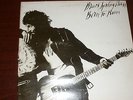
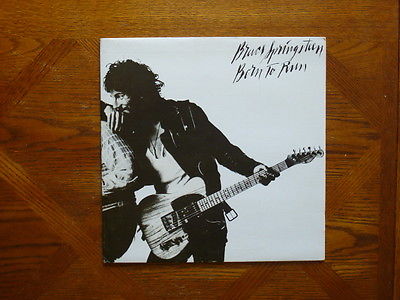
BRUCE SPRINGSTEEN BORN TO RUN INSANELY RARE ORIG SCRIPT COVER TEST PRESSING LP
$
1,792


Favourite Auctions
To save auctions to your favourites, please login
If you don't have an account, please register
Description
Less than 40 of these have sold online in the last eleven years. This is a rare opportunity to acquire the extremely hard to find and exceptionally desirable Born to Run Script Cover album!
This is my personal copy, which I received as a thank you for being an early believer in The Boss. I was Music Director at an FM station in Texas, and we played a lot of Bruce back in the day when we only had his first two albums and a bootleg copy of "The Fever" to work with.Collectors know there are several Script Cover packages in circulation. This one does not have the pouch or the lyric sheet, but it DOES have the red song title card that shows "Meeting Across the River" as "The Heist."
It also comes with an absolutely one-of-a-kind letter from Laurel Canyon Management., Ltd. (Springsteen's management company at the time) thanking me for all the early airplay and continued support. The letter is on Laurel Canyon Mgmt., Ltd letterhead, and even has two typos corrected with White-Out. It's the closest thing to a letter of authenticity that you'll ever find for this rarity. There is a photo of the letter in this listing, but the names have been obscured to prevent counterfeiting. You can buy with confidence knowing that this is an original, authentic, first USA test pressing. It is NOT a reissue, import, or a counterfeit pressing.
The runout area next to the plain white label has P AL-33795-1A on one side and P BL-33795-1A on the other side. (See photo.) The letters MCR also appear in the runout area on both sides.
The record is pressed on a RELATIVELY thick, inflexible vinyl. This is NOT a thin, flimsy ('Dynaflex' type), vinyl, but not the thickest, most rigid vinyl, either.
Of course, this is a full-bodied ANALOG recording, and not an inferior, digital recording!!!
Shipping inside the USA will be by UPS, insured, with signature required. Shipping outside the USA will be by USPS Priority Express Mail International, insured, with signature required. Will NOT ship to Asia, China, Africa, or the Russian Federation. Payment is by Paypal in US dollars only.
In honor of the year the album was released, bidding begins at $19.75.
EBay seller bobdjukic (19357) did some great research on the album, and he has graciously allowed me to reproduce it below. Even if you don’t buy the album, it makes great reading for any Springsteen fan.
Test Pressing copies with 'script covers', free of any graphics, production credits and track listings, containing only Bruce Springsteen's (and Clarence Clemons') photo and the album title in convoluted 'script' font are QUITE LITERALLY THOUSANDS - POSSIBLY AS MANY AS TENS OF THOUSANDS! - OF TIMES rarer that a regular, commercially released, version of the album, and are easily some of the rarest Rock items in existence.
We estimate that regular, retail copies of this album outnumber "script cover" test pressings by a ratio of at least 5,000 : 1 ( NO exaggeration here!). Just to give you a sense of perspective: as of March 2012, the album had sold approximately 6.5 million copies in the Unites States alone (and had probably added another half a million or so in sales since). In contrast, only about 35 copies of the "script covers" had sold online in the past 11 years, and probably as many offline (most in the Good (G)-to-Very Good (VG/VG+) conditions; Near Mint (NM) copies are a sight unseen and practically unknown). Assuming that the number of 'Script Covers' which sold in the past 11 years is just the tip of the iceberg of the total number of copies the collectors are jealously guarding and holding in their private collections (a VERY big "if"), and that Columbia actually originally shipped in 1975 as many as 50 times as many copies as have sold on the collectors' market during the past decade (a vastly overblown estimate, stated purely for argument's sake), we would still end up with a ratio of nearly 2,000 retail copies for every copy of the 'script cover' .
Mind you, a more realistic assessment would probably calculate the number of copies Columbia had shipped at only about 10 times the number made available to the market since 2004, most likely in the 300 to 700 total range, IF EVEN. This would make the ratio of commercially released copies to the test pressing closer to 10,000 : 1. Truly and honestly, Rock rarities don't get any rarer than this. Short of getting The Boss' birth certificate, original Columbia recording contract, marriage certificate, driver's license and signed underwear, you can't get any closer to the Bruce Springsteen Holy Grail than this. THIS IS IT!
Neither the cover nor the labels on the test pressing provide track listings, so Columbia's marketing team included a tentative track listing on a separate neatly printed bright red card as a courtesy to the recipients. Alas, as it turned out, this last insert contained a significant error, because it listed the wrong (later changed) title of the seventh track ("Meeting Across The River") under its original title ("The Heist"), so Columbia retracted this insert from the subsequent mailings after the mistake was discovered. Apparently, the company didn't want to convey the appearance of glamourizing crime, so someone at Columbia gently prodded Bruce Springsteen and/or Jon Landau (the album's principal co-producer) to change the song's title in order to make the track title less controversial and more parent-friendly.
Representing Springsteen's effort to break into the mainstream, Born to Run was a critical and commercial success. It peaked at number three on the Billboard 200, eventually selling six million copies in the US by the year 2000. Two singles were released from the album: "Born to Run" and "Tenth Avenue Freeze-Out"; the first helped Springsteen to reach mainstream popularity. The tracks "Thunder Road" and "Jungleland" became staples of album-oriented rock radio and Springsteen concert high points.
Born to Run garnered widespread critical acclaim. Praise centered on its production quality and Springsteen's songwriting, which focuses on the coming of age of average teenagers and young adults in New Jersey and New York City.
Springsteen began work on the album in May 1974. Given an enormous budget in a last-ditch effort at a commercially viable record, Springsteen became bogged down in the recording process while striving for a wall of sound production. But, fed by the release of an early mix of "Born to Run" to progressive rock radio, anticipation built toward the album's release.
Springsteen has noted a progression in his songwriting compared to his previous work. Unlike Greetings from Asbury Park, N.J. and The Wild, the Innocent and the E Street Shuffle, Born to Run includes few specific references to places in New Jersey, in an attempt to make the songs more identifiable to a wider audience. Springsteen has also referred to a maturation in his lyrics, calling Born to Run "the album where I left behind my adolescent definitions of love and freedom—it was the dividing line." In addition, Springsteen spent more time in the studio refining songs than he had on the previous two albums. All in all, the album took more than 14 months to record, with six months alone spent on the song "Born to Run" itself. During this time Springsteen battled with anger and frustration over the album, saying he heard "sounds in [his] head" that he could not explain to the others in the studio. During the process, Springsteen brought in Jon Landau to help with production. This was the beginning of the breakup of Springsteen's relationship with producer and manager Mike Appel, after which Landau assumed both roles. The album was Springsteen's first to feature pianist Roy Bittan and drummer Max Weinberg (although David Sancious and Ernest "Boom" Carter played the piano and drums, respectively, on the title track).
The album is noted for its use of introductions to set the tone of each song (all of the record was composed on piano, not guitar), and for the Phil Spector-like "Wall of Sound" arrangements and production. Indeed, Springsteen has said that he wanted Born to Run to sound like "Roy Orbison singing Bob Dylan, produced by Spector." Most of the tracks were first recorded with a core rhythm section band comprising Springsteen, Weinberg, Bittan, and bassist Garry Tallent, with other members' contributions then added on.
In terms of the original LP's sequencing, Springsteen eventually adopted a "four corners" approach, as the songs beginning each side ("Thunder Road", "Born to Run") were uplifting odes to escape, while the songs ending each side ("Backstreets", "Jungleland") were sad epics of loss, betrayal, and defeat. (Originally, he had planned to begin and end the album with alternative versions of "Thunder Road".)
Also, original test pressings have "Meeting Across the River" billed as "The Heist". The original album cover has the title printed in a graffiti style font. These copies, known as the "script cover," are very rare and considered to be the "holy grail" for Springsteen collectors
The album's release was accompanied by a $250,000 promotional campaign by Columbia directed at both consumers and the music industry, making good use of Landau's "I saw rock 'n' roll's future—and its name is Bruce Springsteen" quote. With much publicity, Born to Run vaulted into the top 10 in its second week on the charts and soon went Gold. Time and Newsweek magazines put Springsteen on the cover in the same week (October 27, 1975) – in Time Magazine, Jay Cocks praised Springsteen, while the Newsweek article took a cynical look at the "next Dylan" hype that haunted Springsteen until his breakthrough. The question of hype became a story in itself as critics began wondering if Springsteen was for real or the product of record company promotion.
Upset with Columbia's promotion department, Springsteen said the decision to label him as the "future of rock was a very big mistake and I would like to strangle the guy who thought that up." When Springsteen arrived for his first UK concert at the Hammersmith Odeon, he personally tore down the "Finally the world is ready for Bruce Springsteen" posters in the lobby and ordered that the buttons with "I have seen the future of rock 'n' roll at the Hammersmith Odeon" printed on them not be given out. Now fearing the hype might backfire, Columbia suspended all press interviews with Springsteen. When the hype died down, sales tapered off and the album was off the chart after 29 weeks. But the album had established a solid national fan base for Springsteen which he would build on with each subsequent release.
(EXCERPT FROM AN ONLINE ARTICLE IN WIKIPEDIA.ORG)
Why The Boss (or someone from his entourage, or at Columbia, his recording label) decided to, at the proverbial last moment, change the original cover, font and typeset of his ground-breaking third album and completely scuttle the proposed graphic design, replacing it with something much simpler and more elegant, is a matter of some conjecture and speculation. We do not have any final answer, but there could be three possible explanation for the sudden decision to replace the graphic "script" font in the album title with something leaner, meaner, more urbane and elegant.
- The simplest and most widely accepted theory was that that the people around Springsteen thought the album title too difficult to discern and to read in its "script" configuration (indeed, the "script" font does look a wee bit strange, even bizarre, almost kinda gothic in appearance, and definitely counterintuitive relative to the album's urban appeal). So, out the window the grotesque Victorian font went, and was replaced with something more elegant and modern. Voila! The Boss goes lean'n' mean! Done deal!
- The second theory also makes sense: that this was simply an impromptu lettering and typeset and that it was never really intended to stick. Therefore, the decision to abandon the impromptu graphic design after the minute press run of test pressings distributed to the music industry professionals was exhausted was only natural and to be expected.
However, we have a totally, radically, new - third - theory: namely, this particular font - as was used on the 'script cover' test pressings such as the one we have here, was common to a whole slew of 1970s rock and pop releases, and can be found on albums by artists such as Mamas and Papas ("People like us"), Boz Scaggs ("Moments") , Loggins and Messina (first album), Laura Nyro (New York Tendaberry, the withdrawn version) and literally tens, possibly hundreds of other 1970s releases. It was essentially a "cookie-cutter" kind of generic font the recording industry - but Columbia in particular - had used indiscriminately whenever they ran out of original ideas and were in the rush to release something quick. Because this font was pretty much associated with bland, '70s AOR Rock, soft-pop and easy-listening, we assume that Bruce Springsteen must have freaked out when he saw himself in the same league as Loggins and Messina and Mamas and Papas and ordered the graphics radically reworked right on the spot. Indeed, if this was The Boss's motive, the plan worked: the final font, as used on the final release of Born to Run, is almost as iconic as the album itself.
Needless to say, copies of the original "script covers" cover, which we are offering here, have been known to change hands for more than $3,000.00. This is the item of such historical significance that missing out on it would be a major act of foolishness. Don’t fail to grab (by the script!) this insanely rare piece which is only offered once in a blue moon.
***
Bruce Springsteen's make-or-break third album represented a sonic leap from his first two, which had been made for modest sums at a suburban studio; Born to Run was cut on a superstar budget, mostly at the Record Plant in New York. Springsteen's backup band had changed, with his two virtuoso players, keyboardist David Sancious and drummer Vini Lopez, replaced by the professional but less flashy Roy Bittan and Max Weinberg. The result was a full, highly produced sound that contained elements of Phil Spector's melodramatic work of the 1960s. Layers of guitar, layers of echo on the vocals, lots of keyboards, thunderous drums — Born to Run had a big sound, and Springsteen wrote big songs to match it. The overall theme of the album was similar to that of The E Street Shuffle; Springsteen was describing, and saying farewell to, a romanticized teenage street life. But where he had been affectionate, even humorous before, he was becoming increasingly bitter. If Springsteen had celebrated his dead-end kids on his first album and viewed them nostalgically on his second, on his third he seemed to despise their failure, perhaps because he was beginning to fear he was trapped himself. Nevertheless, he now felt removed, composing an updated West Side Story with spectacular music that owed more to Bernstein than to Berry. To call Born to Run overblown is to miss the point; Springsteen's precise intention is to blow things up, both in the sense of expanding them to gargantuan size and of exploding them. If The Wild, the Innocent & the E Street Shuffle was an accidental miracle, Born to Run was an intentional masterpiece. It declared its own greatness with songs and a sound that lived up to Springsteen's promise, and though some thought it took itself too seriously, many found that exalting.
(EXCERPT FROM AN ONLINE REVIEW BY WILLIAM RUHLMAN, ALL MUSIC GUIDE /ALLMUSIC.COM/)
For its extraordinary contribution to the modern music, superb production, craftsmanship, fine musicianship, revolutionary significance and influence it exerted on numerous generations of musicians, writers and general public, or for some other innate quality, this album was voted one of top-200 albums of all time in one of the largest poll of critics, music reviewers, professionals and producers ever organized: the poll, which was conducted by Paul Gambaccini, legendary BBC Radio A&R man, surveyed more than 50 top music professionals (including Roy Carr, Jonathan Cott, Robert Christgau, Cameron Crowe, Chet Flippo, Ben Fong-Torres, Charlie Gillett, Greil Marcus, Murray the K., Lenny Kaye, Bruce Morrow (a/k/a "Cousin Brucie"), Tim Rice (of "Jesus Christ Superstar" and "Evita" fame), Lisa Robinson, Robert Shelton (who wrote liner notes for Bob Dylan's first album), Ed Ward, Joel Whitburn, Pete Wingfield, etc.). For more details, see: "Critics Choice: Top-200 albums" compiled by Paul Gambaccini, Omnibus Press, Library of Congress Catalog No.7855565 (or ?click here for the complete album listing).
For additional historical or discography information on this album, including track listing ?click here