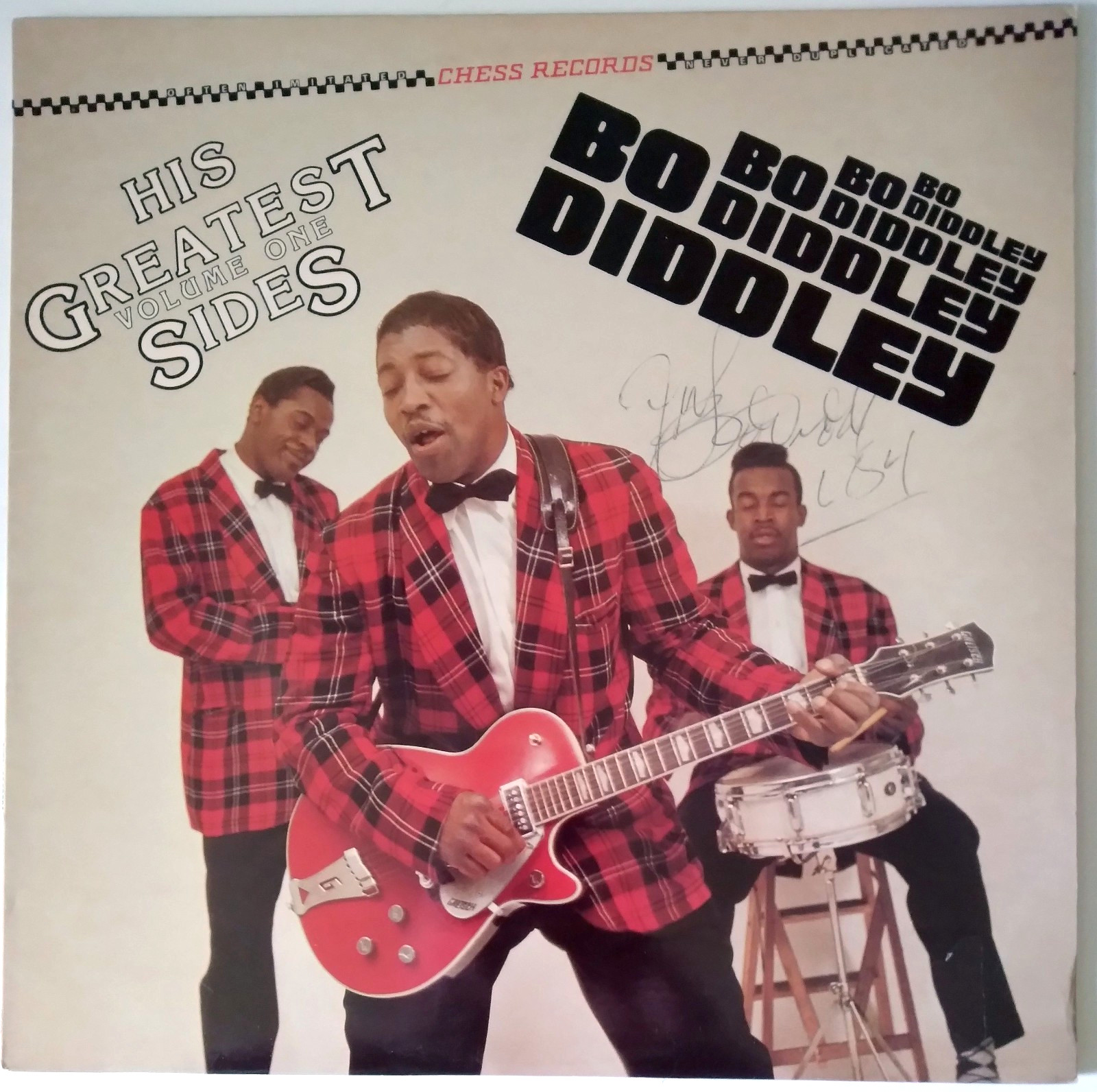
Bo Diddley His Greatest Sides Chess/Sugar Hill Reissue LP * Signed Autographed *
$
166


Favourite Auctions
To save auctions to your favourites, please login
If you don't have an account, please register
Description
Bo Diddley
His Greatest Sides : Volume One
Full-Length 12" Vinyl Record Album
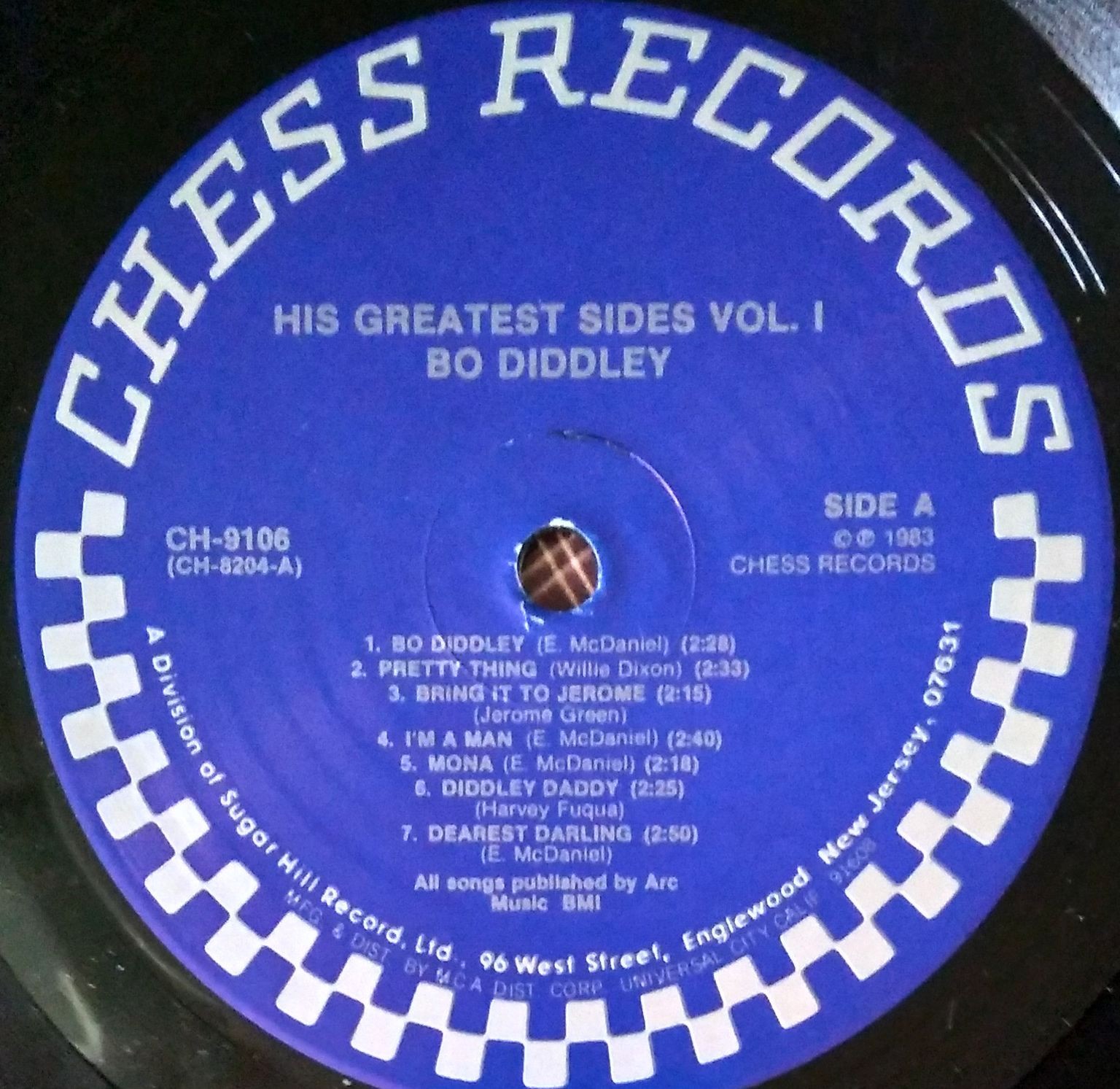
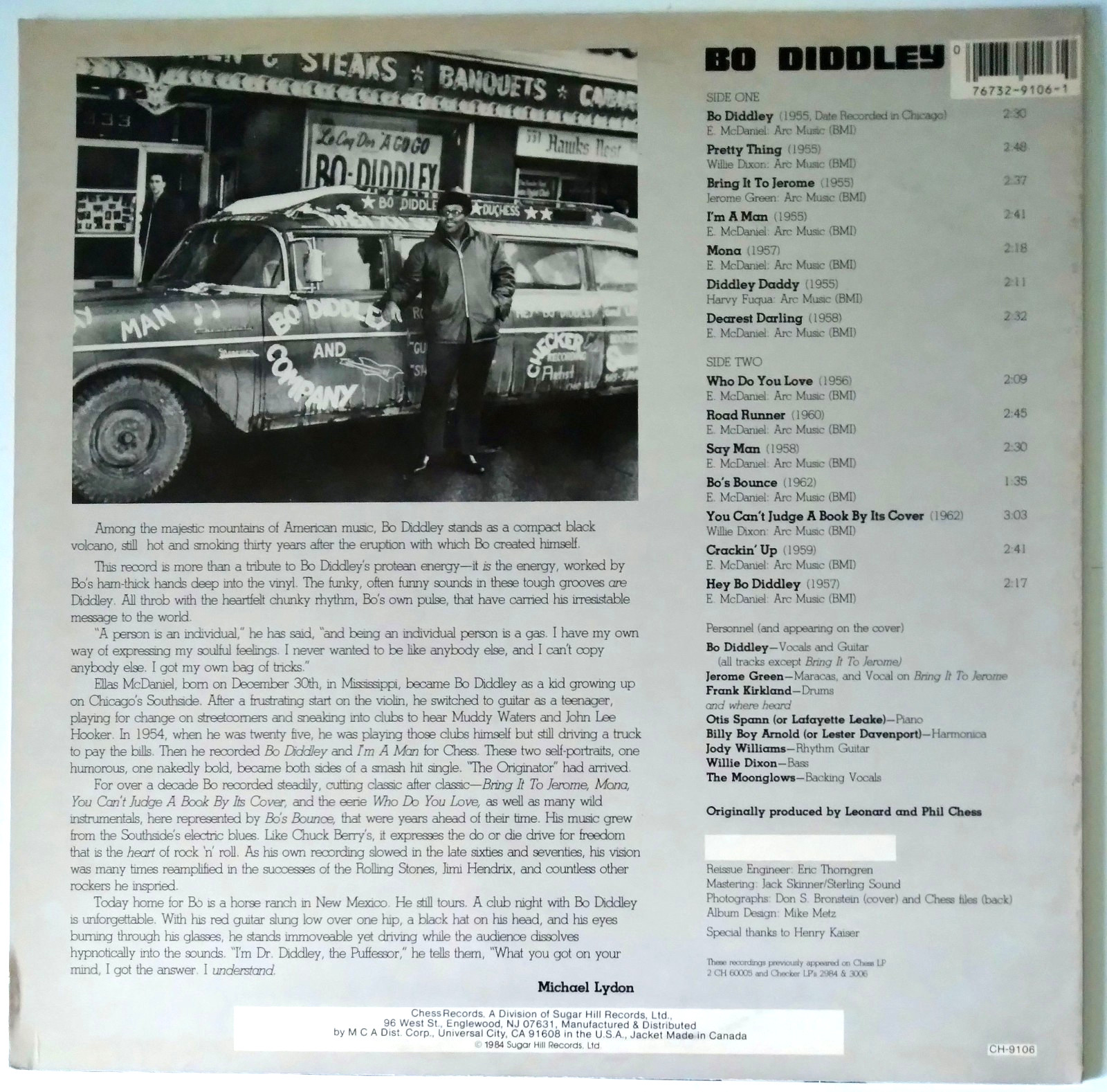
Description: The front cover is signed "Luck Bo Diddley 1984" in blue pen. The album cover features Bo rocking his red Gretsch guitar in his red-checkerboard suit. On the back cover is a photo of Bo posing by his "Checker Recording Artist" Chevrolet Stageway Limousine outside the Hawks Nest. The vinyl record is in glossy clean excellent/near mint condition. The cover is in very good+ condition, minor surface wear, no seam splits. The record labels read "1983" and on the back cover is "©1984 Sugar Hill Records". Barcode #07673291061. Please see pictures. Check out our other listings for a wide variety of vinyl records and CDs. We ship worldwide in secure, padded packaging. Please let us know if you have any questions for a prompt reply.
Tracklist:
1. Bo Diddley
2. Pretty Thing
3. Bring It To Jerome
4. I'm A Man
5. Mona
6. Diddley Daddy
7. Dearest Darling
8. Who Do You Love
9. Road Runner
10. Say Man
11. Bo's Bounce
12. You Can't Judge A Book By Its Cover
13. Crackin' Up
14. Hey Bo Diddley
Ellas McDaniel (born Ellas Otha Bates) (1928-2008) known as Bo Diddley, was an American singer, guitarist, songwriter and music producer who played a key role in the transition from the blues to rock and roll. He influenced many artists, including Buddy Holly, Elvis Presley, the Beatles, the Rolling Stones, the Animals, and the Clash. His use of African rhythms and a signature beat, a simple five-accent hambone rhythm, is a cornerstone of hip hop, rock, and pop music. In recognition of his achievements, he was inducted into the Rock and Roll Hall of Fame in 1987. Diddley is also recognized for his technical innovations, including his distinctive rectangular guitar, with its unique booming, resonant, shimmering tones. Born in McComb, Mississippi, as Ellas Otha Bates, he was adopted and raised by his mother's cousin, Gussie McDaniel, whose surname he assumed. In 1934, the McDaniel family moved to the South Side of Chicago, where he dropped Otha from his name and became Ellas McDaniel. He was an active member of Chicago's Ebenezer Baptist Church, where he studied the trombone and the violin, becoming so proficient on the violin that the musical director invited him to join the orchestra. He performed until he was 18. However, he was more interested in the pulsating, rhythmic music he heard at a local Pentecostal Church and took up the guitar. Inspired by a John Lee Hooker performance, he supplemented his income as a carpenter and mechanic by playing on street corners with friends, including Jerome Green in the Hipsters band, later renamed the Langley Avenue Jive Cats. Green became a near-constant member of McDaniel's backing band, the two often trading joking insults with each other during live shows. During the summers of 1943 and 1944, he played at the Maxwell Street market in a band with Earl Hooker. By 1951 he was playing on the street with backing from Roosevelt Jackson on washtub bass and Jody Williams, whom he had taught to play the guitar. Williams later played lead guitar on "Who Do You Love?" (1956). In 1951, he landed a regular spot at the 708 Club, on Chicago's South Side, with a repertoire influenced by Louis Jordan, John Lee Hooker, and Muddy Waters. In late 1954, he teamed up with harmonica player Billy Boy Arnold, drummer Clifton James and bass player Roosevelt Jackson and recorded demos of "I'm a Man" and "Bo Diddley". They re-recorded the songs at Chess Studios, with a backing ensemble comprising Otis Spann (piano), Lester Davenport (harmonica), Frank Kirkland (drums), and Jerome Green (maracas). The record was released in March 1955, and the A-side, "Bo Diddley", became a number one R&B hit. The origin of the stage name Bo Diddley is unclear. McDaniel claimed that his peers gave him the name, which he suspected was an insult. He also said that the name first belonged to a singer his adoptive mother knew. Harmonicist Billy Boy Arnold said that it was a local comedian's name, which Leonard Chess adopted as McDaniel's stage name and the title of his first single. McDaniel also stated that his school classmates in Chicago gave him the nickname, which he started using when sparring and boxing in the neighborhood with The Little Neighborhood Golden Gloves Bunch. In the story "Black Death" by Zora Neale Hurston, Beau Diddely was a womanizer who impregnates a young woman, disavows responsibility, and meets his undoing by the powers of the local hoodoo man. Hurston submitted it in a contest run by the academic journal Opportunity in 1925, where it won an honorable mention, but it was never published in her lifetime. A diddley bow is a homemade single-string instrument played mainly by farm workers in the South. It probably has influences from the West African coast. In the American slang term bo diddly, bo is an intensifier and diddly is a truncation of diddly squat, which means "absolutely nothing". In 1955, Diddley appeared on the popular television program The Ed Sullivan Show. When someone on the show's staff overheard him casually singing "Sixteen Tons" in the dressing room, he was asked to perform the song on the show. Seeing "Bo Diddley" on the cue card, he thought he was to perform both his self-titled hit single and "Sixteen Tons". Sullivan was furious and banned Diddley from his show, reputedly saying that he wouldn't last six months. Chess Records included Diddley's cover of "Sixteen Tons" on the 1960 album Bo Diddley Is a Gunslinger. Diddley's hit singles continued in the 1950s and 1960s: "Pretty Thing" (1956), "Say Man" (1959), and "You Can't Judge a Book by the Cover" (1962). He also released numerous albums, including Bo Diddley Is a Gunslinger and Have Guitar, Will Travel. These bolstered his self-invented legend. Between 1958 and 1963, Checker Records released eleven full-length Bo Diddley albums. In the 1960s, he broke through as a crossover artist with white audiences appearing at the Alan Freed concerts but he rarely aimed his compositions at teenagers. The album title Surfing with Bo Diddley derived from his influence on surf guitarists rather than surfing per se. In 1963, Diddley starred in a UK concert tour with the Everly Brothers and Little Richard along with the Rolling Stones an unknown band at that time. He wrote many songs for himself and also for others. In 1956, he and guitarist Jody Williams co-wrote the pop song "Love Is Strange", a hit for Mickey & Sylvia in 1957. He also wrote "Mama Can I Go Out", which was a minor hit for the pioneering rockabilly singer Jo Ann Campbell, who performed the song in the 1959 rock and roll film Go Johnny Go. After moving from Chicago to Washington, D.C., Diddley built his first home recording studio in the basement of his home. Frequented by several of Washington, D.C.'s musical luminaries, the studio was the site where he recorded the Checker LP Bo Diddley Is a Gunslinger. Diddley also produced and recorded several up-and-coming groups from the Washington, D.C. area. One of the first singles he recorded was Wyatt Earp with local Doo Wop group the Marquees, featuring his valet, Marvin Gaye. After the Chess brothers failed to see the commercial potential of releasing a song that extended the black cowboy concept, Diddley found acceptance at Okeh Records, a label that rivaled Chess in the promotion of Rhythm and Blues. Diddley convinced Moonglows' founder, and backing vocalist Harvey Fuqua, to hire Marvin Gaye. Gaye joined the Moonglows, who then moved to Detroit with the hope of signing with Motown Records founder Berry Gordy Jr. Diddley included women in his band: Norma-Jean Wofford, also known as The Duchess; Gloria Jolivet; Peggy Jones, also known as Lady Bo, a lead guitarist rare for a woman at that time; and Cornelia Redmond, also known as Cookie V. Over the decades, Diddley's performing venues ranged from intimate clubs to stadiums. In 1972, he played with the Grateful Dead at the Academy of Music in New York City. The Grateful Dead released part of this concert as Volume 30 of the band's concert album series, Dick's Picks. Also in the early 1970s, the soundtrack of the ground-breaking animated film Fritz the Cat contained his song "Bo Diddley", in which a crow idly finger-pops to the track. Diddley spent some years in New Mexico, living in Los Lunas from 1971 to 1978, while continuing his musical career. He served for two and a half years as a deputy sheriff in the Valencia County Citizens' Patrol; during that time he purchased and donated three highway-patrol pursuit cars. In the late 1970s, he left Los Lunas and moved to Hawthorne, Florida, where he lived on a large estate in a custom-made log cabin, which he helped to build. For the remainder of his life he divided his time between Albuquerque and Florida, living the last 13 years of his life in Archer, Florida, a small farming town near Gainesville. In 1979, he appeared as an opening act for The Clash on their US tour. In 1983, he made a cameo appearance as a Philadelphia pawn shop owner in the comedy film Trading Places. He also appeared in George Thorogood's music video for the song "Bad to the Bone," portraying a guitar-slinging pool shark. In 1989, Diddley entered into a licensing agreement with the sportswear brand Nike. The Wieden & Kennedy produced commercial in the "Bo Knows" campaign, teamed Diddley with dual sportsman Bo Jackson, and resulted in one of the most iconic advertisements in advertising history. The agreement ended in 1991, but in 1999, a T-shirt of Diddley's image and "You don't know diddley" slogan was purchased in a Gainesville, Florida sports apparel store. Diddley felt that Nike should not continue to use the slogan or his likeness and fought Nike over the copyright infringement. Despite the fact that lawyers for both parties could not come to a renewed legal arrangement, Nike allegedly continued marketing the apparel and ignored cease-and-desist orders and a lawsuit was filed on Diddley's behalf, in Manhattan Federal Court. In Legends of Guitar filmed live in Spain in 1991, Diddley performed with B.B. King, Les Paul, Albert Collins, and George Benson, among others. He joined the Rolling Stones on their 1994 concert broadcast of Voodoo Lounge, performing "Who Do You Love?". In 1996, he released A Man Amongst Men, his first major-label album and his final studio album with guest artists like Keith Richards, Ron Wood and the Shirelles. The album earned a Grammy Award nomination in 1997 for the Best Contemporary Blues Album category. Diddley performed a number of shows around the country in 2005 and 2006, with fellow Rock and Roll Hall of Famer Johnnie Johnson and his band, consisting of Johnson on keyboards, Richard Hunt on drums and Gus Thornton on bass. In 2006, he participated as the headliner of a grassroots-organized fundraiser concert to benefit the town of Ocean Springs, Mississippi, which had been devastated by Hurricane Katrina. When asked about the fundraiser, Diddley stated, "This is the United States of America. We believe in helping one another". The all-star band included members of the Soul Providers, and famed artists Clarence Clemons of the E Street Band, Joey Covington of Jefferson Airplane, Alfonso Carey of The Village People, and Carl Spagnuolo of Jay & The Techniques. In an interview with Holger Petersen, on Saturday Night Blues on CBC Radio in 2006 he commented on racism in the music industry establishment during his early career, which deprived him of royalties from the most successful part of his career. His final guitar performance on a studio album was with the New York Dolls on their 2006 album One Day It Will Please Us to Remember Even This. He contributed guitar work to the song "Seventeen". In 2007, Diddley suffered a stroke after a concert the previous day in Council Bluffs, Iowa. Nonetheless, he delivered an energetic performance to an enthusiastic crowd. A few months later he had a heart attack. While recovering, Diddley came back to his hometown of McComb, Mississippi for the unveiling of a plaque devoted to him on the Mississippi Blues Trail. He was not supposed to perform, but as he listened to the music of local musician Jesse Robinson, who sang a song written for this occasion, Robinson sensed that Diddley wanted to perform and handed him a microphone, the only time that he performed publicly after his stroke. On June 25, 2019, The New York Times Magazine listed Bo Diddley among hundreds of artists whose material was reportedly destroyed in the 2008 Universal fire. Bo Diddley was married four times. His first marriage, at 18, to Louise Willingham, lasted a year. Diddley married his second wife Ethel Mae Smith in 1949; they had two children. He met his third wife, Kay Reynolds, when she was 15, while performing in Birmingham, Alabama. They soon moved in together and married, despite taboos against interracial marriage. They had two daughters. He married his fourth wife, Sylvia Paiz, in 1992; they were divorced at the time of his death. In 2007, Diddley was admitted to intensive care in Creighton University Medical Center in Omaha, Nebraska, following a stroke after a concert the previous day in Council Bluffs, Iowa. Starting the show, he had complained that he did not feel well. He referred to smoke from the wildfires that were ravaging south Georgia and blowing south to the area near his home in Archer, Florida. The next day, as he was heading back home, he seemed dazed and confused at the airport; 911 and airport security were called, and he was immediately taken by ambulance to Creighton University Medical Center where he stayed for several days. After tests, it was confirmed that he had suffered a stroke. Diddley had a history of hypertension and diabetes, and the stroke affected the left side of his brain, causing receptive and expressive aphasia speech impairment. The stroke was followed by a heart attack, which he suffered in Gainesville, Florida. Bo Diddley died on June 2, 2008, of heart failure at his home in Archer, Florida at the age of 79. Garry Mitchell, his grandson and one of more than thirty-five family members at the musician's home when he died said his death was not unexpected. "There was a gospel song that was sang at his bedside and when it was done he said 'wow' with a thumbs up," Mitchell told Reuters, when asked to describe the scene at the deathbed. "The song was 'Walk Around Heaven' and in his last words he stated that he was going to heaven." He was survived by his children, Evelyn Kelly, Ellas A. McDaniel, Pamela Jacobs, Steven Jones, Terri Lynn McDaniel-Hines, and Tammi D. McDaniel; a brother, the Rev. Kenneth Haynes; and eighteen grandchildren, fifteen great-grandchildren and three great-great-grandchildren. His funeral, a four-hour "homegoing" service, took place on June 7, 2008, at Showers of Blessings Church in Gainesville, Florida. Some in attendance chanted "Hey Bo Diddley" as the Archer Church of God in Christ gospel band played. A number of notable musicians sent flowers, including Little Richard, George Thorogood, Tom Petty and Jerry Lee Lewis. Little Richard, who had been asking his audiences to pray for Bo Diddley throughout his illness, had to fulfill concert commitments in Westbury and New York City the weekend of the funeral. He remembered Diddley at the concert, performing his namesake tune. After the funeral service, a tribute concert was held at the Martin Luther King Center in Gainesville, Florida, and featured guest performances by his son and daughter, Ellas A. McDaniel and Evelyn "Tan" Cooper; long-time background vocalist and original Boette, Gloria Jolivet; long-time friend, co-producer, and former Bo Diddley & Offspring guitarist Scott "Skyntyte" Free; and Eric Burdon. In the days following his death, tributes were paid by then-President George W. Bush, the United States House of Representatives, and musicians and performers including B. B. King, Ronnie Hawkins, Mick Jagger, Ronnie Wood, George Thorogood, Eric Clapton, Tom Petty, Robert Plant, Elvis Costello, Bonnie Raitt, Robert Randolph and the Family Band and Eric Burdon. Burdon used video footage of the McDaniel family and friends in mourning for a video promoting his ABKCO Records release "Bo Diddley Special". In 2009, the guitar used by Bo Diddley in his final stage performance sold for $60,000 at auction. All twenty-two beneficiaries of his estate sought a forensic accounting of his estate, but were denied without explanation. Bo Diddley was posthumously awarded a Doctor of Fine Arts degree by the University of Florida for his influence on American popular music. In its People in America radio series, about influential people in American history, the Voice of America radio service paid tribute to him, describing how "his influence was so widespread that it is hard to imagine what rock and roll would have sounded like without him." Mick Jagger stated that "he was a wonderful, original musician who was an enormous force in music and was a big influence on the Rolling Stones. He was very generous to us in our early years and we learned a lot from him". The documentary film Cheat You Fair: The Story of Maxwell Street by director Phil Ranstrom features Bo Diddley's last on-camera interview. He achieved numerous accolades in recognition of his significant role as one of the founding fathers of rock and roll. In 2005, Bo Diddley celebrated his 50th anniversary in music with successful tours of Australia and Europe and with coast-to-coast shows across North America. He performed his song "Bo Diddley" with Eric Clapton and Robbie Robertson at the Rock and Roll Hall of Fame's 20th annual induction ceremony. The "Bo Diddley beat" is essentially the clave rhythm, one of the most common bell patterns found in sub-Saharan African music traditions. One scholar found this rhythm in 13 rhythm and blues recordings made in the years 1944–55, including two by Johnny Otis from 1948. Bo Diddley gave different accounts of how he began to use this rhythm. The Bo Diddley beat is similar to "hambone", a style used by street performers who play out the beat by slapping and patting their arms, legs, chest, and cheeks while chanting rhymes. Somewhat resembling the "shave and a haircut, two bits" rhythm, Diddley came across it while trying to play Gene Autry's "I've Got Spurs That Jingle, Jangle, Jingle". Three years before his "Bo Diddley", a song with similar syncopation "Hambone", was cut by the Red Saunders Orchestra with the Hambone Kids. In 1944, "Rum and Coca Cola", containing the Bo Diddley beat, was recorded by the Andrews Sisters. Buddy Holly's "Not Fade Away" (1957) and Them's "Mystic Eyes" (1965) used the beat. In its simplest form, the Bo Diddley beat can be counted out as either a one-bar or a two-bar phrase. Here is the count as a one-bar phrase: One e and ah, two e and ah, three e and ah, four e and ah (the boldface counts are the clave rhythm). Many songs (for example, "Hey Bo Diddley" and "Who Do You Love?") often have no chord changes; that is, the musicians play the same chord throughout the piece, so that the rhythms create the excitement, rather than having the excitement generated by harmonic tension and release. In his other recordings, Bo Diddley used various rhythms, from straight back beat to pop ballad style to doo-wop, frequently with maracas by Jerome Green. An influential guitar player, Bo Diddley developed many special effects and other innovations in tone and attack, particularly the resonant "shimmering" sound. His trademark instrument was his self-designed, one-of-a-kind, rectangular-bodied "Twang Machine" referred to as "cigar-box shaped" by music promoter Dick Clark, built by Gretsch. He had other uniquely shaped guitars custom-made for him by other manufacturers throughout the years, most notably the "Cadillac" and the rectangular "Turbo 5-speed" with built-in envelope filter, flanger and delay designs, made by Tom Holmes who also made guitars for ZZ Top's Billy Gibbons, among others. In a 2005 interview on JJJ radio in Australia, he implied that the rectangular design sprang from an embarrassing moment. During an early gig, while jumping around on stage with a Gibson L5 guitar, he landed awkwardly, hurting his groin. He then went about designing a smaller, less-restrictive guitar that allowed him to keep jumping around on stage while still playing his guitar. He also played the violin, which is featured on his mournful instrumental "The Clock Strikes Twelve", a twelve-bar blues. He often created lyrics as witty and humorous adaptations of folk music themes. The song "Bo Diddley" was based on the African-American clapping rhyme "Hambone" which in turn was based on the lullaby "Hush Little Baby". Likewise, "Hey Bo Diddley" is based on the song "Old MacDonald". The song "Who Do You Love?" with its rap-style boasting, and his use of the African-American game known as "the dozens" on the songs "Say Man" and "Say Man, Back Again," are cited as progenitors of hip-hop music. (wiki)
Check out our listings for more vinyl records, CD's & more. Save on shipping!
price rating