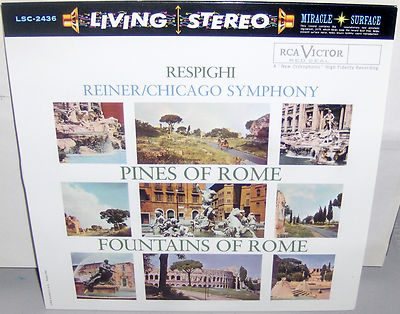
CLASSIC RECORDS LP LSC2436: Respighi - Pines of Rome, etc - REINER - OOP 1st NM
$
99


Favourite Auctions
To save auctions to your favourites, please login
If you don't have an account, please register
Description
****Welcome to our eBay listing, thanks very much for looking!
****FREE SHIPPING to the USA and/or CANADA - all other locations are subject to a reasonable shipping charge.
****Please check out our other eBay store listings and eBay auctions for more great LPs and CDs - new items added daily!
****To access our eBay store either click on the little red door at the top right section of any of our eBay listings or, click on -
http://stores.ebay.com/Hear-The-Difference
Background on this eBay item -
A highly sought-after RCA shaded dog Living Stereo title, the performance and sonics found within, rate a resounding 10 out of 10. The dynamics are monstrous! This is one of the jewels in the Living Stereo crown. This, like the Rimsky-Korsakov Scheherazade, is considered one of the very best LPs by Reiner, the CSO and RCA's crew. Another Mohr and Layton classic.
Pines of Rome is a symphonic poem written in 1924 by the Italian composer Ottorino Respighi and, together with Fontane di Roma and Feste Romane, forms what is sometimes loosely referred to as his "Roman trilogy". Each movement depicts the pine trees in different locations in Rome at different times of day.
- I pini di Villa Borghese (The Pines of Villa Borghese)
- Pini presso una catacomba (Pines near a catacomb)
- I pini del Gianicolo (The Pines of the Janiculum)
- I pini della Via Appia (The Pines of the Appian Way)
The first movement, I pini di Villa Borghese, portrays noisy children playing soldiers and marching in the pine groves of the Borghese gardens. The second movement, Pini presso una catacomba is a majestic dirge, representing pine trees near a catacomb in Campagna. Lower orchestral instruments, plus the organ pedal at 16' and 32' pitch, suggest the subterranean nature of the catacombs, while the trombones represent priests chanting. The third part, I pini del Gianicolo, is a nocturne set near a temple, on the Janiculum hill, of the Roman god Janus. Double-faced gods open large doors and gates, marking the beginning of a new year. Respighi takes the opportunity to include the actual sound of a nightingale, something that had never been done before. (The score mentions a specific recording that can be played on a phonograph: the "Brunswick Panatrope"). The final movement, I pini della Via Appia, portrays pine trees along the great Appian Way. Misty dawn: a legion advances along the Via Appia in the brilliance of the newly-risen sun. Respighi wanted the ground to tremble under the footsteps of his army and he instructs the organ to play bottom B flat on 8', 16' and 32' organ pedal. The score calls for buccine - ancient trumpets that are usually represented by flugelhorns. Trumpets peal and the consular army rises in triumph to the Capitoline Hill.
Fontane di Roma (Fountains of Rome) is a 1916 work by Respighi, now considered part of the Roman Trilogy of symphonic poems. Each of the four sections is meant to depict one of Rome’s fountains during different periods of the day and night.
Arturo Toscanini originally planned to conduct the work in 1916, but the Italian composer refused to appear for the performance after a disagreement over his having included some of Wagner's music on a program played during World War I. Consequently, it did not premiere until March 11, 1917 where it appeared at the Teatro Augusteo in Rome with Antonio Guarnieri as conductor. Although the premiere was unsuccessful, Toscanini finally conducted the work in Milan in 1918 with tremendous success.
The piece was first performed in the United States on February 13, 1919. Toscanini recorded the music with the NBC Symphony Orchestra in Carnegie Hall in 1951. The work has since become one of the most eminent examples of the symphonic poem.
- "La fontana di Valle Giulia all'alba" (The Fountain of Valle Giulia at Dawn)
- "La fontana del Tritone al mattino" (The Triton Fountain in the Morning)
- "La fontana di Trevi al meriggio" (The Trevi Fountain at noon)
- "La fontana di Villa Medici al tramonto" (The Villa Medici Fountain at Sunset)
The first section, "La fontana di Valle Giulia all'Alba", shows this fountain at daybreak in a pastoral landscape, in which cattle pass during the morning.
In the second section- "La fontana del Tritone al mattino" - Naiads and Tritons dancing in the morning light, as figures of the Bernini fountain are seen nearby. Gods and goddesses using conch shells are portrayed by the French horn.
The third section introduces "La fontana di Trevi al meriggio" and is ushered in by a triumph giving news of a recent victory by the god Neptune.
The final section, "La fontana di Villa Medici al tramonto", portrays a much more melancholic atmosphere, as the brilliance of the sun fades.
-
CLASSIC RECORDS LP item - Shaded Dog record labels - RED with SILVER lettering, sporting the famous little nipper dog logo at the top third of the record label.
-
Record Made in the USA
-
Pressing is in STEREO
-
Record Speed: 33 1/3 rpm
-
Earliest version of this audiophile reissue by Classic Records - using 180-gram virgin vinyl and it is long out of print. This one is numbered: 1-0639
-
Record Made in: circa 1990's - original LP was issued in 1960 by RCA. Recorded by Richard Mohr (producer) and Lewis Layton (recording engineer).
-
Record Catalog Number: LSC 2436
Featured on this item:
Ottorino Respighi
Music on this LP Title:
Pines of Rome
Fountains of Rome
Performed By -Chicago Symphony Orchestra
Fritz Reiner, conductor
CONDITION Details:
LP JACKET:-
The LP jacket is in Near Mint condition - even though this item has been opened, it appears as a new record jacket - top notch condition!
-
The jacket has NO seam splits - it is completely intact.
-
The jacket has NO drill holes or saw marks of any kind.
-
The outer plastic cellophane (bag) wrap is still on the LP.
-
There is NO hand writing on the front or back of the jacket.
-
The cover has clean and sharp colors - see pictures with this listing for more detail.
-
The LP is in Near MINT condition as well. Like the jacket, the LP appears as NEW - top notch shape throughout!!
-
This is the mint copy you have always wanted in your collection - any super picky audiophile would be happy with this one!
A Short Note About LP GRADING -
- Mint = Only used for sealed items.
- Near Mint = Virtually flawless in every way.
- Near Mint Minus = Item has some minor imperfections, some audible.
- Excellent = Item obviously played and enjoyed with some noise.
- Very Good Plus = Many more imperfections which are noticeable and obtrusive.
price rating