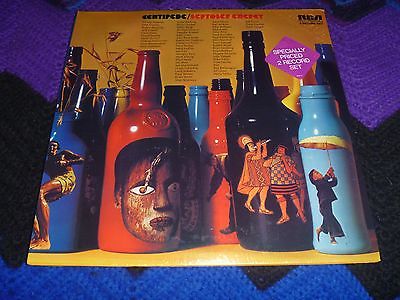
Centipede,Septober Energy,{SEALED} Keith Tippett,Robert Fripp,Promo,Double Album
$
40


Favourite Auctions
To save auctions to your favourites, please login
If you don't have an account, please register
Description
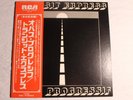
This record is Sealed! “ There is a 3" split in the shrink at the top of the cover, (see pics) Promotion Use Only Stamped Into The Cover, Upper Right Corner. British jazz and rock musicians from a number of bands, including Soft Machine, King Crimson, Nucleus and Blossom Toes. * Double Album *
Rare & Hard To Find Still Sealed.
Please See all High Resolution Photos & Important Note !
About this Album:
Centipede (band)
Centipede Centipede performing at the Lyceum Theatre in London,15 November 1970. Background information Origin London, England Genres Free jazz, jazz fusion, progressive rock Years active 1970–1971, 1975 Labels Neon Associated acts The Keith Tippett Group, Soft Machine, King Crimson Past members See Centipede members
Centipede were an English jazz/progressive rock/big band with more than 50 members, organized and led by the British free jazz pianist Keith Tippett. Formed in 1970, it brought together much of a generation of young British jazz and rock musicians from a number of bands, including Soft Machine, King Crimson, Nucleus and Blossom Toes.
Centipede performed several concerts in England, toured France, and recorded a double-album, Septober Energy (produced by Robert Fripp), before disbanding at the end of 1971. They reformed briefly in 1975 to play at a few French jazz festivals.
History
Centipede was formed by Keith Tippett in 1970 to perform an extended composition, Septober Energy that he had been working on. The members were drawn from his own band at the time, The Keith Tippett Group, several British progressive rock, jazz-rock and avant-garde jazz groups, including Soft Machine (Robert Wyatt, Elton Dean, Nick Evans, Mark Charig), Nucleus (Karl Jenkins, Ian Carr, Brian Smith, Jeff Clyne, Roy Babbington, Bryan Spring, John Stanley Marshall) and King Crimson (Robert Fripp, Peter Sinfield, Ian McDonald, Boz Burrell), and students of the London School of Music. Septober Energy consisted of four movements, or "concepts" that the band improvised around. It was first performed by the band live at the Lyceum Theatre in London on 15 November 1970.
Centipede toured France in November 1970, giving two "memorable performances" at the Alhambra Theatre in Bordeaux. They also played for the Rotterdam Arts Council in the Netherlands, at the Lanchester Arts Festival and the Bristol University Student Union. Centipede's concerts attracted "uneven reviews", with some critics calling Tippett's music "long and leaden", and others praising it as a "bold extension" of what Tippett and his band were already doing.
In April 1971, Neon Records, a British sub-label of RCA in the United States, signed up Tippett and Centipede, and Centipede recorded Tippett's composition on a double album, Septober Energy in June that year. Robert Fripp produced the album and it was released in October 1971 in the United Kingdom only. Tippett had featured prominently on three of King Crimson's albums (In the Wake of Poseidon, Lizard and Islands) and Fripp had even invited Tippett to join the band (he declined). While some of the other Crimson members featured on Septober Energy, Fripp, who had performed live with Centipede, did not.
Centipede, now reduced in size for economic reasons, gave two performances in London to promote the album, one at the Royal Albert Hall in October 1971, and the other at the Rainbow Theatre in December 1971. But the album was not generally well received by critics and as no further engagements were forthcoming, Centipede disbanded at the end of 1971.
In 1974 RCA issued Septober Energy in the United States, hoping to cash in on Fripp's name as the producer, but it failed, particularly because Centipede did not exist to promote the album with performances. The band did, however, reform briefly in October 1975, with David Cross from King Crimson, to perform at several French jazz festivals.
Tippett said in a January 2003 interview that in 1970 the Centipede project was "quite innocent" and that "no-one was doing it for the money".Their debut performance at the Lyceum was a benefit concert for the Jazz Centre Society. Tippett said that at the time there was considerable interest in the project, and that while the initial performance consisted of 50 musicians, "there could have been 100".
Tippett later instigated The Ark, another large big band jazz project that recorded the album Frames (Music For An Imaginary Film) for Ogun Records in 1978.
Recordings
- Septober Energy
Members
The members below are the personnel that appeared on Centipede's album, Septober Energy.
Violins- Wendy Treacher
- Jihn Trussler
- Roddy Skeping
- Wilf Gibson (lead)
- Carol Slater
- Louise Jopling
- Garth Morton
- Channa Salononson
- Steve Rowlandson
- Mica Gomberti
- Colin Kitching
- Philip Saudek
- Esther Burgi
- Michael Hurwitz
- Timothy Kramer
- Suki Towb
- John Rees-Jones
- Katherine Thulborn
- Catherine Finnis
- Peter Parkes
- Mick Collins
- Ian Carr (doubling flugelhorn)
- Mongezi Feza (pocket cornet)
- Mark Charig (cornet)
- Elton Dean (doubling saxello)
- Jan Steele (doubling flute)
- Ian McDonald
- Dudu Pukwana
- Larry Stabbins
- Gary Windo
- Brian Smith
- Alan Skidmore
- Dave White (doubling clarinet)
- Karl Jenkins (doubling oboe)
- John Williams (bass saxophone, doubling soprano)
- Nick Evans
- Dave Amis
- Dave Perrottet
- Paul Rutherford
- John Marshall (and all percussion)
- Tony Fennell
- Robert Wyatt
- Maggie Nichols
- Julie Tippetts
- Mike Patto
- Zoot Money
- Boz Burrell
- Roy Babbington (doubling bass guitar)
- Gill Lyons
- Harry Miller
- Jeff Clyne
- Dave Markee
- Brian Belshaw
- Brian Godding
- Keith Tippett (musical director)
I am a music lover, I have been collecting and playing records since I was a child. I have also purchased many records on ebay, so I know first hand how important grading is to a buyer. I use the goldmine grading system as a guide. (see below for full details)
Combined Shipping:
- If you purchase or win more than one of my listings/auctions, I can ship albums together and provide you with a discount on shipping price!
- With discount shipping is only $1.25 for every additional album purchased after the first!
Check out my other items!
Be sure to add me to your favorites list!
Important Note : (please read):
- My records are play-graded and rated accordingly. I DO NOT necessarily make note of, or take into consideration, any visual imperfections that do NOT affect the sound while being played on my turntable. If you would like a visual description of the vinyl itself, please ask, and I will be happy to provide one for you. If you are buying my records to re-sell Please be aware that I sell records based on how they sound and Not on what they look like.
Goldmine Grading System:
- Mint (M) Absolutely perfect in every way. Certainly never been played, possibly even still sealed. (More on still sealed under "Other Considerations"). Should be used sparingly as a grade, If at all.
- Near Mint (NM or M-) A nearly perfect record. Many dealers won't give a grade higher than this implying (perhaps correctly) that no record is ever truly perfect. The record should show no obvious signs of wear. A 45 RPM or EP sleeve should have no more than the most minor defects, such as almost invisible ring wear or other signs of slight handling. An LP cover should have no creases, folds, seam splits or other noticeable similar defects. No cut-out holes, either. And of course, the same should be true of any other inserts, such as posters, lyric sleeves and the like. Basically, an LP in near mint condition looks as if you just got it home from a new record store and removed the shrink wrap. Near Mint is the highest price listed in all Goldmine price guides. Anything that exceeds this grade, in the opinion of both buyer and seller, is worth significantly more than the highest Goldmine book value.
- Very Good Plus (VG+) Generally worth 50 percent of the Near Mint value. A Very Good Plus record will show some signs that it was played and otherwise handled by a previous owner who took good care of it. Record surfaces may show some signs of wear and may have slight scuffs or very light scratches that don't affect one's listening experiences. Slight warps that do not affect the sound are "OK". The label may have some ring wear or discoloration, but it should be barely noticeable. The center hole will not have been misshapen by repeated play. Picture sleeves and LP inner sleeves will have some slight wear, lightly turned up corners, or a slight seam split. An LP cover may have slight signs of wear also and may be marred by a cut-out hole, indentation or corner indicating it was taken out of print and sold at a discount. In general, if not for a couple things wrong with it, this would be Near Mint. All but the most mint-crazy collectors will find a Very Good Plus record highly acceptable.
- Very Good (VG) Generally worth 25 percent of Near Mint value. Many of the defects found in a VG+ record will be more pronounced in a VG disc. Surface noise will be evident upon playing, especially in soft passages and during a song's intro and fade, but will not overpower the music otherwise. Groove wear will start to be noticeable, as with light scratches (deep enough to feel with a fingernail) that will affect the sound. Labels may be marred by writing, or have tape or stickers (or their residue) attached. The same will be true of picture sleeves or LP covers. However, it will not have all of these problems at the same time, only two or three of them. Goldmine price guides with more than one price will list Very Good as the lowest price. This, not the Near Mint price, should be your guide when determining how much a record is worth, as that is the price a dealer will normally pay you for a Near Mint record.
- Good (G), Good Plus (G+) Generally worth 10-15 percent of the Near Mint value. Good does not mean Bad! A record in Good or Good Plus condition can be put onto a turntable and will play through without skipping. But it will have significant surface noise and scratches and visible groove wear (on a styrene record, the groove will be starting to turn white). A cover or sleeve will have seam splits, especially at the bottom or on the spine. Tape, writing, ring wear or other defects will start to overwhelm the object. It is a common item, you'll probably find another copy in better shape eventually. Pass it up. But, if it's something you have been seeking for years, and the price is right, get it...but keep looking to upgrade.
- Poor (P), Fair (F) Generally worth 0-5 percent of the Near Mint price. The record is cracked, badly warped, and won't play through without skipping or repeating. The picture sleeve is water damaged, split on all three seams and heavily marred by wear and writing. The LP cover barely keeps the LP inside it. Inner sleeves are fully seam split, crinkled, and written upon.
price rating