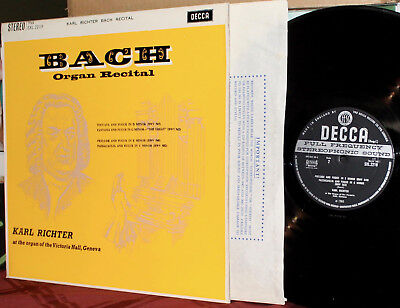
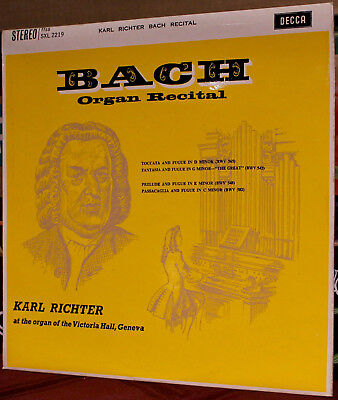
DECCA LP SXL-2219: J.S. BACH - Organ Recital - Karl Richter, organ - 1960 UK ED2
$
100

Favourite Auctions
To save auctions to your favourites, please login
If you don't have an account, please register
Description
****Welcome to our listing, thanks very much for looking!
****See our own website! We have lots of out of print LPs and CDs! Find us on the web at -
hearthedifference.net
****Please see our other listings - new items added daily!
****Shipping cost is only an estimate - it depends on the actual weight and size of the package as well as the service required. We do not profit from shipping costs, so if we overcharge, we will refund the difference back to you. It's always best to wait for our invoice before paying for your item. We will combine shipping for multiple items purchased.
Background -
There are records and then there are "RECORDS". This one belongs in the latter category. Decca is one of the most highly collectible record labels ever made. The LPs the company issued in the "golden age" of LP recordings are the most sought after by audiophiles across the globe.Karl Richter (15 October 1926 – 15 February 1981) was a German conductor, choirmaster, organist and harpsichordist.
Karl Richter was born in Plauen and studied first in Dresden, where he was a member of the Dresdner Kreuzchor and later in Leipzig, where he received his degree in 1949. He studied with Günther Ramin, Karl Straube and Rudolf Mauersberger. In the same year, he became organist at St. Thomas Church, Leipzig, where Johann Sebastian Bach was the musical director for 27 years. While organist at the St. Thomas Church, Leipzig, he was witness to the inauguration of Bach's new grave and prepared a special performance of Bach's "St. Anne" Prelude and Fugue in E-flat for the reception.
In 1951 Richter moved to Munich, where he taught at the conservatory, and was cantor and organist at St. Mark's Church. He also conducted the Münchener Bach-Chor starting in 1954 and the Münchener Bach-Orchester. In the 1960s and 1970s he recorded often and toured Japan, the United States, Canada, Latin America, Eastern Europe and the Soviet Union.
Richter played and conducted a wide range of music (sacred works from Heinrich Schütz to Max Reger, as well as the symphonic and concerto repertoire of the Classical and Romantic periods – even including Bruckner symphonies), but is best remembered for his interpretations of Johann Sebastian Bach and Handel. Richter's performances were known for their soul-searching, intense and festive manner. He avoided the fluctuations in tempo that were previously characteristic of the prevailing Romantic manner of conducting Bach, and devoted much attention to the woodwinds and to balance. His recordings from 1958–70 are notable for "discipline, rhythmic tautness and expressive intensity."
Richter viewed Baroque music as fundamentally impromptu and subjective in nature, explaining in an interview that he had been told his performance of Bach's St. Matthew Passion sounded different from the one he had performed last year. He viewed this observation in a positive light, stating, "It's bad if you play a work with disdainful routine because you have to, and if you no longer have any thoughts or ideas about it." This was one of Richter's strengths, because each concert he conducted was a unique, irreplaceable event, and even though two performances could sound slightly different, both seemed just right in the moment he was playing them. Musicians who played with him acknowledged this and analogized that performing Baroque music with Richter was like playing ping-pong because the back and forth is what directed the piece.
As well as a conductor, Richter is also remembered as a virtuoso harpsichordist and organist. His performances of Bach's organ works are known for their imposing registrations and favorable pace.
In 1971 Richter suffered a heart attack, almost ten years before his death. In the mid-1970s, he suffered increasing problems with his vision. He had a fantastic memory, and began to memorize as many works as he could before he lost his sight. Eventually he had eye surgery, of which he was initially skeptical but which was effective.
When asked about the energy-draining self-imposed burden of work he set himself, he would reply “My time is now,” or even “We Richters don’t grow old."
In the 1970s, according to Nicholas Anderson, "with the growing interest in historically aware performance ... Richter's values were questioned"; in 1981, "a victim of passing fashion and changing taste, he died an embittered man." In a hotel in Munich in 1981 he suffered a fatal heart attack, and was buried in the Enzenbühl cemetery in Zurich eight days later.
Karl Richter was regarded as one of the great Bach conductors of the twentieth century, noted for solid regularity in rhythms and a serious approach to the music, though he was not given to following the changing pronouncements of musicologists concerning historical accuracy in performance.
He was brought up in the tradition of German Protestant religious music; his father was a minister in the central German regions near where Johann Sebastian Bach had lived. Richter learned piano and organ, and as he approached his 12th birthday entered the Kreuzschule school in Dresden. After World War II, he entered the Leipzig Conservatory, where he studied with Rudolf Mauersberger, and also studied at the Leipzig Institute for Sacred Music, where he learned Bach interpretation from Karl Straube and Günther Ramin. Very soon he was appointed choirmaster of the Christuskirche in Leipzig at the age of 20, and in 1947 became the organist of the Thomanerkirche, both institutions with strong Bach traditions.
He left East Germany in 1950 to live in West Germany and settled in Munich, where he was organist of the Markuskirche and started teaching that same year at the Hochschule für Musik of Munich. He organized the Munich Bach Choir in 1951, and in 1953 added to it the Munich Bach Orchestra. His performances naturally centered on Bach and under Richter his musicians and singers became one of the most renowned organizations specializing in the music of the great German master and his era.
The formation of the Munich Bach Chorus and Orchestra reflected a growing international interest in music of the Baroque and, sparked by the advent of the LP record, the notion of integral series of composers' works. Deutsche Grammophon's Archiv label was the first of such historic specialty sub-labels. Richter and his Bach Choir and Orchestra became a major pillar of that label and recorded numerous Bach choral works, gaining international recognition.
They toured frequently, and Richter also played and recorded often as an organist and harpsichordist. In 1968, Richter made one of his most dramatic guest conducting tours when he conducted the St. John Passion and the B minor Mass in both Moscow and Leningrad at a time when religious music of any sort was rarely heard in the Soviet Union.
Although his regularity of tempo (some called it inflexibility) placed him apart from the Romantic manner of performing Bach, Richter's performances otherwise retained the Romantic era's approach, stressing the solemnity of Bach's music and including dramatic large-scale dynamic contrasts. Newer research and the growing popularity of "original" or "period" instrument performances did not affect his interpretations, which used modern instruments. In some respects, younger interpreters who emerged in the 1970s considered him the representative of an approach against which they were reacting.
Later in his career, Richter enlarged his repertory to conduct Classical, and even Romantic, era works, but tended to remain known primarily as a Baroque specialist. He is best remembered for his mastery of Baroque choral/orchestral works of the largest scale, where his architectural approach to the music is most effective. His recordings of the Bach Passions, oratorios, B minor Mass, and Magnificat, as well as Handel oratorios such as the Messiah, are considered his most important contribution to the Baroque discography. - Joseph Stevenson
There’s no shame in detesting organ music, even if some of Bach’s greatest works were written for the instrument. Nor is there anything wrong with wanting only a selection, rather than springing for a massive box. Finally, even if you love this stuff, you should own this record. It’s just wonderfully fun. The popular pieces are here: the big toccatas / preludes and fugues.
The success or failure of any organ recital depends as much on the organ as on the organist. Richter gives you the opportunity to hear a wide range of tone colors and timbres, and Richter takes full advantage of all of the possibilities. His performances are lively and spontaneous in a way that completely rids the music of those creaky, baroque cobwebs that make you wonder if people who like this stuff aren’t just a bit “off” mentally, if you know what I mean.
The opening of the Toccata and Fugue in D minor offers a case in point: no Phantom of the Opera psycho-killer waiting in the wings here–just honest, vivid music making of striking power and imagination. And the sonorities that Richter chooses are simply magical. Pure, three part counterpoint has seldom sounded so otherworldly. The sonics were really demonstration quality for their day, and they still are. You’ll love this LP, even if your friends may start thinking you a tad strange. -- David Hurwitz, ClassicsToday
-
LP made by DECCA Records, in the UK / England / Great Britain
-
LP released in 1960
-
LP is recorded in STEREO
-
Record Catalog Number: SXL 2219
-
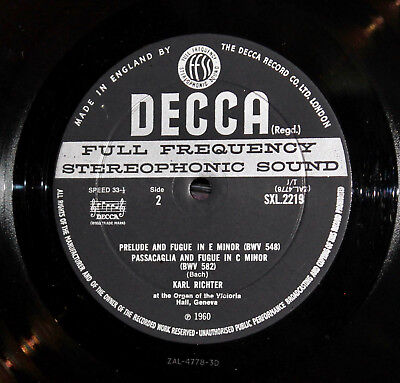
Record Labels are primarily BLACK & SILVER with inverse SILVER and BLACK lettering, featuring the earliest Decca Records logo on the record labels, with "Made in England" at the 11 o'clock position.
- This is the first UK version for this cat#
LABELS:
- Black/silver 'grooved wide band' labels
- “Made in England" at 11 o'clock
- “℗ 1960" at bottom
- Decca 'Musical Notes' logo on both sides
- Tax Code J/T
- Matrix numbers printed upside-down
SLEEVE:
- Front laminated
- NO flip-backs (aka scalloped)
- Boxed Decca logos on front
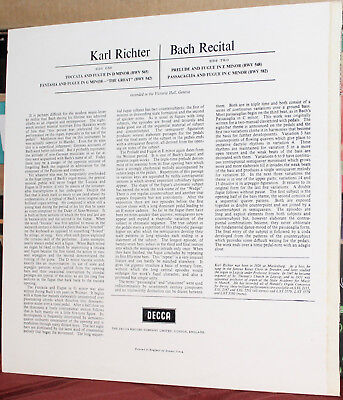
- Boxed DECCA logo on back
- Large "STEREO" on front
- Stereo on spine with text
- "Printed in England by Robert Stace" on back/bottom
- No comment re; "Laminated with 'Clarifoil' made by British Celanese Limited" on back
- Unsigned liner notes in English on back
CATALOG NUMBERS:
- SXL 2219 on sleeve
- SXL.2219 on labels
OTHER INFORMATION:
- Recorded October or November 1954 at the Organ of the Victoria Hall, Geneva.
- Labelography code: ED2
- BWV 565 and BWV 582 issued in mono on cat# LXT 5110, BWV 542 and BWV 548 issued in mono on cat# LXT 5029.
- On back of the sleeve the title is "Bach Recital"
• Matrix / Runout (Runout side A - machine stamped): ZAL-4777-3D I ⵎT K7 1 SM
• Matrix / Runout (Runout side B - machine stamped): ZAL-4778-3D I KT 1
• Matrix / Runout (Matrix on label - side A): ZAL.4777
• Matrix / Runout (Matrix on label - side B): ZAL.4778
J.S. Bach // Karl Richter
LP Title & Music on this item -Bach - Organ Recital
1. Toccata and Fugue in D minor, BWV 565 by J.S. Bach
Performer: Karl Richter (Organ)
Period: Baroque
Written: by 1708; Germany
Date of Recording: BY 1964
Length: 8 Minutes 57 Secs.
2. Fantasia and Fugue in G minor, BWV 542 "Great G minor" by J.S. Bach
Performer: Karl Richter (Organ)
Period: Baroque
Written: 1708-1717; Weimar, Germany
Date of Recording: BY 1964
Length: 12 Minutes 37 Secs.
3. Prelude and Fugue in E minor, BWV 548 "Wedge" by J.S. Bach
Performer: Karl Richter (Organ)
Period: Baroque
Written: 1727-1731; Leipzig, Germany
Date of Recording: BY 1967
Length: 12 Minutes 53 Secs.
4. Passacaglia in C minor, BWV 582 by J.S. Bach
Performer: Karl Richter (Organ)
Period: Baroque
Written: circa 1708-1712; Arnstadt, Germany
Date of Recording: 1978
Length: 15 Minutes 27 Secs.
A1 Toccata And Fugue In D Minor (Bwv 565)
A2 Fantasia And Fugue In G Minor - "The Great" (Bwv 542)
B1 Prelude And Fugue In E Minor (Bwv 548)
B2 Passacaglia And Fugue In C Minor (Bwv 582)
Performers / Credits on this disc include -
• Composed By – Bach
• Engineer [Uncredited] – Roy Wallace
• Mastered By – E (24)
• Organ – Karl Richter
• Producer [Uncredited] – James Walker, Peter Andry, Victor Olof
• Recorded At – Victoria Hall, Geneva
• Mastered At – Decca Studios
• Printed By – Robert Stace
• Record Company – The Decca Record Company Limited
CONDITION Details:
The LP jacket is in near mint minus condition. The jacket is tight and clean, with NO seam splits. It has "clarifoil" on the front of the jacket, not back. The corners are solid. The colors on the jacket are sharp with NO discoloration on the front or back. The corners and seams show very little shelf wear due to the age (see pictures with this listing for more detail as they are of the actual item).
The LP is in near mint minus condition! There are no serious marks on the vinyl. There may be some very light spider marks on the LP which are caused by sliding the LP in and out of the inner sleeve. Most of the time, these types of marks are not audible, but it really depends on the sensitivity of your audio gear. This is not a new audiophile LP....some extraneous sound is inevitable and should be expected for a vintage LP. A record from the 1960s is rarely perfect. The LP retains much of the original gloss and sheen! There are NO serious spindle marks on the record labels either. That said, acquiring a vintage LP like this is for the performance and rarity of the LP, not necessarily just for the sound quality.A Short Note About LP GRADING -
- Mint = Only used for sealed items.
- Near Mint = Virtually flawless in every way.
- Near Mint Minus = Item has some minor imperfections, some audible.
- Excellent = Item obviously played and enjoyed with some noise.
- Very Good Plus = Many more imperfections which are noticeable and obtrusive.
For best results, always thoroughly clean your LPs before playing them.
LPs can be audiophile quality pressings (any collector of fine MFSL, half speeds, direct to discs, Japanese/UK pressings etc., can attest to the difference a quality pressing can make to an audio system).
Do not let this rarity slip by!price rating