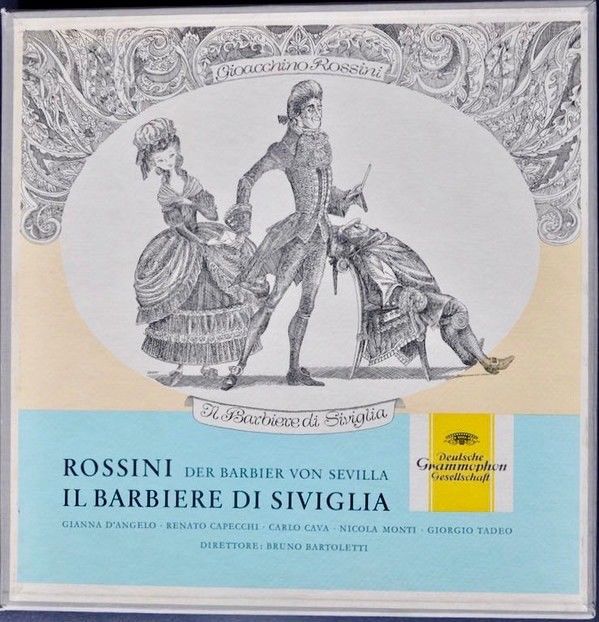
DGG 3-LP Box 18-665/67: ROSSINI Barber of Seville, D'Angelo, Capecchi 1960 TULIP
C$
50
$
36


Favourite Auctions
To save auctions to your favourites, please login
If you don't have an account, please register
Description
****Welcome to our listing, thanks very much for looking!
****See our own website! We have lots of out of print LPs and CDs! You can find us on the world wide web at -
hearthedifference.net
****Shipping cost is only an estimate - it depends on the actual weight and size of the package as well as the service required. We do not profit from shipping costs, so if we overcharge, we will refund the difference back to you. It's always best to wait for our invoice before paying for your item. We will combine shipping for multiple items purchased.****Please see our other listings for more great LPs and CDs - new items added daily.
****To access our eBay store click on the little red door at the top right section of any of our eBay listings or, click on -
http://stores.ebay.com/Hear-The-Difference
Background -
Bruno Bartoletti and Ardis Kranik were one of the foremost teams in opera administration, Kranik leading the Chicago Lyric Opera into financial stability and Bartoletti keeping it at an international-quality level. However, his greatest mark on the musical world stemmed from his passionate championing of contemporary music, both European and American. He studied music at the Conservatory of his native Florence and after graduating, was employed by the Teatro Communale, where he worked as a pianist at the Teatro's center for training young singers. There, he worked with the leading conductors of the day, including Mitropoulos and Serafin, and his own conducting debut was in 1953, when he led the orchestra in a production of Rigoletto. As his career developed, he led several world premieres, including Malipiero's Il figliuol prodigo, Mortari's La scuola delle moglie, and Ginastera's Don Rodrigo. Among European premieres, he conducted Luciano Berio's Opera, Hans Werner Henze's The Stag King, and Shostakovich's The Nose. His United States debut was in 1956, at the Lyric, in Verdi's Il Trovatore (as a last-minute substitute recommended by Tito Gobbi) and in 1964, he took on the dual role of artistic director and principal conductor. He remained active in Italy, as well, most notably as artistic director of the Maggio Musicalefrom 1986 to 1991. As the Lyric became fiscally stronger, he and Kranik were able to become more adventurous in repertoire, eventually beginning the "Towards the twentieth century" initiative, in which a contemporary opera, often a world premiere, appeared in every season. He retired in 1999. - Anne FeeneyThe Barber of Seville, or The Useless Precaution is an opera buffa in two acts by Gioachino Rossini with an Italian libretto by Cesare Sterbini. The libretto was based on Pierre Beaumarchais's French comedy Le Barbier de Séville (1775). The première of Rossini's opera (under the title Almaviva, o sia L'inutile precauzione) took place on 20 February 1816 at the Teatro Argentina, Rome.
Rossini's Barber has proven to be one of the greatest masterpieces of comedy within music, and has been described as the opera buffa of all "opere buffe". After two hundred years, it remains a popular work.
Rossini's opera recounts the events of the first of the three plays by French playwright Pierre Beaumarchais that revolve around the clever and enterprising character named Figaro, the barber of the title. Mozart's opera The Marriage of Figaro, composed 30 years earlier in 1786, is based on the second part of the Beaumarchais trilogy. The first Beaumarchais play was originally conceived as an opéra comique, but was rejected as such by the Comédie-Italienne. The play as it is now known was premiered in 1775 by the Comédie-Française at the Théâtre des Tuileries in Paris.
Other operas based on the first play were composed by Giovanni Paisiello (his Il barbiere di Siviglia premiered in 1782), by Nicolas Isouard in 1796, and then by Francesco Morlacchi in 1816. Though the work of Paisiello triumphed for a time, only Rossini's version has stood the test of time and continues to be a mainstay of operatic repertoire. On 11 November 1868, two days before Rossini's death, the composer Costantino Dall'Argine (1842–1877) premiered an opera based on the same libretto as Rossini's work, bearing a dedication to Rossini. The premiere was not a failure, but critics condemned the "audacity" of the young composer and the work is now forgotten.
Rossini was well known for being remarkably productive, completing an average of two operas per year for 19 years, and in some years writing as many as four. Musicologists believe that, true to form, the music for Il barbiere di Siviglia was composed in just under three weeks, although the famous overture was actually recycled from two earlier Rossini operas, Aureliano in Palmira and Elisabetta, regina d'Inghilterra and thus contains none of the thematic material in Il barbiere di Siviglia itself.
Once you get used to Renato Capecchi’s Figaro, which sounds as if he’s on speed (he’s almost menacing in his perkiness at times), there’s much to enjoy about this old-fashioned Barber from 1960. Capecchi hiccups, sings falsetto, yodels, and underlines so often that some listeners might want to kill him after a while, but his get-up-and-go is undeniable and catching, and it’s in keeping with Bruno Bartoletti’s happy-time conducting. And the fact that we get a high-soprano Rosina (rather than the written-for mezzo, but very much the practice until Marilyn Horne) adds to the immediate, colorful, bright-edged entertainment. In fact, Gianna d’Angelo is quite good, singing with plenty of character and appeal, and with far less whistly high notes than say, Roberta Peters–her immediate competition on disc.
Nicola Monti’s Almaviva has almost no real coloratura ability and all notes above A-flat are weak; but he’s very much “inside” the role and he’s got real style. Style is also in evidence with our Bartolo, Giorgio Tadeo; he mugs far less than most in this role (and far less than Capecchi). Carlo Cava as Basilio adds flavor but his voice is shallow and he sounds as if he’d rather be speaking. The rest of the cast, as well as the orchestra and chorus are all very good. There are lots of cuts, particularly in Act 2, and the sound is far too bright and forward–adjust your volume down. In all, this is a nice Barber, albeit without winning any prizes or replacing any favorites. - Robert Levine
This is an OPENED, in NEAR MINT condition 3-LP box set issued by "DGG - Deutsche Grammophon Gesellschaft" in 1960 - a super RARE title that is long out of print!
The 3-LP boxed set made by DGG Records is a highly collectible title from their catalog - a superb CLASSICAL title featuring the music of -
Rossini // Bruno Bartoletti
Title and tracks -
Il Barbiere Di Siviglia (complete opera)
Performers / Credits -
• Chorus – Coro Dell'Opera Nazionale Italiana• Conductor – Bruno Bartoletti
• Libretto By – Sterbini
• Orchestra – Orchestre Symphonique De La Radio Bavaroise
• Text By [Original] – Beaumarchais
• Vocals [Bartolo] – Giorgio Tadeo
• Vocals [Basilio] – Carlo Cava
• Vocals [Figaro] – Renato Capecchi
• Vocals [Fiorello] [Un Commissaire De Police] – Giorgio Giorgetti
• Vocals [Le Comte Almaviva] – Nicola Monti
• Vocals [Marceline] – Gabriella Carturan
• Vocals [Rosina] – Gianna D'Angelo
Track Listing -
A1. Atto 1
A2. Atto 2
B1. Atto 3
B2. Atto 4
C1. Atto 5
C2. Atto 6
C3. Atto 7
D1. Atto 8 (Finale I)
E1. Atto 9
E2. Atto 10
E3. Atto 11
E4. Atto 12
F1. Atto 13
F2. Atto 14
F3. Atto 15
F4. Atto 16 (Finale II)
The title is from the rare DGG series of vintage LPs.
- DGG - Deutsche Grammophon Gesellschaft RECORDS
- LPs made in Germany
- Pressings are in MONO, they have the TULIP label vintage (indicates earliest pressings)
- With 46-page booklet, printed in Germany 12/60.
Boxed set of three lp's, with illustrated 46 page book that details the story, plus provides full words in Italian, German, English and French. Illustrated by hand throughout with full page black and white photos of the cast. ? 1961 Deutsche Grammophon GmbH, Hamburg
Recording: Munich, Herkules-Saal, 6/1960 - Comes in a luxurious linen covered boxed set
- Record vintage = made in 1960 (out of print)
- LP catalog # LPM 18-665/67
CONDITION Details:
The 3-LP linen-like covered outer box is in near mint condition! The box has NO splits or crushed corners, but does show some light shelf wear, along the seams and corners. The colors on the box are sharp and clean (see pictures with this listing for more detail).
The set comes complete with a large format, 46 page paper insert/libretto.
The 3-LPs are in near mint minus condition! We found that the vinyl looked superb on this vintage LP set. There are no significant marks and the LPs retain much of the original gloss and sheen - obviously well taken care of! They do have a bit of dust and perhaps a finger print or two on them so they should be cleaned before playing. There are NO serious spindle marks on the record labels either. Just beautifully made vinyl! That said, acquiring a vintage LP like this is for the performance and rarity of the LP, not necessarily for the sound quality. A Short Note About LP GRADING -- Mint = Only used for sealed items.
- Near Mint = Virtually flawless in every way.
- Near Mint Minus = Item has some minor imperfections, some audible.
- Excellent = Item obviously played and enjoyed with some noise.
- Very Good Plus = Many more imperfections which are noticeable and obtrusive.
For best results, always properly clean your LPs before playing them.
The LP is an audiophile quality pressing (any collector of fine MFSL, half speeds, direct to discs, Japanese/UK pressings etc., can attest to the difference a quality pressing can make to an audio system).
Don't let this rarity slip by!!!
price rating









![The Afro Soul Prophecy - Heat in the City [New Vinyl LP]](https://www.popsike.org/php/thumbnail.php?url=https://www.popsike.pics/pix/20240301/134958196931.jpg)
