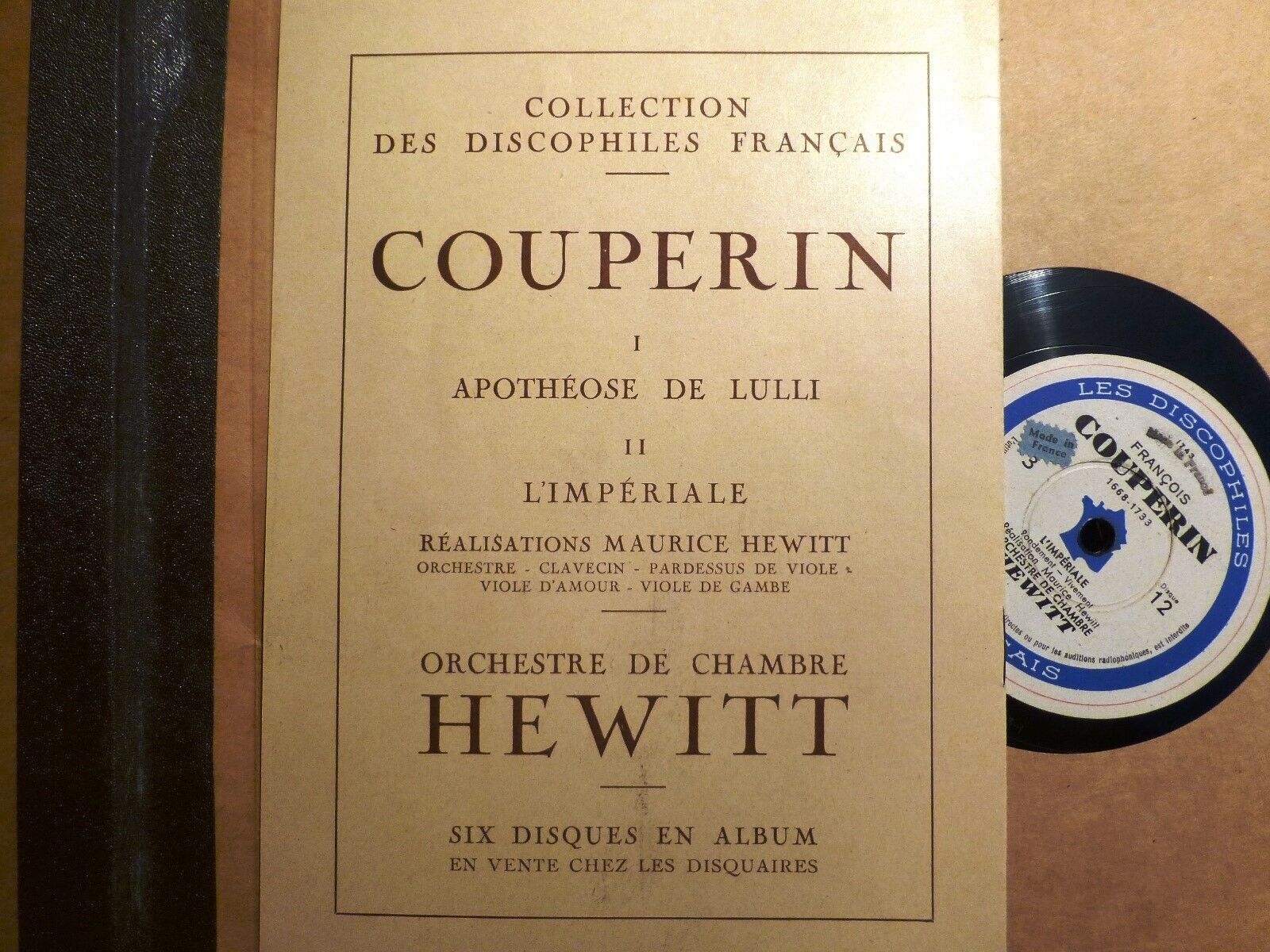
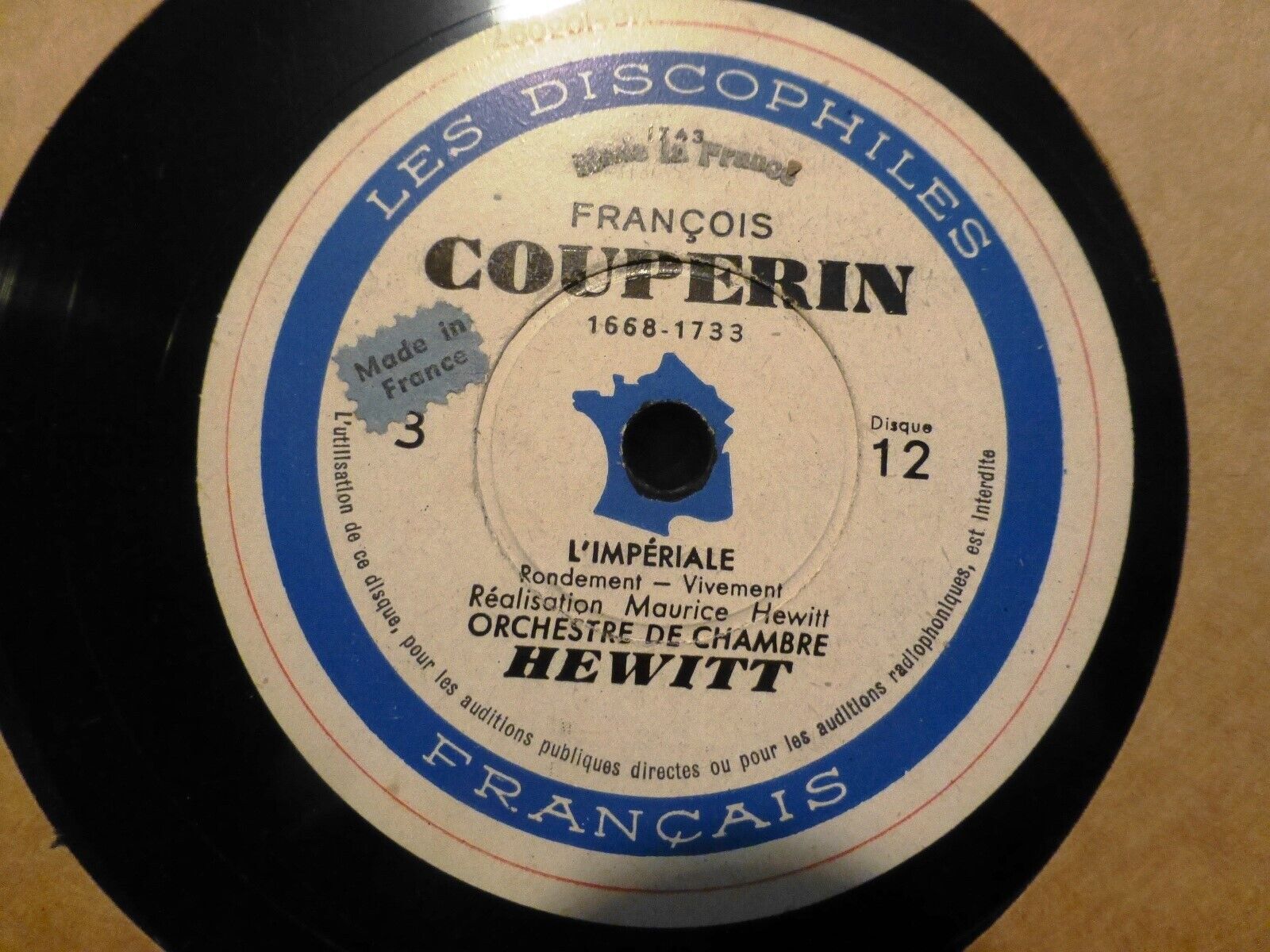
DISCOPHILES FRANCAIS Maurice HEWITT COUPERIN Apotheose de Lulli L'IMPERIALE 6x78
$
40


Favourite Auctions
To save auctions to your favourites, please login
If you don't have an account, please register
Description
Great Recording on the audiophile lable
Les DISCOPHILES FRANCAIS Maurice HEWITT Orch
Aanother artifact from Occupied France, from a member of the Resistance, the violinist and conductor Maurice Hewitt (1884-1971). Hewitt, in earlier years a member of the Quatour Capet and of the Société des Instruments Anciennes, was also the founder of the acclaimed label "Les Discophiles Françaises" which specialized at first in early music. Hewitt himself directed many of its early recordings, including this one, an album containing two disc premières of important chamber works by François Couperin:
Couperin: L'Impériale (No. 3 of "Les Nations") and L'Apothéose de Lulli
Orchestre de Chambre Maurice Hewitt
Recorded December 1-3, 1941
Les Discophiles Françaises 11 through 16, six 78-rpm records
Link (FLAC files, 141.75 MB)
Link (MP3 files, 88.96 MB)
Couperin did not specify instrumentation for either of these works, merely two treble instruments and continuo; they are normally heard as trio sonatas. Hewitt uses his own arrangement for string orchestra with harpsichord, pardessus de viole, viola d'amore and viola da gamba. This is Couperin with a big, rich string sound, quite unlike what we are accustomed to hearing today.
Couperin: L'Impériale; L'Apothéose de Lulli Orchestre de Chambre Maurice Hewitt Recorded December 1-3, 1941, probably in the Studio Albert, Paris, France. Issued as Discophiles Françaises 11 through 13 (L'Impériale) and 14 through 16 (L'Apothéose de Lulli); the two works were issued together in an album with a booklet of notes in French by Henri Gheon. The side and matrix information: L'Impériale: Side 1 (PART 1741-1): Gravement; Vivement Side 2 (PART 1742-1): Gravement et marqué; Légèrement Side 3 (PART 1743-1): Rondement; Vivement Side 4 (PART 1744-1): Allemande; Bourrée; Chaconne, part 1 Side 5 (PART 1745-1): Chaconne, part 2 Side 6 (PART 1746-1): Chaconne, part 3; Menuet L'Apothéose de Lulli: Side 1 (PART 1747-3): Lulli aux Champs-Elysées; Air Side 2 (PART 1748-1): *Voi de Mercure; *Descente d'Apollon; Rumeurs souterraines; Plaintes Side 3 (PART 1749-1): Enlèvement de Lulli; Accueil entre doux et agard; **Remerciements de Lulli Side 4 (PART 1750-1): Apollon persuade Lulli et Corelli (Essai en forme d'Ouverture); Air léger; Second air Side 5 (PART 1751-1): La Paix du Parnasse, part 1 (Sonade en trio: Gravement; Saillie: Vivement) Side 6 (PART 1752-1): La Paix du Parnasse, part 2 (Rondement; Vivement) *The label assigns these two sections to Side 1, but they actually appear on Side 2. **The label assigns this section to Side 4, but it actually appears on Side 3.original issue 6x12" 78 rpm record. with orig booklet in non matching album
Condition: Excellent pristine, possibly unplayed. Plays E+ Exceptionally quiet
Album great, tape repair on spine
A CHOICE COPY
Maurice Hewitt (6 October 1884 – 7 November 1971) was a French violinist and conductor, as well as a member of the French Résistance.
Born in Asnières-sur-Seine, Hewitt studied the violin at the Conservatoire de Paris. From 1914, he was a member of the ensemble Société des Instruments anciens,[1] from 1918 to 1930 a member of the Capet Quartet, which was particularly dedicated to the interpretation of Beethoven's string quartets. From 1930 to 1943 he led his own quartet, and in 1941 he founded the Orchestre de Chambre Hewitt.[2]
He also founded the record company Les Discophiles Français.[3] Here he released six albums until 1942, including the first recording of Jean-Philippe Rameaus Six Concerts en Sextuor. On further albums he released e.g. Mozarts's Clarinet Concerto KV 622 (with François Étienne[4]), François Couperin's L'Impériale and L'Apothéose de Lulli and Mozarts's String Trios with the Trio Pasquier (Jean Pasquier, violin, Pierre Pasquier, viola und Étienne Pasquier, cello).
From 1940 Hewitt was active in the Resistance, where he belonged to Colonel Maurice Buckmaster's network. In 1943 he was denounced and arrested and in 1944 deported to the Buchenwald Concentration Camp (prison number 44007). There he founded an illegal string quartet with Polish inmates.
After the liberation of France in 1945, he gave a concert with Gabriel Fauré's Requiem in memory of the French who were deported to Germany and died there. Hewitt was active as a conductor and music teacher until the 1950s.
He died in Créteil in 1971.
price rating