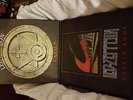
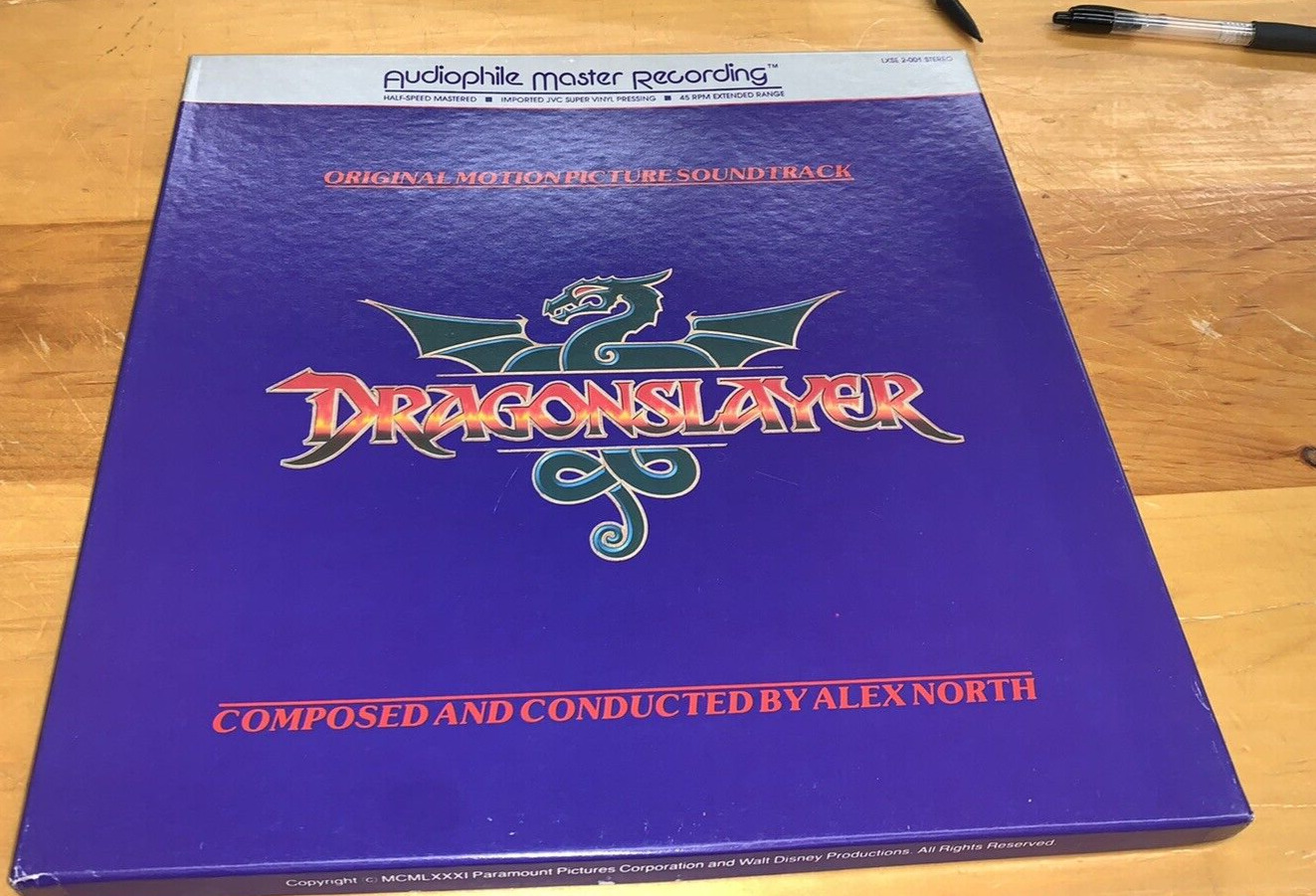
Dragonslayer OST Alex North Audiophile Half-Speed Mastered Double LP Box Set
$
100

Favourite Auctions
To save auctions to your favourites, please login
If you don't have an account, please register
Description
Alex North – Dragonslayer (Original Motion Picture Soundtrack) Alex North - Dragonslayer (Original Motion Picture Soundtrack) album cover More images
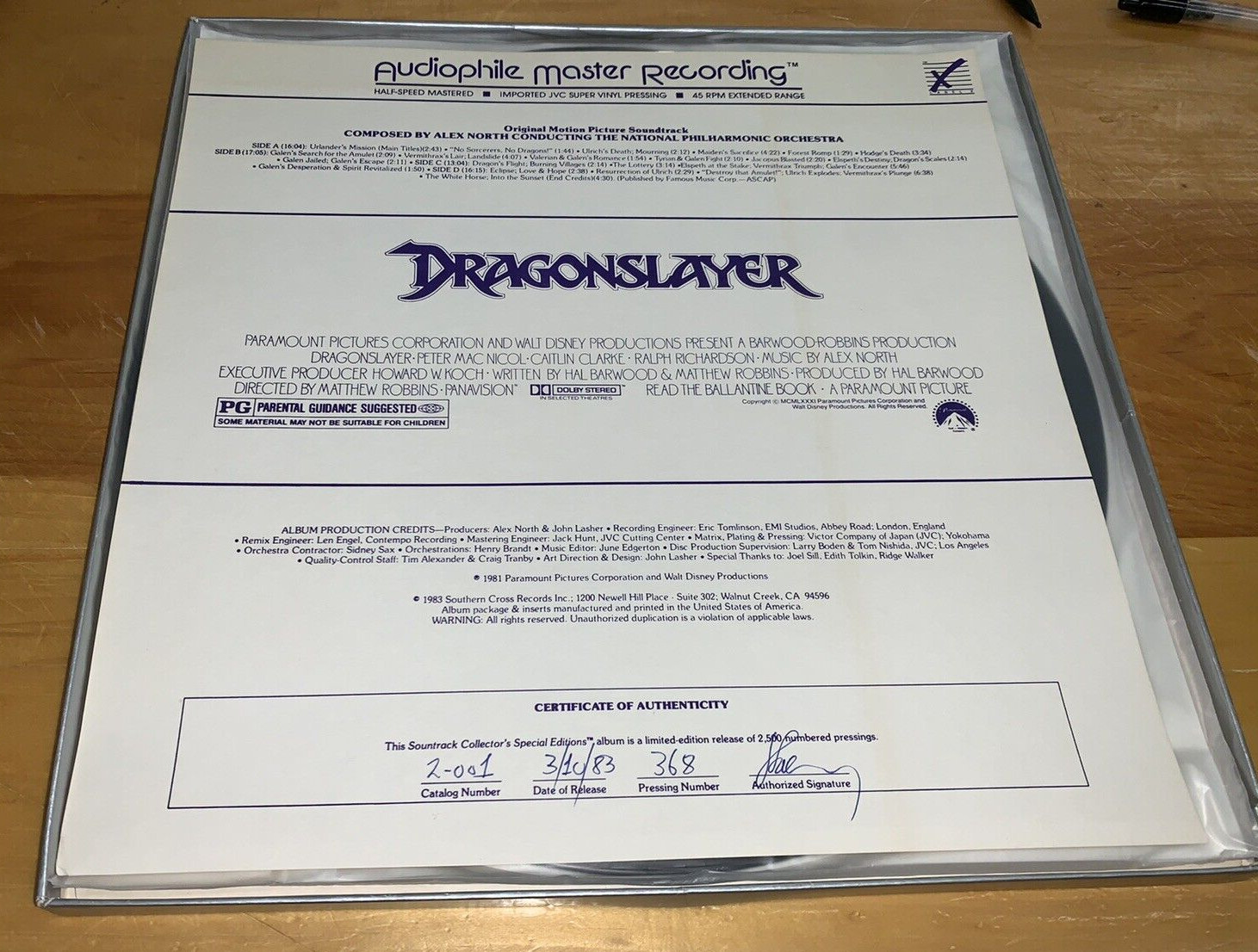
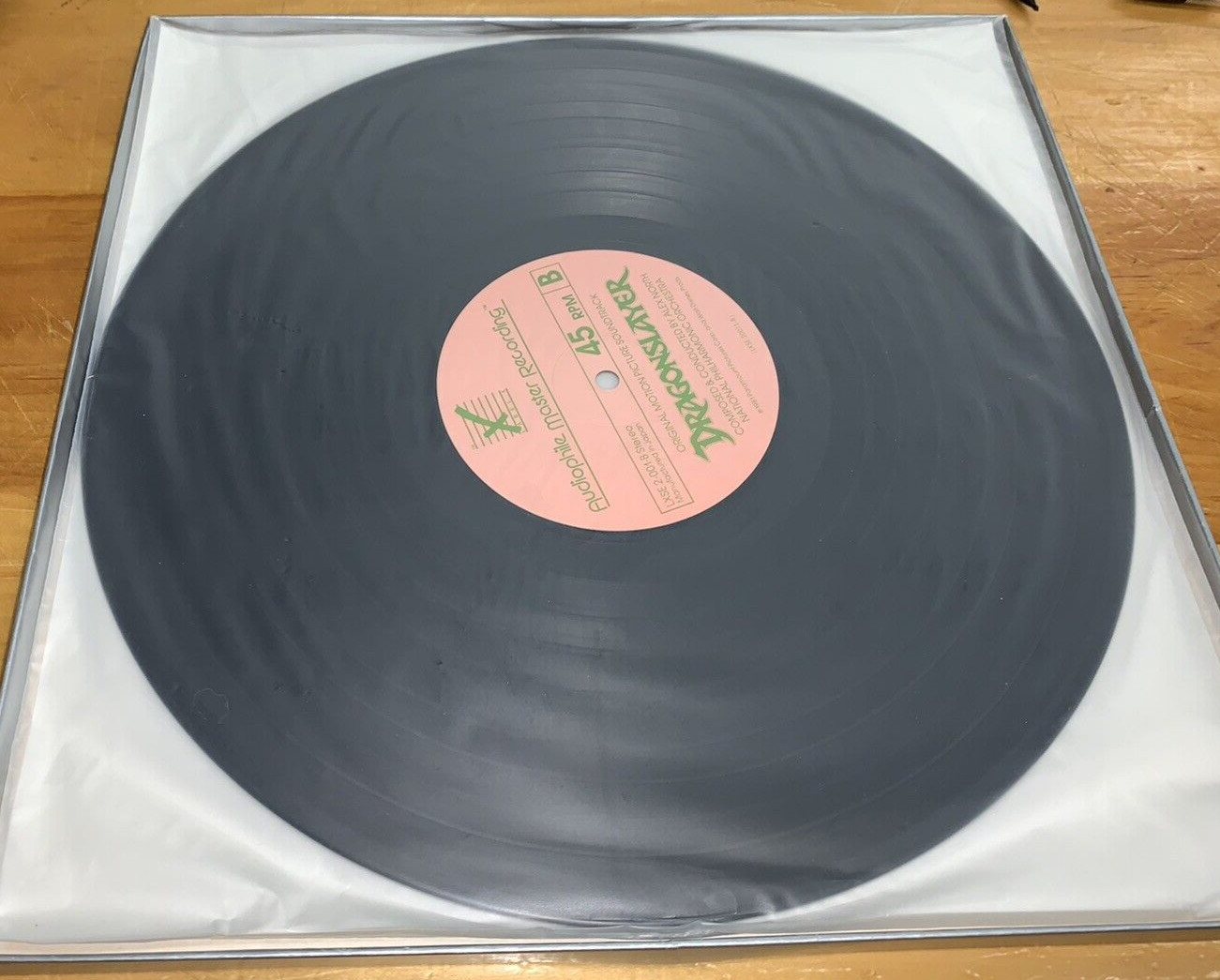
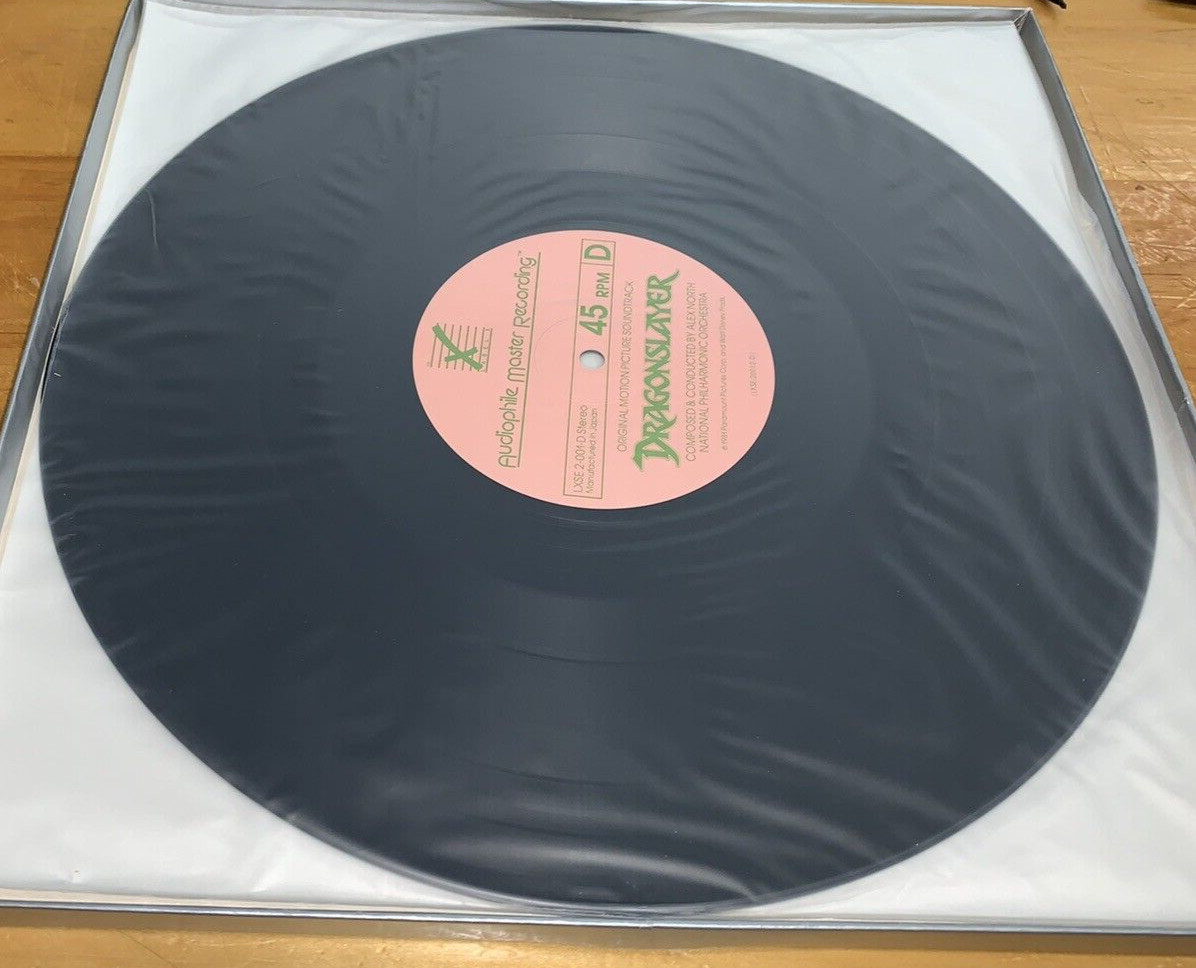
Label: Southern Cross Records – LXSE 2-001, Label X (3) – LXSE 2-001 Format: 2 x Vinyl, LP, 45 RPM Box Set, Numbered Country: US Released: Mar 10, 1983 Genre: Classical, Stage & Screen Style: Score, Contemporary A1 Urlander's Mission (Main Title) 2:43 A2 "No Sorcerers, No Dragons!" 1:44 A3 Ulrich's Death: Mourning 2:12 A4 Maiden's Sacrifice 4:22 A5 Forest Romp 1:29 A6 Hodge's Death 3:34 B1 Galen's Search For The Amulet 2:09 B2 Vermithrax's Lair; Landslide 4:07 B3 Valerian & Galen's Romance 1:54 B4 Tyrian & Galen Fight 2:10 B5 Jacopus Blasted 2:20 B6 Elspeth's Destiny; Dragon's Scales 2:14 B7 Galen Jailed; Galen's Escape 2:11 C1 Dragon's Flight; Burning Villages 2:14 C2 The Lottery 3:14 C3 Elspeth At The Stake; Vermithrax Triumph; Galen's Encounter 5:46 C4 Galen's Desperation & Spirit Revitaliazed 1:50 D1 Eclipse; Love & Hope 2:38 D2 Resurrection Of Ulrich 2:29 D3 "Destroy That Amulet!"; Ulrich Explodes; Vermithrax's Plunge 6:38 D4 The White Horse; Into The Sunset (End Credits) 4:30 Lacquer Cut At – JVC Cutting Center Composed By, Conductor – Alex North Lacquer Cut By – Jack Hunt Hand-numbered on insert out of 2,500 copies.
"Audiophile Master Recording Half-Speed Mastered ■ Imported JVC Super Vinyl Pressing ■ 45 RPM Extended Range"
Dragonslayer is a 1981 American dark fantasy film directed by Matthew Robbins from a screenplay he co-wrote with Hal Barwood. It stars Peter MacNicol, Ralph Richardson, John Hallam, and Caitlin Clarke. It was a co-production between Paramount Pictures and Walt Disney Productions, where Paramount handled North American distribution and Disney handled international distribution through Buena Vista International. The story is set in a fictional medieval kingdom where a young wizard encounters challenges as he hunts a dragon, Vermithrax Pejorative.
It is the second joint production between Paramount and Disney, after Popeye (1980), and is more mature than most contemporary Disney films. Because the audience expected the film be solely children's entertainment, the violence, adult themes and brief nudity were somewhat controversial, though Disney did not hold the North American distribution rights. The film was rated PG in the U.S.
The special effects were created at Industrial Light and Magic, the first use of ILM outside of a Lucasfilm production. Phil Tippett had co-developed an animation technique there for The Empire Strikes Back (1980) called go motion, a variation on stop motion. This led to the film's nomination for the Academy Award for Best Visual Effects, but it lost to Raiders of the Lost Ark, the only other visual effects nominee that year, whose special effects were also provided by ILM. Including the hydraulic 40-foot (12 m) model, the dragon consists of 16 puppets dedicated to flying, crawling, or breathing fire.[2]
The film received generally positive reviews from critics, but it performed poorly at the box office, grossing $14.1 million worldwide against a production budget of $18 million. It was nominated for the Academy Award for Best Original Score, which went to Chariots of Fire. It was nominated for a Hugo Award for Best Dramatic Presentation, again given to Raiders of the Lost Ark. On October 21, 2003, Dragonslayer was released on DVD in the U.S. by Paramount Home Entertainment. The film was re-released in remastered format on Blu-ray and 4K Ultra HD on March 21, 2023, in the U.S. by Paramount Home Entertainment.
Plot Urland, a sixth-century post-Roman kingdom situated near the River Ur,[3] is being terrorized by Vermithrax Pejorative, a 400-year-old dragon.[3] To appease the creature, King Casiodorus offers it virgin girls selected by lottery twice a year. An expedition led by a young man named Valerian seeks help from the last sorcerer, Ulrich of Cragganmore.
The expedition is followed by Tyrian, the brutal and cynical captain of Casiodorus's Royal Guard. His lieutenant Jerbul and he openly intimidate the wizard, doubtful of his abilities. Ulrich invites Tyrian to stab him to prove his magical powers. Tyrian does so and Ulrich dies instantly, to the horror of his young apprentice Galen Bradwarden and his elderly servant Hodge, who cremates Ulrich's body and places the ashes in a leather pouch.
Galen is selected by the wizard's magical amulet as its next owner; encouraged, he journeys to Urland. On the way, he discovers Valerian is a young woman, who is disguised to avoid being selected in the lottery. In an effort to discourage the expedition, Tyrian kills Hodge. Just before dying, Hodge hands Galen Ulrich's ashes and informs Galen that Ulrich wanted them spread over a lake of burning water.
Arriving in Urland, Galen inspects the dragon's lair and magically seals its entrance with a rockslide. Tyrian apprehends Galen and takes him to Castle Morgenthorme, from which King Casiodorus governs Urland. Casiodorus disputes that Galen is a real wizard and complains that his attack may have angered the dragon instead of killing it, as his brother and predecessor once did. The king confiscates the amulet and imprisons Galen. His daughter, Princess Elspeth, visits Galen and is shocked when he informs her of rumors that the lottery is rigged; it excludes her name and those others whose families are rich enough to bribe the king into disqualifying their children. Her father is unable to lie convincingly when she confronts him over this.
Meanwhile, the dragon frees itself from its prison, causing an earthquake. Galen narrowly escapes from his prison, but without the amulet. The village priest, Brother Jacopus, leads his congregation to confront the dragon, denouncing it as the Devil. The dragon incinerates him and then heads for the village of Swanscombe, burning all in its path.
When the lottery begins anew to placate it, Elspeth rigs the draw so that only her name can be chosen. Desperate, King Casiodorus returns the amulet to Galen so that he might save Elspeth. Galen uses the amulet to enchant a heavy spear (forged by Valerian's father and dubbed Sicarius Dracorum, or "Dragonslayer") with the ability to pierce the dragon's armored hide. Valerian gathers some molted dragon scales to create a shield for Galen. Valerian laments that, her cross-dressing disguise now blown, she will be eligible for the lottery since she is still a virgin, and that Galen has fallen in love with Princess Elspeth. Galen admits he has fallen in love, but with Valerian, not Elspeth. The couple kisses, realizing their romantic feelings for each other.
Attempting to rescue Elspeth, Galen fights and kills Tyrian. The princess, however, is determined to make amends for all the girls whose names have been chosen in the past; she descends into the dragon's cave and to her death. Galen follows her and finds a brood of young dragons feasting on her corpse. He slays them and goes on to find Vermithrax resting within an underground lake of fire. He manages to wound the great dragon, but the spear's wooden shaft is broken in the battle. Only Valerian's shield saves him from incineration.
After his failure to kill Vermithrax, Valerian convinces Galen to leave Swanscombe with her. As both prepare to depart, the amulet gives Galen a vision of the "burning water" within the dragon's cave. Galen realizes that Ulrich had planned his own death and cremation, being too old and frail to make the journey himself.
Galen returns to the cave with the pouch. When he spreads the ashes over the fiery lake, the wizard is resurrected within the flames. Ulrich reveals that his time is short, and that Galen must destroy the amulet "when the time is right". The wizard then transports himself to a mountaintop, where he summons a storm and confronts Vermithrax. After a brief battle, the monster snatches the old man and flies away with him. Cued by Ulrich, Galen crushes the amulet with a rock. The wizard's body explodes and kills the dragon, whose corpse falls from the sky.
In the aftermath, villagers inspecting the dragon's corpse credit God with the victory. The king arrives and drives a sword into the dragon to claim the glory for himself. As Galen and Valerian leave Urland together, he confesses that he misses both Ulrich and the amulet. He says, "I just wish we had a horse." Suddenly, a white horse appears, insinuating that the power of the amulet is now within Galen himself. The couple mount the horse and ride away.
Cast Peter MacNicol as Galen Brandwardyn Caitlin Clarke as Valerian Ralph Richardson as Ulrich of Cragganmore John Hallam as Tyrian Peter Eyre as King Casiodorus Ulfilas Albert Salmi as Greil (dubbed by Norman Rodway) Sydney Bromley as Hodge Chloe Salaman as Princess Elspeth Ulfilas Emrys James as Simon (Valerian's Father) Roger Kemp as Horsrick, Casiodorus's Chamberlain Ian McDiarmid as Brother Jacopus Production Conception According to Hal Barwood, Matthew Robbins and he got the inspiration for Dragonslayer from The Sorcerer's Apprentice sequence in Fantasia. They later came up with a story after researching St. George and the Dragon. Barwood and Robbins rejected the traditional conceptions of the medieval world to give the film more realism: "Our film has no knights in shining armor, no pennants streaming in the breeze, no delicate ladies with diaphanous veils waving from turreted castles, no courtly love, no holy grail. Instead, they set out to create a very strange world with a lot of weird values and customs, steeped in superstition, where the clothes and manners of the people were rough, their homes and villages primitive, and their countryside almost primeval, so that the idea of magic would be a natural part of their existence." For this reason, they chose to set the film after the end of Roman rule in Britain, prior to the arrival of Christianity. Barwood and Robins began to hastily work on the story outline on June 25, 1979, and completed it in early August. They received numerous refusals from various film studios, due to their inexperience in budget negotiations. The screenplay was eventually accepted by Paramount Pictures and Walt Disney Pictures, becoming the two studios' second joint effort after Popeye (1980).[3]
Dragon
According to Barwood, the dragon's basic body plan was based on that of the Jurassic pterosaur Rhamphorhynchus.[4] About 25% of the film's budget went into the dragon's special effects. Graphic artist David Bunnett was assigned to design the look, and was fed ideas on the movement mechanics, and then rendered the concepts on paper. They decided early to emphasize flying, because the most important sequence is the final battle. Bunnett gave it a degree of personality, deliberately trying to avoid the creature from Alien, which he believed was "too hideous to look at".[3]
Ken Ralston's flying model of the dragon, Vermithrax Pejorative After Bunnett handed his storyboard panels to the film crew, the dragon design used a wide variety of techniques. The final creature is a composite of several different models. Phil Tippett of ILM finalized the design, and sculpted a reference model, which Danny Lee of Disney Studios closely followed in constructing the larger dragon props for close-up shots. Two months later, Lee's team finished a 16-foot head and neck assembly, a 30-foot tail, thighs, legs, claws capable of grabbing a man, and a 30-foot-wide (9.1 m) wing section. The parts were flown to Pinewood Studios outside London in the cargo hold of a Boeing 747.[3]
Brian Johnson was hired to supervise the special effects, and began planning on- and off-set effects with various specialists. Dennis Muren, the effects cameraman, stated, "We knew the dragon had a lot more importance to this film than some of the incidental things that appeared in only a few shots in Star Wars or The Empire Strikes Back. The dragon had to be presented in a way that the audience would be absolutely stunned."[3]
After the completion of principal shooting, a special-effects team of 80 people at ILM studios in northern California worked eight months in producing 160 composite shots of the dragon. Chris Walas sculpted and operated the dragon head used for close-up shots. The head measured 8 ft in length. The model was animated by a combination of radio controls, cable controls, air bladders, levers, and by hand—thus giving the illusion of a fully coordinated face with a wide range of expressions.[3] Real World War II-era flamethrowers were used for the dragon's fire-breathing effects. The animals used for the dragon's vocalizations included lions, tigers, leopards, jaguars, alligators, pigs, camels, and elephants.[citation needed]
Phil Tippett built a model for the dragon's walking scenes. He did not want to use standard stop-motion animation techniques, and had his team build a dragon model that would move during each exposure, rather than in between, as was once the standard. This process, named "go motion" by Tippett, was tested with motion control in The Empire Strikes Back. To make the motion even smoother, they decided to use a motorized rod puppet with a computer program that recorded the creature's movements in motion as a real animal would move, which added motion blur and removed the jerkiness common in prior stop-motion films.[3][5]
Ken Ralston was assigned to the flying scenes. He built a model with an articulated aluminum skeleton for a wide range of motion. Ralston shot films of birds flying to incorporate their movements into the model. As with the walking dragon, the flying model was filmed using go-motion techniques. The camera was programmed to tilt and move at various angles to convey the sensation of flight.[3]
Casting Peter MacNicol first met Robbins in the office of casting director, Debby Brown, who had seen MacNicol's work as Benvolio in Romeo and Juliet at the Guthrie Theater in Minneapolis. She had left a note backstage for him, encouraging him to move to New York, saying, "he would do well there". He took her advice. On his first day in New York City, MacNicol stopped by Brown's office to tell her he was now a Manhattan resident. While there, he heard the loud voices of actors coming from Brown's audition room. He asked Brown if anything right for him was in the project. She responded with a smile, "Well...actually, there is." An hour later, MacNicol was the front runner for the role of Galen. He was flown to England along with Caitlin Clarke for a screen test. Within a day or two, Paramount and Disney had said yes, and he was renting a flat in Chelsea. MacNicol had grown up riding horses—his first paid job was on a ranch near Arlington, Texas—so the young actor knew how to ride, even jump hurdles without a saddle, but during his pre-filming, he needed to learn to ride the type of trooper-style saddle they were using in the movie. Because he would have to ride on camera during action sequences, his riding skills had to be stress-tested. "They took away my stirrups, they took away my reins and whipped the horse, and then they told me to windmill my arms and turn a complete circle in the saddle. Then, they took away the saddle!" The young actor had already worked for two years in classical repertory theater and was highly trained in voice production. Nevertheless, a voice coach was hired to achieve the mid-Atlantic sound the role required. Having studied stage combat at the University of Minnesota (two years of classes in tumbling, foil, saber, rapier, and dagger), he was eager to do as much of the fighting as they would allow. The role also required some juggling and magic tricks. For this, he was mentored by British prestidigitator Harold Taylor, who had previously performed for the British royal family.[3]
Caitlin Clarke was initially hesitant to involve herself in the film, as she was preparing to audition for a play in Chicago. Her agent insisted, though, and after doing an audition tape, was called back for more tests. Clarke failed them but managed to pass after doing another test at Robbins's insistence. She got along well with Ralph Richardson and stated that he taught her more in one rehearsal than she had learned in years of acting classes.[3]
Set design
Ulrich's Castle looks over to Moel Siabod, Dolwyddelan Castle, North Wales. Elliot Scott was hired to design the sets of the film's sixth-century world. He temporarily converted the 13th-century Dolwyddelan Castle into Ulrich's ramshackle sixth-century fortress, to the surprise of the locals. He built the entire village of Swanscombe on a farm outside London. Although Scott extensively researched medieval architecture in the British Museum and his own library, he took some artistic liberties in creating the thatched-roof houses, the granary, Simon's house and smithy, and Casiodorus's castle, because he was unable to find enough information on their exact look. He built the interior of the dragon's lair, using 25,000 cubic feet (710 m3) of polystyrene and 40 tons of Welsh slate and shale. The shots of the Welsh and Scottish landscapes were extended through the use of over three dozen matte paintings.[3]
Nearly all of the outdoor scenes were shot in North Wales. The final scene was shot in Skye, Scotland.
Galen (Peter MacNicol) and Hodge (Sydney Bromley) rehearsing for the pack levitation scene. Director Mathew Robbins is monitoring through the camera in Capel Curig, North Wales
The location of Valerian's speech and handing a shield (made from the Dragon's scales) to Galen is below Tryfan, Llyn Ogwen, North Wales.
Dolwyddelan Castle was used for Ulrich's castle. Costumes The costumes were designed by Anthony Mendelson, who consulted the British Museum, the London Library, and his own reference files to evoke the designs of the early Middle Ages. They are roughly stitched and use colors that would have been possible with the vegetable dyes of the time. The costumes of Casiodorus and his court were designed of fine silk, as opposed to the coarsely woven clothes of the Urlanders.[3]
Music The film's Academy Award-nominated score was composed by Alex North. The score's linear conception was developed through transparently layered and polyphonic orchestral texture, dominated by a medieval-style modal harmony. It was largely based on five major thematic concepts:
The suffering of the Urlanders A "magic" motif The amulet The sacrificial virgins The relationship between Galen and Valerian North had six weeks to compose the score,[6] which features music rejected from his score for Stanley Kubrick's 2001: A Space Odyssey. The opening sequence of Dragonslayer features a reworking of his original music for the opening of 2001's "Dawn of Man" sequence—which in that final film is played without music—and a waltz representing the dragon in flight that had been a variation of the cue "Space Station Docking", which in the final cut of 2001 was replaced by "The Blue Danube".[7] North was disappointed by the resulting dragon scenes, as they do not use the entirety of the pieces he composed for them. He later stated that he had written "a very lovely waltz for when the dragon first appears, with just a slight indication that this may not be a bad dragon". The waltz was replaced by tracks used earlier in the movie.[citation needed]
The score was widely praised. Pauline Kael wrote in the New Yorker that the score was a "beauty", and that "at times, the music and the fiery dragon seem one". Royal S. Brown of Fanfare Magazine praised the soundtrack as "one of the best scores of 1981".[8]
price rating