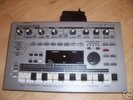
E-MU Xtreme Lead - 1 64 Polyphonic Synthesizer Mint
€
138
$
160


Favourite Auctions
To save auctions to your favourites, please login
If you don't have an account, please register
Description
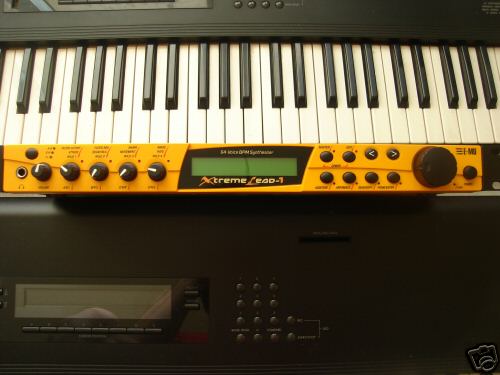
I am selling my E-MU Xtreme Lead - 1. The unit is in perfect condition. No damage whatsoever, works perfect!
I couldn't resist. I just had to have this piece and its here in the lab, sitting atop my sampler, with the knobs directly above my keyboard. This is not a piece you want to put in a distant rack, you need it close to where you compose. Its got some well implemented knobs, great samples, cool beats, and as many arpeggios as your music can handle.
For those unfamiliar with this type of synth, the XL-1 is a "specialty synth". This is not for people wanting to do General MIDI, pop, mainstream. It's not made to be your first and only synth. It made for people doing electronica, dance, techno, drum and bass, space music, retro, house, psychedelic, acid.. Ok, you get the idea. It will also fit well in a major composer's synth arsenal. Anyone who already has a lot of synths may want this for the soundset, the filters, the arpeggios, the Super Beats mode and the ability to add 32 meg cards burned on their Ultra. All that is good. In my studio with 12 modules, I will be counting on the XL-1 for filtered basses, arpeggios, drums and swept soundscapes. The synth has its unique personality clearly carved out. I think of it as a modern sounding analog.
The Basic Analog Sound
The XL-1 has tons of vintage analog synth sounds sampled, however, the sounds don't act dynamically like real analog synth, probably because the emu filters do not self-oscillate on the high harmonics like a real Moog or Korg from the 70's does. A snapshot of the real thing, even with great filters and modulation, is still not the real thing. But even most of the 'virtual analogs" based on physical modeling have some trouble here, but usually they can eek it out.. Keep in mind that the XL-1 is not a physical model of an analog synth, like the Korg Electribe, or MS2000, or Z1 for example. You are buying into good old sample playback technology with state of the art digital filters. As a result you have a lot more options than just a low pass filter and resonance. Because of the combination of great analog samples and great digital filters and knobs you get the capability to go far beyond modeling and can get timbres analog could never do on its best and brightest day. And as a bonus you get more polyphony. Instead of 4 or 8 voices that you might get in a modeled synth in this price range, you get 64. The weakness is with those analog style sounds that come from self oscillating feedback. Zaps, bubbles, and the radio like whine. These are hard to get on an XL1, and easier to get on a modeled analog, and of course on a real vintage monophonic analog, its just a knob twist away. Hope that helps with the decision process.
Super Beats
I've spent a few days with it and I am learning there is a lot to like about the box. More than meets the eye I am pleased to say. When one first sees the 1 rack unit orange box, you might be fooled into thinking its another plain old module with loops. Guess again. I could sum it up with two words: flexibility and tweakability, in the deepest sense, both being quite important to me. It's more than "just a DJ box" though it would work admirably in a club, being able to latch down beats, kiks, snares, hats, fx, etc., in any order you want, or all at once, latch a bass groove and riff away. That's the Super Beats mode, and here's--very basically-- how it works.
Basically 2 channels are reserved for it. One is the trigger channel, the other the beats channel, and they both play from channel 1, sort of like a built in "performance" mode. So playing through your midi sequencer, channel 1 triggers the loops on channel 2 and also triggers whatever else is in channel 1's preset. Now stay with me here. You know how most synth patches will have 4 parts? Well the beats channel is different. It can have 16 parts. These 16 parts are assigned to the keys that typically make a drum layout. C1-B2. You can actually select which drum hit (ie., kik, snare, hat) goes on which key. And you can group these parts into 4 groups so they all fire from hitting one key. All these parts are looping simultaneously, so when you latch on a group, its like latching on a drum (and bass) pattern.
If that sounds a bit complex that's because it is. But your XL-1 comes with so many beats presets you can usually find the loop you want just hunting through the presets. But, if you want to be original, there is no end in sight to what you might come up with. Its relatively easy to come up with a totally synced drum and bass pattern triggered by one key that's totally unique.. This is an Xtremely Powerful drum engine at work. The SuperBeats mode works well as a real time groovebox. Many of the built in riffs ands arpeggios are very hip and you can do a lot of entertaining with this box alone. You can also use the superbeats mode with a sequencer and still get the benefit of the rest of the channels. Yep, superbeats on Channels 1 and 2 and your choice of arpeggios, pads, leads, drum kits on each of the 14 other channels. There is more to it that I told you here, but I wanted only to give you a taste of the flexibility of the SuperBeats mode. If you want to know more, read the downloadable PDF manual at Emu's Site.
What's also cool is that midi channels 3-16 play presets like a standard module does, but, you can turn on your arpeggiator of choice, or simply leave it off and play normal leads and pads. There's a tremendous variety of drum samples for the dance context. Lots of these will be recognizable from the Orbit and Phatt, but there's new material here too. They are not all tamed either, some are much hotter than others, and that's a good thing.
The arpeggiators deserves some mention here. You can choose between a factory set arpeggio which was designed with the patch in mind, or change it to any one of the other preset arps. If you are like me and don't like "other people's arpeggios" all the time, you can roll your own preset arpeggio (whose editor reminds me of the way the wavestation made wave sequences) or do it the old fashioned way by holding down a chord. These "manual" modes of arpeggiation are vast. You can do up, down, up/down, random, forwards/backwards and vice versa. You have a choice of note value, speed, and can even set it to transpose after a cycle to any interval you wish. Powerful stuff! Each midi channel can have its own unique arpeggiator. The creativity that this has in a midi sequencer environment cannot be overstated. Its ideal for creating sequences that are like audio loops, yet have a real time tweakable control. It kind of reminds me of using ACID pro, but in a totally MIDI way, which is much more flexible and creatively inspiring.
1. Some really warm and smooth analog sounds with excellent bottom. It's Phat alright. You can use this as a straight ahead analog sample synth. But when you start tweaking the knobs, that's where the fun begins. Some patches are truly outstanding when you twist it up a bit. I am reminded of some of the fantastic soundscapes I've made with my stuff that took often 4 hours per patch. There are some drum patterns that really kik too. D&B (crunchy!), jungle (as furry as it gets!), house (throbbing) are very authentic. You can put your own spin on it too, unlike with some groove boxes. These ain't loops. They're looped arpeggios of drum hits in essence, but they act and sound like loops. What I really like though is not to be forced to use them. Just assign to beats preset to a different channel and you have a single shot drum map like we are used to with modules, and you can sequence your own patterns, perhaps just using the beats mode for a quick fill here and there. That's how I will use it most of the time.
2. Lots of filters. On most patches they are assigned to the 1st and 2nd knob. Yes you can tweak in real time and right into your sequencer. Great for Trance. Easy to get a usable result.
3. Knobs: There are 4 controller knobs which each do triple duty to tweak what is said to be filter cutoff, resonance, "shape", image, attack, decay/rel, "movement", rate, and then "wild", 1,2,3,4. After going through most of the sounds it appears that these categories were used as a guide and not a rule by the programmers. That's cool. The Wild knobs are cool for various changes in sound, timbre, pitch, etc. And here's something really cool. Dial up a patch, tweak with the knobs, save. Your done. It remembers the knob settings, which are set, again, to frequency cutoff, resonance, pitch, amp envelopes, lfo rate, and "wilds" (ummm) No menuing at all. That is really really cool. And if you want to tweak deep, you hit the edit button, scroll with the wheel to the parameter and then use the knobs to change values. Eminently Tweakable. And dudes, you are talking to a TweakMeister here!
4. The OS. Emu really has OS writing down. This is the standard proteus style OS and has no surprises. Parameters are where they should be, its easy to navigate and you can use the knobs for deep editing. As you might expect with this type of display, you're gonna be doing some sub-menuing. Yes, you can program this box from the front panel. The Super Beats mode is ingenious in both depth and simplicity once you understand it. I imagine we will eventually se a SoundDiver editor. I successfully dumped the ram to SoundDiver's p2000 editor, but it rightfully would not recognize the samples (it was looking for the p2k samples, natch) This is good as it indicates that the sysex parameters are detailed enough that it will be possible to build editors that can sense which expansion board is installed.. It just needs a little tweak at emagic and it will work well. You can bet I will be talking to them about that. I was able to get all the names out of SoundDiver and AutoLink. them up to Logic--thank god I didn't have to type 512 patch names. If you need the names let me know and I'll upload them.
5. Downloadable ROM. The Tweakmeister smiles at Emu. Really. The OS is currently at v 1.00 and as diehards know, NEVER buy anything at v 1.00...until now. When the next OS is done we will be able to download it and install it, all the tools are supplied. This completely removes the dread of contacting a company to get the latest chip. I've been in this biz long enough to know that synths at 1.0 usually have a few gremlins at work. The XL-1 is no exception (see below) but the upgradeable OS gives me confidence. Update. OS 1.21 is available from Emu's site
6. Four layers per preset. Yes! You can make things as rich as you want. Massive pads are possible. Incredible soundscapes await the Tweakmeister's who dare go in and make them. After making about 15 patches I'm pretty psyched. .There's exactly 1,210 samples in the box--an incredible number. Of course, many are short drum sounds and some timbres are looped rather fast, but its all within the character of the box. It's nice that there is no piano eating up the ram or any of that GM nonsense. The diversity of samples will free up your sampler.
7. 512 RAM presets. The unit comes with all 512 ROM presets copied in RAM. This means you can immediately start tweaking and saving and you don't lose a preset. Most synths only give you 128 or 256 RAM presets, so 512 is great! I like the thought behind this. I am really bothered by synths that put their best patches in RAM so you hate to overwrite stuff. Alesis and Roland can learn something here. Saving is easy. Its not easy to access the ROM samples though from a sequencer, though. You can dial it up on the front panel quickly, or in the program change map, but I am the type that like to call up all my patches remotely. I'm sure it is possible with a bank sysex command, but my favorite sequencer, Logic, can't access the rom via program change. The manual is not clear on this subject either. Nor is the sysex documentation. Emu always writes manuals in Hex, when the real world sequencers want commands in Decimal. Wish they'd get a clue. Of course one can get out the handy Hex/Dec converter, but hey, life is short.
8. The output is HOT, like a synth should be. The master volume is a 3 o'clock with my board trims normalled. Typically, modules have to set to 10 to get this level, not 7. Nice to have some headroom. Makes the midi mix easier to accomplish. This is the only synth in my rack, other than the wavestation SR, that I have to actually turn down the volume.
XL1 Extreme Lead 1 Features
• 32 MB Sound ROM with 512 ROM & 512 User Presets
• 64 voice polyphony (expandable to 128 with Turbo upgrade)
• SuperBEATS Mode
• 12 assignable real-time front panel controls
• Rhythmic Pattern Generator/Arpeggiator
• Audio Channels: 64
• MIDI: MIDI In, MIDI Out, MIDI Thru
• MIDI Channels: 16
• Presets: 512 user presets. (The number of ROM presets is determined by the sound SIMMs installed.)
• Filters: 6th order (50 different types)
• Audio Outputs: 2 polyphonic analog outputs, 20-bit DeltaSigma DACs
• Max. Output Level: +4 dB
• Output Impedance: 1000 Ohms
• Sound Memory: 32 MB (expandable to 64 MB)
• Data Encoding: 16-bit linear data
• Effects Engine: 24-bit internal processing
• Sample Playback Rate: 44.1 kHz
• Signal to Noise: >92 dB
• Dynamic Range: >90 dB
• Frequency Response: 20 Hz - 20 kHz (+2/-1 dB)
• THD + Noise: < 0.02% (1kHz sine wave, A-weighting)
• IMD: < 0.05%
• Stereo Phase: Phase Coherent +/- 1º at 1 kHz
• Power Consumption: 15 Watts
• Voltage Input: 90VAC-260VAC at 50Hz-60Hz
• Dimensions: H: 1.75 inches W: 19 inches L: 8.5 inches
• Weight: 6 lb., 14 oz. (3.1 Kg)
• 12th order filters
• Advanced synthesis architecture
• 2 outputs (expandable to 6 + S/PDIF with Turbo upgrade)
• 24-bit dual stereo-effects processor
• 1 additional internal ROM expansion slot (expandable to 3 with Turbo upgrade)
• 16 MIDI channels (expandable to 32 with Turbo upgrade)
• Plays back Flash ROMs authored on E4 Ultra Samplers
For further info or questions, mail me through my ebay or at spinazievis@hotmail.com
I like all electronic projects and make modifications on demand! So, it does not have to be an instrument that i am selling - You can also make me a proposition about an instrument you have and want to get modified and/or circuitbend. Repairs also welcome!
You still have legal protection and a safe way of paying if you like me to do something outside of Ebay: All the projects that are not related to ebay can still be paid with services like PAYPAL. All other services too.
I Repaired, modified and made a lot of different electronic instruments so, everything is welcome, there are no strange questions. For example - If you want me to build a Modular system or a special drumcomputer.. That is possible ofcours..
If you live in Belgium - Paypal is not valid for payment(because of the costs) - All foreign people can use paypal ofcours! - A normal banktransfer is what i like most(fastest, the least costs..: )
I will ship the object well protected.
If the object is not like described, you can have a refund. This must be agreed upon.
price rating