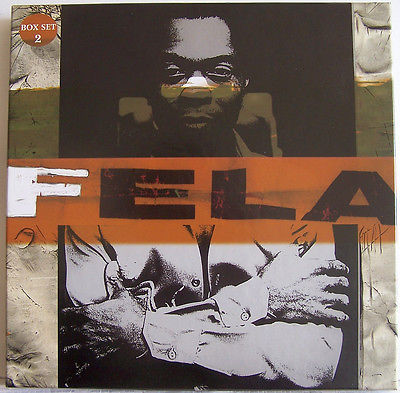
Fela Kuti : Box Set Two
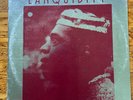
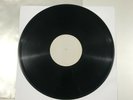
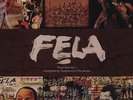
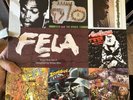
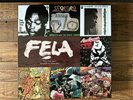
Album description: This is a Limited Box Set that holds six original, remastered Fela Kuti LPs with original artwork, six color postcards of his female performers and an insert with the six albums pictured, no booklet. Each box is numbered with a 5 digit number. This is No. 01966, which is on the insert and the back of the box. The six vinyl records are all in glossy clean mint condition. The album covers are in excellent, like new condition. The box & the postcards are also in excellent, like new condition. The entire box set weighs about five pounds when safely packaged for shipment. The pictures in this listing are of the actual box set you will receive. Check out our other listings for a wide variety of records, cassettes, CD's, magazines & more, everything reasonably priced. We ship worldwide in very secure packaging and shipping costs will be combined on multiple purchases. Any questions, please email.
Album List:
1. Shakara
2. Expensive Sh*t
3. Monkey Banana
4. Na Poi
5. Sorrow Tears And Blood
6. Authority Stealing
Shipping Costs:
USA: $4.00 Media Mail
Canada: $35.00 Priority Mail
Mexico: $43.00 Priority Mail
Europe/Asia/Australia/South America: $53.00 Priority Mail
Combined shipping available for additional purchases.
************* FELA BIOGRAPHY ************* Fela Anikulapo Kuti (15 October 1938 - 2 August 1997) was a Nigerian multi-instrumentalist musician and composer, pioneer of Afrobeat music, human rights activist, and political maverick. Fela was born Olufela Olusegun Oludotun Ransome-Kuti in Abeokuta, Ogun State, Nigeria into a middle-class family. His mother, Funmilayo Ransome-Kuti was a feminist activist in the anti-colonial movement and his father, Reverend Israel Oludotun Ransome-Kuti, a Protestant minister and school principal, was the first president of the Nigeria Union of Teachers. His brothers, Beko Ransome-Kuti and Olikoye Ransome-Kuti, both medical doctors, are well known in Nigeria. Fela was a first cousin to the Nigerian writer and Nobel laureate Wole Soyinka, the first African to win a Nobel Prize for Literature. Fela was sent to London in 1958 to study medicine but decided to study music instead at the Trinity College of Music. While there, he formed the band Koola Lobitos, playing a fusion of jazz and highlife. In 1963, Fela moved back to Nigeria, re-formed Koola Lobitos and trained as a radio producer for the Nigerian Broadcasting Corporation. He played for some time with Victor Olaiya and his All Stars. In 1967, he went to Ghana to think up a new musical direction. That was when Kuti first called his music Afrobeat. In 1969, Fela took the band to the United States. While there, Fela discovered the Black Power movement through Sandra Smith Izsadore, a partisan of the Black Panther Party, which would heavily influence his music and political views and renamed the band Nigeria '70. Soon, the Immigration and Naturalization Service was tipped off by a promoter that Fela and his band were in the U.S. without work permits. The band then performed a quick recording session in Los Angeles that would later be released as The '69 Los Angeles Sessions. After Fela and his band returned to Nigeria, the band was renamed The Africa '70, as lyrical themes changed from love to social issues. He then formed the Kalakuta Republic, a commune, a recording studio, and a home for many connected to the band that he later declared independent from the Nigerian state. Fela set up a nightclub in the Empire Hotel, named the Afro-Spot and then the Afrika Shrine, where he performed regularly. Fela's music became very popular among the Nigerian public and Africans in general. In fact, he made the decision to sing in Pidgin English so that his music could be enjoyed by individuals all over Africa, where the local languages spoken are very diverse and numerous. As popular as Fela's music had become in Nigeria and elsewhere, it was also very unpopular with the ruling government, and raids on the Kalakuta Republic were frequent. During 1972, Ginger Baker recorded Stratavarious with Fela appearing alongside Bobby Gass. Around this time, Kuti was becoming more involved in Yoruba religion. In 1977, Fela and the Afrika '70 released the album Zombie, a scathing attack on Nigerian soldiers using the zombie metaphor to describe the methods of the Nigerian military. The album was a smash hit and infuriated the government, setting off a vicious attack against the Kalakuta Republic, during which one thousand soldiers attacked the commune. Fela was severely beaten, and his elderly mother was thrown from a window, causing fatal injuries. The Kalakuta Republic was burned, and Fela's studio, instruments, and master tapes were destroyed. Fela claimed that he would have been killed had it not been for the intervention of a commanding officer as he was being beaten. Fela's response to the attack was to deliver his mother's coffin to the Dodan Barracks in Lagos, General Olusegun Obasanjo's residence, and to write two songs, "Coffin for Head of State" and "Unknown Soldier", referencing the official inquiry that claimed the commune had been destroyed by an unknown soldier. Fela and his band then took residence in Crossroads Hotel as the Shrine had been destroyed along with his commune. In 1978, Fela married twenty-seven women, many of whom were his dancers, composers, and singers to mark the anniversary of the attack on the Kalakuta Republic. Later, he was to adopt a rotation system of keeping only twelve simultaneous wives. The year was also marked by two notorious concerts, the first in Accra in which riots broke out during the song "Zombie", which led to Fela being banned from entering Ghana. The second was at the Berlin Jazz Festival after which most of Fela's musicians deserted him, due to rumors that Fela was planning to use the entire proceeds to fund his presidential campaign. Despite the massive setbacks, Fela was determined to come back. He formed his own political party, which he called Movement of the People. In 1979, he put himself forward for President in Nigeria's first elections for more than a decade, but his candidature was refused. At this time, Fela created a new band called Egypt '80 and continued to record albums and tour the country. He further infuriated the political establishment by dropping the names of ITT Corporation vice-president Moshood Abiola and then General Olusegun Obasanjo at the end of a hot-selling 25-minute political screed titled "I.T.T. (International Thief-Thief)". In 1984, Muhammadu Buhari's government, of which Kuti was a vocal opponent, jailed him on a charge of currency smuggling which Amnesty International and others denounced as politically motivated. Amnesty designated him a prisoner of conscience, and his case was also taken up by other human rights groups. After 20 months, he was released from prison by General Ibrahim Babangida. Once again, Fela continued to release albums with Egypt '80, made a number of successful tours of the United States and Europe and also continued to be politically active. In 1986, Fela performed in Giants Stadium in New Jersey as part of the Amnesty International A Conspiracy of Hope concert, sharing the bill with Bono, Carlos Santana, and The Neville Brothers. In 1989, Fela and Egypt '80 released the anti-apartheid Beasts of No Nation album that depicts on its cover U.S. President Ronald Reagan, UK Prime Minister Margaret Thatcher and South African Prime Minister Pieter Willem Botha. His album output slowed in the 1990s, and eventually he stopped releasing albums altogether. In 1993, he and four members of the Afrika '70 organization were arrested for murder. The battle against military corruption in Nigeria was taking its toll, especially during the rise of dictator Sani Abacha. Rumors were also spreading that he was suffering from an illness for which he was refusing treatment. On 3 August 1997, Olikoye Ransome-Kuti, already a prominent AIDS activist and former Minister of Health, stunned the nation by announcing his younger brother's death a day earlier from Kaposi's sarcoma which was brought on by AIDS. More than a million people attended Fela's funeral at the site of the old Shrine compound. A new Africa Shrine has opened since Fela's death in a different section of Lagos under the supervision of his son Femi Kuti. The musical style performed by Fela Kuti is called Afrobeat, which is a complex fusion of Jazz, Funk, Ghanaian/Nigerian High-life, psychedelic rock, and traditional West African chants and rhythms. Afrobeat also borrows heavily from the native "tinker pan" African-style percussion that Kuti acquired while studying in Ghana with Hugh Masekela, under the uncanny Hedzoleh Soundz. The importance of the input of Tony Allen, Fela's drummer of twenty years, in the creation of Afrobeat cannot be overstated. Afrobeat is characterized by a fairly large band with many instruments, vocals, and a musical structure featuring jazzy, funky horn sections. The "endless groove" is used, in which a base rhythm of drums, shekere, muted West African-style guitar, and melodic bass guitar riffs are repeated throughout the song. Commonly, interlocking melodic riffs and rhythms are introduced one by one, building the groove bit-by-bit and layer-by-layer to an astonishing melodic and polyrhythmic complexity. The horn section then becomes prominent, introducing other riffs and main melodic themes. Fela's band was notable for featuring two baritone saxophones, whereas most groups were using only one of this instrument. This is a common technique in African and African-influenced musical styles, and can be seen in funk and hip hop. Fela's bands at times even performed with two bassists at the same time both playing interlocking melodies and rhythms. There were always two or more guitarists. The electric West African style guitar in Afrobeat bands are paramount, but are used to give basic structure, playing a repeating chordal/melodic statement, riff, or groove. Some elements often present in Fela's music are the call-and-response within the chorus and figurative but simple lyrics. Fela's songs were also very long, at least 10–15 minutes in length, and many reaching the 20 or even 30 minutes. His LP records frequently had one 30-minute track per side. Typically there is an instrumental "introduction" jam part of the song, perhaps 10-15 minutes long, before Fela starts singing the "main" part. His songs were mostly sung in Nigerian pidgin, although he also performed a few songs in the Yoruba language. Fela's main instruments were the saxophone and the keyboards, but he also played the trumpet, electric guitar, and took the occasional drum solo. Fela was known for his showmanship, and his concerts were often quite outlandish and wild. He referred to his stage act as the Underground Spiritual Game. "Imagine Che Guevara and Bob Marley rolled into one person and you get a sense of Nigerian musician and activist Fela Kuti". Herald Sun, February 2011. In recent years there has been a revitalization of Fela's influence on music and popular culture, and new bands, such as Antibalas, who carry the Afrobeat banner to a new generation of listeners. (wiki bio)
Any questions? Please send an email.
Check out our listings for 1000's of vinyl records, CD's, cassettes, books & more. Save on shipping!




![FELA ANIKULAPO KUTI - BOX SET 1 [LTD EDT 6xLPs] SEALED](https://www.popsike.org/php/thumbnail.php?url=https://www.popsike.pics/pix/20100228/200444691836.jpg)
