Franco Battiato Sulle Corde Di Aries Italian progrock
$
79


Favourite Auctions
To save auctions to your favourites, please login
If you don't have an account, please register
Description
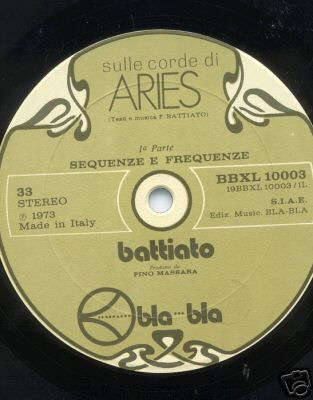
Bla Bla records BBXL 10003 (mfd. in Italy) - Franco Battiato - Sulle Corde Di Aries LP from 1973.Record is in excellent near mint minus condition.The gatefold cover is VG+ with slight ringwear on back and barely visible staining on front. America's self-regarding vision of itself is such that artists who are undisputed legends elsewhere are not seen to have made it if they have no stateside success. That doesn't mean that they can't have an influence worldwide, whether English-speaking or not, which is where longtime Italian superstar Franco Battiato comes into the picture. Avant-rocker Jim O'Rourke has named him as one of his favorites, Simple Minds' Jim Kerr has collaborated with him, while an ever-expanding series of reissues brought his early work to the attention of prog-psych fanatics around the globe in the late '90s, even as he pursues his current recording interests in other spheres. Born in 1945 in the village of Jonio, Battiato's initial stabs into musical work in the 1960s didn't go anywhere beyond a single or two, leaving his first real break to occur in the early '70s when he began recording a series of albums for the underground label Bla Bla. Starting with Fetus in 1971 and concluding with L'Egitto Prima Delle Sabbie (Egypt Before the Sands) in 1978, he staked out his own claim in the high-ferment world of Italian prog rock. Musically accomplished if sometimes poorly recorded, and unafraid to indulge in more than a little whimsy, these records covered the gamut from extreme experimentalism to more song-focused efforts, the two most notable of which would be 1972's Pollution and 1973's Sulle Corde Di Aries (On the Ropes of Aries). Compared to other bands like Area and PFM, however, Battiato and his band were cult figures more loved abroad than at home; performances in France and Germany as the opening act for Brian Eno and Nico give a sense as to his appeal elsewhere. Battiato's often extravagant appearance at this time make him something of an Italian Peter Gabriel, while his lyrics eschewed then-fashionable Maoist/terrorist posing in favor of a deep but humorous combination of Asian philosophies and literary reflection. Working with a smaller band and greater range of side players — including, intriguingly enough, cellist Jane Robertson, fresh from working with Don Cherry on Relativity Suite — Battiato aims at a somewhat more grandiose level with Sulle Corde di Aires. Consisting only of four pieces, the first of which, "Sequenze e Frequenze," is a mostly instrumental number spanning a full side, on the one hand Sulle Corde sounds like Battiato taking himself a bit more seriously. On the other, it contains enough vibrant life to be well worth a listen beyond the world of prog fandom. The combination of acoustic guitar elegance (credit Gianni Mocchetti in particular for his work) and electronic drum pulse and keyboard overdubs some four minutes into "Sequenze e Frequenze," for instance, has a Krautrock-inspired life of its own. Battiato subtly ups the ante a little bit later with an increasingly wacky and fun kalimba sequence over a rolling, stuttering synth/guitar loop that could be right out of Pink Floyd's "One of These Days," with even more keyboard drones and melodies adding to the at-once serene and playful mood. The remaining three songs offer up more in the way of general variety, touching on everyone from acid-folk tribalism to hints of neo-classical approaches, not to mention a playful pseudo-Renaissance jam via oboe and clarinet combined with Mochetti's mandolin on "Da Oriente ad Occidente." The jazz connection hinted at via Robertson's appearance on "Aria di Rivoluzione" gets a more conventional nod due to Daniele Cavallanti's work on soprano sax and Gianni Bedori's performance on regular saxophone. Both are competent players if not uniquely inspired, but Bedori's jamming on the increasingly intense "Aries" deserves a nod. Battiato himself sings only at a few points on Sulle Corde, but when he does, it continues the balanced mood between seriousness and sheer joy.
price rating