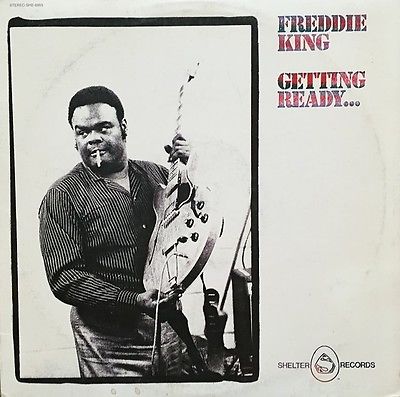
Freddie King: Getting Ready-1971 Shelter 1st Edition 33 RPM Stereo Record
$
26


Favourite Auctions
To save auctions to your favourites, please login
If you don't have an account, please register
Description
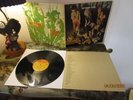
Used 1971 Shelter Stereo Release of Bandleader/Guitar Master/Pioneering Blues Vocalist Freddie King Entitled Getting Ready...Produced by Leon Russell & Don Nix, Engineered by John Fry, Remixed at Ardent Studios in Memphis, Album Recorded at Ter-Mar Chess Studios in Chicago - "Guitarist Freddie King rode to fame in the early '60s with a spate of catchy instrumentals which became instant bandstand fodder for fellow bluesmen and white rock bands alike. Employing a more down-home (thumb and finger picks) approach to the B.B. King single-string style of playing, King enjoyed success on a variety of different record labels. Furthermore, he was one of the first bluesmen to employ a racially integrated group on-stage behind him. Influenced by Eddie Taylor, Jimmy Rogers, and Robert Jr. Lockwood, King went on to influence the likes of Eric Clapton, Mick Taylor, Stevie Ray Vaughan, and Lonnie Mack, among many others. Freddie King (who was originally billed as "Freddy" early in his career) was born and raised in Gilmer, TX, where he learned how to play guitar as a child; his mother and uncle taught him the instrument. Initially, King played rural acoustic blues, in the vein of Lightin' Hopkins. By the time he was a teenager, he had grown to love the rough, electrified sounds of Chicago blues. In 1950, when he was 16 years old, his family moved to Chicago, where he began frequenting local blues clubs, listening to musicians like Muddy Waters, Jimmy Rogers, Robert Jr. Lockwood, Little Walter, and Eddie Taylor. Soon, the young guitarist formed his own band, the Every Hour Blues Boys, and was performing himself. In the mid-'50s, King began playing on sessions for Parrott and Chess Records, as well as playing with Earlee Payton's Blues Cats and the Little Sonny Cooper Band. Freddie King didn't cut his own record until 1957, when he recorded "Country Boy" for the small independent label El-Bee. The single failed to gain much attention. Three years later, King signed with Federal Records, a subsidiary of King Records, and recorded his first single for the label, "You've Got to Love Her With a Feeling," in August of 1960. The single appeared the following month and became a minor hit, scraping the bottom of the pop charts in early 1961. "You've Got to Love Her With Feeling" was followed by "Hide Away," the song that would become Freddie King's signature tune and most influential recording. "Hide Away" was adapted by King and Magic Sam from a Hound Dog Taylor instrumental and named after one of the most popular bars in Chicago. The single was released as the B-side of "I Love the Woman" (his singles featured a vocal A-side and an instrumental B-side) in the fall of 1961 and it became a major hit, reaching number five on the R&B charts and number 29 on the pop charts. Throughout the '60s, "Hide Away" was one of the necessary songs blues and rock & roll bar bands across America and England had to play during their gigs. King's first album, Freddy King Sings, appeared in 1961, and it was followed later that year by Let's Hide Away and Dance Away With Freddy King: Strictly Instrumental. Throughout 1961, he turned out a series of instrumentals -- including "San-Ho-Zay," "The Stumble," and "I'm Tore Down" -- which became blues classics; everyone from Magic Sam and Stevie Ray Vaughan to Dave Edmunds and Peter Green covered King's material. "Lonesome Whistle Blues," "San-Ho-Zay," and "I'm Tore Down" all became Top Ten R&B hits that year. Freddie King continued to record for King Records until 1968, with a second instrumental album (Freddy King Gives You a Bonanza of Instrumentals) appearing in 1965, although none of his singles became hits. Nevertheless, his influence was heard throughout blues and rock guitarists throughout the '60s -- Eric Clapton made "Hide Away" his showcase number in 1965. King signed with Atlantic/Cotillion in late 1968, releasing Freddie King Is a Blues Master the following year and My Feeling for the Blues in 1970; both collections were produced by King Curtis. After their release, Freddie King and Atlantic/Cotillion parted ways. landed a new record contract with Leon Russell's Shelter Records early in 1970. King recorded three albums for Shelter in the early '70s, all of which sold well. In addition to respectable sales, his concerts were also quite popular with both blues and rock audiences. In 1974, he signed a contract with RSO Records -- which was also Eric Clapton's record label -- and he released Burglar, which was produced and recorded with Clapton. Following the release of Burglar,King toured America, Europe, and Australia. In 1975, he released his second RSO album, Larger Than Life. Throughout 1976, Freddie King toured America, even though his health was beginning to decline. On December 29, 1976, King died of heart failure. Although his passing was premature -- he was only 42 years old -- Freddie King's influence could still be heard in blues and rock guitarists decades after his death." - "The first of Freddie King's three albums for Leon Russell's Shelter label set the tone for his work for the company: competent electric blues with a prominent rock/soul influence. King sings and plays well, but neither the sidemen nor the material challenge him to scale significant heights. Part of the problem is that King himself wrote none of the songs, which are divided between Chicago blues standards and material supplied by Leon Russell and Don Nix. The entire album is included on the compilation King of the Blues." - Tremendous Personnel for the Septet Features Legendary Composer Freddie King on Electric Guitar, the Brilliant Leon Russell on Piano & Guitars, Don Preston on Guitar, Jon Gallie on Organ, the Great Donald "Duck" Dunn on Bass and Chuck Blackwell or Charles Myers on Drums! - Selections on Side One Are Don Nix's Same Old Blues, the Elmore James Classic Dust My Broom, Big Maceo's Worried Life Blues, Eddie Boyd's Five Long Years & the Big Bill Broonzy/Charles Segar Standard Key to the Highway - Tracks for Side Two Are Don Nix's Going Down, Leon Russell/Don Nix's Living on the Highway, Walking by Myself, Original Freddie King Composition Tore Down and Leon Russell/Don Nix/Duck Dunn's Palace of the King - Used Copy, Cover Has a Light Surface Ring, Record Very Good++ - Stereo Recording, Product Code SHE-8905 - California Residents Add 9.75% Sales Tax - International S & H Extra -
price rating