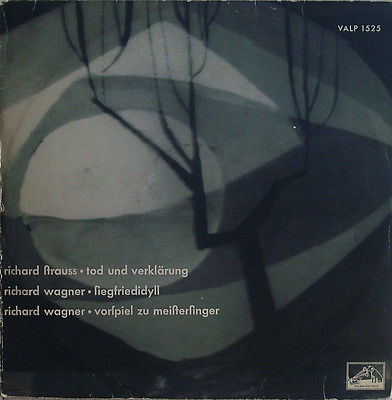
Furtwangler: Tod und Verklärung + Siegfried Idyll, etc. - Austrian HMV VALP 1525
$
75


Favourite Auctions
To save auctions to your favourites, please login
If you don't have an account, please register
Description
redgarnett Store ITEM DESCRIPTION:
This beautiful and exceedingly rare LP from Austrian HMV (VALP 1525, Austrian pressing, red/gold “Langspiel33Platte” semi-circle label – ED1, mono) features Wilhelm Furtwangler and the Vienna Philharmonic Orchestra's magnificent accounts of Richard Strauss' Tod und Verklärung Op. 20 (Death and Transfiguration) and the Prelude to Act I of Wagner's Die Meistersinger von Nürnberg and the same composer's Siegfried Idyll.
The Strauss was set down on 21, 23, and 24 January 1950 (producer: Walter Legge / engineer: Anthony Griffith), while the the Die Meistersinger Act I Prelude was recorded during 1-4 April 1949 (producer: Walter Legge / engineer: Douglas Larter) and the Siegfried Idyll on 16/17 February 1949, with Legge again the producer, Larter again the engineer.
All sessions were held in the warm acoustics of the Musikvereinssaal, Vienna.
Furtwangler distills a powerful atmosphere in all three works, richly evocative, with the VPO on spell-binding form throughout.
It seems worth re-printing an essay on Furtwangler which appears on ArkivMusic in the detail page for the EMI CD set “Wilhlem Furtwangler – The Great EMI Recordings”:
“Wilhelm Gustav Heinrich Ernst Martin Furtwängler, to give him his full name, was born in Berlin on 25 January 1886. His father was an archaeologist and his mother a painter. Both were cultured and enlightened people who brought up their eldest son in the beliefs of German humanism. When the young Wilhelm showed early signs of exceptional talent they decided to provide him with a private education based around the Arts. Although his artistic interests were wide it was music that eventually became his overriding passion and he started learning the piano at an early age, composing his first music at the age of seven. The idea of becoming a composer was his prime ambition, despite the failure of his early attempts at composition.
Several factors led to Furtwängler taking up the baton: the wish to conduct his own works; his increasing interest in the art of interpretation and the need to make a living, following the death of his father in 1907. His first concert as conductor was in Munich in 1906 with a programme of works by Bruckner and Beethoven as well as one of his own pieces. His rise to fame as a conductor was quite rapid and, after working in Breslau, Zurich and at the court opera in Munich, he gained his first big appointments at the Lübeck Opera (1911-1915) and in Mannheim (1915-1920). In 1920 he succeeded Richard Strauss as conductor of the Berlin Staatsoper concerts and in 1922, after the death of Nikisch, he took over the conductorship of the Leipzig Gewandhaus and Berlin Philharmonic Orchestras. It was at this time that he also began a long and successful relationship with the Vienna Philharmonic Orchestra. But it was with the Berlin Philharmonic that Furtwängler was to remain for the rest of his career.
Throughout the 1920s and '30s Furtwängler and the Berlin Philharmonic went on a series of European tours to Scandinavia, Switzerland, Italy, Hungary and England. In 1937 Furtwängler conducted at Covent Garden as part of the Coronation celebrations and, in 1938, he was back again to conduct two cycles of the Ring. At this time, too, Furtwängler found himself inextricably involved in the politics of Germany. His liberal outlook meant that it was difficult for him to see Nazism as a serious threat to his country and he dissociated himself from it and opposed it whenever he could. He refused to give the Nazi salute, even in the presence of Adolf Hitler, and used his influence to save the lives of as many Jewish musicians as he could. In spite of this and because of his rather naive political outlook many outside Germany saw his continued residence and musical activity as a kind of collaboration. The final ten years of Furtwängler's life were dogged by controversy, not helped by the American Military Government in post-war Germany delaying his denazification process until 1947, when he was once again allowed to take up conducting.
Success in Europe quickly followed and he appeared with the Berlin and Vienna Philharmonic Orchestras as well as local orchestras in London, Stockholm, Edinburgh, Lucerne, Milan, Salzburg and Paris. It is from this time that the superb recordings in this 21-CD set were made. Here is a special selection of some of EMI's celebrated Furtwängler recordings, some recorded live at concerts and some made in the studios. The combination of Furtwängler and EMI brought about one of the greatest collaborations in recording history and the Company is proud to be able to contribute this set to the 125th birthday celebrations of a great conductor.”
The reverse side of the jacket carries insightful liner notes (uncredited), printed in German only. The striking cover art is similarly uncredited, alas.
CONDITION – PLEASE READ VERY CAREFULLY:
The gradations of condition I use are as follows: MINT, Near-Mint, Excellent, Very Good, Good, Fair, Poor.
The condition of the jacket is GOOD. There is a fair amount of edgewear, creasing, as well as a small bit of writing, ringwear, and a sticker tear to the rear panel. However, there are no seamsplits, bends, or owners' markings and the album remains solid, bright, and highly attractive – overall, still a decent collector's copy.
The condition of the LP is VERY GOOD+. Though there is light surface noise throughout, in general the playback remains quite fine. However, those wanting a flawless or near-MINT copy are kindly advised to look elsewhere. Overall, this rates as a very good collector's copy.
PLEASE NOTE:
This LP has been carefully cleaned using a VPI cleaning machine. All LPs are provided with a new Nagaoka (or Nagaoka-style) inner sleeve. The images I've provided are of the actual item you are potentially bidding on - these are not stock images or images I've taken from other sites. Bid with confidence!
PAYMENT:
Payment by PayPal is greatly preferred. Payment should be made within 5 days.
SHIPPING:
Shipping is free to anywhere in the world; this is true regardless of the number of LPs you buy, be it 1 or a 100. All LPs will be sent via standard airmail (7-10 days delivery). Note: There is no tracking number provided with standard airmail. Should you wish to have your item(s) sent via certified airmail (i.e., with a tracking number), please contact me.
FEEDBACK:
I will promptly leave feedback for all buyers. Please do not leave negative, or even neutral, feedback without first giving me an opportunity to resolve any dissatisfaction you might have with an item or transaction. I do understand that, on occasion, a buyer might believe the item description to be inaccurate or that a buyer may be disappointed in some other way regarding the sale. I promise I will do my very best to resolve any unhappiness you've experienced in your buying experience with me to your complete satisfaction. Thank you.
REFUNDS:
Returns are honored, and any buyer you makes a return will be refunded in full. Please contact me before making a return.
Please see my other classical LP and CD auctions, and feel free to write with any questions, I'll be glad to help.
price rating