GREEK ELECTRONIC SKALKOTTAS LP AVANT-XENAKIS-SFETSAS
$
114


Favourite Auctions
To save auctions to your favourites, please login
If you don't have an account, please register
Description
NIKOS SKALKOTAS / KYRIAKOS SFETSAS / DIMITRI TERZAKIS / THEODORE ANTONIOU
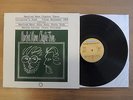
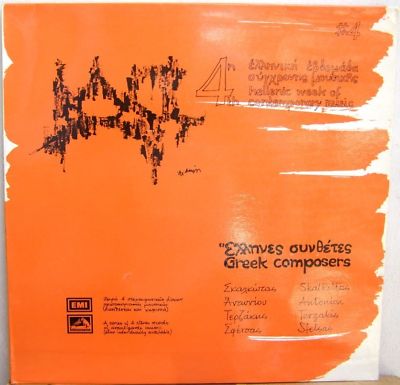
GREEK COMPOSERS - 4th HELLENIC WEEK OF CONTEMPORARY MUSIC #4 LP
EMI Greece
Mega rare original greek pressings of the Hellenic Weeks series with exclusive contributions from Nikos Skalkotas, Theodore Antoniou, Kyriakos Sfetsas and Dimitri Terzakis.
Some info on the release: SCARCE original pressing vinyl from the legendary Greek Composers Hellenic weeks series released back in the early 70's on EMI, Greece, containing mostly premiere recordings of works from the most well known composers of the time, both from Greece and foreign countries. No need to tell you how difficult to find is the series even in Greece. Pressed in a limited edition run of possibly 500 copies at that time, while there was also a special boxset edition. The record sold here is the 4th volume from the 4th week of contemporary music containing works from Nikos Skalkottas, Kyriakos Sfetsas, Dimitris Terzakis and Theodore Antoniou. A great mix of experimental electronics, tape works and avant-garde musics. Especially the electronic works on the record are really unvelievable!! All works on the record have not been re-issued on compact disc or any other form until today...your only chance to find a copy of this gem, don't let this go away.
Skalkottas was born in Chalcis on the island of Euboea, to a poor family said to have been folk musicians and marble carvers. He started violin lessons with his father and uncle Kostas Skalkottas at the age of five, at about the same time as his family moved to Athens. He continued studying violin with Tony Schulze at the Athens Conservatory, from which he graduated in 1920 with a diploma of high distinction. The following year a scholarship from the Averoff Foundation enabled him to study abroad. From 1921 to 1933 he lived in Berlin, where he first took violin lessons at the Prussian Academy of Arts with Willy Hess. Deciding in 1923 to give up his career as a violinist and become a composer, he studied composition with Paul Kahn, Paul Juon, Kurt Weill and Philipp Jarnach. Between 1927 and 1930 he was a member of Arnold Schoenberg's Masterclass in Composition at the Academy of Arts, where his fellow pupils included Marc Blitzstein, Roberto Gerhard and Norbert von Hannenheim. Skalkottas had been living for several years with the violinist Mathilde Temko; they had two children, though only the second, a daughter, survived infancy. In 1930 Skalkottas devoted considerable effort to having some of his works performed in Athens, but they were met with incomprehension, and even in Berlin his few performances did not make much better headway. In 1931 he seems to have had a personal and artistic crisis: his relationship with Temko came to an end and he is also reported to have fallen out with Schoenberg, though the nature of their disagreement is unclear and Schoenberg continued to rate him highly as a composer. In any event Skalkottas seems to have composed nothing for at least two years.
As a composer he worked alone, but wrote prolifically, mainly in his very personal post-Schoenbergian idiom that had little chance of being comprehended by the Greek musical establishment.
Skalkottas' early works, most of which he wrote in Berlin, are lost, as are some of those written in Athens. The earliest of his works available to us today date from 1922-24; these are piano compositions as well as the orchestration of Cretan Feast by Dimitris Mitropoulos. Among the works written in Berlin are the sonata for solo violin, several works for piano, chamber music and some symphonic works. Although during the period 1931-1934 Skalkottas did not compose anything, he resumed composing in Athens and continued until his death. His output comprised symphonic works (36 Greek Dances, the symphonic overture The Return of Ulysses, the fairy drama Mayday Spell, the Second Symphonic Suite, the ballet The Maiden and Death, works for wind orchestra and several concertos), chamber, vocal and instrumental works including the huge cycle of 32 Piano Pieces.
Skalkottas's short life seems to symbolise the special vulnerability of the Schoenberg pupil whose musical roots lay a little outside Austro-Germanic traditions. Throughout his career Skalkottas remained faithful to the neo-classical ideals of Neue Sachlichkeit and 'absolute music' proclaimed in Europe in the 1925. Already in Berlin he was taking an interest in jazz and at the same time developing a very personal form of the twelve-note method, making use of not one but several tone-rows in a work and organizing these rows to define different thematic and harmonic areas. (For example, the Largo Sinfonico employs no less than 16 twelve-tone rows.) Like Schoenberg, he persistently cultivated classical forms (such as sonata, variations, suite), but his worklist is divided between atonal, twelve-tone and tonal works, all three categories spanning his entire composing career. Such apparent heterogeneity could have been intensified by a love of Greek folk music. The most striking example of his commitment to Greek folk music is the series of 36 Greek Dances composed for orchestra between 1931 and 1936, arranged for various different ensembles in the ensuing years and in part radically reorchestrated in 1948-49. About two-thirds of these dances are based on genuine Greek folk themes from different parts of the Greek mainland and islands, but the other third use material of Skalkottas's own composition in folk style.
Nevertheless, he remained sceptical of the attempts of his Greek contemporaries to integrate folk music into the modern symphonic style, and only juxtaposed and mixed folk, atonal and 12-note styles in a few works such as the incidental music to Christos Evelpides's 1943 fairy-tale drama Mayday Spell. Skalkottas was evidently reluctant to deploy the kind of structural and stylistic tensions that would have betrayed the integrationist ideals of his Schoenbergian inheritance. This could be seen (in terms of a comprehensive connecting impulse) as a link between the Second Viennese, Busoni, Stravinsky and Bartókian schools. Around 1945 he seems to have reappraised his aesthetic direction to some extent and written several works in a more conventionally tonal idiom - many of these have key-signatures, for instance. Yet the general level of dissonance is not significantly lessened. Skalkottas was able to draw diverse and in some ways conflicting threads together and not to compromise, rather to enhance, his own originality, range and power of expression.
Kyriakos Sfetsas was born on September 29, 1945, in Amfilochia. He was raised in Lefkada where, at an early age, he studied music for the first time at the Philarmonic Band and the National Conservatory of the city with the late Fotis Vlachos. He continued his studies at the National Conservatory of Athens (1963-1966), where he studied the piano with Krino Kalomiri and theory of music with Michalis Vourtsis. On August 30, 1964, in Lefkada, he accompanied on the piano Maria Callas in her last performance in Greece. A few months after the 1967 dictatorship, he moved to Paris. There, on a French State scholarship (1969-1972), he pursued further studies with the composer and educator Max Deutsch (composition, analysis, orchestral conducting), while seeking the mentorship and advice of Iannis Xenakis, Luigi Nono and Henri Dutilleux.
The first public performance of his work (Episodes for piano solo) took place just after the uprising of May '68 at the "Latin America Hall" in Paris, receiving favourable reviews. After that, his music was often performed and he had his first commissions (by French Radio and TV, the Ars Nova Orchestra and the Dance Group of Vitry). After that period, several of his works are performed in renowned international contemporary music festivals (Royan, Reims, Bordeaux and Paris); at the same time, he works on a regular basis with the contemporary dance group of Vitry and the choreographer Michel Cazerta. Belongs to the great avant-garde/experimental composers "wave" that appeared in Europe in the 60's/70's/80's with main representators composers like Bernd Alois Zimmermann, Helmut Lachenmann and Salvatore Sciarrino, Brian Ferneyhough and Nicolaus A. Huber, Karlheinz Stockhausen and Mauricio Kagel, Bruno Maderna, Henri Pousseur or more widely Penderecki, John Cage, Toru Takemitsu and of course Wolfgang Rihm. A portion of his Paris works were published by Editions Transatlantiques, and it was in Paris in 1974 that he released for the first time one of his works on record: Four-channel electro-acoustic music for the Ballet Smog, one of the first pieces written for four-channel tape in the world. In Greece, he made his debut as a composer at the 4th Hellenic Week of Contemporary Music (Athens, 19th - 26th September 1971) with his work Docimology(at the same time with works of Anestis Logothetis and Jani Christou). He returned to Greece in Autumn 1975, this time to stay. At the invitation of Manos Hatzidakis, he worked at the Third Programme of the Hellenic Radio (1975-1976) as a free lance producer. In 1977, as a regular employee of the Hellenic Radio, he served as head of the music departments of the 2nd and 1st Programmes, and from the summer of 1982 to January 1994 as director of the 3rd Programme.
His body of work consists of a large number of compositions: symphonic, choral, ballet and theatre music, chamber, electronic, pieces for solo instruments, pieces in jazz and fusion style, songs on Greek and World poems. In the years after 1980, he also writes music for films. In 1980, his music for P. Tasios' Paragelia receives first prize at the Film Festival of Thessaloniki.
Condition: Vinyl lies in mint condition, looks crystal clear and plays perfectly, while cover lies in mint condition, like new. Keeper's copy.
Tracklist
A1 ???. ????????? - I. Tango Bassoon - ?????? ????????????Oboe - ????????? ????????????
Piano - ??????? ?. ???????????
Trumpet - ?????? ???????? A2 ???. ????????? - II. Fox-Trot Bassoon - ?????? ????????????
Oboe - ????????? ????????????
Piano - ??????? ?. ???????????
Trumpet - ?????? ???????? - - A3 ??????? ???????? - Protest II For Chamber Music Ensemble And Tape / ??????????? ?? ??? ?????????? ???????? ???????? ??? ????????????? Conductor - ??????? ????????
Ensemble - ?????????? ????????? ???????? B1 ???????? ???????? - X For Choir, Instrumental Ensemble And Tape / ? ??? ???????, ???????? ?????? ??? ????????????? Choir - ??????? ????????????? ????????????
Conductor - ??????? ????????, ??????? ????????
Ensemble - ?????????? ????????? ???????? B2 ???????? ??????? - Docimology For Instrumental Ensemble / ??????????? ??? ???????? ?????? Conductor - ??????? ????????
Ensemble - ?????????? ????????? ????????
SHIPPING & PAYMENT
Shipping: Shipping for this LP is 7$ airmail in Europe / 9$ for the rest of the world
Registered mail: +5$
Insurance: optional
Combined shipping: BIG discounts
Payment: Paypal
Packaging: I am a collector too and i know
price rating