HARMONIUM Vincent Persichetti SIGNED Poems WALLACE STEVENS
$
50


Favourite Auctions
To save auctions to your favourites, please login
If you don't have an account, please register
Description
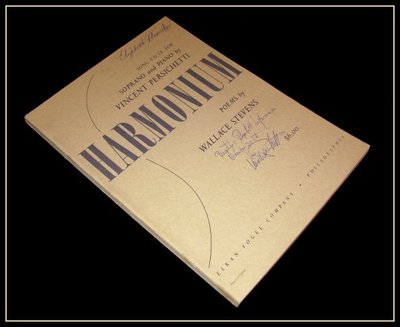
Harmonium
Song Cycle for Soprano and Piano
Inscribed and Signed
Acclaimed 20th century composer Vincent Persichetti's Harmonium: Song Cycle for Soprano and Piano. Complete score. Lyrics comprised of Wallace Stevens poetry. Inscribed and signed on front panel by composer Persichetti to noted opera soprano Elizabeth Wrancher, presumably following a performance. Signed by Wrancher on front panel. Frontis wood engraving by Bernard Kohn.
VINCENT PERSICHETTI:
Vincent Ludwig Persichetti (June 6, 1915 – August 14, 1987) was an American composer, teacher, and pianist. An important musical educator and writer, Persichetti was a native of Philadelphia. He was known for his integration of various new ideas in musical composition into his own work and teaching as well as for training many noted composers in composition at the Juilliard School.
His students at Juilliard included Philip Glass, Michael Jeffrey Shapiro, Kenneth Fuchs, Richard Danielpour, Robert Dennis, Peter Schickele, Lowell Liebermann, Robert Witt, Randell Croley and Leo Brouwer. He also taught composition to conductor James DePreist at the Philadelphia Conservatory.
Life
Persichetti was born in Philadelphia, Pennsylvania in 1915 and remained a resident of that city throughout his life. Though neither of his parents were musicians, his musical education began early. Persichetti enrolled in the Combs College of Music at the age of five, where he studied piano, organ, double bass and later music theory and composition with Russel King Miller, whom he considered a great influence. By the time he reached his teens, he was paying for his own education by accompanying and performing. He continued to do so throughout high school, adding church organist, orchestral player and radio staff pianist to his experience. His first public performance of his own original works came at the age of 14. In addition to his musical talents, the young Persichetti attended art school and remained an avid sculptor until his death. He attended Combs for his undergraduate education as well. After receiving his bachelor's degree in 1936 he was immediately offered a teaching position.
By the age of 20, Persichetti was simultaneously head of the theory and composition department at Combs, a conducting major with Fritz Reiner at the Curtis Institute, and a student of piano (with Olga Samaroff) and composition at the Philadelphia Conservatory. He earned a master's degree in 1941 and a doctorate in 1945 from Philadelphia, as well as a conducting diploma from Curtis. In 1941, while still a student, Persichetti headed the theory and composition department as well as the department of postgraduate study at Philadelphia. In 1947, William Schuman extended an offer of professorship at Juilliard, where his students included Einojuhani Rautavaara, Leonardo Balada, Steven Gellman, Peter Schickele (P.D.Q. Bach), Michael Jeffrey Shapiro, Larry Thomas Bell, Claire Polin, Toshi Ichiyanagi, Robert Witt (who also studied with Persichetti at the Philadelphia Conservatory) and Philip Glass. He became Editorial Director of the Elkan-Vogel publishing house in 1952.
Music
Persichetti is one of the major figures in American music of the 20th century, both as a teacher and a composer. Notably, his Hymns and Responses for the Church Year has become a standard setting for church choirs. His numerous compositions for wind ensemble are often introductions to contemporary music for high school and college students. His early style was marked by the influences of Stravinsky, Bartók, Hindemith, and Copland before developing into his own distinct voice in the 1950s.
Persichetti's music draws on a wide variety of thought in 20th century composition as well as Big Band music. His own style was marked by use of two elements he refers to as "graceful" and "gritty": the former being more lyrical and melodic, the latter being sharp and intensely rhythmic. He frequently used polytonality and pandiatonicism in his writing and his music could be marked by sharp rhythmic interjections, but his embracing of diverse strands of musical thought makes characterizing his body of work difficult. This trend continued throughout his compositional career. His music lacked sharp changes in style over time. (Persichetti once proclaimed in an interview in Musical Quarterly that his music was "...not like a woman, that is, it does not have periods!"). He frequently composed in his car, sometimes taping staff paper to the steering wheel.
His piano music forms the bulk of his creative output, with a concerto, a concertino, twelve sonatas, and a variety of other pieces written for the instrument, virtuosic pieces as well as pedagogical and amateur-level compositions. Persichetti was an accomplished pianist. Persichetti wrote many pieces suitable for less mature performers, considering them to have serious artistic merit. Persichetti is also one of the major composers for the concert wind band repertoire, with his 14 works for the ensemble. The Symphony No. 6 for band is of particular note as a standard larger work. He wrote one opera, entitled The Sibyl. The music was noted by critics for its color, but the dramatic and vocal aspects of the work were found by some to be lacking. He wrote nine symphonies, of which the first two were withdrawn (as were the first two symphonies by two other American composers of the late thirties and early forties, William Schuman and Peter Mennin), and four string quartets. Many of his other works are organized into series. One of these, a collection of primarily instrumental works entitled Parables, contains 25 works, many for unaccompanied wind instruments (complete listing below), and his 15 Serenades include such unconventional combinations as a trio for trombone, viola, and cello as well as selections for orchestra, for band, and for duo piano.
In addition to his frequent appearances as lecturer on college campuses, for which he was noted for his witty and engaging manner, he wrote the famous music theory textbook Twentieth Century Harmony: Creative Aspects and Practice as well as coauthoring a monograph, with Flora Rheta Schreiber, on William Schuman.
ELIZABETH WRANCHER:
1930-2012. Elizabeth Wrancher graduated from the Indiana University School of Music in 1955, upon which time she traveled to Germany as a Fulbright Scholar. A lyric dramatic soprano, Elizabeth Wrancher remained in Europe for 13 years, singing 28 roles, and performing in major opera houses throughout Germany, Belgium, Switzerland and Austria. She was the first American to win first prize in the coveted International Music Contest; was an actor and singer in three German movies; and from 1953 to 1980, was a guest soloist with major orchestras in Germany and the United States. Her recordings are currently housed in the archives of the Salzburg Mozarteum in Augsburg.
She joined the voice faculty at the University of South Florida in 1968, and in 1974 left there to develop a vocal program at the University of Central Florida, where she remained for the next 29 years. She is noted for her vocal master classes, her service as an adjudicator, and her exceptional ability to train young voices. She received a research grant for "OPERA LIVE," which performed in the community and in public schools in the central Florida area.
Elizabeth Wrancher was a member of the National Arts and Letters, the National Association of Teachers of Singing, the Florida State Music Teachers Association, the Nation Teachers Association, the National Federation of Music Clubs, the Wednesday Music Club, Pi Kappa Lambda and Mu Phi Epsilon. Ms. Wrancher was alson an active member of the Board of Directors and Advisory Board of the Orlando Opera Company.
All items guaranteed to be authentic and original
unless otherwise noted.
"A book must be the axe
for the frozen sea inside us."
Franz Kafka
- AUTHOR: n/a
- EDITOR/ILLUSTRATOR/TRANSLATOR: Vincent Persichetti, Composer
- TITLE: Harmonium
- DATE: [1959]
- PLACE: Philadelphia
- IMPRINT: Elkan-Vogel Co.
- FORMAT: 12" x 9"
- COLLATION/PAGINATION: pp. [1-4] 5-105 [blank, 3]
- EDITION: [First Edition]
Tight copy with light shelf wear and three highlighted titles in Contents.
FulfillmentThe following terms apply:
- Buyer pays shipping unless otherwise noted.
- Seller pays insurance.
- PayPal only unless otherwise arranged.
- All items packed securely and shipped within one business day of receipt of payment.
- Inquiries answered promptly.
price rating