HERBERT EIMERT 1950s ELEKTRONISCHE MUSIK 1stPress TELEFUNKEN MINT
£
49
$
65


Favourite Auctions
To save auctions to your favourites, please login
If you don't have an account, please register
Description
Herbert Eimert ...
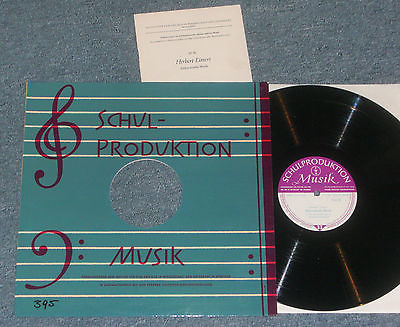
Elektronische Musik --- Schulproduktion
I. Akustische Und Theoretische Grundbegriffe II. Zur Geschichte Und Zur Kompositionstechnik
rare German first press and limited edition vinyl LP released released in the late 1950s by TELEFUNKEN / DECCA (TELDEC) with catalognumber SP 96. Cover complete with booklet and vinyl all in pristine NEARMINT/MINT condition - perfect! Famous 1950s electronic music by German pioneer and founder of the first electronic music studio in Germany, Herbert Eimert ...Don't miss this mega-rare release of the album on the Schulproduktion label, which was also released on German Wergo label in the early 1960's. Stunning early electronic music experiments in the vein of early Karlheinz Stockhausen, Gottfried Michael Koenig, Ernst Krenek, etc. recorded here with true audiophile soundquality. See photos ...
"Herbert Eimert studied music theory and composition from 1919-1924 at the Cologne Musikhochschule with Hermann Abendroth, Johann Eduard Franz Bölsche, and August von Othegraven. In 1924, while still a student, he published an Atonale Musiklehre (Atonal Music Theory Text) which, together with a twelve-tone string quartet composed for the end-of-term examination concert, led to an altercation with Bölsche, who withdrew the quartet from the program and expelled Eimert from his composition class.
In 1924, he began studies in musicology at the University of Cologne with Ernst Bücken, Willi Kahl, and Georg Kinsky, and read philosophy with Max Scheler (a pupil of Husserl) and Nicolai Hartmann. He attained his doctorate in 1931 with a dissertation titled Musikalische Formstrukturen im 17. und 18. Jahrhundert. Versuch einer Formbeschreibung (Musical Form Structures in the 17th and 18th Century. Attempt at a Description of Form).From 1927-33 he was employed at the Cologne Radio and wrote for music magazines such as Melos and the Neue Zeitschrift für Musik. In 1930 he became a music critic for the Kölner Stadtanzeiger, and from 1935–45 worked as an editor at the Kölnischen Zeitung.
After the war, he became in 1945 the first salaried staff member of the Cologne Radio (NWDR), administered by the British occupation forces. In 1947 he took over the NWDR Department of Cultural Reporting, and in 1948 became director of the Musikalische Nachtprogramme (late-night music programs), a position he held until 1966. In 1951, Eimert and Werner Meyer-Eppler persuaded the director of NWDR, Hanns Hartmann, to create a Studio for Electronic Music, which Eimert directed until 1962. This became the most influential studio in the world during the 1950s and 1960s, with composers such as Michael von Biel, Konrad Boehmer, Herbert Brün, Franco Evangelisti, Johannes Fritsch, Rolf Gehlhaar, Karel Goeyvaerts, David C. Johnson, Mauricio Kagel, Gottfried Michael Koenig, Ernst Krenek, György Ligeti, Mesías Maiguashca, Henri Pousseur, Karlheinz Stockhausen (who succeeded Eimert as director), and Iannis Xenakis working there (Morawska-Büngeler 1988).
In 1950 he published the Lehrbuch zur Zwölftonmusik, which became one of the best-known introductory texts on Schoenbergian twelve-tone technique, and was translated into Italian, Spanish, and Hungarian. From 1955-62 he edited in conjunction with Karlheinz Stockhausen the influential journal Die Reihe. His book Grundlagen der musikalischen Reihentechnik appeared in 1964. From 1951–57 he lectured at the Darmstadt International Vacation Courses for New Music. In 1965 he became Professor at the Hochschule für Musik in Cologne and directed their studio for electronic music until 1971. Together with Hans Ulrich Humpert, his successor at the electronic studio of the Musikhochschule, he worked on the Lexikon der elektronischen Musik (Dictionary of Electronic Music). Just short of completing the manuscript Eimert died, on 15 December 1972, in Düsseldorf. ..."
-------------------------------------------------------------------------------------------------------------------------------------------------------------------------------------------------------------------------------------------------
Please note that I am located in Germany and international shipping is not free, and I ship worldwide via Deutsche Post registered airmail - see postage rates below. Being a record collector myself I will professionally package all records safely in special cardboard mailers to avoid damage during shipment. I am happy to combine shipping of course - please contact me for any questions or special requests.
EU, UK&I:
£5.70 (6.-Euro) for 'registered' airmail package below 500gram (typically works for 1LP)
£9.15 (9.60Euro) for 'registered' airmail package up to 1kg.
£18.60 (19.50 Euro) for 'registered airmail' package up to 2kg
£17.20 (18.-Euro) for 'registered & insured package' up to 5kg - add £4.80 (5.-Euro) for up to 10kg
EUROPE w/o EU i.e. Russia, Ukraine, Turkey, Norway, Switzerland, etc....:
£5.70 (6.-Euro) for 'registered' airmail package below 500gram (typically works for 1LP)
£9.15 (9.60Euro) for 'registered' airmail package up to 1kg.
£18.60 (19.50 Euro) for 'registered airmail' package up to 2kg
£29.50 (31.-Euro) for 'registered & insured' package up to 5kg - add £4.80 (5.-Euro) for up to 10kg
OVERSEAS i.e. Asia, Americas, Australia, Africa…:
£5.70 (6.-Euro) for 'registered' airmail package below 500gram (typically works for 1LP)
£9.15 (9.60Euro) for 'registered' airmail package up to 1kg.
£18.60 (19.50 Euro) for 'registered' airmail package up to 2kg
£40.00 (42.-Euro) for 'registered & insured' package up to 5kg - add £14.30 (15.-Euro) for up to 10kg - add £42.85 (45.-Euro) for up to 20kg
GERMANY: ... versichertes Paket 7.50Euro bis 10kg.
For insured airmail add £1.50 per 100.-Euro in value ...
price rating