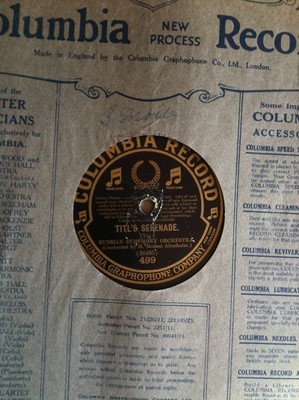
HISTORIC EARLY RECORDING Russian Symphony Orchestra Titl's Serenade
£
111
$
147


Favourite Auctions
To save auctions to your favourites, please login
If you don't have an account, please register
Description
HISTORIC EARLY RECORDING Russian Symphony Orchestra ULTRAS SCARCE The Russian Symphony Orchestra was among the first U.S. orchestras to make recordings. U.S. Columbia discs of short pieces by Tchaikovsky, and others were made in New York City from 1910-1912. ON offer here is an early 1911 recording: Matrix Number - Record Number - Date - Musical Work
36484-1 Columbia A5321 October, 1911 Wagner - Wesendonck Lieder - 'Traume'
36485-1 Columbia A5469 October, 1912 Titl's Serenade
Record in very good condition with wear associated with its age!!!!
Please keep an eye out for our forthcoming scarce Russian & Soviet recordings.
The Russian Symphony Orchestra Society was created in late 1903 by Modest Altschuler, and was the training ground for many orchestral musicians who later achieved fame in the leading "established" orchestras of America. The Russian Symphony of New York's first concern was in the Cooper Union Hall (where Lincoln made his famous first speech in New York City in 1840) on January 7, 1904. This was the first of 6 concerts at Cooper Union that season 1. The first concert was of music by Tchaikovsky, Glinka, Rachmaninoff (at that time, still an innovation), and Henryk Wieniawski (1835-1880), with Michael Svedrofsky, the Russian Symphony's newly arrived Concertmaster as soloist. The Rachmaninoff work was the U.S. premiere (and first performance outside Russia) of The Rock.
"...an orchestra of 65, consisting of Jewish graduates of the Imperial Conservatory performed...Immediate acclaim led the conductor [Altschuler] to expand his complement of musicians to 95 and to move uptown to Carnegie Hall..." 1.
During the 1900s and 1910s the Russian Symphony toured the United States and Canada featuring performances and compositions by leading contemporary Russian. The Russian Symphony was made up mainly of Russian Jewish immigrants who, like Altschuler, left Russia and Poland to escape the pogroms that were an unfortunate feature of the later nineteenth and early twentieth century there. According to contemporary reviews, the Russian Symphony of New York typically had 50 to 60 musicians for a concert. As you will see below, many gifted and later famous musicians were active in the Russian Symphony in New York in the 1900s and 1910s. However, financially they, and the Russian Symphony essentially scraped by financially. Some accounts report that the musicians received their remuneration through donations donated during the intermissions of performances.
The Russian Symphony of New York did have, however, its prominent backers. William Boyce-Thompson (1869-1930), a governor of the Federal Reserve Bank of New York and a lover of things Russian was President of the Russian Symphony Society during the 1910s.
Modest (or Moisei Isaacovich) Altschuler, Conductor
Modest Altschuler was born in Mogilyov, near Kiev, at that time in Russia, and now Belarus on February 18, 1873. Interestingly, Irving Berlin (born Israel Isidore Baline) as well as Benar Heifetz , cello of the Philadelphia Orchestra, was also born in Mogilev. Mogilev has been part of Poland, part of Lithuania, and now part of Belarus. Altschuler studied first, starting at age 13 at the Warsaw Conservatory. After graduation, Altschuler went to Moscow where he studied cello with Alfred von Glehn (1858-1930 ) who was himself a student of the famous cello teacher, Karl Davydov (or Davidov, 1838-1889). Interestingly, Gregor Piatigorsky (1903-1976) was also a student of von Glehn, and said that von Glehn was not a very demanding or inspiring teacher 7. An interesting later development was that in December, 1907, von Glehn appeared as a cello soloist at the Russian Symphony Orchestra Society concerts.
Altschuler also studied composition with Anton Arensky (1861-1906), and harmony with Taneyev (1856-1915). He also studied conducting at the Moscow Conservatory. Modest Altschuler emigrated to the U.S. in 1896, along with his brother Bernard, also a cellist who played with the Russian Symphony in concerts in the 1910s.
Altschuler created the Russian Symphony Orchestra Society in late 1903 with the help of Alexander Saslavsky, another Russian émigré. Alexander Saslavsky was Concertmaster of the Russian Symphony Orchestra for about half of its life. Even during the life of the Russian Symphony Orchestra Society, Altschuler continued to give occasional cello chamber music concerts in New York City 6.
Notable U.S. and World Premieres by the Russian Symphony Orchestra Society
Modest Altschuler was always interested in new music, and the Russian Symphony Orchestra Society introduced new music in every season for 15, including many U.S. premieres, and some world premieres, with most, but not all of the composers having Russian backgrounds.
The Russian Symphony made the American premiers of a number of later famous Russian works. For example, on February 25, 1905 at Carnegie Hall, Altschuler and the Russian Symphony made the U.S. premier of Mussorgsky's Prelude to Khovanshchina.
The Russian Symphony Orchestra Society also premiered a number of works by now obscure Russian composers including Alexander Ilyinsky or Alexander Alexandrovich Il'yinksy (1859-1920), Vasily Andreyevich Zolotaryov or Zolotarev (1872-1964), Eduard Frantsovitch Nápravník (1839-1916), who was conductor of the Mariinsky Theatre in St. Petersburg for many years, and Alexander Nikolayevich Serov (1820-1871). It made a number of world premiers, often of now forgotten composers such as Edvard Armas Järnefelt (1869-1958) and Emil Mylnarski (1870-1935), and father-in-law to Artur Rubinstein).
1903 Premieres by the The Russian Symphony Orchestra Society
The first performance outside Russia of Rachmaninoff's "The Rock was by Altschuler and the Russian Symphony Society of New York in 1903. "The Rock is a fantasy for orchestra, composed by Rachmaninoff in 1893 while both he and Modest Altschuler were students at the St. Petersburg Conservatory. Rachmaninoff had the same two teachers in composition as did Modest Altschuler: Anton Arensky for harmony and Sergei Taneyev for counterpoint.
1904 Premieres by the The Russian Symphony Orchestra Society
They also gave U.S. premiers of many other famous compositions, such as the Caucasian Sketches, opus 10 of Mikhail Ippolitov-Ivanov (1859-1935) and the First Symphony of Sergei Taneyev (1856-1915), both premiered by the Russian Symphony in their first 1904 season 4. That same year, they premiered in the U.S. Rimsky-Korsakov's overture May Night, and the Glazunov symphonic poem Stenka Razine.
1905 Premieres by the The Russian Symphony Orchestra Society
In 1905, as well as Mussorgsky's Prelude to Khovanshchina, they gave the U.S. premiere of two Rimsky-Korsakov works: Tsar Saltan suite and of music from Snegurachka (the 'Snow Maiden'). That year, they also gave the U.S. premiere of Vasily Kalinnikov (1866-1901) First Symphony. In 1905, the Russian Symphony also gave the U.S. premiere of the Anton Arensky (1861-1906) Violin Concerto, with Maud Powell as soloist.
1906 Premieres by the The Russian Symphony Orchestra Society
In 1906, they gave the U.S. premiere of the Reinhold Gliere (1875-1956) (a pupil of Taneyev) First symphony in E flat major, composed in 1900. Also, Glazunov's Dance Scene, opus 81, composed in 1904, and his Symphony no. 3 in D major, composed in 1890.
At the November 8, 1906 concert, Alexander Pechnikov (1873-1949), the violinist who was a student of Leopold Auer appeared as a soloist with the Russian Symphony Orchestra Society 15.
1907 Premieres by the The Russian Symphony Orchestra Society and the Scriabin Seasons
In 1907, the Russian Symphony Orchestra gave the U.S. premiere of Sibelius's Karelia Overture and then the Karelia Suite, two different works, both composed in 1893.
The 1906 -1907, and 1907 - 1908 seasons of the Russian Symphony Orchestra Society were certainly an Alexander Scriabin seasons.
In December, 1906, Alexander Scriabin himself, conducted by Vasily Safonoff (then conductor of the New York Philharmonic) performed Scriabin's Piano Concerto, composed about 9 years previously. Vasily Safonoff was a teacher of both Scriabin and Modest Altschuler when they and also the pianist Josef Lhevinne were at the Moscow Conservatory. Interestingly, Safonoff, like Leopold Stokowski, conducted without a baton. Safonoff may have been the first prominent modern conductor not to use a baton. Also, speaking of Josef Lhevinne, this legendary pianist made he U.S. debut with the Russian Symphony Orchestra Society at a concert given in Carnegie Hall on January 27, 1906 4.
In February, 1907, the Russian Symphony Orchestra performed the U.S. premiere of Scriabin's Symphony no. 1 in E major, composed in 1900. This was less than two months after the December 20, 1906 concert in which Scriabin himself made the U.S. premiere of his piano concerto with the Russian Symphony Orchestra. In March, 1907, they gave the U.S. premiere of Scriabin's Symphony no 3 in C minor "The Divine Poem" of 1904. The next year, in December, 1908, they gave the U.S. premiere of Scriabin's Symphony no. 4 "The Poem of Ecstasy", written in 1905.
In 1907, the Russian Symphony also gave the U.S. premiere of the Glazunov Symphony no. 8 in E flat major, composed just the previous year. Also, the U.S. premiere of Arensky's First symphony.
1908 Premieres by the The Russian Symphony Orchestra Society
The next year, in 1908, the orchestra premiered in the United States the Sibelius Symphony no. 3 in C major (however, in my opinion, Sibelius's weakest of his series of grand and inspired symphonies). Again, this Sibelius symphony was only completed in the previous year, 1907. In 1908, they also gave the U.S. premiere of part of Glazunov's Seasons from which they played Winter. The world premiere of the Seasons was only a few years previously, in 1900 in St. Petersburg by the Imperial Ballet conductor Riccardo Drigo (1846-1930).
Another 1908 premiere was not an orchestral composition, but of a later star soloist. Mischa Elman (1892-1967) who had his U.S. debut on December 10, 1908 with the Russian Symphony Orchestra Society in Carnegie Hall in the Tchaikovsky Violin Concerto.
1909 and 1910 Premieres by the The Russian Symphony Orchestra Society
In January, 1909, the Russian Symphony Orchestra gave the U.S. premiere of Rachmaninoff's Symphony no. 2 in E minor, which of course was one of Rachmaninoff's most successful works. Rachmaninoff himself conducted the world premiere less than 12 months earlier in St. Petersburg February 8, 1908.
In 1910, the Russian Symphony Orchestra gave the U.S. premiere of one of Glazunov's most successful compositions, his Violin Concerto in A minor, opus 82 written in 1905, and given its world premiere in St. Petersburg February 1905 with the legendary Leopold Auer as soloist. For the 1910 Russian Symphony Orchestra U.S. premiere, the violin solo was none less than Mischa Elman, then only age 19, who was to go on to a super-star career. Interestingly, Elman was one of Leopold Auer's pupils at the St. Petersburg Conservatory.
Later in 1910 (November) the Orchestra gave the U.S. premiere of two of Anatoly Lyadov's most famous works: the tone poems, The Enchanted Lake opus 62, and Kikimora opus 63, both composed only the previous year in 1909. The next month, in December, 1910, the Russian Symphony Orchestra gave the U.S. premiere of Stravinsky's Fireworks which again had been premiered in Russia only the year before in St. Petersburg. Sergei Diaghilev was at this premiere, and it motivated him to commission Stravinsky in 1910 to compose the Firebird for Diaghilev's Ballets Russes. This performance by the Russian Symphony Orchestra was also the first American performance of any work by Stravinsky 4.
1911 Premieres by the The Russian Symphony Orchestra Society
Alexander Alexandrovich Ilyinsky (1859-1920) - 'Psyche', a symphonic movement.
Later Concerts of the Russian Symphony Orchestra
Although Modest Altschuler ended the annual seasons of New York concerts of the Russian Symphony Orchestra Society in 1919, with the post WW1 economic recession, the orchestra continued to perform in the summer season.
Recall that orchestra musicians of the era did not have 52 weeks of employment with their orchestras. Full year around employment for most orchestras did not occur until the 1960s. The first orchestra to offer 52 week employment was the Boston Symphony 9, which had the summer Tanglewood season to bridge the summer. Among performing orchestras, Toscanini's NBC Symphony Orchestra topped the Boston Symphony, offering higher salaries and 52 week employment. In 1964, the New York Philharmonic negotiated its first 52 week employment contract with its musicians 10. The Philadelphia Orchestra and the Chicago Symphony followed, but did not provide the full 52 seeks to all musicians. There were three tiers: 52 weeks, 50 weeks, and 47 weeks 11. By the 1970-1971 season, six American orchestras had 52 week contracts with their musicians, adding Cleveland, San Francisco and Houston.
In the 1920s and 1930s, a large percentage of professional musicians worked in the orchestras of movie theaters. "...By 1927, approximately 25,000, or an estimated one-quarter or one-third of musicians who earned the majority of their income from musical performances worked in front of the silent screen..." 12. In fact, as you can see in Modest Altschuler Later Career , Altschuler himself worked for about two years as Music Director of the Circle Theater, a movie theater in Indianapolis, and now home of the Indianapolis Symphony Orchestra.
However, at the time of the Russian Symphony Orchestra Society concerts, no orchestral musicians enjoyed 52 week employment with a symphony orchestra. The U.S. and Canadian tours of the Russian Symphony, while probably not well-paid, did provide off-season employment for many leading New York based musicians. For this reason, the Russian Symphony continued to tour in the summers of 1920, 1921, and 1922. It is likely that the musicians who played those summers varied, unlike to stable membership of, for example, the Boston or Philadelphia orchestras.
The Russian Symphony Orchestra Society Pioneers Women Composers
The Russian Symphony also premiered works by women, rare at that time. In 1912 they premiered the Serenade by Mary Lawrence Townsend, presumably an American woman composer, of whom I have found no other record.
Russian Symphony Orchestra Pioneering Recordings
The Russian Symphony Orchestra was among the first U.S. orchestras to make recordings. U.S. Columbia discs of short pieces by Tchaikovsky, and others were made in New York City from 1910-1912. These works (with corrected titles indicated) included:
Matrix Number - Record Number - Date - Musical Work
30797-1 Columbia A5321 June 26, 1911 Anton Rubinstein - Russkaya & Trepak - Russian Dance
30798-1 Columbia A5394 June 26, 1911 Glinka - Kamarinskaya - part 1
30799-2 Columbia A5394 June 26, 1911 Glinka - Kamarinskaya - part 2
30800-1 Columbia A5321 May 26, 1911 Volga Boatman song (Ej uhnem!,??,?????!)
30851 Columbia A5345 June, 1911 Edward Lassen - Festival Overture
30852 Columbia A5360 June, 1911 Dvorak - Symphony no 9 - Largo
30867 Columbia A5360 June, 1911 Johan Halvorsen - Entrance march of Boyars
30868 Columbia A5345 June, 1911 Tchaikovsky - Sleeping Beauty
30953 Columbia
30954 Columbia A5321 September, 1911 Ippolitov-Ivanov - Caucasian Sketches - Procession of the Sardar
36484-1 Columbia A5321 October, 1911 Wagner - Wesendonck Lieder - 'Traume'
36485-1 Columbia A5469 October, 1912 Serenade (Dvorak?)
38145 Columbia A1211 July 1912 Gounod - Marche funèbre d'une marionnette
price rating