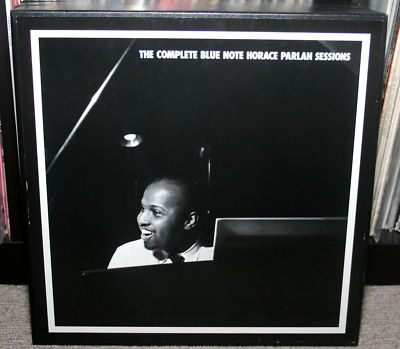
HORACE PARLAN Mosaic Complete Blue Note 8 LP NM
$
296


Favourite Auctions
To save auctions to your favourites, please login
If you don't have an account, please register
Description
This is a beautiful condition copy of the highly-regarded Mosaic Records release of the great jazz pianist Horace Parlan's 1960 recordings for Blue Note, on eight LPs. This is a very early press of the collection: it is 572 out of 5000 copies made. Details about the musicians, etc involved follows below. LPs and outer box are in clear NM condition.
Review from AMG.com:
"Horace who?" That's what one is likely to encounter when excitedly talking of this set to jazz pedestrians. And it's not their fault, either. People who are reasonably familiar with the music can be excused for not hearing of the great American hard bop pianist who has made his living from Denmark since 1972. At age 70, Parlan is still a pianist of enormous talent, but is rarely heard on this side of the Atlantic. The Mosaic set compiles all seven of Parlan's sessions as a leader from 1960 through 1963 -- Movin' and Groovin', Us Three, Speakin' My Piece, Headin' South, On the Spur of the Moment, Up and Down, and Happy Frame of Mind -- and his work on the label as part of Booker Ervin's band on Back From the Gig. Before becoming a leader, he enjoyed the honor of being Charles Mingus' pianist (1957-1959), during an era that saw the release of two of Mingus' finest records: the groundbreaking Blues and Roots and Mingus Ah Um. One of the reasons for the richness of those recordings was Parlan's style. A pianist who suffered from polio since the age of five, the fourth and fifth fingers of his right hand were useless. He compensated by using the thumb and first two fingers to complete extended chords normally handled by the left hand. But, to become a soloist, he developed a style that Mingus would find irresistible: He would use short melodic runs with the right hand and build them into chunky percussive chords that had the density of Red Garland's and the gutbucket funk of Horace Silver's, all while rooted in the blues. The Movin' and Groovin' sides tell the whole story in a way. The set begins with a formalist interpretation of "C Jam Blues, a tune on which many of Parlan's rhythmic and melodic principles are showcased. Much of Parlan's inventiveness is built upon repetition, which is used as a structural device to dull the harmonic movement of a particular tune. Here, he uses thick, block-like chords in non-varying eighths against a minimal set of right-hand lines that grow more elaborate with each pass through the chorus. Elsewhere on the album, on "Up in Cynthia's Room," a badassed blues gives way to an ostinato of shimmering color and grace. It was used again with a quintet on "Speakin' My Piece," with more of the dark blues funk percussively added to Parlan's solo to make it stick out among the horns. Another of Parlan's hot moves is his rooting in the gospel traditions for which repetition was made, varying phrases just enough to move the tune along without edging it too far from its harmonic root -- give a listen to the preacher's shout in "Wadin'" for an example of this. Slide-and-jump and call-and-response methods are employed over and over again, with chords built by the minute to juxtapose his short rhythmic melodic eight hand inventions against. Al Harewood on drums and bassist George Tucker were one of the steadiest, most rock-solid rhythm sections in the music at the time, capable of backing any soloist. They are present on all but two Parlan sessions, the first of which has Sam Jones on bass and the last which features Butch Warren and Billy Higgins on bass and drums, respectively. Parlan's choice of material, from the mainly standards bag of the first couple of recordings to the mix of original compositions and bandmates' material on the other four, is an evolution of the music as much as it is of Parlan himself. After 1961, the hard bop trend was to keep it all inside the unit wherever possible. Even on Booker Ervin's date (with Grant Green on guitar) that ends the set, the tunes tend to be homemade and written for the band. With horn players, Parlan really shined as a soloist. His sessions with Stanley and Tommy Turrentine for Speakin' My Piece showcase his structural style in a manner that gives the soloists more freedom and elongates the blues line to an extent that it almost disappears. With his varying placement of meter and his shifting of harmonics always toward the blues end, ostinato becomes a natural extension of meter and rolls off the end onto another chorus, giving the appearance that the 12-bar blues has been subverted. His short, tight, intense bursts of sound are small, span-wise, but resonant for the horn player or bassist who is playing off of them. Of all the recordings here, perhaps Up and Down, his second from last as a leader, is Parlan's signature album from the period. "The Other Part of Town" is an outlandish bit of harmonic strangling on Parlan's part, with Booker Ervin's trademark tone spitting through the mix and Grant Green funking it up just enough that Parlan has to take control with huge chords played in blocks all around the his phrase-like melody, which builds and releases tension before turning around on about the tenth chorus and restating the blues theme for the other soloists. Parlan may not be the best-known of Blue Note's piano giants, but that doesn't make him any less an architect of the hard bop sound of the early '60s, as this wonderful box -- with Mosaic's usual exhaustive annotation -- so profoundly attests.
ABOUT THE SELLER:
I have been selling music on eBay for over ten years, and take my listings seriously. All LPs have been carefully and conservatively graded, and where possible have been cleaned and played prior to being listed. You can be assured that you will be purchasing exactly what is described in the listing. Listed below are the shipping costs and a detailed listing of the grading scale for LPs. Please feel free to ask any questions.
SHIPPING COSTS:
--Domestic US Media Mail: $4.00 for one LP, with $1.00 for each additional LP. Double-LP sets count as 2 LPs, triple-LP sets count as 3 LPs, and so forth
--Domestic US Priority Mail: $9.00 for one LP, with $1.00 for each additional LP.
--International first-class mail: $14.00 for one LP, with $2.00 for each additional LP under 4 lbs. Over 4 lbs determined by weight.
--International express: determined by shipment weight.
Combined shipping discounts apply.
LP GRADING SCALE:
These are the grading guidelines used and are based on Goldmine Grading for Records
MINT (M): Perfect! This record looks like it has just left the manufacturer, with NO flaws what so ever. It looks as though it had never been handled. No scuffs or scratches, blotches or stains. No stickers address labels, writing on the covers or labels. No tears or seam splits. No wear to the cover or record period! Age of the record has nothing to do with it.
NEAR MINT or NM, M- : this record appears virtually flawless A very minor scuff and very little else can appear on the vinyl. It should play without any noise over the flaw. The flaw is very hard to see. The cover looks as close to perfect with only minor signs of wear and or age. Minor impressions to the cover (due to the outer edge of the vinyl resting inside) may be acceptable, however the artwork is be as close to perfect as can be.
EXCELLENT or EX or VG++ : minor scuffs which are only slightly visible. There may be more than a few scuffs and NO Scratches COVER: Artwork is still as close to perfect as can be. Some impression to the cover (minor outer ring wear) but no ink wear! Some slight creases to the corners, but not wrinkled and obtrusive to the eye. The corners can show white (where the artwork pasted slick was) meaning, slight wear. No seam splits or writing on the cover or taped repairs can make this grade.
VERY GOOD PLUS or VG+ record shows wear, surface scuffs. The vinyl still has a great luster, but the flaws will be noticeable to the naked eye. If the flaws don't cause any surface noise, the vinyl can still make the VG+ grade. COVERS: A virtually clean cover, but may have small writing on it.The artwork looks clean with slightly more aging. The back of the cover usually gives away the age of the cover. Flat white paper will be somewhat yellow yet no stains or mildew from water damage. Some minor wear to the seams or spine, but no tears or holes popping through. The corners will be slightly dog eared yet no crackly bends, defacing the artwork. In essence, a VG+ cover should have no more than 3 flaws mentioned.
VERY GOOD or VG: this record is a record that is good enough. They are not really going to look very good, but it will STILL play very good. there will almost always be some surface noise when they are played. The Dynamics should still be excellent, overpowering the surface noise. A VG record will appear well have been played but still have some luster. VG covers will look worn, used. There may be some seam splitting . There will be some ring wear, where the ink has begun to wear off. Giving the cover a look of snow falling. If the artwork looks snowy all over, it is less than VG condition. There may be some writing on the cover (still, no Large letters in magic marker). It will look aged and more yellowish due to contamination's in the air (sometimes looking like cigarette smoke). Still it should be decent.
GOOD or G A good record will look very well played, dull, grayish and possibly abused. However a Good record should still play. It will have distracting surface noise. Such as crackle that is continuous or some hiss. Will also have some loss of dynamics caused from grooves being worn. It should play without any skips or any obtrusively loud pops or repeated clicks, caused by deep scratches. Good means that it will play with some form of decency, so one can still enjoy the music even though you can still hear noise caused from the wear. A Good cover will have just about everything wrong with it. It will have seam splits (possibly taped repaired, but only with scotch tape. No duct tape or masking tape repairs. These are big turn offs. May have magic marker writing on the cover but still if they are in huge letters, it is a big turn off.In essence, the cover will looked virtually trashed, but some artwork will still be noticed. If the artwork is worn, it is POOR and the cover is worthless.
price rating