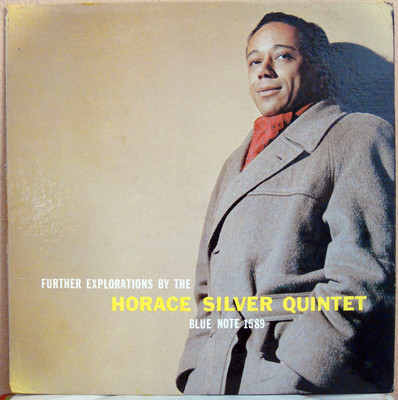
HORACE SILVER: "FURTHER EXPLORATIONS BY...... "ORIG. BLUE NOTE 1589 (1958) HEAR
$
51


Favourite Auctions
To save auctions to your favourites, please login
If you don't have an account, please register
Description
ARTIST : HORACE SILVER
TITLE: FURTHER EXPLORATIONS BY THE HORACE SILVER QUINTET
LABEL & RECORD #: BLUE NOTE #BLP-1589 (1958)VINYL CONDITION: HEAR !! :HEAVY VINYL! TRACKS ARE STRONG VG+ TO VG++ (NO SIGNIFICANT NOISE....A FEW LIGHT SCUFFS PRODUCING ULTRA MINIMAL NOISE ON A FEW TRACKS..... HEAR WELL THE SOUND CLIPS!) CLEANED SUPERFICIALLY!!!!!!! SO MAYBE IT WILL SOUND VG+++ IG CLEANED THOROUGHLY!
dead wax # BN-LP-1589plus RVG AND THE "EAR"!...
47 West 63rd, NYC ON LABEL
LABELS CONDITIONS: SEE SCAN : NM COVER CONDITION : SEE SCAN : VG++...ONE BUMPED CORNER, NO SPLITS, A FEW (4) SMALL/MINI STAINS ("YELLOWISH") ON TOP & BOTTOM SEAM EDGES...NOTHING SIGNIFICANT!REMARKS: A JAZZ GIANT!!!!!!!! ORIGINAL BLUE NOTE, NOT STILL A DIVISION OF OTHER LABELS!!!!!
THE LP:
"Further Explorations by the Horace Silver Quintet is an album by jazz pianist Horace Silver released on the Blue Note label in 1958 featuring performances by Silver with Art Farmer, Clifford Jordan, Teddy Kotick, and Louis Hayes. The Japanese editions feature the same artwork shown here, but have blue as dominant colour instead of yellow. The Allmusic review by Steve Leggett awarded the album 4 stars and states "Further Explorations is a solid, even striking outing, and if it isn't maybe quite as flashy as some of its predecessors, it is no less substantive and revealing".
HORACE SILVER:
"When Horace Silver once wrote out his rules for musical composition (in the liner notes to the 1968 record, Serenade to a Soul Sister), he expounded on the importance of "meaningful simplicity." The pianist could have just as easily been describing his own life. For more than fifty years, Silver has simply written some of the most enduring tunes in jazz while performing them in a distinctively personal style. It's all been straightforward enough, while decades of incredible experiences have provided the meaning."
“Silver was born in Norwalk, Connecticut on September 2, 1928. His father had immigrated to the United States from Cape Verde---and that island nation's Portuguese influences would play a big part in Silver's own music later on. When Silver was a teenager, he began playing both piano and saxophone while he listened to everything from boogie-woogie and blues to such modern musicians as Bud Powell and Thelonious Monk. As Silver's piano trio was working in Hartford, Connecticut, the group received saxophonist Stan Getz's attention in 1950. The saxophonist brought the band on the road and recorded three of Silver's compositions.
In 1951, Silver moved to New York City where he accompanied saxophonists Coleman Hawkins, Lester Young and many other legends. In the following year, he met the executives at Blue Note while working as a sideman for saxophonist Lou Donaldson. This meeting led to Silver signing with the label where he would remain until 1980. He also collaborated with Art Blakey in forming the Jazz Messengers during the early 1950s (which Blakey would continue to lead after Silver formed his own quintet in 1956).
During these years, Silver helped create the rhythmically forceful branch of jazz known as "hard bop" (chronicled in David H. Rosenthal's 1992 book, Hard Bop: Jazz and Black Music, 1955-1965). He based much of his own writing on blues and gospel---the latter is particularly prominent on one of his biggest tunes, "The Preacher." While his compositions at this time featured surprising tempo shifts and a range of melodic ideas, they immediately caught the attention of a wide audience. Silver's own piano playing easily shifted from aggressively percussive to lushly romantic within just a few bars. At the same time, his sharp use of repetition was funky even before that word could be used in polite company. Along with Silver's own work, his bands often featured such rising jazz stars as saxophonists Junior Cook and Hank Mobley, trumpeter Blue Mitchell, and drummer Louis Hayes. Some of his key albums from this period included Horace Silver Trio (1953), Horace Silver and the Jazz Messengers (1955), Six Pieces of Silver (1956) and Blowin' The Blues Away (1959), which includes his famous, "Sister Sadie." He also combined jazz with a sassy take on pop through the 1961 hit, "Filthy McNasty."
But it was a few years later when Silver would record one of his most famous songs, the title track to his 1964 album, Song For My Father. That piece combined his dad's take on Cape Verdean folk music (with a hint of Brazilian Carnival rhythms) into an enduring F-minor jazz composition. Over the years, it has become an American popular music standard, covered not only by scores of instrumentalists, but also such singers as James Brown. As social and cultural upheavals shook the nation during the late 1960s and early 1970s, Silver responded to these changes through music. He commented directly on the new scene through a trio of records called United States of Mind (1970-1972) that featured the spirited vocals of Andy Bey. The composer got deeper into cosmic philosophy as his group, Silver 'N Strings, recorded Silver 'N Strings Play The Music of the Spheres (1979).
After Silver's long tenure with Blue Note ended, he continued to create vital music. The 1985 album, Continuity of Spirit (Silveto), features his unique orchestral collaborations. In the 1990s, Silver directly answered the urban popular music that had been largely built from his influence on It's Got To Be Funky (Columbia, 1993).
TRACKS SIDE A:
1. The Outlaw
2. Melancholy Mood
3. Pyramid
TRACKS SIDE B:
1. Moonrays
2. Safari
3. Ill Wind
WEB & BLOG REMARKS:
SESSION INFO:
Art Farmer (tp -1,3/6) Clifford Jordan (ts -1,3/6) Horace Silver (p) Teddy Kotick (b) Louis Hayes (d)
Rudy Van Gelder Studio, Hackensack, NJ, January 13, 1958
1. tk.3 The Outlaw
2. tk.9 Melancholy Mood
3. tk.10 Moonrays
4. tk.12 Ill Wind
5. tk.16 Pyramid
6. tk.21 Safari
** also issued on Blue Note BST 81589
Please Follow The Shipping Rates Below:
LPs
1 Item
Xtra Item
Air Mail Media U.S.A
$4.00 (Delivery Confirmation Included)
Add $0.25
Air Mail Priority U.S.A
$8.50 (Delivery Confirmation Included)
Add $1.50
Air Mail Canada
$7.60
Add $2.00
Air Mail Europe
$15.00
Add $2.00
Air Mail Asia
$15.00
Add $2.00
Air Mail Caribbean
$12.00
Add $2.00
Air Mail South America
$13.50
Add $2.00
If Buying More Than 3 Records We Will Inform You The Shipping & Handling....We do combine shipping for multiple purchases.
Insurance Available If Requested - Domestic Only:
$1.75 ................ $0.01 to $50
$2.25 ................ $50.01 to $100
$2.75 ................ $100.01 to $200
* We offer a money back + shipping costs guarantee on our records (unless otherwise noted) if you feel the LP was not graded properly (in Grading “disputes” Return Shipping Not Included). We will issue a full refund upon its return, once our mistake has been verified.
Record Grading: Standard guidelines for grading records comes down to a subjective judgment that may vary from person to person. We grade records and LP covers visually AND (when possible) play-tested. We make every effort to give full disclosure (remember that the LP has at least 12 tracks and the grading may vary between each other) and your satisfaction is guaranteed. Don't assume that our vinyl determination of "Very Good+" is the same as yours!
RECORD OR COVER GRADED VG or LESS WILL BE "SOLD AS IS"
MINT: Unplayed, still sealed.
NM RECORDS: are shiny, with no visible defects, they might have one or 2 minor superficial scuff and they should play without any noise. Writing, stickers or other markings cannot appear on the label, nor can any “spindle marks” from someone trying to blindly put the record on the turntable. Major factory defects also must not be present; a record and label obviously pressed off center is not Near Mint. If played, it will do so with no surface noise. (NM records don’t have to be “never played”; a record used on an excellent turntable can remain NM after many plays if the disc is properly cared for.)
NM COVERS:
have no creases, ring wear or seam splits of any kind.
Picture Sleeves: should look as if they never housed a record. This is a great reason to remove your 45s from their picture sleeves and keep them separate. Just keeping the 45 inside the sleeve will cause damage than can reduce the grade of the sleeve.
VG++ (Excellent) RECORDS:
Barely noticeable play wear and background noise. May have surface scuffs and/or superficial marks, which will be inaudible or indiscernible from the background, no scratches. Very nice, flaws noted.
VG++ COVERS:
Artwork is still as close to perfect as can be. Some impression to the cover (minor outer ring wear) but no ink wear! Some slight creases to the corners, but not wrinkled and obtrusive to the eye. The corners can show white (where the artwork pasted slick was) meaning, slight wear. No seam splits or writing on the cover or taped repairs can make this grade.
VG+ RECORDS:
may show some slight signs of wear, including light scuffs or very light scratches that do not affect the listening experience. Slight warps that do not affect the sound are OK. Minor signs of handling are OK, too, such as telltale marks around the center hole, but repeated playing has not misshapen the hole. There may be some very light ring wear or discoloration, but it should be barely noticeable.
VG+ COVERS:
should have only minor wear. A VG+ cover might have some very minor seam wear or a split (less than one inch long) at the bottom, the most vulnerable location. Also, a VG+ cover may have some defacing, such as a cut-out marking. Covers with cut-out markings can never be considered Near Mint.
VG+ PICTURE SLEEVES:
might show some very light creasing where it is obvious that a record once resided (or still does reside). A VG+ picture sleeve might have some very minor seam wear or a split (less than one inch long) at the bottom, the sleeve’s most vulnerable location.
VG RECORDS:
They have more obvious flaws than their counterparts in better shape. They lack most of the original gloss found on factory-fresh records. Groove wear is evident on sight, as are light scratches deep enough to feel with a fingernail. When played, a VG record has surface noise, and some scratches may be audible, especially in soft passages and during a song’s intro and ending. But the noise will not overpower the music otherwise. Minor writing, tape, or a sticker can detract from the label. Many collectors who have jukeboxes will use VG records in them and not think twice. They remain a fine listening experience, just not the same as if it were in better shape.
VG COVERS and PICTURE SLEEVES:
will have many signs of human handling. Ring wear in the middle or along the edges of the cover where the edge of a record would reside, is obvious, though not overwhelming. Some more creases might be visible. Seam splitting will be more obvious; it may appear on all three sides, though it won’t be obvious upon looking. Someone might have written or stamped a price tag on it, too.
RECORDS GRADED VG OR BELOW WILL BE "SOLD AS IS"
Items are to be paid within 7 days (if not paid by that time it will be subject for relisting) of auction close and will be shipped within 48 hours of receipt of payment. Paypal is the preferred method of payment.
Carlos A. Flores 25830 Crippen Dr. Land O' Lakes, FL 34639
price rating