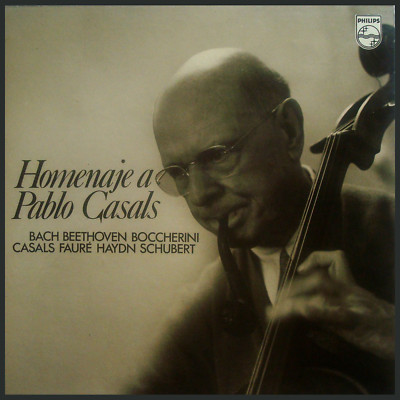
Homage to Pablo Casals - Spanish Philips (7LP box set)
$
158


Favourite Auctions
To save auctions to your favourites, please login
If you don't have an account, please register
Description
ITEM DESCRIPTION:
This beautiful 7 LP box set from Spanish Philips (6747124/07, Spanish pressings, red/silver label, full-size booklet included, mono/stereo) entitled “Homenaje a Pablo Casals” features a lavish tribute to the legendary Catalan cellist and conductor, where he is heard not only in those two capacities, but also as a composer. This box usefully (and handsomely) gathers together most of his recordings that appeared on the Dutch label.
------------------------
This particular Phiips issue is very attractive, consisting of a heavy cloth box with gilt lettering and a full-size, 14-page booklet, with striking portraits of Casals and extensive note on the music (in Spanish only).
------------------------
Included are the following works / performances:
Gabriel Fauré: Elegie for Cello and Orchestra Op. 24 (Rehearsal)
> Pablo Casals, conductor, rehearsing l'Orchestre des Concerts Lamoureux and 10 Cellists:
Paul Bazelaire
Maurice Marechal
Gaspard Cassado
Rudolf von Tobel
Etienne Pasquier
Andre Levy
Gaston Marchesini
Guy Fallot
Charles Bartsch
Jean Vaugeois
Gabriel Fauré: Elegie for Cello and Orchestra Op. 24 (Performance)
> Pablo Casals conducting l'Orchestre des Concerts Lamoureux and the 10 above-named cellists
Pablo Casals:
Los Reyes Magos ("The Three Kings")
Sardana
> Pablo Casals conducting a student orchestra of 112 cellists
Johann Sebastien Bach: Sarabande, from the Suite for Solo Cello No. 5 in C minor BWV 1011
> Pablo Casals, solo cellist
All of the above stem from a concert given at the Grand Amphithéâtre de la Sorbonne, Paris on 10 October 1956.
Wrote the superb critic Gary Lemco of the Archipel CD release of the Faure for Audiophile Edition: "We have a glimpse into the working methods of the great Catalan cellist, conductor and composer Pablo Casals (1876-1973), rehearsing and performing the Faure Elegie as a vast concerted string ensemble from Paris, at the Grand Amphitheatre de la Sorbonne, October 1956.
"Casals leads his extended (twenty-four minutes) rehearsal in clear articulate French, with palpable changes in tempo, timbre, and phrasing. The eight minute realization exerts a healthy though somber energy, fluid and polished. Casals’ own two composition owe everything to Bach’s chorales, but their enjoy their own sense of graceful, contrapuntal homage to the Infinite, the Sardana’s exuding a more sensuous, frothy surface. The Sardana offers huge sighs, a melodic thrust that more than once recalls a Max Steiner evocation of the Sierre Madre. The audience cheers in huge waves. The Bach Sarabande, introspective and devotional, has that inevitable counterpoint of Casals’ own, guttural singing voice and intake of breath."
------------------------
Joseph Haydn: Cello Concerto No. 2 in D Major Hob.VIIb: 2: II, with cellist Maurice Gendron and Pau Casals conducting the Lamoureux Concerts Association Orchestra – rec. at the Maison de la Mutualité, Paris on 5 October 1960
Luigi Boccherini: Cello Concerto No. 9 in B-flat Major G. 482 (in the arrangement by Friedrich Grutzmacher), with cellist Maurice Gendron and Pau Casals conducting the Lamoureux Concerts Association Orchestra – rec. at the Maison de la Mutualité, Paris on 5 October 1960
Wrote the critic D.S. in his October 1961 review for The Gramophone: "This is a most welcome disc for three reasons. First, the beautifully clean, eternally reliable technique of Gendron is a joy to the ear. In so many records of 'cello concertos, with their inevitable profusion of passages well into the range of a violin, the listener is gradually drawn nearer to the edge of his chair, as if he were witnessing Blondin on a tight-rope above Niagara. One can hardly listen for sheer nervousness. Will he fall off that top F and drop into the C? With Gendron there is no need for nerves. He sounds absolutely secure and self-confident, producing a warm, golden tone at all altitudes, and the only occasions when his intonation slips is in an occasionally awkward piece of doublestopping. There are several of these in both the Haydn and Boccherini, and as those listeners know who have carefully watched 'cellists at play, extraordinary handpositions have to be adopted in order to "get round" certain bits of rudimentary polyphony.
"The second reason for welcoming this performance is the first engraving of Boccherini's original score. All the other versions have used a comic edition prepared by one GrUtzmacher, who was chambervirtuoso to the King of Saxony in the late nineteenth century. It really is odd, the way Germans love to violate Italian music: it's almost as if the very purity and luminosity of this music brings out their worst features. What Gratzmacher did was as follows: he found a manuscript in the Dresden State Library of a 'Cello Concerto in B flat by Boccherini. It was in a sketchy state, and later research has revealed that someone, presumably the composer himself, adapted it from one of his 'cello sonatas. Grtitzmacher then took the themes from the outer movements, fitted them into a framework of his own devising, and then orchestrated them. For a slow movement, he chose not the original one, but a G minor movement from one of Boccherini's Paris concertos. This farrago has since been played by 'cellists both great and obscure all over the world. Fournier, Starker, and Cassadci use it in their recordings. No wonder connoisseurs of eighteenth-century music, and Boccherini's in particular, weighed this piece in the balance and found it wanting.
"The Philips sleeve-note merely tells us that in this recording "the original manuscript was the source", but if it is true that the original was only in the form of a sketch, somebody must have worked very hard to produce the edition we can now hear. The cadenzas, according to the sleeve-note, are by Gendron: they are not too long, and he plays them with incomparable brilliance. 'Cellist and orchestra are perfectly balanced in the mono version, though I prefer the stereo disc for its excellent perspective and warmth of tone. This is in fact the only Haydn/Boccherini coupling in stereo, and I suppose that should be my third reason for recommending the record; but what I was really thinking of at the beginning of this review was the contribution of Pablo Casals, who conducts the Lamoureux Orchestra with the kind of mastery and precision that could only come from one who knew intimately the instrument responsible for the solo passages. I would unhesitatingly proclaim this disc as the finest so far of either concerto, quite apart from questions of authenticity. No devotee of 'cello music should miss it."
The composer Ned Rorem said of Gendron: "He was the most gifted, the most difficult, the most spiritual human being I ever met." He was certainly one of the last century's great cellists and these remarkable concerto performances remain discographic landmarks.
------------------------
Ludwig van Beethoven: Trio No. 3 in C minor for Piano, Violin, and Cello Op. 1 No. 3 – Pau Casals, Sandor Vegh, and Mieczyslaw Horszowski – recorded 'live' in Bonn in September 1958.
Ludwig van Beethoven: Trio No. 5 in D Major for Piano, Violin, and Cello Op. 70 No. 1 “Ghost”, with Pau Casals, Sandor Vegh, and Karl Engel – recorded 'live' at l’église St-Pierre, Prades on 19 July 1961
Ludwig van Beethoven: Trio No. 7 in B-flat Major for Piano, Violin, and Cello in B-flat Major Op. 97 “Archduke”, with Pau Casals, Sandor Vegh, and Mieczyslaw Horszowski – recorded 'live' in Bonn in September 1958.
Ludwig van Beethoven: Sonata for Cello and Piano in F Major Op. 17 (a transcription of the Horn Sonata), with Pau Casals and Mieczyslaw Horszowski – recorded 'live' in Bonn in September 1958.
Ludwig van Beethoven: Cello Sonata No. 1 in F Major Op. 5 No. 1, with Pau Casals and Wilhelm Kempff – recorded 'live' at l’église St-Pierre, Prades on 19 July 1961
Ludwig van Beethoven: Sonata for Cello and Piano No. 2 in G minor Op. 5 No. 2, with Pau Casals and Mieczyslaw Horszowski – recorded 'live' in Bonn in September 1958.
Franz Schubert: String Quintet in C Major D. 956 (Op. 163) – recorded 'live' at the Festival Casals in Prades in July 1961. Joining Casals on this occasion were Sandor Vegh (1st violin), Sandor Zoldy (2nd violin), Georges Janzer (viola), and Paul Szabo (2nd cello).
Wrote the distinguished critic Joan Chissell in her March 1994 review for The Gramophone: “When recording the F major Sonata, Op. 5 No. 1 and Ghost Trio at his Prades Festival in the summer of 1961, Casals was already approaching his eighty-fifth birthday. He was only three years younger when performing all the other works in this three-disc set before a live audience in the Beethovenhaus in Bonn. And surely nothing better demonstrates his indomitable spirit than that first sonata with Wilhelm Kempff, then 65, as partner. Both artists exult in its melodic buoyancy, its surprises of key, its pungent sforzandos and its close-knit repartee; they bring up everything with the immediacy and zest of new discovery. I also felt that acoustics and balance were more favourable to the cello here. In the three sonatas recorded with the equally sympathetic 66-year-old Horszowski, I sometimes thought the piano too forwardly placed—as for instance in the fugal finale of the late D major Sonata, the only place where Casals himself sounds just a little tired, or perhaps less than wholly committed. Predictably, the unforgettable playing in this work comes in the slow movement, where both artists create an atmosphere of rapt, intimate spirituality almost impossible to describe in words. The G minor Sonata's slow introduction is another example of the quite extraordinary plangency Casals could draw from his instrument in the mezza voce range—and this with often almost vibrato-free purity of line.
“As for the three trios included, Horszowski is again at the piano in the Archduke and the early C minor work. In the Ghost, however, Casals and Sandor Vegh are joined by Karl Engel. From the insert-notes we learn that the Archduke was in Casals's repertoire for some 60 years, and that he had already recorded it with Thibaud and Cortot in 1928 as well as with Schneider and Istomin for American Columbia in 1951 before this last Beethovenhaus performance. Though unable to lay my hands on either of the two earlier versions, I chanced to have [what was at the time] the catalogue's newest set of Beethoven's piano trios at my side, from the Fontenay Trio, for comparison. And the most obvious difference of approach is tempo. In every movement without exception in all three works, Casals and his colleagues, not being of the jet age, are less inclined to hurry. Perhaps they are a little too slow in the Archduke's slow movement for its ma pero con moto qualifying the Andante cantabile marking, but how profoundly felt it all is, not least the sublime coda. The Scherzo certainly emerges a little less on its toes, a little more elderly, in fact, from the older team, who I think just occasionally over-relax tension in the middle of the opening movement and in the finale. But, again, what mellowness of phrasing they offer, and what intuitive single-mindedness of ensemble. The older players' reading of the early C minor work is considerably less urgent and forceful, yet no less eloquent in its own way—especially, of course, the variations of the Andante cantabile. In these Beethovenhaus recordings there's a plumminess in the actual sound-quality, very different from the bright clarity of the Fontenay reproduction. But what old-world warmth it has in compensation.
“Finally, the Ghost. Here Casals and Vegh haunt your memory with their spectral sotto voce in the very slow but finely sustained Largo, even if a little more weight from the cellist would not have come amiss when taking over the laden opening motif in this movement's two all-important climactic crescendos. Firmly reined in by Engel, both flanking movements have tremendous drive. I'll end by adding that even if not told who the cellist was throughout these three discs, you'd probably guess at once: without all those little grunts and gasps and groans at moments of heightened intensity, Casals would not have been Casals.”
These performances have seldom been out of the catalog, although too often their presence has persisted on cheap, and rather unattractive, licenses (many unauthorized).
------------------------
CONDITION – PLEASE READ CAREFULLY:
The gradations of condition I use are as follows: MINT, Near-Mint, Excellent, Very Good, Good, Fair, Poor.
The condition of the cloth box is EXCELLENT++. There is slight evidence of shelfwear, as well as some very minor discoloration, but that is all. There are no corner breaks, bends, seamsplits, owners' markings, or other defects, and the box remains extremely solid and very handsome in appearance – overall, a truly excellent collector's copy.
The condition of the 7 LPs is near-MINT throughout – overall, fine collector’s copies.
The condition of the full-size, 14-page booklet is EXCELLENT. There is a small bit of writing on the front cover, as well as slight bumping at corners. However, the pages remain bright and crisp and the binding perfect – overall, an excellent collector's copy.
PLEASE NOTE:
The images I've provided are of the actual item you are potentially bidding on - these are not stock images or images I've taken from other sites. Bid with confidence!
PAYMENT:
Payment by PayPal is greatly preferred. Payment should be made within 7 days.
SHIPPING:
Shipping is free to anywhere in the world; this is true regardless of the number of LPs you buy, be it 1 or a 100. All LPs will be sent via standard airmail (7-10 days delivery). Note: There is no tracking number provided with standard airmail. Should you wish to have your item(s) sent via certified airmail (i.e., with a tracking number), please contact me. The fee for this $5.00 USD.
FEEDBACK:
I will promptly leave feedback for all buyers. Please do not leave negative, or even neutral, feedback without first giving me an opportunity to resolve any dissatisfaction you might have with an item or transaction. I do understand that, on occasion, a buyer might believe the item description to be inaccurate or that a buyer may be disappointed in some other way regarding the sale. I promise I will do my very best to resolve any unhappiness you've experienced in your buying experience with me to your complete satisfaction. Thank you.
REFUNDS:
Returns are honored, and any buyer you makes a return will be refunded in full. Please contact me before making a return.
Please see my other classical LP and CD auctions, and feel free to write with any questions, I'll be glad to help.
price rating