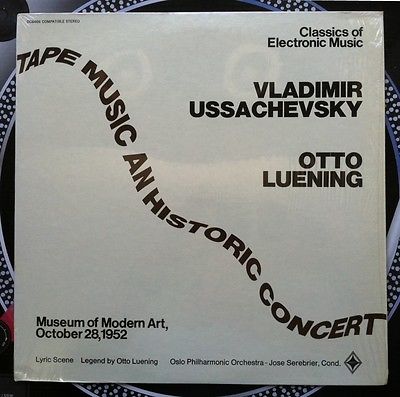
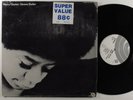
In Shrink USSACHEVSKY+LUENING 1st ELECTRONIC LP 1952 PSYCH-PROG Desto DC 6466
$
50


Favourite Auctions
To save auctions to your favourites, please login
If you don't have an account, please register
Description
A historic recording-documentation of the 1st EVER tape-electronic music concert back from 1952 at the Museum of Modern Art-New York October 28,1952. Included are the pieces "Sonic Contours", "Low Speed", "Fantasy in space", "Incantation", Invention in twelve notes", "Moonflight", "Lyric scene", "Legend". Weird cut-ups, electronic distortion and other pioneer techniques were introduced from the 2 composers on this concert, which altered for ever the world of electronic music and brought it to what we know today!! This is the original pressing from the 60's on Desto Records, Usa. Sounds from outer space, just impossible to imagine that this is a 1952 recording, sounds still very fresh and new!! Get this NOW!!
Vladimir Ussachevsky (1911-1990) wrote works for a variety of media, but he is perhaps best known for his work in choral and electronic music. His choral works draw primarily from the Russian liturgical music Ussachevsky experienced as a child. By contrast, Ussachevsky's electronic music incoporates a wide range of sounds taken from both acoustic and electronic sources. His skill with manipulating existing material, especially from recorded instruments, is evident in a number of works including A Piece for Tape Recorder (1956) and Of Wood and Brass (1964-1965).
The son of a Mongolian prince, Ussachevsky was born in Hailar, Manchuria near the Siberian border. He lived in a very musical environment: his mother was a pianist and all of his four siblings showed musical talent. Along with his musical life at home and in church, Ussachevsky played in local dance bands and accompanied screenings of silent films. In 1930 Ussachevsky and part of his family fled the area due to unrest and the threat of Japanese invasion; they emigrated to the United States and settled in southern California. There he received formal musical training at Pasadena Junior College and Pomona College in Los Angeles, and from 1935 to 1939 at Eastman School of Music in Rochester, New York. There he studied with Bernard Rogers, Howard Hanson, and Burrill Phillips.
During World War II Ussachevsky worked for the Office of Strategic Services (now Secret Service) and US State Department. In 1947 he joined the faculty of Columbia University, where he would teach until his retirement in 1980. There he and Otto Luening were among the first composers in the US to experiment in the electronic medium; in 1959 they co-founded with Milton Babbitt and Roger Sessions what would become known as the Columbia-Princeton Electronic Music Center, one of the most important studios of electronic music in the world. Ussachevsky served as chairman of the center for 20 years; his students included Charles Dodge, Robert Moog, Alice Shields, Harvey Sollberger, and Charles Wuorinen.
In addition to his work at Columbia, Ussachevsky taught and was composer-in-residence at the University of Utah. He served as president of the American Composers Alliance between 1968 and 1970 and was an advisory member of the CRI label, where many of his works have been recorded. His music may also be found on the Capstone, d'Note, Desto, Finnadar and New World labels.
STEREO
Ships fast from California
See my feedback!
price rating








![Various - DJ Athome presents Spaced Out | [Black Vinyl LP] |](https://www.popsike.org/php/thumbnail.php?url=https://www.popsike.pics/pix/20230328/394535096506.jpg)