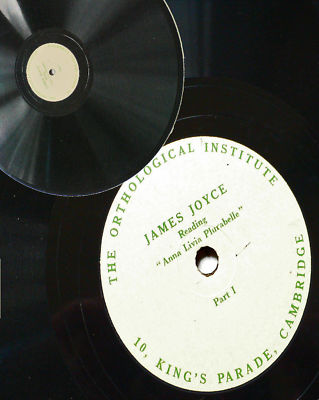
JAMES JOYCE Reads Anna Plurabelle 1929 1st Press VG+
$
57


Favourite Auctions
To save auctions to your favourites, please login
If you don't have an account, please register
Description
For sale, the original 1929 first pressing of James Joyce reading from his as yet unfinished Finnegan’s Wake, the Anna Livia Plurabelle episode (Slocum & Cahoon, page 173) for the Orthological Institute at Cambridge. The record is in MINT condition – no scratches, cracks or chips - but NOT in its original sleeve.
HEAR A CLIP FROM THE READING: http://www.midnightseaenterprises.com/Audio/JOYCE%20CLIP.mp3
This record is sold in as-is condition and all sales are final. Insurance provided if you use USPS. GOOD LUCK!
Recently this same record sold for more than $500 at Christy’s auction house. Here is what they noted about the auction:
(http://www.christies.com/LotFinder/lot_details.aspx?intObjectID=4632928)
JOYCE, James (1882-1941). Anna Livia Plurabelle. Cambridge: The Orthological Institute, Cambridge. Twelve-inch double-sided shellac 78rpm record.
LOT 269/ SALE 5624: Price Realized: £312 ($536) , 30 November 2005
A FINE EXAMPLE OF THE FIRST PRESSING OF JOYCE'S ONLY RECORDING FROM FINNEGANS WAKE, recorded by C.K. Ogden (1889-1957), the inventor of Basic English. "The best way to come to [Finnegans Wake] is through the 'Anna Livia' recording and the 'Tales Told of Shem and Shaun'." (Connolly: The Modern Movement, 87) "How beautiful the 'Anna Livia' recording is, and how amusing Joyce's rendering of an Irish washerwoman's brogue!" (Beach:Shakespeare and Company, 1956).
BACKGROUND ON THIS RECORDING:
From http://www.jamesjoyce.ie/detail.asp?ID=185
‘Anna Livia Plurabelle’ – 1929
“Sylvia Beach also claimed a hand … by bringing Joyce together with C.K. Ogden, the English linguist and philosopher. Ogden was co-author (with IA Richards) of The Meaning of Meaning, and his translation of Wittgenstein’s Tractatus Logico Philosophicus was published in 1922, the same year as Ulysses.
In 1929, Joyce suggested that Ogden might write a preface to Tales Told of Shem and Shaun, to be published by Caresse and Harry Crosby’s Black Sun Press in Paris. Admittedly, Joyce only suggested Ogden after Julian Huxley and John Sullivan had already declined, but Joyce hoped Ogden (who was also a mathematician) might discuss the mathematical structure of his Work in Progress. Though Ogden chose not to discuss the structure, Joyce still described Ogden’s preface as “useful,” and the book was published on 9 August 1929.
Ogden was keenly promoting Basic English, an international language of 850 words in which, he claimed, everything could be said. In 1927, he founded the Orthological Institute at Cambridge to promote Basic English and to train teachers. Realizing the usefulness of voice recordings for language teaching, he equipped the Institute with what he claimed were the ‘largest recording machines in the world’, and he organized recordings by contemporary writers including Joyce and Shaw.
Joyce chose to read part of the ‘Anna Livia Plurabelle’ section of his Work in Progress for Ogden’s recording...For the Orthological Institute’s recording in August 1929, Ogden had part of the text of ‘Anna Livia Plurabelle’ produced in half-inch letters on large sheets to make it easier for Joyce to read. Sylvia Beach marveled at such large type until a friend pointed out that Ogden had merely photographed and enlarged the pages of the book. Even so, the light in the recording studio was not enough for Joyce to see even half-inch letters, and Ellmann claims that he was prompted in a whisper during the recording. Despite the prompt, Joyce faltered during the first attempt and the recording had to start again.
The ALP recording took up two sides of a twelve-inch disc and it lasts eight and a half minutes. The recording sold for two guineas (£2 2s), a large amount of money at the time. Just two years later, Ogden said that the first impression had sold out but demand for the recording continued. He said a second impression was being prepared, though he also noted that the price was being halved, “in the interests of the wider public which is loath to part with more than 21 [shillings] even for a double-sided twelve-inch disc.” …..
Sylvia Beach thought the ALP recording was beautiful and she was amused by Joyce’s rendering of the brogue of an Irish washer-woman. Harry Levin, writing in his 1944 study of Joyce, remarked: “Everyone who has played Joyce’s captivating phonograph record from ‘Anna Livia Plurabelle’ will agree that the best introduction to his book is to hear him read it aloud. Yet even the author’s expressive brogue cannot convey all the inflections, unless it is supplemented by the text” (Levin: 124).”
price rating




![John Nolan - Abendigo [NH08-042] original LP (SEALED)](https://www.popsike.org/php/thumbnail.php?url=https://www.popsike.pics/pix/20240806/176510020324.jpg)