JOHN CAGE ELECTRONIC 2-LP BOX SOUND POETRY-FOLKWAYS-NWW
$
51


Favourite Auctions
To save auctions to your favourites, please login
If you don't have an account, please register
Description
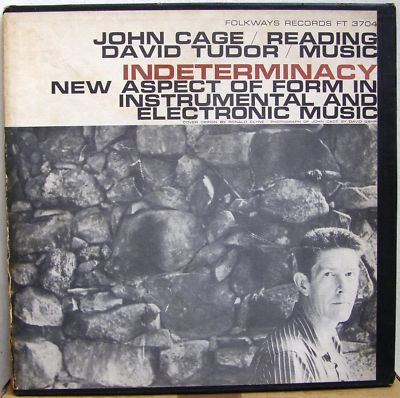
JOHN CAGE / DAVID TUDOR
INDETERMINACY: NEW ASPECT OF FORM IN INSTRUMENTAL AND ELECTRONIC MUSIC 2-LP BOXSET
Folkways
w/book
Very rare 1959 double lp boxset on Folkways with John Cage's text sound compositions with live electronics by David Tudor.
Some info on the release: Rare Folkways Records release (Ilhan Mimaroglu, Henry Jacobs, Tod Dockstader, Barton McLean and Gianni Safred, Barton Smith, Lars-Gunnar Bodin, Travelon Gamelon, Malcolm Goldstein, Philip Corner) back from 1959. For "Indeterminancy ..." (recorded in 1959), Cage assembled (quasi-) random enlightening and highly entertaining incidents from his experience and that of his friends, parables and stories from ancient texts, from secondhand sources and spontaneous insight. Each of these text parts was read at varying speeds to conform to the limit of a minute, some extremely slowly and others rushing to meet the deadline. Each story is however treated with equal import(ance), the complexity of their interrelation and meaning left to the listener. Simultaneously, pieces that he composed using indeterminant procedures ("Water Walk", "Concert for Piano and Orchestra", "Williams Mix", etc.) were performed on piano and live electronics by David Tudor. At times, the voice even becomes obscured and that is accepted in this musical situation which attempts to replicate "nature in its manner of working", and the way thoughts, observations and stimuli all intermix within the mind.
David Tudor: piano, whistles, tape machines, and amplified slinky. Late in September in 1958 I was in Stockholm in a hotel. I set about writing the present lecture which I was obliged to give a week later at the Brussels Fair. I recalled a remark made years before by David Tudor that I should make a talk that was nothing but stories. The idea was appealing when he gave it to me but I had never acted on it. A few weeks before, in Darmstadt, Karlheinz Stockhausen had said, "I'll publish your Brussels talk in Die Reihe." I replied, "You'd better wait and see what it is I write." He said, "No matter what it is, I'll publish it." My intention in putting 90 stories together in an unplanned way is to suggest that all things, sounds, stories (and, by extension, beings) are related, and that this complexity is more evident when it is not over-simplified by an idea of relationship in one person's mind. Most of the stories are things that happened that stuck in my mind. Others I read in books and remembered, those for instance, from Kwang-Tse and Sri Ramakrishna. The 2nd, 15th, 16th, 46th, and 75th stories are to be found somewhere in the literature surrounding Zen. David Tudor plays material from his part of the Concert for Piano and Orchestra (1957-58), using tracks from the Fontana Mix (1958-59) as noise elements where these arae notated in Concert.
John Milton Cage Jr. was a pioneer of chance music, electronic music and non-standard use of musical instruments, Cage was one of the leading figures of the post-war avant-garde and, in the opinion of many, the most influential American composer of the 20th century. He was also instrumental in the development of modern dance, mostly through his association with choreographer Merce Cunningham, who was also Cage's romantic partner for the most part of the latter's life. Cage is perhaps best known for his 1952 composition 4?33?, the three movements of which are performed without a single note being played. A performance of 4?33? can be perceived as including the sounds of the environment that the listeners hear while it is performed, rather than merely as four minutes and thirty three seconds of silence and has become one of the most controversial compositions of the century. Another famous creation of Cage's is the prepared piano (a piano with its sound altered by placing various objects in the strings), for which he wrote numerous dance-related works and a few concert pieces, the most well-known of which is Sonatas and Interludes (1946–48).
His teachers included Henry Cowell (1933) and Arnold Schoenberg (1933–35), both known for their radical innovations in music, but Cage's major influences lay in various Eastern cultures. Through his studies of Indian philosophy and Zen Buddhism in the late 1940s, Cage came to the idea of chance-controlled music, which he started composing in 1951. The I Ching, an ancient Chinese classic text on chance events, became Cage's standard composition tool for the rest of his life. In a 1957 lecture, Experimental Music, he described music as "a purposeless play" which is "an affirmation of life – not an attempt to bring order out of chaos nor to suggest improvements in creation, but simply a way of waking up to the very life we're living". Cage collaborated with David Tudor, Robert Rauschenberg, and Charles Olson at Black Mountain College where a performance took place amongst the audience. "Happenings", as set forth by Cage, are theatrical events that abandoned the traditional concept of stage-audience and occur without a sense of definite duration; instead, they are left to chance. They have a minimal script, with no plot. In fact, a "Happening" is so-named because it occurs in the present, attempting to arrest the concept of passing time. Cage believed that theater was the closest route to integrating art and (real) life. The term "Happenings" was coined by Allan Kaprow, one of his students, who was to define it as a genre in the late fifties. In following these developments Cage was strongly influenced by Antonin Artaud’s seminal treatise The Theatre and Its Double, and the “Happenings” of this period can be viewed a forerunner to the ensuing Fluxus movement. In October of 1960, Mary Baumeister's Cologne studio hosted a joint concert by Cage and the video artist Nam June Paik, who in the course of his 'Etude for Piano' cut off Cage's tie and then washed his co-performer’s hair with shampoo.
Condition: Vinyls lie in very good+(+) condition, look to be quite clean for their age with small signs of usage, but play with crackle and some surface noise, while box lies in very good+ condition, has split corners and also splits on the inside, while its' 2 parts are detached and looks yellowed. Book lies in excellent condition.
Tracklist
A Indeterminacy: New Aspect Of Form In Instrumental And Electronic Music 22:30 B Indeterminacy: New Aspect Of Form In Instrumental And Electronic Music 22:30 C Indeterminacy: New Aspect Of Form In Instrumental And Electronic Music 22:30 D Indeterminacy: New Aspect Of Form In Instrumental And Electronic Music 22:30SHIPPING & PAYMENT
Shipping: Shipping for this 2LP box is 12$ airmail in Europe / 15$ for the rest of the world
Registered mail: +5$
Insurance: optional
Combined shipping: BIG discounts
Payment: Paypal
Packaging: I am a collector too and i know
price rating