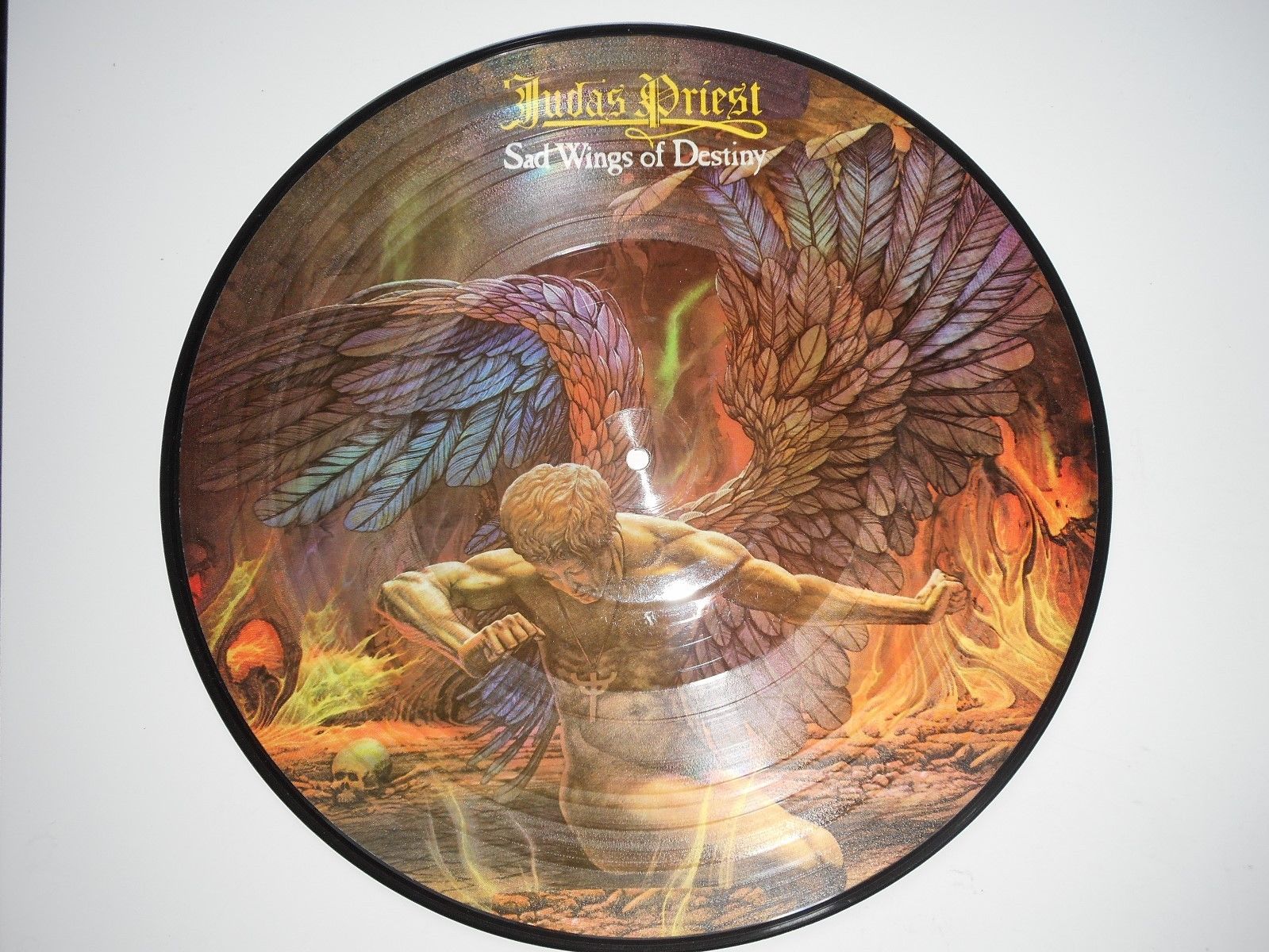
JUDAS PRIEST "SAD WINGS OF DESTINY" PICTURE DISC LP ORIGINAL FRENCH IMPORT
$
41


Favourite Auctions
To save auctions to your favourites, please login
If you don't have an account, please register
Description
YOU ARE BIDDING ON A PICTURE DISC LP BY JUDAS PRIEST CALLED "SAD WINGS OF DESTINY". IT WAS RELEASED ON THE S.P.I. LABEL (PD 79) OUT OF FRANCE IN 1976. THE PICTURE DISC IS WITH NO DEFECTS
***ALL LP'S COMES IN RESEALABLE JAPANESE MYLAR SLEEVES FOR PROTECTION
The cover art for the album, titled Fallen Angels, was illustrated by Patrick Woodroffe. It is best known for introducing the pitchfork-like symbol known as the "Judas Priest Cross," as worn by the angel.
Sad Wings of Destiny was Judas Priest's second and final studio record made while under contract with Gull Records, an independent UK company. Despite critical acclaim, the band was struggling financially due to lack of support from the label. Shortly after changing management, the band severed their ties with Gull and signed with Columbia Records. Consequently, Judas Priest lost all rights to the recordings on their first two albums and to all demo recordings made during the sessions while under contract with Gull.Sad Wings of Destiny was initially published and distributed by Janus Records in the United States.
Whilst the band lost the rights to recording royalties, they obtained copyright ownership of the songs themselves, many of which became staples for their live shows. "Victim of Changes", "The Ripper", "Tyrant" and "Genocide" appear on Judas Priest Unleashed in the East, a live album released by CBS in 1979. "Diamonds and Rust", a Joan Baez song originally recorded for Sad Wings, but left off of the final album, was re-recorded for Sin After Sin, their first CBS release, and also on Unleashed. Gull later released the band's original recording of "Diamonds and Rust" on a 'best of' album.
The year 1976 was crucial for the evolution of heavy metal, as landmark albums like Rainbow's Rising and Scorpions' Virgin Killer began to reshape the genre. Perhaps none was quite as important as Judas Priest's sophomore effort, Sad Wings of Destiny, which simultaneously took heavy metal to new depths of darkness and new heights of technical precision. Building on the hard prog of bands like Queen and Wishbone Ash, plus the twin-guitar innovations of the latter and Thin Lizzy, Sad Wings fused these new influences with the gothic doom of Black Sabbath, the classical precision of Deep Purple, and the tight riffery of the more compact Led Zeppelin tunes. Priest's prog roots are still readily apparent here, particularly on the spacy ballad "Dreamer Deceiver," the multi-sectioned "Victim of Changes," and the softer sonic textures that appear from time to time. But if Priest's style was still evolving, the band's trademarks are firmly in place -- the piercing, operatic vocals of Rob Halford and the tightly controlled power riffing of guitarists K.K. Downing and Glenn Tipton.
This foundation sounded like little else on the metal scene at the time, and gave Sad Wings of Destiny much of its dramatic impact. Its mystique, though, was something else. No metal band had been this convincingly dark since Black Sabbath, and that band's hallucinatory haze was gone, replaced by a chillingly real cast of serial killers ("The Ripper"), murderous dictators ("Tyrant"), and military atrocities that far outweighed "War Pigs" ("Genocide"). Even the light piano ballad "Epitaph" sounds like a morbidly depressed Queen rewriting Sabbath's "Changes." Three songs rank as all-time metal classics, starting with the epic "Victim of Changes," which is blessed with an indelible main riff, a star-making vocal turn from Halford, explosive guitar work, and a tight focus that belies its nearly eight-minute length. "The Ripper" and "Tyrant," with their driving guitar riffs and concise construction, are the first seeds of what would flower into the New Wave of British Heavy Metal movement.
More than any other heavy metal album of its time, Sad Wings of Destiny offered the blueprint for the way forward. What's striking is how deeply this blueprint resonated through the years, from the prog ambitions of Iron Maiden to the thematic echoes in a pair of '80s thrash masterpieces. The horrors of Sad Wings are largely drawn from real life, much like Slayer's Seasons in the Abyss, and its all-consuming anxiety is over powerlessness, just like Metallica's magnum opus, Master of Puppets. (Though this latter preoccupation doubtlessly had more psychosexual roots in Rob Halford's case -- witness the peculiar torture fantasy of "Island of Domination.") Unfortunately, Sad Wings of Destiny didn't have as much impact upon release as it should have, mostly owing to the limitations of the small Gull label. It did, however, earn Judas Priest a shot with Columbia, where they would quickly become the most influential band in heavy metal not named Black Sabbath.
price rating


