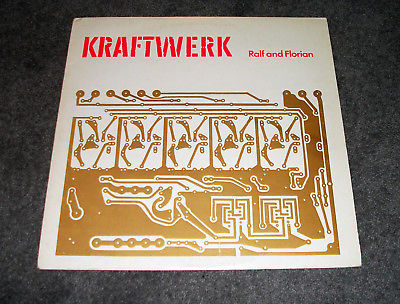
KRAFTWERK - RALF AND FLORIAN *** UK EMBOSSED COVER*** VERTIGO (1973)
£
26
$
34


Favourite Auctions
To save auctions to your favourites, please login
If you don't have an account, please register
Description
KRAFTWERK - RALF AND FLORIAN (1973)
VERTIGO DELUXE 6360 616
Vinyl - VG+
EMBOSSED Cover - VG
Ralf und Florian Studio album by Kraftwerk Released October 1973 (DEU)
released later in other countries Recorded May–July 1973 Studio Various[show] Genre
- Krautrock
- electronic
- avant-garde
- ambient[1]
- Philips
- Vertigo
(Out of print)
- Ralf Hütter
- Florian Schneider
- Conny Plank (uncredited)
(1972) Ralf and Florian
(1973) Autobahn
(1974) Alternative cover Cover for the UK edition Professional ratings Review scores Source Rating Allmusic [2]
Ralf und Florian (English title: Ralf and Florian) is the third studio album by the German electronic band Kraftwerk. It was released in October 1973 on Philips.
Contents
- 1Background
- 2Track listing
- 3Personnel
- 4Charts
- 4.1Weekly charts
- 5References
- 6External links
Background[edit]
Rear cover, photographed by Barbara Niemöller.Along with Kraftwerk's first two albums, Ralf und Florian to date has never been officially re-issued on compact disc. However, the album remains an influential and sought-after work, and bootlegged CDs were widely distributed in the 1990s on the Germanofon label. The band hinted that the album may finally see a re-mastered CD release after issuing the box set The Catalogue in the autumn of 2009.[3]
As indicated by the title (and like their previous album), all the tracks were written, performed and produced by Ralf Hütter and Florian Schneider, with the sessions engineered by the influential Konrad "Conny" Plank. The album has a fuller and more polished sound quality than previous efforts, and this is clearly due to the use of a number of commercial recording studios in addition to Kraftwerk's own yet-to-be-named Kling Klang. The colour photograph on the back of the cover gives a vivid impression of the bohemian state of Kraftwerk's own facilities at the time – including egg-box trays pasted, nailed, or stuck on the walls as acoustic treatment.
The album is still almost entirely instrumental (some wordless vocalising appears in "Tanzmusik", and "Ananas Symphonie" features the band's first use of a machine voice created by an early prototype vocoder, a sound which would later become a Kraftwerk trademark). Instrumentation begins to show more obvious use of synthesizers (Minimoog and EMS Synthi [4]AKS), but most melodic and harmonic keyboard parts are performed on Farfisa electronic piano/organ. Flute and guitar are still much in evidence. The band were still without a drummer, and several tracks, particularly "Tanzmusik", make use of a preset organ rhythm machine. "Kristallo" features a striking rhythmic electronic bassline (actually created on the EMS synthesizer with the aid of the vocoder), however in general the album is much gentler and less rhythmically precise than Kraftwerk's later electronic work.
The LP included a "musicomic" poster insert of cartoons by Emil Schult, who had been playing electric violin live with the band (although he does not feature on the album recordings). Schult remained a collaborator of Kraftwerk. The cartoons illustrated each track on the album, as well as the city of Düsseldorf, with the caption "In Düsseldorf am Rhein, klingt es bald!", which translates literally in English as "In Düsseldorf on the Rhine, it will sound soon" (perhaps the phrase "the sound gets around" captures the snappy feel of the maxim better). This is kind of a reference to Kraftwerk's Düsseldorf-based Kling Klang studio.
The album was a modest success in Germany. Drummer Wolfgang Flür was recruited to play with Ralf and Florian for a subsequent promotional TV appearance in Berlin, for the German WDR TV arts show Aspekte. He became a member of the group thereafter.
Track listing[edit]
All music composed by Ralf Hütter and Florian Schneider.
Side one No. Title Length 1. "Elektrisches Roulette[5]" ("Electric Roulette") 4:20 2. "Tongebirge[6]" ("Mountain of Sound") 2:50 3. "Kristallo[7]" ("Crystals") 6:20 4. "Heimatklänge[8]" ("The Bells of Home") 3:45 Side two No. Title Length 5. "Tanzmusik[9]" ("Dance Music") 6:35 6. "Ananas Symphonie[10]" ("Pineapple Symphony") 13:55- Note: The above English translations are taken from the US version of the album issued by Vertigo in 1975.
Personnel[edit]
Kraftwerk- Ralf Hütter – vocals, keyboards, organ, electronics, bass guitar, guitar, drums, percussion
- Florian Schneider – vocals, keyboards, electronics, flute, violin, guitar, percussion
All records sent securely with cardboard stiffeners.
I will combine postage.
GOOD LUCK!
Record Collector Magazine's Grading Guide:
"MINT: The record itself is in brand new condition with no surface marks or deterioration in sound quality. The cover and any extra items such as the lyric sheet, booklet or poster are in perfect condition. Records advertised as Sealed or Unplayed should be Mint.
EXCELLENT: The record shows some signs of having been played, but there is very little lessening in sound quality. The cover and packaging might have slight wear and / or creasing.
VERY GOOD: The record has obviously been played many times, but displays no major deterioration in sound quality, despite noticeable surface marks and the occasional light scratch. Normal wear and tear on the cover or extra items, without any major defects, is acceptable.
GOOD: The record has been played so much that the sound quality has noticeably deteriorated, perhaps with some distortion and mild scratches. The cover and contents suffer from folding, scuffing of edges, spine splits, discolouration, etc.
FAIR: The record is still just playable but has not been cared for properly and displays considerable surface noise; it may even jump. The cover and contents will be torn, stained and / or defaced.
POOR: The record will not play properly due to scratches, bad surface noise, etc. The cover and contents will be badly damaged or partly missing.
price rating


