KRIPS RUBENSTEIN Living Stereo LSC White Dog BEETHOVEN Complete Piano Concerti
$
25


Favourite Auctions
To save auctions to your favourites, please login
If you don't have an account, please register
Description
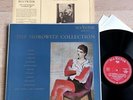
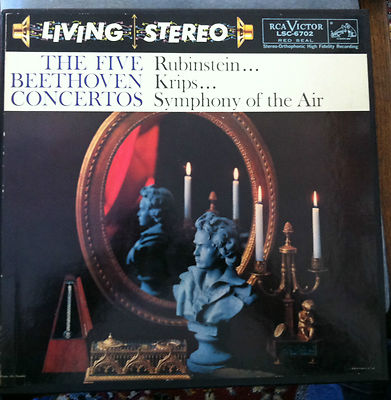
Beethoven - The Five Concertos
Performed by pianist Artur Rubinstein with Josef Krips conducting the Symphony of the Air.
RCA Victor "Living Stereo" LSC-6702, "White Dog"
Stampers: 8S/6S, 6S/9S, 6S/9S, 15S/14S, 16S/18S
5LP box set with booklet.
The Box is in very good condition with minor shelf wear and one edge slightly split. The records seem to have been played only 1 or twice and are very very clean.
Josef Alois Krips (8 April 1902 – 13 October 1974) was an Austrian conductor and violinist, was born in Vienna and went on to become a pupil of Eusebius Mandyczewski and Felix Weingartner. From 1921 to 1924, he served as Weingartner's assistant at the Vienna Volksoper and as répétiteur and chorus master. Afterwards he became conductor of several orchestras, including a period as music director of the orchestra in Karlsruhe from 1926 to 1933. In 1933 he returned to Vienna as a resident conductor of the Volksoper and a regular conductor at the Wiener Staatsoper. He also became a professor at the Vienna Academy of Fine Arts in 1935. He conducted regularly at the Salzburg Festival between 1935 and 1938.
In 1938, the Nazi annexation of Austria (or Anschluss) forced Krips to leave the country. (Krips was raised a Roman Catholic, but would have been excluded from musical activity because his father was born Jewish).[1] Krips moved to Belgrade, where he worked for a year with the Belgrade Opera and Philharmonic, until Yugoslavia also became involved in World War II. For the rest of the war he worked in a food factory.
On his return to Austria at the end of the war in 1945, Krips was one of the few conductors who were allowed to work, since he had not worked under the Nazi régime. He was the first to conduct the Vienna Philharmonic and the Salzburg Festival in the post-war period.
From 1950 to 1954 Krips was principal conductor of the London Symphony Orchestra. Afterwards he led the Buffalo Philharmonic Orchestra and the San Francisco Symphony (from 1963 to 1970). He made his Covent Garden debut in 1947 and his Metropolitan Opera in 1966, becoming a frequent guest conductor from then on. In 1970, he became conductor of the Deutsche Oper in Berlin. Between 1970 and 1973, he was the principal conductor of the Vienna Symphony.
Krips died in Geneva, Switzerland in 1974 at seventy-two. His brother was Henry Krips, who moved to Australia and was the chief conductor of the Adelaide Symphony Orchestra for a record term of 23 years (1949-1972).
Recordings
In 1955, Krips made a critically acclaimed recording of Mozart's Don Giovanni with the Vienna State Opera featuring Cesare Siepi, Fernando Corena, Walter Berry, Suzanne Danco, Lisa Della Casa and Hilde Gueden. In 1957, Krips conducted the Symphony of the Air in stereo recordings of the five Beethoven piano concertos with Arthur Rubinstein for RCA Victor.
In 1960, Krips recorded Beethoven's nine symphonies for Everest Records. For this set of recordings, Krips conducted the London Symphony Orchestra, and for the Symphony No. 9, the soloists included Donald Bell, baritone, Jennifer Vyvyan, soprano, Rudolf Petrak, tenor, and Shirley Carter (later known as Shirley Verrett), mezzo soprano. The BBC Chorus, under the chorusmaster Leslie Woodgate also performed. This series of recordings was popular with music critics and the public, and the recordings have been reissued several times in authorized and in bootleg editions.
During the 1970s, Krips recorded Mozart's late symphonies for Philips Records, conducting the Concertgebouw Orchestra. These have been reissued over the years by Philips and latterly Decca. Krips did not make any commercial recordings with the San Francisco Symphony, although many of his concerts were broadcast in stereo by San Francisco station KKHI.
Arthur Rubinstein, KBE (January 28, 1887 – December 20, 1982) was a Polish-American classical pianist who received international acclaim for his performances of the music written by a variety of composers; many regard him as the greatest Chopin interpreter of his time. He is widely considered one of the greatest pianists of the twentieth century. He played in public for eight decades. Rubinstein grew-up on Piotrkowska street, ?ód?, Poland. Rubinstein was born in ?ód?, Congress Poland (part of the Russian Empire for the entire time Rubinstein resided there) on January 28, 1887, to a Jewish family. He was the youngest of seven children, and his father owned a small textile factory.
Rubinstein's birth name was to be Leo, but his eight-year-old brother claimed that "His name must to be Arthur. Since Arthur X (a neighbor's son) plays the violin so nicely, the baby may also become a great musician!". And so Artur he was called, although in English-speaking countries, he preferred to be known as Arthur Rubinstein. However, his United States impresario Sol Hurok insisted he be billed as Artur, and records were released in the West under both versions of his name.
At the age of two, Rubinstein demonstrated perfect pitch and a fascination with the piano, watching his elder sister's piano lessons. By the age of four, he was recognised as a child prodigy. His father had a predilection for the violin and offered Rubinstein a violin; but Rubinstein rejected it because he thought his instinct was for harmony and polyphony. The Hungarian violinist Joseph Joachim, on hearing the four-year-old child play, was greatly impressed, told Arthur's family :"This boy may become a very great musician -- he certainly has the talent for it... When the time comes for serious study, bring him to me, and I shall be glad to supervise his artistic education." On December 14, 1894, seven-year-old Arthur Rubinstein had his debut with pieces by Mozart, Schubert and Mendelssohn.
At the age of ten, Rubinstein moved to Berlin to continue his studies, and gave his first performance with the Berlin Philharmonic in 1900, at the age of 13. Joseph Joachim recommended Karl Heinrich Barth (with whom he often played in trio) as the boy's piano teacher.
In 1904, Rubinstein moved to Paris to launch his career in earnest, where he met the composers Maurice Ravel and Paul Dukas and the violinist Jacques Thibaud. He also played Camille Saint-Saëns' Piano Concerto No. 2 in the presence of the composer. Through the family of Juliusz Wertheim (to whose understanding of Chopin's genius Rubinstein attributed his own inspiration in the works of that composer) he formed friendships with the violinist Paul Kochanski and composer Karol Szymanowski
Rubinstein made his New York debut at Carnegie Hall in 1906, and thereafter toured the United States, Austria, Italy, and Russia. According to his own testimony and that of his son in François Reichenbach's film L'Amour de la vie (1969), he was not well received in the United States. By 1908, Rubinstein, destitute and desperate, hounded by creditors, and threatened with being evicted from his Berlin hotel room, made a failed attempt to hang himself. Subsequently he said that he felt "reborn" and endowed with an unconditional love of life. In 1912, he made his London debut, and found a home there in the Edith Grove, Chelsea, musical salon of Paul and Muriel Draper, in company with Kochanski, Igor Stravinsky, Jacques Thibaud, Pablo Casals, Pierre Monteux and others.
During World War I, Rubinstein stayed in London, giving recitals and accompanying the violinist Eugène Ysaÿe. In 1916 and 1917, he made his first tours in Spain and South America where he was wildly acclaimed. It was during those tours that he developed a lifelong enthusiasm for the music of Enrique Granados, Isaac Albéniz, Manuel de Falla, and Heitor Villa-Lobos. He was the dedicatee of Villa-Lobos's Rudepoêma and Stravinsky's Trois mouvements de Petrouchka.
In the fall of 1919 Rubinstein toured the English Provinces with soprano Emma Calvé and tenor Vladimir Rosing. In 1921 Rubinstein gave two American tours, travelling to New York with Karol Szymanowski and his close friend Paul Kochanski. In 1932, the pianist, who stated he neglected his technique in his early years, relying instead on natural talent, withdrew from concert life for several months of intensive study and practice.
Rubinstein toured the United States again in 1937, his career becoming centered there during the World War II years when he lived in Brentwood, California. He became a naturalized American citizen in 1946.
Although best known as a recitalist and concerto soloist, Rubinstein was also considered an outstanding chamber musician, partnering with such luminaries as Henryk Szeryng, Jascha Heifetz, Pablo Casals, Gregor Piatigorsky, and the Guarneri Quartet. Rubinstein recorded much of the core piano repertoire, particularly that of the Romantic composers. At the time of his death, the New York Times in describing him wrote, "Chopin was his specialty . . . it was [as] a Chopinist that he was considered by many without peer". With the exception of the Études, he recorded most of the works of Chopin. He was one of the earliest champions of the Spanish and South American composers and of French composers who, in the early twentieth century, were still considered "modern" such as Debussy and Ravel. In addition, Rubinstein was the first champion of the music of his compatriot Karol Szymanowski. Rubinstein, in conversation with Alexander Scriabin, named Brahms as his favorite composer, a response that enraged Scriabin.
In 1975, a documentary named Artur Rubinstein, Love of Life was on; a TV special named Rubinstein at 90 represented he had been playing for people for eight decades.
By the mid-1970s, Rubinstein's eyesight had begun to deteriorate. He retired from the stage at age eighty-nine in May 1976, giving his last concert at London's Wigmore Hall, where he had first played nearly seventy years before.
Rubinstein, who was fluent in eight languages,[10] held much of the repertoire, not simply that of the piano, in his formidable memory.[10] According to his memoirs, he learned César Franck’s Symphonic Variations while on a train en route to the concert, without the benefit of a piano, practicing passages in his lap. Rubinstein described his memory as photographic, to the extent that he would visualize an errant coffee stain while recalling a score.[13]
Rubinstein also had exceptionally developed aural abilities, which allowed him to play whole symphonies in his mind. "At breakfast, I might pass a Brahms symphony in my head" he said. "Then I am called to the phone, and half an hour later I find it's been going on all the time and I'm in the third movement." This ability was often tested by Rubinstein's friends, who would randomly pick extracts from opera and symphonic scores and ask him to play them from memory.[1]
Rubinstein's autobiography contained two volumes: My Young Years (1973); and "My Many Years" (1980). Many were displeased by their emphasis on gossip over music. The pianist, Emanuel Ax, one of Rubinstein's greatest admirers, was profoundly disappointed by reading "My Many Years" - "Until then," he told Sachs, "I had idolized Rubinstein - I had wanted to have a life like his, the book changed all that. "
Of his youth, Rubinstein once said: "It is said of me that when I was young I divided my time impartially among wine, women and song. I deny this categorically. Ninety percent of my interests were women." At the age of forty-five, in 1932, Rubinstein married Nela M?ynarska, a twenty-four-year-old Polish ballerina (who had studied with Mary Wigman). Nela was the daughter of the Polish conductor Emil M?ynarski and his wife Anna Hrynewicz, who was from a Lithuanian aristocratic family. Nela had first fallen in love with Rubinstein when she was eighteen, but when Rubinstein began an affair with an Italian princess she married Mieczys?aw Munz. Nela subsequently divorced Munz and three years later married Rubinstein. They had five children (one died in infancy), including photographer Eva, who married William Sloane Coffin, and son John Rubinstein, a Tony Award-winning actor and father of actor Michael Weston. Nela subsequently authored Nela's Cookbook, which included the dishes she prepared for the couple's legendary parties. Both before and during his marriage, Rubinstein carried on a series of affairs with women, including Irene Curzon.
In addition to fathering a daughter (South American pianist Luli Oswald) with his mistress Paola Medici del Vascello, who was an Italian marchioness (née Princess Paola di Viggiano), he may have been the father of American decorator and artist Muriel Draper's son Sanders Draper, who perished in World War II. In 1977, at age 90, he left his wife for the young Annabelle Whitestone, though he and Nela never divorced.
While he was an agnostic, Rubinstein was nevertheless proud of his Jewish heritage.[19] He was a great friend of Israel,[20] which he visited several times with his wife and children, giving concerts with the Israel Philharmonic Orchestra, recitals, and master classes at the Jerusalem Music Centre. In 1949, Rubinstein - who lost family members in the Holocaust - along with other prominent musicians (including Horowitz and Heifetz) announced that he would not appear with the Chicago Symphony if it engaged the conductor Wilhelm Furtwängler, who had remained in Germany during the war.
Throughout his life, Rubinstein was deeply attached to Poland. At the inauguration of the UN in 1945, Rubinstein showed his Polish patriotism at a concert for the delegates. He began the concert by stating his deep disappointment that the conference did not have a delegation from Poland. Rubinstein later described becoming overwhelmed by a blind fury and angrily pointing out to the public the absence of the Polish flag. He then sat down at the piano and played the Polish national anthem loudly and slowly, repeating the final part in a great thunderous forte. When he had finished, the public rose to their feet and gave him a great ovation.
In his youth, as a natural pianist with a big technique, Rubinstein practiced as little as possible, learning new pieces quickly and without sufficient attention to textual details, relying on his personal charm to conceal the lack of finish in his playing. But his attitude toward his playing changed after his marriage. He stated that he did not want his children to take him as a has-been, so he began in the summer of 1934 to restudy his entire repertoire. "I buckled down back to work -- six hours, eight hours, nine hours a day." he recalled in 1958. "And a strange thing happened... I's began to discover new meaning, new qualities, new possibilities in music that I have been regularly playing for more than 30 years." In general, however, Rubinstein believed that a foremost danger for young pianists is to practice too much. Rubinstein regularly advised that young pianists should practice no more than three hours a day. "I was born very, very lazy and I don't always practice very long," he said, "but I must say, in my defense, that it is not so good, in a musical way, to overpractice. When you do, the music seems to come out of your pocket. If you play with a feeling of 'Oh, I know this,' you play without that little drop of fresh blood that is necessary – and the audience feels it." Of his own practice methods, he said, "At every concert I leave a lot to the moment. I must have the unexpected, the unforeseen. I want to risk, to dare. I want to be surprised by what comes out. I want to enjoy it more than the audience. That way the music can bloom anew. It's like making love. The act is always the same, but each time it's different."
Rubinstein was reluctant to teach in his earlier life, refusing to accept William Kapell's request for lessons. It was not until the late 1950s that he accepted his first student Dubravka Tomši? Srebotnjak. Other students of Rubinstein include François-René Duchâble, Avi Schönfeld, Ann Schein Carlyss, Eugen Indjic, Dean Kramer, and Marc Laforêt. Rubinstein also gave master classes towards the end of his life.
Rubinstein died in his sleep at his home in Geneva, Switzerland, on December 20, 1982, at the age of ninety-five, and his body was cremated. On the first anniversary of his death, an urn holding his ashes was buried in Jerusalem — as specified in his will — in a dedicated plot now dubbed "Rubinstein Forest" overlooking the Jerusalem Forest. This was arranged with Israel's chief rabbis so that the main forest wouldn't fall under religious laws governing cemeteries. In October 2007, his family donated to the Juilliard School an extensive collection of original manuscripts, manuscript copies and published editions that had been seized by the Germans during World War II from his Paris residence. Seventy-one items were returned to his four children, marking the first time that Jewish property kept in the Berlin State Library was returned to the legal heirs.
In 1974, Jan Jacob Bistritzky established the Arthur Rubinstein International Piano Master Competition, held every three years in Israel, intended to promote the careers of young and outstanding pianists. The Arthur Rubinstein Award and other prizes are presented to the winners. The Rubinstein Competition also commissions works by Israeli composers.
Recordings
In 1910, Rubinstein recorded Franz Liszt’s Hungarian Rhapsody No. 10 for the Polish Favorit label.[7] The pianist was displeased with the acoustic recording process, saying it made the piano sound "like a banjo" and did not record again until the advent of electrical recording. However, Rubinstein made numerous player piano music rolls for the Aeolian Duo-Art system and the American Piano Company (AMPICO) in the 1920s.
Beginning in 1928, Rubinstein began to record extensively for His Master's Voice and then RCA Victor, making a large number of solo, concerto and chamber music recordings until his retirement in 1976. As recording technology improved, from 78-rpm discs to LPs and stereophonic recordings, Rubinstein re-recorded much of his repertoire. All of his RCA recordings have been released on compact disc and amount to about 107 hours of music.
Rubinstein preferred to record in the studio, and during his lifetime approved for release only about three hours of live recordings. However, since the pianist’s death, several labels have issued live recordings taken from radio broadcasts.
price rating




![PINK FLOYD [ APPLES AND ORANGES ] DEMONSTRATION 7](https://www.popsike.org/php/thumbnail.php?url=https://www.popsike.pics/pix/20220319/255444422970.jpg)