KURT WEILL Walt WHITMAN SONGS Creator WILLIAM HORNE Adam Garner CONCERT HALL
$
25



Favourite Auctions
To save auctions to your favourites, please login
If you don't have an account, please register
Description
Welcome to my new auctions of 2020. This is the FIRST WEEK of 2 Weeks of great auctions,
running until February 9th.
I would be happy to hold your won items until Feb 9th to combine them in one economical package.
Please wait for me to send you an invoice. DO NOT USE EBAY CHECKOUT if you want the lowest possible postage.
Pls shoot me a short email to request an invoice with the correct shipping charge
A series of great Opera records from early 1903 Russian G&Ts to 1940 German War time pressings
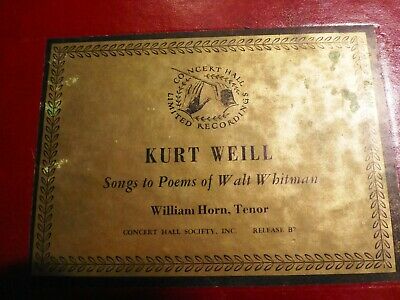
PREMIERE RECORDING Limited EDITION No 40 of 1000, performer signatures on back cover
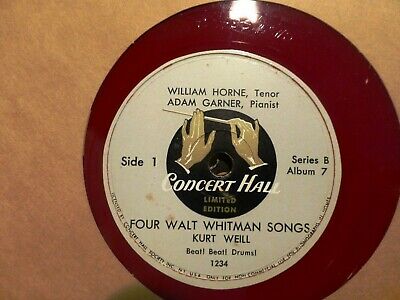
Premiered in 1947 for Concert Hall Records, with tenor William Horne and pianist Adam Garner
KURT WEILL, FOUR WALT WHITMAN SONGS
Beat! Beat! Drums!
O Captain! My Captain!
Come Up from the Fields, Father.
Dirge for Two Veterans.
Great DEBUT ALBUM of Tenor WILLIAM HORNE fresh from his successes as Billy Budd at Tanglewood, and the Premiere of The Mother of us All
2x12" red vinyl 78 rpm record w orig album and notes
Condition:
EXCELLENT pristine, needs cleaning, album solid, rubs on cover, top half of spine missing
Composed in 1942–47
Premiered in 1947 for Concert Hall Records, with tenor William Horne and pianist Adam Garner
Performance Time: Approximately 18 minutes
Unlike some émigrés who fled Europe ahead of the Nazi menace, Kurt Weill never indulged in backward glances or nostalgia. Even before he became an American citizen on August 27, 1943, Weill had proudly declared in a radio broadcast that he had “never felt as much at home in my native land as I have from the first moment in the United States.” Musicologist Kim H. Kowalke has related that in 1937, Weill declared to the playwright Paul Green, “I have the feeling that most people who ever came to this country came for the same reasons which brought me here: fleeing from the hate, the oppression, the restlessness and troubles of the Old World to find freedom and happiness in a New World.”
That same year, Green sent a copy of Whitman’s Leaves of Grass to Weill as a celebratory gift. The choice of poet was hardly at random, as Green gave Weill the work of the most American poet imaginable, a book that eloquently welcomed aspiring future citizens of the United States just like Weill. The composer had certainly encountered Whitman in Germany—German readers were familiar with Leaves of Grass through a number of expert translations. In 1926, years before his emigration, Weill saluted an upcoming broadcast recitation of Whitman’s verse in Der deutsche Rundfunk: “Walt Whitman was the first truly original poetic talent to grow out of American soil.”
After the attack on Pearl Harbor in 1941, Weill quickly composed three settings of Whitman’s Civil War poems: the first, “Beat! Beat! Drums!” is martial and defiant; the second, a setting of Whitman’s famous poem, “O Captain! My Captain!” is touching and poignant, with gentle echoes of Mahler’s Lieder; and the last, “Dirge for Two Veterans,” is both bluesy and deeply moving. In 1947, Weill revisited Whitman with a setting of “Come Up from the Fields, Father.” He positioned this as the third of his Four Walt Whitman Songs, which were recorded by tenor William Horner for Concert Hall Records. (“Another émigré composer to America, Carlos Surinach, orchestrated “Come Up from the Fields, Father” in Weill’s manner.)
William Horne, 69, a Tenor With New York City Opera
Published: April 21, 1983
. .William Horne, a tenor who sang with the New York City Opera, died Tuesday in Manhattan. He was 69 years old. Mr. Horne graduated from the Curtis Institute of Music and was a winner of the Naumburg Award.
In 1942, he appeared on Broadway in the Irving Berlin revue ''This Is the Army.''
Mr. Horne made his New York City Opera debut in 1944 as des Grieux in Puccini's ''Manon Lescaut.'' He sang the title role of Benjamin Britten's ''Peter Grimes'' in its first United States performance in 1946, conducted by Leonard Bernstein at Tanglewood, and appeared in the 1947 world premiere of Virgil Thomson's ''The Mother of Us All.'' In 1948, he recorded an album of Kurt Weill's songs under the composer's supervision. Mr. Horne later went into private teaching and vocal coaching and worked with Zero Mostel for ''Fiddler on the Roof.''
He is survived by his two brothers, Louis and Bernard
An die ferne Geliebte, opus 98, Ludwig van Beethoven's only song cycle, is generally thought of as being the first true song cycle. It was composed in April 1816. "An die ferne Geliebte," translated, is "To the Distant Beloved." The cycle is based on poems by Aloys Jeitteles, and is an enduring classic.
Libretto
1. Auf dem Hügel sitz ich spähend
Auf dem Hügel sitz ich spähend
In das blaue Nebelland,
Nach den fernen Triften sehend,
Wo ich dich, Geliebte, fand.
Weit bin ich von dir geschieden,
Trennend liegen Berg und Tal
Zwischen uns und unserm Frieden,
Unserm Glück und unsrer Qual.
Ach, den Blick kannst du nicht sehen,
Der zu dir so glühend eilt,
Und die Seufzer, sie verwehen
In dem Raume, der uns teilt
Will denn nichts mehr zu dir dringen,
Nichts der Liebe Bote sein?
Singen will ich, Lieder singen,
Die dir klagen meine Pein!
Denn vor Liebesklang entweichet
Jeder Raum und jede Zeit,
Und ein liebend Herz erreichet
Was ein liebend Herz geweiht!
2. Wo die Berge so blau
Wo die Berge so blau
Aus dem nebligen Grau
Schauen herein,
Wo die Sonne verglüht,
Wo die Wolke umzieht,
Möchte ich sein!
Dort im ruhigen Tal
Schweigen Schmerzen und Qual
Wo im Gestein
Still die Primel dort sinnt,
Weht so leise der Wind,
Möchte ich sein!
Hin zum sinnigen Wald
Drängt mich Liebesgewalt,
Innere Pein
Ach, mich zög's nicht von hier,
Könnt ich, Traute, bei dir
Ewiglich sein!
3. Leichte Segler in den Höhen
Leichte Segler in den Höhen,
Und du, Bächlein klein und schmal,
Könnt mein Liebchen ihr erspähen,
Grüßt sie mir viel tausendmal.
Seht ihr, Wolken, sie dann gehen
Sinnend in dem stillen Tal,
Laßt mein Bild vor ihr entstehen
In dem luft'gen Himmelssaal.
Wird sie an den Büschen stehen
Die nun herbstlich falb und kahl.
Klagt ihr, wie mir ist geschehen,
Klagt ihr, Vöglein, meine Qual.
Stille Weste, bringt im Wehen
Hin zu meiner Herzenswahl
Meine Seufzer, die vergehen
Wie der Sonne letzter Strahl.
Flüstr' ihr zu mein Liebesflehen,
Laß sie, Bächlein klein und schmal,
Treu in deinen Wogen sehen
Meine Tränen ohne Zahl!
4. Diese Wolken in den Höhen
Diese Wolken in den Höhen,
Dieser Vöglein muntrer Zug,
Werden dich, o Huldin, sehen.
Nehmt mich mit im leichten Flug!
Diese Weste werden spielen
Scherzend dir um Wang' und Brust,
In den seidnen Locken wühlen.
Teilt ich mit euch diese Lust!
Hin zu dir von jenen Hügeln
Emsig dieses Bächlein eilt.
Wird ihr Bild sich in dir spiegeln,
Fließ zurück dann unverweilt!
5. Es kehret der Maien, es blühet die Au
Es kehret der Maien, es blühet die Au,
Die Lüfte, sie wehen so milde, so lau,
Geschwätzig die Bäche nun rinnen.
Die Schwalbe, die kehret zum wirtlichen Dach,
Sie baut sich so emsig ihr bräutlich Gemach,
Die Liebe soll wohnen da drinnen.
Sie bringt sich geschäftig von kreuz und von quer
Manch weicheres Stück zu dem Brautbett hieher,
Manch wärmendes Stück für die Kleinen
Nun wohnen die Gatten beisammen so treu,
Was Winter geschieden, verband nun der Mai,
Was liebet, das weiß er zu einen.
Es kehret der Maien, es blühet die Au.
Die Lüfte, sie wehen so milde, so lau.
Nur ich kann nicht ziehen von hinnen.
Wenn alles, was liebet, der Frühling vereint,
Nur unserer Liebe kein Frühling erscheint,
Und Tränen sind all ihr Gewinnen.
6. Nimm sie hin denn, diese Lieder
Nimm sie hin denn, diese Lieder,
Die ich dir, Geliebte, sang,
Singe sie dann abends wieder
Zu der Laute süßem Klang.
Wenn das Dämmrungsrot dann zieht
Nach dem stillen blauen See,
Und sein letzter Strahl verglühet
Hinter jener Bergeshöh;
Und du singst, was ich gesungen,
Was mir aus der vollen Brust
Ohne Kunstgepräng erklungen,
Nur der Sehnsucht sich bewußt:
Dann vor diesen Liedern weichet
Was geschieden uns so weit,
Und ein liebend Herz erreichet
Was ein liebend Herz geweiht.
Gerhard Hüsch (Hanover, February 2, 1901 - Munich, November 23, 1984) was one of the most important German singers of modern times. He specialized in Lieder, and to a lesser extent in opera.
Between 1925 and 1942, Hüsch sang regularly at several German (as well as British and Italian) opera houses, primarily in Berlin from 1930 onwards. The role for which he is best remembered is that of Papageno in Mozart's The Magic Flute, but his repertoire included most of the standard lighter baritone roles, including Wagner's (he appeared at Bayreuth, most notably as Wolfram in Tannhäuser) and Richard Strauss's (he appeared in the premiere of Strauss's Intermezzo). Lacking the sheer devastating vocal amplitude of his contemporaries Hans Hotter and Gottlob Frick, Hüsch concentrated on beautifully lucid diction and an unfailingly smooth vocal line.
Nowhere were these qualities better displayed than in his pioneering prewar Lieder records. Here he shows the art which conceals art. He gave us the first more-or-less-uncut versions of Schubert's Winterreise and Die Schöne Müllerin song-cycles, not to mention Beethoven's An die Ferne Geliebte; his discs of songs by Hugo Wolf, made under Walter Legge's auspices, helped introduce that composer to thousands of music-lovers previously unfamiliar with Wolf's output; and he released a generous selection of songs by Hans Pfitzner, these recordings bearing the imprimatur of Pfitzner himself at the piano. The obscure Finnish composer Yrjö Kilpinen found in Hüsch a steadfast champion. Sometimes Hüsch performed in choral masterpieces as well, his recorded work in this field including an exceptional Jesus in a wartime set – severely abridged – with Günther Ramin conducting, of Bach's St. Matthew Passion.
After World War II, Hüsch, whose political naïveté during the Third Reich (and, in particular, closeness to Rosalind von Schirach, the sister of Baldur von Schirach)[1] was unlikely to endear him to the Allies, mostly abandoned concert and operatic appearances, preferring to concentrate on teaching. A professor at the Munich Hochschule für Musik, he numbered among his pupils the British tenor Nigel Rogers. He gave masterclasses not only in Europe but in Japan.
More Great Records on sale right now:
https://www.ebay.com/sch/m.html?_ssn=carsten_sf&_from=R40&_nkw=&_sacat=0&_sop=1
http://shop.ebay.com/carsten_sf/m.html
====
A Quick NOTE ON GRADING AND SHIPPING:
As you can see from my feedback, I try hard to earn your POSITIVE FEEDBACK and FIVE STAR RATINGS.
If for any reason your transaction was NOT SATISFACTORY, pls contact me and I will work something out with you. YOU WILL NEVER HAVE A REASON TO GIVE ME A NEGATIVE RATING or a LOW STAR RATING.
Quick note on grading:
The Grade (Excellent to Poor, I don't give Mint) refers to the WEAR of the record. Any other defects are stated separately
When I listen to a record, I may also give it an aural grade (again E to P), and make a SUBJECTIVE judgment of the pressing quality for hiss and surface noise.
"SUPERQUIET" is basically noiseless, like a vinyl pressing.
"VERY QUIET" is an exceptionally quiet record for a given pressing.
"Quiet" is a record that is a great example without undue noise for a give pressing.
These judgments are SUBJECTIVE and will depend one the styli, phonograph etc. you use on your own equipment.
Multiple item shipping: I am happy to combine items for shipment in one parcel.
If you win multiple items, pls send me an INVOICE REQUEST to calculate the correct postage. Ebay check out will not give you the correct multiple item discount!
Records will be packed safely between corrugated cardboard in a sturdy box with plenty of padding for safe shipment.
Shipment is usually Media Mail, unless you request another service. Shipping is at your risk, I will be happy to insure items at your cost.
I charge actual postage plus a small fee for packing materials
As always, I guarantee your satisfaction. If you don't like the item, just return it, and I will refund the full purchase price.
If you are in the San Francisco area, I encourage pick-up in person.
US Domestic Shipping:
Here is a guideline for US Media Mail Shipping:
Prices below are for regular 78 rpm records. Up to about 5 records, I will ship Edison Discs for the same rates. Albums from Album Sets count as 1 record. Above that and for international shipments, it will be actual weight plus a small packing charge (1-3$ depending on size of shipment)
1 record: 4.85 – 5.75$
2 records: 6.75$
5 records: 9.00$
10 records: 12.00$
MANY MORE RECORDS: Don't worry. I safely ship 40 - 50 pounds of records double boxed in moving boxes, and even then Media Mail will probably not exceed 35$.
Please send me a message if you would like to get an estimate for you shipping rates!
I am very happy to ship records worldwide.
Please use the EBAY shipping cost only as a guideline. My actual charges are usually lower
One record usually ships for 25$ for 10" 25-35$ for most 12" records (Less for Canada).
As always, I would appreciate any suggestions and corrections from you, pls contact me with any question.
Thank you very much, and good luck bidding !!!
price rating