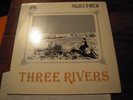
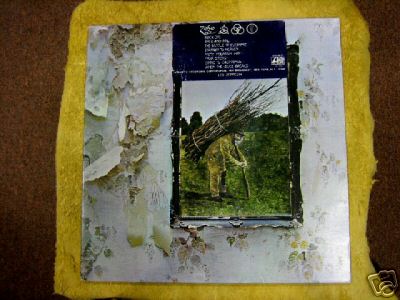
LED ZEPPELIN IV. ZOSO WHITE LABEL PROMO
$
225


Favourite Auctions
To save auctions to your favourites, please login
If you don't have an account, please register
Description
LED ZEPPELIN
Atlantic SD 7208 Led Zeppelin IV ( White Label Promo) 1971
Cover: VG++ .. sticker on cover and has general wear .. slight ringwear .. slightly rounded corners
Vinyl: EX/EX+ .. well you can hear a slight tick on side One leading into Black Dog .. not really prevalent but keeps this one from being NM. Side 2 appears to be free from annoying background noise .
Side One:
Black Dog
Rock And Roll
The Battle Of Evermore
Stairway To Heaven
Side Two:
Misty Mountain Hop
Four Sticks
Going To California
When The Levee Breaks
Led Zeppelin IV
From Wikipedia, the free encyclopedia
The correct title of this article is . This article's title contains characters or symbols not found in Unicode. Studio album by Led Zeppelin Released November 8, 1971 Recorded December 1970 – March 1971 atHeadley Grange, Hampshire, with The Rolling Stones Mobile Studio;
Island Studios, London;
Sunset Sound, Los Angeles.
Mixed at Island Studios, London;
Olympic Studios, London. Genre Hard rock
Heavy metal
Folk rock Length 42:38 Label Atlantic Producer(s) Jimmy Page, Peter Grant Professional reviews
- All Music Guide link
- Robert Christgau (A) link
- NME (9/10) October 2, 1992 p. 29
- Q July 1994
- Rolling Stone (Favorable) December 11, 1971 p. 63
(1970)
(1971) Houses of the Holy
(1973)
is the fourth album by English rock band Led Zeppelin, released on November 8, 1971. It has no easily expressed official title and is commonly referred to as Led Zeppelin IV. Atlantic Records catalogues have used the names Four Symbols and The Fourth Album, and it is also variously referred to as Untitled, Runes, Sticks, Man with Sticks, Four and ZoSo (after the appearance of the first character or symbol printed on the LP label). Led Zeppelin guitarist Jimmy Page frequently refers to the album as Led Zeppelin IV in interviews, while singer Robert Plant thinks of it as "the Fourth Album, that's it." The album is one of the best-selling albums in history, with over 23 million units sold in the United States alone. Estimates for worldwide figures usually top 30 million units.
Overview
The album was recorded at Island Records's newly opened studios in Basing Street, London, around the same time as Jethro Tull's Aqualung, and at Headley Grange, a remote Victorian house in East Hampshire, England, as well as Sunset Sound in Los Angeles, CA
After the lukewarm, if not confused and sometimes dismissive, critical reaction Led Zeppelin III had received in the autumn of 1970, Page decided that the next Led Zeppelin album would not have a title, but would instead feature four hand-drawn symbols on the inner sleeve and record label, each one chosen by the band member it represents. "We decided that on the fourth album, we would deliberately play down the group name, and there wouldn't be any information whatsoever on the outer jacket," Page explained. "Names, titles and things like that do not mean a thing."[1]
These symbols are the official title of the album, and Atlantic Records initially distributed graphics of the symbols in many sizes to the press for inclusion in charts and articles. The album was one of the first to be produced without conventional identification, and this communicated an anti-commercial stance that was controversial at the time (especially among certain executives at Atlantic).
Led Zeppelin IV remains a perennial favorite on classic rock radio and features "Stairway to Heaven", one of the most famous and popular rock songs ever recorded. This was the band's third consecutive U.K. chart topper, and it reached #1 in the U.S., lasting 259 weeks on the chart there. During the track's 35 years of existence, its combined radio airplay in the United States alone has totaled over 50 years[citation needed].
In 1998, Q magazine readers voted Led Zeppelin IV the 26th greatest album of all time; in 2000 "Q" placed it at #26 in its list of the 100 Greatest British Albums Ever. In 2003, the album was ranked number 66 on Rolling Stone magazine's list of the 500 greatest albums of all time. It is #7 on Pitchfork Media's Top 100 Albums of the 1970s. A 2005 listener poll conducted by Toronto classic rock station Q107 (CILQ) named Led Zeppelin IV the #2 best classic rock album of all time. In 2006, the album was rated #1 on Classic Rock magazine's100 Greatest British Albums poll; that same year it was voted #1 in Guitar World 100 Greatest Albums readers' poll and was ranked #7 in ABC media's top ten albums.
[edit] The symbols
The four symbols on the cover of Led Zeppelin IV, representing Jimmy Page, John Paul Jones, John Bonham, and Robert Plant (from left to right) respectively.Although the symbols that form its title (and the album itself) are sometimes referred to as "Runes", only the middle two are runes. The other two are sigils.
Each member of the band chose a personal emblem for the cover. Left to right, their members and meanings:
- Jimmy Page's symbol is generally referred to as "ZoSo", though its symbols have nonalphabetic connotations. It was not designed by Page himself.[1] The source of the ZoSo symbol itself is no longer a mystery but the meaning of it still is; it originated in 'Ars Magica Arteficii' (1557) by Gerolamo Cardano (also known as J. Cardan), an old alchemical grimoire, where it has been identified as a sigil consisting of zodiac signs. The sigil is reproduced in "Dictionary of Occult, Hermetic and Alchemical Sigils" by Fred Gettings, published in 1982 by Routledge & Kegan Paul (see here). The symbol used to represent the planet Saturn for purposes of magic. Page is a Capricorn, a sign ruled by Saturn, and the Z-like symbol is distinctive as a common astrological mark for Saturn. The oSo portion is similar to the alchemic symbol for mercury, also associated with Saturn. In cabalistic or hermetic study, knowledge seekers look to the god Mercury (Hermes, see Hermes Trismegistus and the Hermetica) for guidance and light, more or less the scene that unfolds in the drawing on the inside cover of the album and later acted out by Page in the concert film The Song Remains the Same. This part of the symbol is also strikingly similar to the Lucifer script ciphered by Aleister Crowley in his book The Equinox; and the symbol as a whole strongly resembles characters of the "alphabet of the Magi", a seventeenth century text used for fashioning magical talismans. What it means personally to Page is unknown, as he has never publicly revealed its meaning. His interest in Aleister Crowley, however, is widely known. The guitarist owns many of Crowley's original manuscripts and other effects, including (until the mid-1980s) Crowley's former home on Loch Ness, Boleskine House. In the 1970s Page owned the occult bookshop The Equinox in London, also an enterprise for publishing rare manuscripts.
- John Paul Jones' symbol is a single circle intersecting 3 vesica pisces (a triquetra). Taken from a book of runes, it symbolises a person with confidence and competence.[1] However, Jones claims it represents an exorcism (said to irritate the occultist Page).[citation needed]
- John Bonham's symbol, the three interlocking rings, represents the trinity of mother, father and child. It could also depict an aerial view of a drum kit. It does in fact represent the pagan idea of trilogies and trios, and, more commonly, is a Christian symbol for the Trinity. In the 1990 Bonham tribute radio special, "It's Been A Long Time", son Jason Bonham stated that the symbol was chosen as a representation of man, woman, and child. Jones's and Bonham's symbols fitting together -- one to the other inside out, inverse images -- is no accident. In any good rock band, particularly in Led Zeppelin, the bassist and drummer form interlocking parts of a rhythmic whole.[citation needed] In reality the symbol originally appeared on an english beer company that happened to be Bonzo's favorite so when choosing symboles he decided to borrow this one. [2]
- The symbol for Robert Plant is the Egyptian feather of Ma'at, representing truth, justice, fairness and writing, encapsulated by an unbroken circle representing life.[1]
There is actually a fifth, smaller symbol chosen by guest vocalist Sandy Denny representing her contribution to "The Battle of Evermore"; it appears in the credits list on the inner sleeve of the LP, serving as an asterisk.
[edit] Album songs
The album included examples of hard rock, such as its first cut, "Black Dog", and quiet moments such as "Going to California", an acoustic song inspired by Joni Mitchell and featuring delicate mandolin figures played by Jones. "Four Sticks" showcased Bonham's heavy drumming (Bonham reportedly used two drumsticks in each hand, giving the track a rolling, symphonic effect) and the relentless riffs of Jimmy Page. "The Battle of Evermore" is the only Led Zeppelin song to feature a guest vocalist, Sandy Denny of Fairport Convention.[3] This song and the playful "Misty Mountain Hop" include lyrical references to J. R. R. Tolkien's The Lord of the Rings (director Ralph Bakshi had wanted to use music from Led Zeppelin in his 1978 animated film adaptation of the book, but was unable to get the rights[4]). Along the way to constructing movements of what Page called "light and shade," Led Zeppelin created some of their most enduring, definitive music: "Rock and Roll", "When the Levee Breaks", "Black Dog" and especially "Stairway to Heaven".
"Black Dog" opens the affair, announcing itself with an overtly sexual, reverberating, guttural wail from Plant, then crashes into the whiplike tail of a classic Page riff, which chases the unique time signature of a stomping beat from Bonham. The title of the song came about, supposedly, because a stray black dog had been loitering about the studio during the recording. Christian researchers offer another theory. While the song hits the surface as a sexual come-on in overdrive, it is more an invocation of sorts: The Chienne Noire, or Black Dog, was the name of an occult club in Somerset Maugham's "The Magician," a novel in which the protagonist, Oliver Haddo, was modeled after Aleister Crowley.
Folk and metal are fused together in the eight-minute, suite-like "Stairway to Heaven", which became a massive album-oriented rock FM radio hit despite never being released as a single. "Stairway" has been controversial due to unsubstantiated but insistent claims of "satanic" backmasked messages, not to mention Page's undeniable influence on some of the frontwards lyrical imagery and symbolism, though it is generally regarded as Plant's breakthrough writing as a lyricist. The song features three distinct movements: a slow acoustic introduction, a more up-tempo acoustic middle section, and an electric finale marked by an iconic guitar solo. In 2005, the readers of Guitar World magazine voted Page's "Stairway to Heaven" guitar solo the greatest solo of all time.[5]
"Rock and Roll" is a tribute to the early rock music of the 1950s but with a heavy metal twist, featuring John Bonham's classic drum introduction and Jimmy Page's driving 12 bar riff. Recently (as of 2006), the song has been used prominently in Cadillac automobile commercials--one of the extremely rare instances of Led Zeppelin's surviving members permitting the licensing of their songs.[6]
concludes with an altered version of a Memphis Minnie/Kansas Joe McCoy blues song, "When the Levee Breaks". Led Zeppelin's version opens with a drum beat, which has been sampled for use in many modern rock and rap releases.[7] The distinct resonance of the drums in the song was achieved by recording them in a stairwell at Headley Grange, a former poorhouse in Headley, East Hampshire. The stairwell echoed at exactly half the tempo of the song, adding a false hit between each beat.
[edit] Album cover and inside sleeve
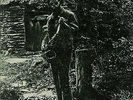
The painting on the front of the album showing an old man carrying a bundle of sticks, was allegedly purchased from a junk shop in Reading, Berkshire by a Led Zeppelin roadie (Jimmy Page has stated it was bought by Robert Plant)[8] and affixed to the internal, papered wall of the partly demolished house for the photograph to be taken. 'The man with the sticks on his back' can also refer to the biblical Cain, who, in legend was said to have ended his journeys on the moon contributing to the image on the face of the moon. Film critic Robert Ring has also suggested that the picture might be a reference to the 1920s witchcraft documentary Häxan: Witchcraft through the Ages. In the film, there is a similar-looking witch, and inside the bundle of sticks are body parts from a thief hung on the gallows (Trivia section, "Häxan", Classic-Horror). This would be fitting, given Page's interest in hermetic studies. The house and surrounding area in the picture are by Butterfield Court in the Eve Hill area of Dudley; the use of Eve Hill may be an in-joke ["Ev-il"] by the band.
The tower block on the back cover is of Butterfield Court in Dudley, England (not the now demolished Prince of Wales Court, as is sometimes incorrectly stated). Butterfield Court can be seen, owing to it being 20-stories high and on top of a ridge, 25 miles away in rural Worcestershire and Shropshire and on a clear day, over 45 miles away in Wales. A contemporary image of Butterfield Court can be seen here [1]
The typeface for the lyrics to "Stairway To Heaven", printed on the inside sleeve of the album, was Page's contribution. He found it in an old arts and crafts magazine called Studio which started in the late 1800s. He thought the lettering interesting and got someone to work up a whole alphabet.[8]
Credits
- Led Zeppelin:
- Jimmy Page - Acoustic guitar, electric guitar, mandolin, producer, remastering, digital remastering
- Robert Plant - Vocals, harmonica
- John Paul Jones - Synthesizer, bass guitar, keyboards, mandolin, recorders
- John Bonham - Drums
- Ian Stewart - Piano on "Rock and Roll" (uncredited)
- Sandy Denny - Vocals (Track 3)
- Peter Grant - Executive producer
- George Chkiantz - Mixing
- Andy Johns - Engineer, mixing
- George Marino - Digital remastering
- Graphreaks - Design coordinator
- Barrington Colby Mom - Inside illustration (The Hermit)
price rating