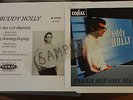
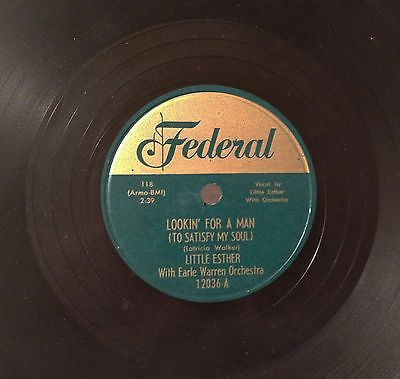
LITTLE ESTHER $ THE DOMINOES LOOKIN FOR A MAN HEART TO HEART 12036 FEDERAL
$
24


Favourite Auctions
To save auctions to your favourites, please login
If you don't have an account, please register
Description
Comes with Federal sleeve. Please see my other auctions for more rare records.Please feel free to make me an offer.
Born Esther Mae Jones in Galveston, Texas. When she was an adolescent, her parents divorced, and she was forced to divide her time between her father in Houston and her mother in the Watts area of Los Angeles. Because she was brought up singing in church, she was hesitant to enter a talent contest at a local blues club, but her sister insisted and she complied. A mature singer at the age of 14, she won the amateur talent contest in 1949 at the Barrelhouse Club owned by Johnny Otis. Otis was so impressed that he recorded her for Modern Records and added her to his traveling revue, the California Rhythm and Blues Caravan, billed as "Little Esther Phillips" (she reportedly took the surname from a gas station sign).[3]
Early career[edit
Her first hit record was "Double Crossing Blues", recorded in 1950 for Savoy Records. After several hit records with Savoy, including her duet with Mel Walker on "Mistrusting Blues", which went to number one that year, as did "Cupid Boogie". Other Phillips records that made it onto the U.S. Billboard R&B chart in 1950 include "Misery" (number 9), "Deceivin' Blues" (number 4), "Wedding Boogie" (number 6), and "Faraway Blues" (number 6). Few female artists, R&B or otherwise, had ever enjoyed such success in their debut year.[2] Phillips left Otis and the Savoy label at the end of 1950 and signed with Federal Records.
But just as quickly as the hits had started, they stopped. Although she recorded more than thirty sides for Federal, only one, "Ring-a-Ding-Doo", charted; the song made it to number 8 in 1952. Not working with Otis was part of her problem; the other part was her drug usage. By the middle of the decade Phillips was chronically addicted to drugs.[4] Being in the same room when Johnny Ace shot himself (accidentally) on Christmas Day, 1954, while in-between shows in Houston, did not help matters.
In 1954, she returned to Houston to live with her father to recuperate. Short on money, she worked in small nightclubs around the South, punctuated by periodic hospital stays in Lexington, Kentucky, stemming from her addiction. In 1962,Kenny Rogers re-discovered her while singing at a Houston club and got her signed to his brother Lelan’s Lenox label.
- Ju^
price rating