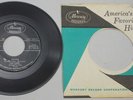
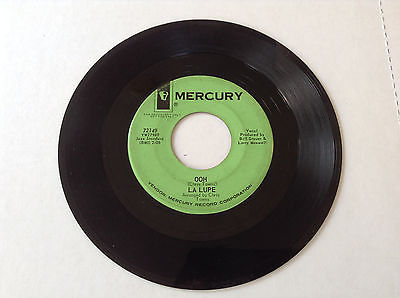
La Lupe ?Fever/Ooh Mercury 72149 1962 Rare Promo Killer Latin Soul RARE
$
100


Favourite Auctions
To save auctions to your favourites, please login
If you don't have an account, please register
Description
La Lupe ?– Fever/Ooh Label: Mercury ?– 72149 Format: Vinyl, 7", Single Country: US Released: 1963 Genre: Latin, Funk / Soul Style: Rhythm & Blues Tracklist Hide Credits A1 FeverArranged By – Chris TownsMusic By – John DavenportProducer – Bill Grauer, Larry MaxwellWritten-By – Ed Cooley* 2:17 B1 OohArranged By – Chris TownsProducer – Bill Grauer, Larry MaxwellWritten-By – Chris Towns 2:05 Notes Jay-Cee Music (A side) Jazz Standard (B Side) Barcode and Other Identifiers Other: YW27948 La Lupe (born Guadalupe Victoria Yolí ) (Santiago de Cuba, 23 December 1939[1] – Bronx, New York City, New York, 29 February 1992),[2] was a Cuban singer of several musical genres: boleros, guarachas and Latin soul in particular. Known for her energetic, sometimes controversial performances, she is considered by many to be one of the leading singers in the salsa music genre. La Lupe was born in the barrio of San Pedrito in Santiago de Cuba. Her father was a worker at the local Bacardi distillery and a major influence on her early life. Her introduction to fame was in 1954, on a radio program which invited fans to sing imitations of their favorite stars. Lupe bunked off school to sing a bolero of Olga Guillot's, called Miénteme (Lie to me), and won the competition. The family moved to Havana in 1955, where she was enrolled at the University of Havana to become a teacher. Like Celia Cruz, she was certified as a schoolteacher before she became a professional singer.[3] Lupe married in 1958 and formed a musical trio with her husband Eulogio "Yoyo" Reyes and another female singer. This group, Los Tropicuba, broke up along with the marriage in 1960. She began to perform her own act at a small nightclub in Havana, La Red (The Net), which had a clientele of distinguished foreigners. She acquired a devoted following, which included Ernest Hemingway, Tennessee Williams, Jean-Paul Sartre, Simone de Beauvoir and Marlon Brando.[citation needed] She also performed regularly on radio. She released her first album, Con el Diablo en el cuerpo (With the Devil in my body) in 1960, for RCA Victor, which was later certified gold.[3] Her first television appearance on Puerto Rican television caused a stir due to her frenzied, vibrant performance, which reportedly shocked some viewers.[4] In 1962 she found herself exiled to the United States. In New York City she performed at a cabaret named La Barraca, where she was discovered by Mongo Santamaría and started a new career, making more than 10 records in five years. She married a second time, to salsa musician Willie García, with whom she had a daughter. That marriage also ended in divorce.[4] Lupe's passionate performances covered the range of music: son montuno, bolero, boogaloo, venturing into other Caribbean styles like Dominican merengue, Puerto Rican bomba and plena. It was her recordings which brought Tite Curet Alonso into prominence as a composer of tough-minded boleros in the salsa style. In the 1960s she was the most acclaimed Latin singer in New York City due to her partnership with Tito Puente. She was the first Latin singer to sell out a concert event at Madison Square Garden. She did a wide variety of cover versions in either Spanish or accented English, including "Yesterday", "Dominique" by The Singing Nun, "Twist & Shout", "Unchained Melody", "Fever" and "America" from West Side Story. FRED WEINBERG, who was her favorite audio engineer, and who also produced several of her albums, called La Lupe "A Hurricane" in the studio due to her intense singing, and enthusiasm. (Weinberg can be seen in the PBS Documentary "THEY CALL ME LA LUPE" Directed by Ela Troyano.[5] The quality of her performances became increasingly uneven. There were persistent rumours of her drug addiction, ("untrue", states Fred Weinberg, who worked with her on most of her albums for many years)."If anything, she clung to Religion and never even saw her take a drink"[5]> and her life was "a real earthquake" according to close friends.[6] She ended some of her on-stage engagements being treated with an oxygen mask.[4] Although she may have been poorly managed by her label Fania Records in particular, she managed and produced herself in mid-career, after she parted ways with Tito Puente.[6
price rating




![Bob Dylan Bringing It All Back Home LP UK 1st Press Mono [Ex/Vg+]](https://www.popsike.org/php/thumbnail.php?url=https://www.popsike.pics/pix/20240217/134941080713.jpg)