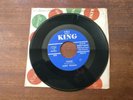
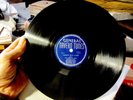
Last Rec 1940 JELLY ROLL MORTON SEXTET Red Allen Get The Bucket WHY GENERAL 1706
$
30




Favourite Auctions
To save auctions to your favourites, please login
If you don't have an account, please register
Description
A series of great JAZZ Records from early Ragtime to Beb-Bop on 78 rpm Victrola Records
More great Jazz and Vocal Records in my other listings!
Great Jazz by JELLY ROLL MORTON Piano talking and singing in his last commercial sessions for the GENERAL label
This is JELLY ROLL MORTONS LAST RECORDING SESSIONS for the GENERAL/ REEVES Label in January 1940. This is an ORIGINAL ISSUE RECORD, NOT A REISSUE !
JELLY ROLL MORTON SEXTETwith great Trumpet solo by "Red" Allen, vocals by Morton
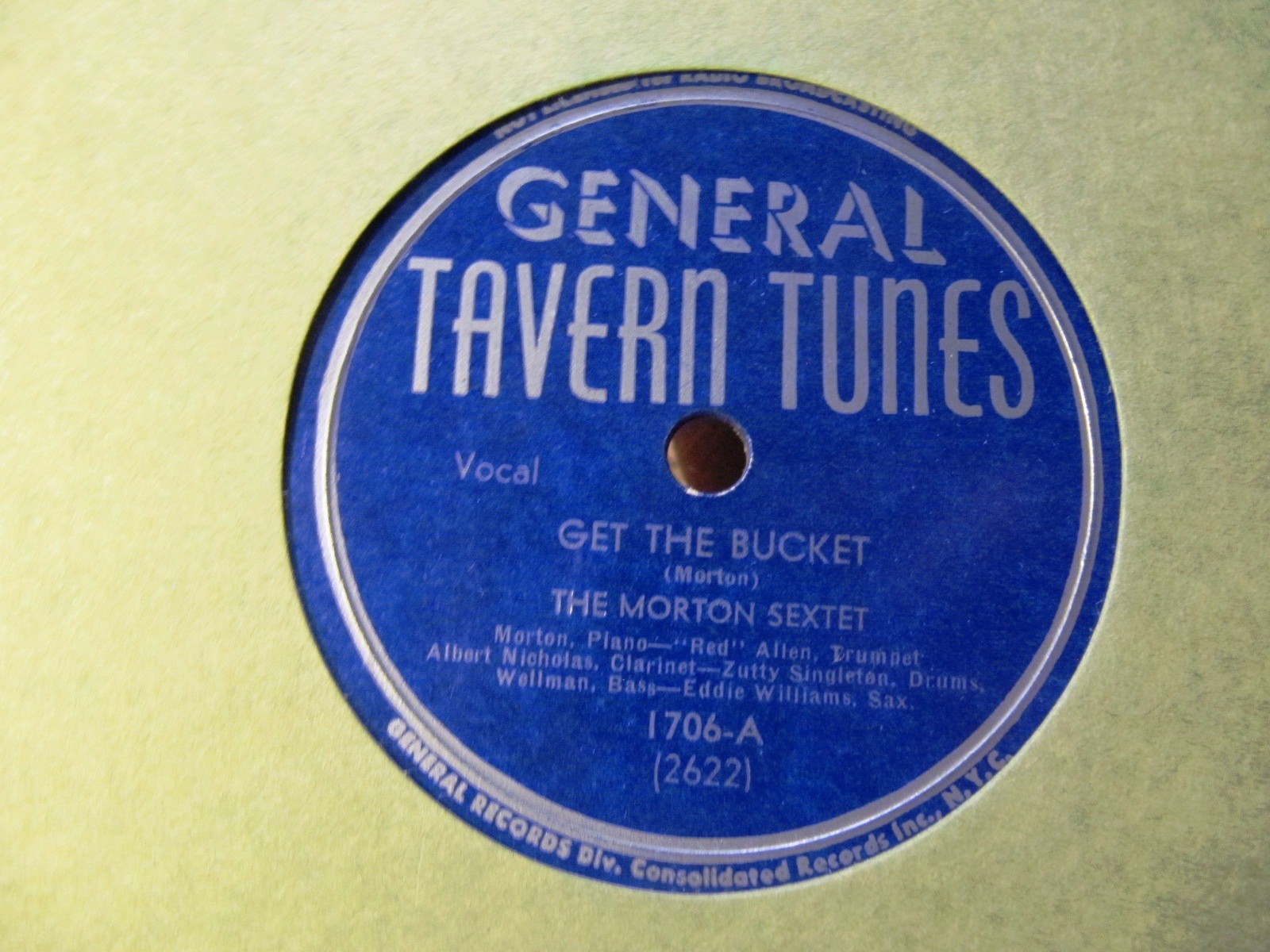
The Morton Sextet – Get The Bucket / Why
Reeves Sound Studios, New York, January 23, 1940
Label:
General – 1706
Series:
Tavern Tunes
Format:
Shellac, 10", 78 RPM
Country:
US
Released:
Feb 1940
Genre:
Jazz
Style:
A Get The Bucket
Written-By – Morton*
B Why
Written-By – Werac*, Morton*
Record Company – Consolidated Records Inc.
Bass – Wellman Braud
Clarinet – Albert Nicholas
Drums – Zutty Singleton
Piano – Morton*
Saxophone – Eddie Williams (5)
Trumpet – "Red" Allen*
Orig Issue General 10" 78 rpm record
Condition:
EXCELLENT close to PRISTINE , plays E+ EXCEPTIONALLY QUIET
A CHOICE COPY
Jelly Roll Morton's Red Hot Peppers Orch
b. Sept. 13, 1884, New Orleans, LA, USA. d. July 10, 1941, Los Angeles, CA, USA. (Cardiac Arrest). (Note: Many differerent birthdates are claimed by various sources. This birthdate is from his World War 1 draft card - a date that Morton gave to the draft board
Overview:
Morton has been credited with the concept of individual improvisation within rehearsed orchestral arrangements, a format which became a Jazz staple. He was Jazz's first great composer, writing such songs as "Wolverine Blues," "Milenburg Joys," "Black Bottom Stomp," "Shreveport Stomp," "Doctor Jazz (his only vocal)," "Grandpa's Spells," "The Pearls," "Mr. Jelly Roll," "The Chant," "Wild Man Blues," "I Thought I Heard Buddy Bolden Say," "Original Jelly Roll Blues," "Winin' Boy Blues,""Don't You Leave Me Here," "Sweet Substitute" , and "King Porter Stomp" (which later became huge hits for both the Fletcher Henderson and Benny Goodman orchestra's during the 'Swing' era).
In 1926, the members consisted of Jelly Roll Morton (piano); Kid Ory (t'bone); George Mitchell (trumpet); John Lindsay (bass); Andrew Hillaire (drums); Johnny St. Cyr (banjo); Omer Simeon (clarinet)
In 1904, while he was still in his teens, Jelly's began his career playing piano in the brocade-and-mirrored halls of New Orleans bordellos. In the "Street Vernacular" of old New Orleans, words such as jelly roll, biscuit, biscuit roller and cream puff had come to be common euphemisms for sexual organs and intercourse. It is said that Jelly Roll got his name upon seeing a black vaudeville comedian introduce himself as "Sweet Papa Cream Puff, right out of the bakery shop." Never one to be upstaged, Morton soon began announcing himself as "Papa Jelly Roll, with stove pipes in my hips and all the women in town dyin' to turn my damper down."
Earning a living could be quite difficult for a Black man in those days and so Jelly Roll rounded out his income from Piano Playing with such other work as pimping, pool hustling, card sharking, bell-hopping and tailoring. In 1908, at just age 18, he left New Orleans and began a tour of cities on the Gulf coast and in Texas. It is known that he also went to St. Louis and visited Scott Joplin. After touring briefly with a minstrel show, he settled in California, - living there from 1917 to 1922.
By this time he had a fairly well established reputation as a musician, songwriter, bandleader and arranger. In late 1922, he moved his operations to Chicago, IL, then the center of the Jazz world. In 1927, he moved to New York. But by now the times were changing. The terrible World Wide 1929 Depression would soon hit and shortly thereafter, Benny Goodman introduced the world to a new type of Music, - Swing! "Dixieland" or "Jazz" music was in decline and Morton fell on hard times during those 'depression' years. (It was said he even had to pawn the diamond in his front tooth.) Some of Jelly's compositions were still being played, but he received little or no royalties, and he fell into some obscurity.
In 1938, Alan Lomax, then a folk archivist for the Library of Congress, found Jelly playing in a Washington, D.C. "dive" called "The Jungle Inn". Lomax was able to record some interviews with Jelly Roll. By the time Lomax had completed the interview (some weeks later), Lomax had accumulated today's equivalent of a few dozen LPs of music and "Mr. Jelly Lord's" , recounting of the early history of New Orleans and how he - Jelly Roll - had invented Jazz.
Shortly after the interviews with Lomax, Morton returned to New York, but not finding much work there, he again set out for California,- this time driving cross country in a dilapidated vehicle which kept breaking down. In California, his health began to fail. Mr. Jelly Lord blamed his condition on a voodoo spell, and he died in Los Angeles on July 10, 1941.
price rating