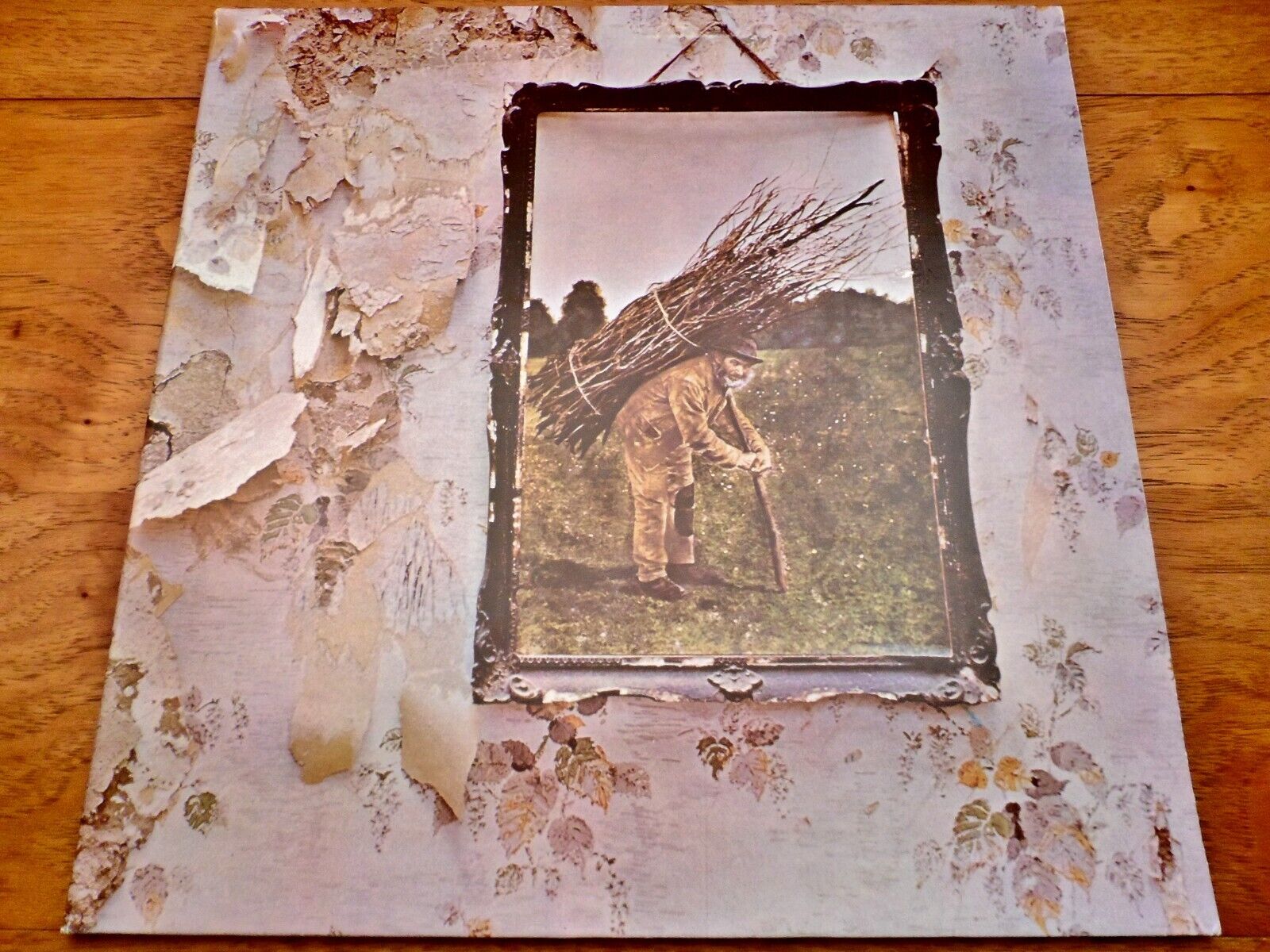
Led Zeppelin IV Rare Atlantic Records Porky Pecko Duck Monarch Vinyl +Insert
$
100


Favourite Auctions
To save auctions to your favourites, please login
If you don't have an account, please register
Description
Welcome to Classic Cadillac Records! I visually grade all my records as accurately as possible and will never grade anything above Near Mint unless it's still sealed. Please note that a visual grade can differ from a play grade, and am happy to spot check a record upon request. All orders are shipped within 1 business day (usually sooner) and packed with extra care to ensure fast, safe arrival. Please look closely at all pictures, read all relevant details and ask any questions you may have before buying. I offer a full 30-day return policy on everything I sell, so buy with confidence! 20% restocking fee charged on items returned for reasons other than it not working properly. Thanks for looking!
Untitled Studio album by Led Zeppelin Released 8 November 1971 Recorded December 1970 – February 1971[1][2] Studio
- Rolling Stones Mobile at Headley Grange, Headley
- Island Studios, London[1]
- Sunset Sound, Los Angeles[3][4]
- Hard rock
- heavy metal
(1970) Untitled
(1971) Houses of the Holy
(1973) Singles from untitled
- "Black Dog" / "Misty Mountain Hop"
Released: 2 December 1971 - "Rock and Roll" / "Four Sticks"
Released: 21 February 1972
The untitled fourth studio album by the English rock band Led Zeppelin, commonly known as Led Zeppelin IV, was released on 8 November 1971 by Atlantic Records. Produced by the band's guitarist, Jimmy Page, it was recorded between December 1970 and February 1971, mostly in the country house Headley Grange. The album contains the band's most well-known recording, the eight-minute-long "Stairway to Heaven".
The informal recording environment inspired the band, allowing them to try different arrangements of material and create songs in various styles. After the band's previous album Led Zeppelin III (1970) received lukewarm reviews from critics, they decided their fourth album would officially be untitled and represented instead by four symbols – one chosen by each band member – without featuring the name or any other details on the cover. Unlike the prior two albums, the band was joined by guest musicians: the singer Sandy Denny on "The Battle of Evermore", and the pianist Ian Stewart on "Rock and Roll". As with prior albums, most of the material was written by the band, though there was one cover song, a hard rock re-interpretation of the Memphis Minnie blues song "When the Levee Breaks".
The album was a critical and commercial success and is Led Zeppelin's best-selling album, having shipped over 37 million copies worldwide. It is one of the best-selling albums in the United States and of all time, while critics have regularly placed it high on lists of the greatest albums of all time.
Cover
The four symbols represent (from top left clockwise):Page, Jones, Plant, and Bonham Lot Long, a Wiltshire thatcher in a 1892 photograph by Ernest Howard Farmer Salisbury Tower, Ladywood, Birmingham.In place of a title, Page decided each member could choose a personal emblem for the cover. Initially thinking of a single symbol, he then decided there could be four, with each member of the band choosing his own. He designed his own symbol and has never publicly disclosed any reasoning behind it. It has been argued that his symbol appeared as early as 1557 to represent Saturn. The symbol is sometimes referred to as "ZoSo", though Page has explained that it was not in fact intended to be a word at all. Jones' symbol, which he chose from Rudolf Koch's Book of Signs, is a single circle intersecting three vesica pisces (a triquetra). It is intended to symbolise a person who possesses both confidence and competence. Bonham's symbol, the three interlocking (Borromean) rings, was picked by the drummer from the same book. It represents the triad of mother, father and child, but, also happens to be the logo for the steel and armament producer Krupp and, turned upside down, Ballantine beer. Plant's symbol of a feather within a circle was his own design, being based on the sign of the supposed Mu civilisation. A fifth, smaller symbol chosen by guest vocalist Sandy Denny represents her contribution to "The Battle of Evermore"; the figure, composed of three equilateral triangles, appears on the inner sleeve of the LP, serving as an asterisk.
Sandy Denny's symbol of three downward-pointing equilateral trianglesDuring Led Zeppelin's tour of the United Kingdom in winter 1971 shortly after the album's release, the symbols could be seen on the group's stage equipment; Page's on one of his amplifiers, Bonham's on his bass drum head, Jones' on a covering for his Rhodes piano, and Plant's on the side of a PA cabinet. Only Page's and Bonham's symbols were retained for subsequent tours.
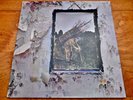
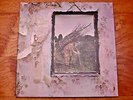
The picture on the front of the album of an old man carrying a bundle of sticks on his back was bought in an antique shop in Reading, Berkshire by Plant. The picture was then affixed to the internal, papered wall of a partly demolished suburban house for the cover photograph to be taken. Research in 2023 suggests that the image, which had previously been described as an oil painting, is a black and white photograph dating to 1892 which had been hand-coloured. The original photograph was taken by Ernest Howard Farmer (1856 – 1944), the first head of the school of photography at Regent Street Polytechnic. The research also suggests that the stooped figure is Lot Long (or Lot Longyear, 1823–1893), a thatcher from Mere, Wiltshire.
The block of flats seen on the album is Salisbury Tower in the Ladywood district of Birmingham. Page has explained that the cover of the fourth album was intended to bring out a city/country dichotomy that had initially surfaced on Led Zeppelin III, and a reminder that people should look after the Earth. He later said the cover was supposed to be for "other people to savour" rather than a direct statement. The album cover was among the 10 chosen by the Royal Mail for a set of "Classic Album Cover" postage stamps issued in January 2010.
The inside illustration, entitled "The Hermit", painted by Barrington Coleby (credited to Barrington Colby MOM on the album sleeve), was influenced by the design of the card of the same name in the Rider–Waite tarot deck. This character was later portrayed by Page himself in Led Zeppelin's concert film, The Song Remains the Same (1976). The inner painting is also referred to as View in Half or Varying Light. The typeface for the lyrics to "Stairway to Heaven", printed on the inside sleeve of the album, was Page's contribution. He found it in an Arts and Crafts magazine called The Studio which dated from the late 19th century. He thought the lettering was interesting and arranged for someone to create a whole alphabet.
Critical reception
Professional ratings Retrospective professional ratings Aggregate scores Source Rating Metacritic 100/100 Review scores Source Rating AllMusic Blender Christgau's Record Guide A The Encyclopedia of Popular Music Entertainment Weekly A+ Mojo MusicHound Rock 5/5 Pitchfork 9.1/10 Q The Rolling Stone Album GuideLed Zeppelin IV received overwhelming praise from critics. In a contemporary review for Rolling Stone, Lenny Kaye called it the band's "most consistently good" album yet and praised the diversity of the songs: "out of eight cuts, there isn't one that steps on another's toes, that tries to do too much all at once." Billboard magazine called it a "powerhouse album" that has the commercial potential of the band's previous three albums. Robert Christgau originally gave Led Zeppelin IV a lukewarm review in The Village Voice, but later called it a masterpiece of "heavy rock". While still finding the band's medieval ideas limiting, he believed the album showed them at the pinnacle of their songwriting, and regarded it as "the definitive Led Zeppelin and hence heavy metal album".
In a retrospective review for AllMusic, Stephen Thomas Erlewine credited the album for "defining not only Led Zeppelin but the sound and style of '70s hard rock", while "encompassing heavy metal, folk, pure rock & roll, and blues". In his album guide to heavy metal, Spin magazine's Joe Gross cited Led Zeppelin IV as a "monolithic cornerstone" of the genre. BBC Music's Daryl Easlea said that the album made the band a global success and effectively combined their third album's folk ideas with their second album's hard rock style, while Katherine Flynn and Julian Ring of Consequence of Sound felt it featured their debut's blues rock, along with the other styles from their second and third albums. Led Zeppelin's Rock and Roll Hall of Fame biography described the album as "a fully realized hybrid of the folk and hard-rock directions". PopMatters journalist AJ Ramirez regarded it as one of the greatest heavy metal albums ever, while Chuck Eddy named it the number one metal album of all time in his 1991 book Stairway to Hell: The 500 Best Heavy Metal Albums in the Universe. According to rock scholar Mablen Jones, Led Zeppelin IV and particularly "Stairway to Heaven" reflected heavy metal's presence in countercultural trends of the early 1970s, as the album "blended post-hippie mysticism, mythological preoccupations, and hard rock".
Steven Hyden observed in 2018 that the album's popularity had given rise to a reflexive bias against it from both fans and critics. "There are two unwritten laws" about the album, he wrote. The first was that a listener must claim a track from side two, the "deep cuts with credibility" side, was his or her favourite, and the second was that one should never say it was their favourite among the band's albums. He blamed this later tendency for why "rock critics who try too hard always make a case for In Through the Out Door being Zeppelin's best." The band members themselves, he noted, also seemed to prefer performing the songs from side two in their solo shows.
Accolades
In 2000, Led Zeppelin IV was named the 26th-greatest British album in a list by Q magazine. In 2002, Spin magazine's Chuck Klosterman named it the second-greatest metal album of all time and said that it was "the most famous hard-rock album ever recorded" as well as an album that unintentionally created metal—"the origin of everything that sounds, feels, or even tastes vaguely metallic". In 2000 it was voted number 42 in Colin Larkin's All Time Top 1000 Albums. In 2003, the album was ranked number 66 on Rolling Stone magazine's list of "The 500 Greatest Albums of All Time", then re-ranked number 69 in a 2012 revised list, and re-ranked 58 in a 2020 revised list. It was also named the seventh-best album of the 1970s in a list by Pitchfork. In 2016, Classic Rock magazine ranked Led Zeppelin IV as the greatest of all Zeppelin albums.
Accolades for the fourth Led Zeppelin album Accolade Publication Country Year Rank "The 100 Greatest Albums Ever Made" Mojo UK 1996 24 Grammy Hall of Fame Award Grammy Awards US 1999 * "Album of the Millennium" The Guitar US 1999 2 "100 Greatest Rock Albums Ever" Classic Rock UK 2001 1 "500 Greatest Albums Ever" Rolling Stone US 2020 58 "Top 100 Albums of the 1970s" Pitchfork US 2004 7 1001 Albums You Must Hear Before You Die Robert Dimery US 2005 * "100 Best Albums Ever" Q UK 2006 21 "100 Greatest British Rock Albums Ever" Classic Rock UK 2006 1 "The Definitive 200: Top 200 Albums of All-Time" Rock and Roll Hall of Fame US 2007 4 NME's The 500 Greatest Albums of All Time NME UK 2013 106Track listing
Original release
All tracks are written by Jimmy Page and Robert Plant, except where noted.
Side one No. Title Writer(s) Length 1. "Black Dog"- Page
- Plant
- John Paul Jones
- Page
- Plant
- Jones
- John Bonham
- Page
- Plant
- Jones
- Page
- Plant
- Jones
- Bonham
- Memphis Minnie
7:08 Total length: 42:31
price rating