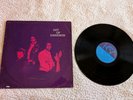
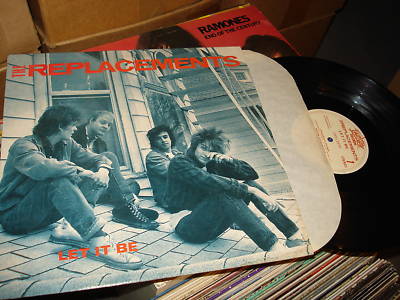
Let It Be - The Replacements LP
$
27


Favourite Auctions
To save auctions to your favourites, please login
If you don't have an account, please register
Description
LP NM
Jacket VG+
Biography by Stephen Thomas ErlewineThe Replacements initially formed in 1979, when Paul Westerberg joined a garage punk band formed by brothers Bob (guitar) and Tommy Stinson (bass) and drummer Chris Mars. Originally called the Impediments, the Minnesota residents changed their name to the Replacements after being banned from a local club for disorderly behavior. In their early days, they sounded quite similar to Hüsker Dü, the leaders of the Minneapolis punk scene. However, the Replacements were wilder and looser than the Hüskers and quickly became notorious for their drunken, chaotic gigs. After they built up a sizable local following the Minneapolis label Twin/Tone signed them.
Sorry Ma, Forgot to Take Out the Trash, a sloppy hardcore collection, was released in 1981 but failed to make much of an impact on the national scene. It was followed the next year by the Stink EP, which followed the same pattern as the debut. It was the band's second album, 1983's Hootenanny, that first garnered the band attention and helped build their fan base. On Hootenanny, the group started playing around with other genres, adding elements of pop, straightforward rock & roll, country, and folk, although sometimes the eclecticism was ironic.
Hootenanny set the stage for Let It Be, the band's critical and artistic breakthrough. Released in 1984, Let It Be showed that the band had successfully expanded their musical reach and that Westerberg had grown considerably as a songwriter; he was now capable of pop like "I Will Dare," full-throttle rock & roll, and introspective ballads like "Answering Machine." Critics and fellow musicians were quick to praise the band, and they developed a large underground following. The buzz was large enough to convince Sire to sign the band in 1985.
The Replacements' first major-label album, Tim, was scheduled to be produced by Westerberg's idol, Alex Chilton, but the sessions fell through; the album was produced by former Ramone Tommy Erdelyi. Upon its release in 1985, Tim garnered rave reviews that equalled those for Let It Be. Though the band was poised for a popular breakthrough, they were unsure about making the leap into the mainstream. As a result, they never let themselves live up to their full potential. The Replacements landed a spot on Saturday Night Live, but they were roaring drunk throughout their performances and Westerberg said "f*ck" on the air. Their concerts had became notorious for such drunken, sloppy behavior. Frequently, the band was barely able to stand up, let alone play, and when they did play, they often didn't finish their songs. The Replacements also refused to make accessible videos — the video for "Bastards of Young" featured nothing but a stereo system, playing the song — thereby cutting themselves off from the mass exposure MTV could have granted them.
After the tour for Tim, Bob Stinson was fired from the band, allegedly for his drug and alcohol addictions. The Replacements recorded their next album as a trio in Memphis, TN, with former Big Star producer Jim Dickinson. The resulting album, Pleased to Meet Me, was more streamlined than their previous recordings. Again, the reviews were uniformly excellent upon its spring 1987 release, but the band didn't earn many new fans. During the tour for Pleased to Meet Me, guitarist Slim Dunlap filled the vacant lead guitarist spot and he became a full-time member after the tour.
Two years later, the band returned in the spring of 1989 with Don't Tell a Soul, the Replacements' last bid for a mainstream audience. The bandmembers had cleaned up, admitting that their years of drug and alcohol abuse were behind them, and were now willing to play the promotional game. Don't Tell a Soul boasted a polished, radio-ready production and the group shot MTV-friendly videos, beginning with the single "I'll Be You." Initially, the approach worked — "I'll Be You" became a number one album rock track, crossing over to number 51 on the pop charts. However, Don't Tell a Soul never really took off and failed to establish the band as a major commercial force.
Defeated from the lackluster performance of Don't Tell a Soul, Paul Westerberg planned on recording a solo album, but Sire rejected the idea. Consequently, the next Replacements album, All Shook Down, was a solo Westerberg record in all but name. Recorded with a cast of session musicians as well as the band, All Shook Down was a stripped-down, largely acoustic affair that hinted at the turmoil within the band. Chris Mars left shortly after its fall 1990 release, claiming that Westerberg had assumed control of the band; he would launch a solo career two years later. The Replacements toured in support of All Shook Down, with Steve Foley, formerly of the Minneapolis-based Things Fall Down, as their new drummer. Neither the tour nor the album were successful, and the Replacements quietly disbanded in the summer of 1991.
Tommy Stinson formed Bash & Pop the following year; in 1995, he formed a new band called Perfect. Dunlap released a solo album in 1993. Bob Stinson died February 15, 1995, from a drug overdose. Westerberg began a solo career slowly, releasing two songs on the Singles ("Dyslexic Heart," "Waiting for Somebody") soundtrack in 1992; he also scored the film. He released his debut solo album, 14 Songs, in the summer of 1993 to mixed reviews. Paul Westerberg's second solo album, Eventually, was released in the spring of 1996.
Near Mint (NM): A nearly perfect record. There may be one or two small inaudible defects. The record should show no obvious signs of wear. A 45 RPM or EP sleeve should have no more than the most minor defects, such as almost invisible ring wear or other sights of slight handling. An LP jacket should have no creases, folds, seam splits or any other noticeable similar defect. No cut-out holes, either.
Near Mint Minus (NM-): A record that should play mint but has a few slight visible marks. The album will have as much luster as an NM, there just may be some superficial scuffs from the sleeve or very light hairlines that shouldn't be audible. An NM- album cover subjectively fits somewhere in between VG+ and NM.
Very Good Plus (VG+): A Very Good Plus record will show some signs that it was played and otherwise handled by a previous owner who took good care of it. Record surfaces may show some slight signs of wear and may have slight scuffs or very light scratches that don t significantly affect play. Slight warps that do not affect the sound are OK. The label may have some ring wear or discoloration, but it should be barely noticeable. The center hole will not have been misshapen by repeated play. 45 Picture sleeves will have some slight wear, lightly turned-up corners, or a slight seam-split. An LP jacket may have slight signs of wear also and may be marred by a cut-out hole, indentation or corner indicating it was taken out of print and sold at a discount.
Very Good (VG): Many of the defects found in a VG+ record will be more pronounced in a VG disc. Surface noise will be evident upon playing, especially in soft passages and during a song s intro and fade, but will not overpower the music otherwise. Groove wear will start to be noticeable, as will light scratches (deep enough to feel with a fingernail) that will affect the sound. Labels may be marred by writing, or have tape or stickers (or their residue) attached. The same will be true of picture sleeves or LP covers. However, it will not have all of these problems at the same time, just two or three of them.
Good (G), Good Plus (G+): Good does not mean Bad! A record in Good or Good Plus condition can be put onto a turntable and will play though without skipping. But it will have significant surface noise and scratches and visible groove wear. A jacket or sleeve will have seam splits, especially at the bottom or on the spine. Tape, writing, ring wear or other defects will start to overwhelm the subject.
Poor (P), Fair (F): Below good. imperfections will be described.
Please check out my other items for sale. (I offer shipping discounts) I'll Be adding More Daily except for Friday and Saturday.
ALL SHIPPING PRICES ARE FINAL
additional items are 1.50 per item up to 6 within USA (if you are bidding on multiple items lots I have in one listing. you pay each shipping total added together)
Priorty shipping is available e-mail for total
NOTE: Gatefold Lps Count as 2 Lps when shipping out of the country
CANADA Multiple LP Shipping Rates In USD
1 LP 7.75
2. Lps 9.25
3 Lps 12.50
4 Lps 15.50
5 Lps 16.50
6 Lps 18.00
Multiple Shipping Rates Rest Of The World Outside USA in USD
Note: Gatefold Lps Count as 2 Lps
1 LP 14.00
2 LP 17.00
3. Lps 22.50
4 Lps 25.25
5 Lps 28.00
6 Lps 33.00
The MAN has to get his cut so Texas residents must add 8.25 % Sales Tax
If you are unsure about shipping costs please do not hesitate to e-mail me.
QUESTIONS:? Please ask. That is what I am here for. (I may not get to them if you wait close to an item's ending.)
MORE PICTURES? Just ask and I'll send them to you
MEDIA MAIL: is not recommended for rare items. Priority mail is faster and safer.
I leave feedback after item arrives and it is left for me. (It's easier to keep up with that way) Please limit your feedback comments to things within the realm of my responsibility.
Thank you for reading all of this :-)
price rating